Key Takeaways
- An AI citation audit tells you, on a per-topic and per-platform basis, where your visibility gaps come from and what type of action closes each one.
- The majority of citations driving AI responses typically come from third-party sources, not brand-owned pages. Competitors appear because independent sites reference them, not because their own content is being surfaced.
- High-volume, low-differentiation content faces the highest displacement risk in an AI environment. Generic how-to guides are exactly the type of content AI can synthesize without sending users anywhere.
- The goal of content strategy shifts from answering every possible question to being present with genuine authority in the specific contexts that matter to your buyers.
If you’ve been tracking your brand in AI tools and wondering why the data isn’t telling you anything useful, the problem is usually upstream: generic prompts, the wrong measurement model, inputs that don’t reflect how real buyers actually search. In an earlier piece, I introduced a structured framework for fixing it. This post is about what happens once the framework does its job.
Once you have well-constructed prompts, two layers of metrics, and a clear picture of where your brand appears across AI platforms, you get a specific and actionable output: a citation audit. Understanding what is an AI audit and what it tells you is where measurement becomes strategy.
The citation audit sorts your visibility gaps into three categories: gaps that require digital PR, gaps that require owned content, and gaps that point to social and community management. Each category demands a different type of response. And the pattern running across all of them points to the same conclusion: the content playbook built around maximizing coverage and keyword volume is losing ground to one built around genuine authority and relevance.
This post makes that argument concrete, and closes the argument with the strategic implication that follows.
What the Citation Audit Actually Shows
Once the structured topical analysis is complete, the methodology exports citation data for the highest-opportunity topics on each platform. That data breaks down across three dimensions.
Third-party content accounts for the bulk of what AI is drawing on. In most audits, well over 80 percent of highly cited pages come from independent sources: sector publications, accounting and advisory firm blogs, business setup consultancies, and regulatory guides. These are not the brand’s own pages. They are pages where the brand (or a competitor) is mentioned in the context of explaining something broader.
Owned content plays a smaller role than most teams expect, but it’s not irrelevant. Specific owned pages, particularly long-form guides that cover a topic with genuine depth, do earn citations. The issue is that most brands’ owned content skews toward service pages and thin category coverage, which AI systems have little reason to cite when better third-party resources exist.
Social and UGC signals are a smaller but growing dimension. Platforms like Reddit and Quora appear in citation data for certain topic types, particularly those involving peer experience, comparisons, and community knowledge. This is an underserved channel for most brands.
The example below shows how this ecosystem applied to one NP Digital client that we worked with.
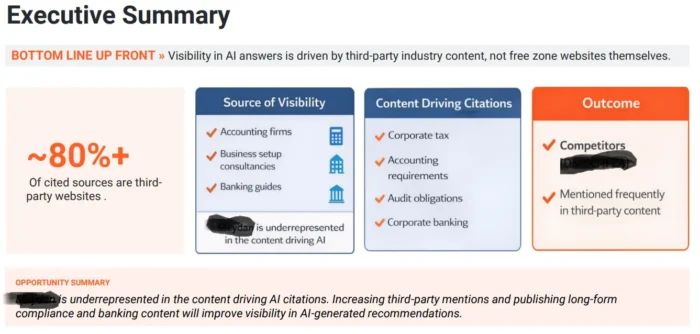
In one audit, roughly 80 percent of highly cited pages for compliance-related topics came from independent accounting, tax, and audit firms. The brand’s own content was rarely surfaced. Competitors appeared not because of anything they had published directly, but because third-party sites were using them as examples when explaining regulations and requirements. Visibility was earned indirectly, through the content ecosystem, not through the brand’s own pages.
The Coverage Trap
To understand why this matters strategically, it helps to understand the model it’s replacing.
The coverage mindset that drove SEO content strategy for the past decade wasn’t irrational. Traffic was the primary currency. Search engines rewarded breadth. The more questions you could answer, the more pages you could rank, and the more traffic you could capture and convert at the margin. Publishing at volume made sense.
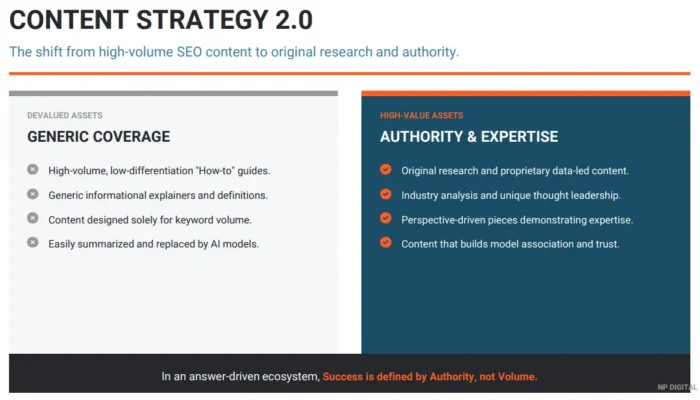
Alt text: Two-column diagram contrasting devalued generic content types on the left with high-value authoritative content types on the right, illustrating the shift from coverage to authority in an AI search environment.]
That model is breaking down in an AI environment, and the citation audit is where you see it most clearly.
AI systems are built to synthesize and summarize. Content that exists to answer broad, generic questions is exactly the type of content AI can handle on its own, without sending users anywhere. A page explaining what SEO is, or listing the top ten CRM tools, or walking through a basic how-to process is precisely the type of content that gets absorbed into an AI response rather than cited as a source.
The more your content resembles what an AI would generate from a basic prompt, the less reason an AI has to cite you. This is the coverage trap: scaling the old model doesn’t just fail to improve AI visibility; it actively increases exposure to displacement.
What AI Systems Actually Cite
The citation audit goes beyond revealing gaps to reveal patterns in what earns citations, and that pattern is consistent across topics and platforms.
Citations go to content that demonstrates genuine expertise in a specific context versus the biggest brand or highest-traffic page. Original research with proprietary data. Long-form guides that go deeper than the obvious. First-hand experience presented with authority. Comparison content that places competitors in context rather than avoiding them.
The pattern from real audit work: educational long-form guides consistently outperform service pages. Content that mentions competitors as examples within broader category coverage drives more citations than content focused exclusively on the brand. Pages that answer a specific, high-intent question with real depth earn citations.
This is a function of what the content actually contains. AI systems are drawing on content that has established a genuine association with a concept, problem, or use case. That association is built through depth, specificity, and demonstrable expertise, not through breadth of coverage.
![Table showing that for both compliance and banking topics, long-form educational guides from third-party sources dominate AI citations, with brands mentioned as examples rather than as primary sources.]](https://neilpatel.com/wp-content/uploads/2026/06/what-is-an-ai-audit-001-700x308.webp)
The practical implication: AI SEO strategy stops being about answering every question and starts being about answering specific questions better than anyone else. That’s a meaningful shift in how content is briefed, produced, and measured. Good AI keyword research makes that brief concrete, identifying exactly which topics and contexts to prioritize.
Three Actions That Close the Gap
The citation audit produces a specific output: for each topic cluster and each platform, it identifies which type of action is most likely to close the visibility gap. Those actions fall into three categories, each with different resource requirements and timelines.
| Digital PR | Owned content | Social / UGC |
| Earn third-party mentions Partner with publishers AI draws on. Contribute expert commentary. Be included in sector guides. | Build authority content Comprehensive guides, comparison pages, original data. Topics the audit identifies as underserved. | Community presence Be credible where buyers research before reaching your site. Longest runway, growing signal weight. |
| Fastest impact Citations driven by external mentions, not owned pages | Medium-term Depends on topic gap size and content quality | Longest runway Matters increasingly as AI incorporates social signals |
Digital PR and third-party mentions are the highest-leverage activity for most brands, because they address the most common finding: that the majority of AI citations are coming from independent sources, not owned pages. The goal is to be embedded in the content ecosystem for your topic. That means partnering with the publications, advisory firms, and consultancies that are producing the content AI draws on. Contributing expert commentary, providing authoritative reference material that others can link to, and collaborating on guides where your brand appears as a contextual example alongside competitors.
Owned content investment is the right response when the citation audit shows that your owned pages are genuinely absent from the topic, not just outperformed. The priority isn’t more content; it’s better content in the right areas. The audit identifies exactly which topics are underserved. The content itself needs to be the type that AI systems and third-party sites can cite: comprehensive guides that cover a topic with real depth, comparison pages that place your offer in context, step-by-step process guides built around specific use cases, and, where possible, original data or analysis that doesn’t exist elsewhere. Depth and specificity earn citations. Breadth and volume don’t.
Social and community presence is the response when visibility gaps are driven by UGC signals, typically in topics where buyers seek peer experience and independent comparison rather than brand-produced content. Community management in the right channels, credible participation in conversations on Reddit, Quora, and industry forums, and authentic engagement rather than promotional presence. This is the longest runway of the three, but it’s growing in importance as AI systems increasingly incorporate social signals into what they surface.
The Bigger Picture: Presence Over Position
Traditional search was about position. Rank highly, earn traffic, convert at the margin. Visibility was a number: position one, page one, top ten. You knew where you stood, and you optimized to move up.
AI-driven search works differently. A brand can shape what users learn about a category, influence the answer to a high-intent question, and be present at the moment a decision is forming, all without appearing as a link. Visibility is no longer a rank. It’s a probability: how likely are you to be present when it actually matters?
The brands that understand this earliest are building an advantage that compounds. Not because they’ve found a new SEO trick, but because they’ve shifted their content investment toward genuine authority in specific contexts, and that authority is what AI systems consistently draw on.
That’s the conclusion the citation audit points to, and it’s what makes AI visibility tools genuinely useful when they’re used right. They serve as a diagnostic that tells you where authority is missing and what to build next.
Success in this environment is defined by presence, not position. The content strategy implications follow directly from that.
FAQs
How do you audit AI search optimization response analysis?
Start by running structured prompts across the major AI platforms, covering the topics most relevant to your buyers’ decision-making process. Analyze which pages are being cited in responses to those prompts, and categorize them by source type: third-party, owned, or social. The distribution tells you where the gap is coming from and what type of action closes it. Secondary metrics, including run length, entropy, and Gini coefficient, reveal how stable your visibility is and how competitive each topic is.
How do you use AI for a content audit?
An AI citation audit is a specific type of content audit that goes beyond traditional performance metrics. Rather than measuring traffic or rankings for your owned pages, it measures how often your brand and content appear in AI-generated responses to relevant prompts. The output identifies which topics are underserved, which content types earn citations, and whether the gap requires digital PR, new owned content, or community presence. It connects content decisions directly to AI visibility outcomes.
How do you audit for AI search visibility?
Build a structured set of prompts using the SPIV framework, grounded in your actual buyer personas and intent stages rather than generic category terms.
Pair that with AI keyword research to identify the topic gaps the audit surfaces, and you have a complete workflow from measurement to action.
Run those prompts across ChatGPT, Google Gemini, Perplexity, and Google AI Overviews on a recurring basis. Track both primary metrics from the platform and secondary metrics calculated on top of the export data. The citation analysis, which identifies what sources AI is drawing on and where your brand appears in that ecosystem, is the layer that tells you what to do next.
Conclusion
This series started with a measurement problem.
Most teams tracking AI visibility are using deterministic tools to measure a probabilistic system, running generic prompts that describe buyers who rarely exist in practice. The data looks clean. The picture it paints isn’t representative.
The response to that problem was a methodology: structured prompt construction grounded in real buyer personas and intent stages, a two-layer metric system that separates surface-level visibility from genuine diagnostic insight, and a modular audit format that makes the output actionable rather than overwhelming.
What the citation audit adds to that is the strategic implication. AI visibility is built primarily through third-party mentions, not owned pages. Coverage-first content is the most exposed to displacement. Genuine authority in specific, high-intent contexts is what earns consistent citations. The content investment that follows from that is about producing the right things, in the right depth, for the contexts where decisions actually happen.
The brands that make that shift now will hold ground as search continues to change. The ones that don’t will keep producing content that looks healthy in their dashboards while becoming invisible in the moments that matter most.
Are You Using Google Ads? Try Our FREE Ads Grader!
Stop wasting money and unlock the hidden potential of your advertising.
- Discover the power of intentional advertising.
- Reach your ideal target audience.
- Maximize ad spend efficiency.