
Close Menu
    Facebook X (Twitter) Instagram
    Wifi PortalWifi Portal
    • Blogging
    • SEO & Digital Marketing
    • WiFi / Internet & Networking
    • Cybersecurity
    • Tech Tools & Mobile / Apps
    • Privacy & Online Earning
    Facebook X (Twitter) Instagram
    Wifi PortalWifi Portal
    Home»Cybersecurity»New Linux ‘Dirty Frag’ zero-day gives root on all major distros
    Cybersecurity

    New Linux ‘Dirty Frag’ zero-day gives root on all major distros

    adminBy adminMay 10, 2026No Comments3 Mins Read
    Facebook Twitter LinkedIn Telegram Pinterest Tumblr Reddit WhatsApp Email
    Dirty Frag Linux Tux
    Share
    Facebook Twitter LinkedIn Pinterest Email

    Dirty Frag Linux Tux

    A new Linux zero-day exploit, named Dirty Frag, allows local attackers to gain root privileges on most major Linux distributions with a single command.

    Security researcher Hyunwoo Kim, who disclosed it earlier today and published a proof-of-concept (PoC) exploit, says this local privilege escalation was introduced roughly nine years ago in the Linux kernel’s algif_aead cryptographic algorithm interface.

    Dirty Frag works by chaining two separate kernel flaws, the xfrm-ESP Page-Cache Write vulnerability and the RxRPC Page-Cache Write vulnerability, to modify protected system files in memory without authorization and achieve privilege escalation.

    Also, while Dirty Frag belongs to the same class as the Dirty Pipe and Copy Fail Linux vulnerabilities, it exploits the fragment field of a different kernel data structure.

    “As with the previous Copy Fail vulnerability, Dirty Frag likewise allows immediate root privilege escalation on all major distributions, and it 

    chains two separate vulnerabilities,” Kim said.

    “Dirty Frag is a case that extends the bug class to which Dirty Pipe and Copy Fail belong. Because it is a deterministic logic bug that does not depend on a timing window, no race condition is required, the kernel does not panic when the exploit fails, and the success rate is very high.”

    This kernel privilege escalation affects a wide range of Linux distros, including Ubuntu, Red Hat Enterprise Linux, CentOS Stream, AlmaLinux, openSUSE Tumbleweed, and Fedora, which have not yet received patches.
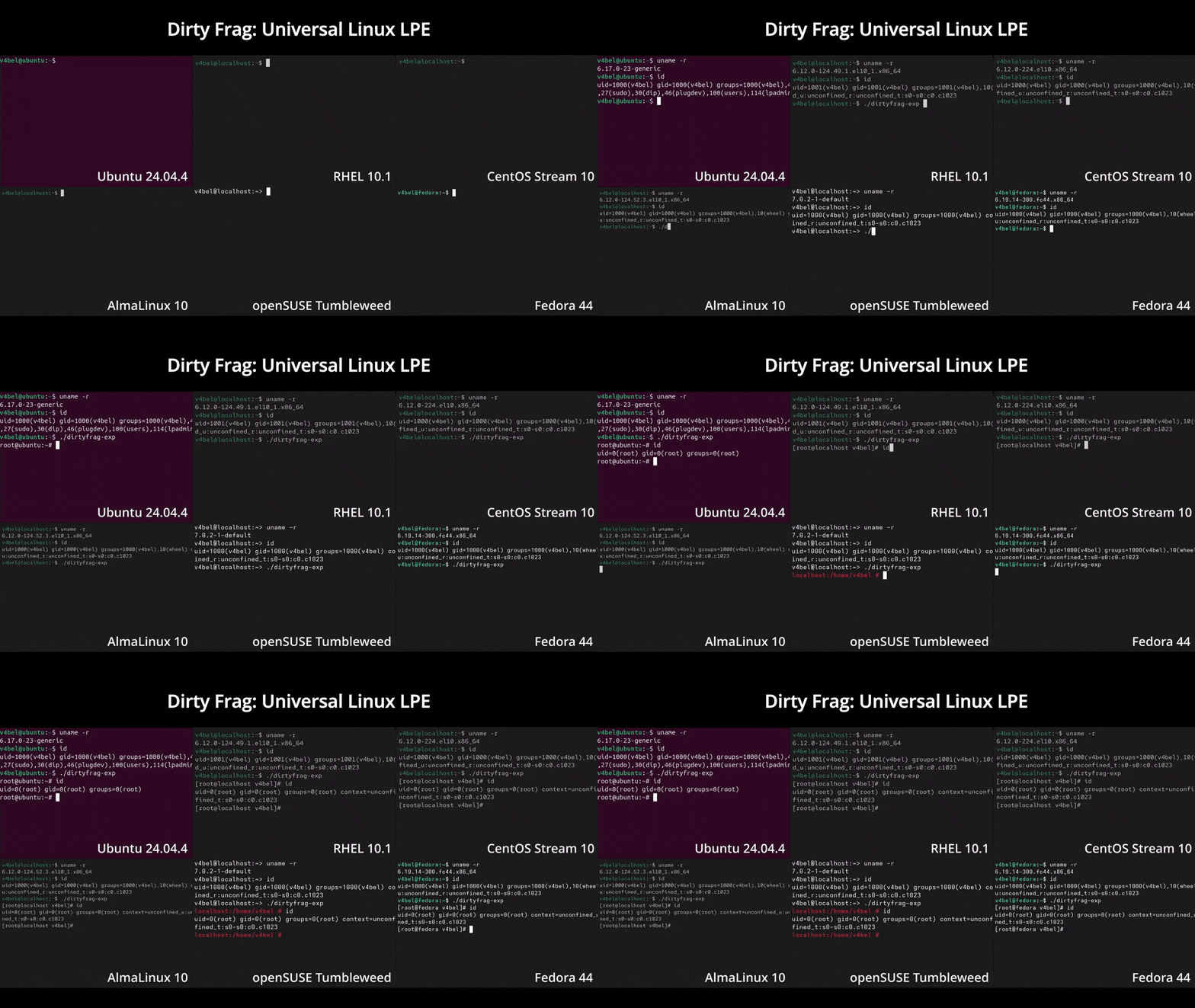
    Dirty Frag demo
    Dirty Frag demo (Hyunwoo Kim)

    ​Kim released complete Dirty Frag documentation and a PoC exploit with distribution maintainers’ agreement after an embargo on full public disclosure was broken on May 7, 2026, when an unrelated third party independently published the exploit.

    “Because the embargo has currently been broken, no patch or CVE exists. After consultation with the maintainers on linux-distros@vs.openwall.org and at their request, this Dirty Frag document is being published,” Kim said.

    To secure systems against attacks, Linux users can use the following command to remove the vulnerable esp4, esp6, and rxrpc kernel modules (however, it’s important to note that this will break IPsec VPNs and AFS distributed network file systems):

    
    sh -c "printf 'install esp4 /bin/false\ninstall esp6 /bin/false\ninstall rxrpc /bin/false\n' > /etc/modprobe.d/dirtyfrag.conf; rmmod esp4 esp6 rxrpc 2>/dev/null; true"

    This new zero-day disclosure comes as Linux distro maintainers are still rolling out patches for “Copy Fail,” another root privilege escalation vulnerability now actively exploited in attacks.

    CISA added Copy Fail to its Known Exploited Vulnerabilities (KEV) Catalog last Friday, ordering federal agencies to secure their Linux devices within two weeks, by May 15.

    “This type of vulnerability is a frequent attack vector for malicious cyber actors and poses significant risks to the federal enterprise,” the U.S. cybersecurity agency warned at the time. “Apply mitigations per vendor instructions, follow applicable BOD 22-01 guidance for cloud services, or discontinue use of the product if mitigations are unavailable.”

    In April, Linux distros patched another root-privilege escalation vulnerability (dubbed Pack2TheRoot) that had been found after a decade since it was introduced in the PackageKit daemon.

    Update May 08, 09:58 EDT: The two page-cache write vulnerabilities chained by Dirty Frag are now tracked under the following CVE IDs: the xfrm-ESP one was assigned CVE-2026-43284, and the RxRPC isye is now CVE-2026-43500.


    article image

    AI chained four zero-days into one exploit that bypassed both renderer and OS sandboxes. A wave of new exploits is coming.

    At the Autonomous Validation Summit (May 12 & 14), see how autonomous, context-rich validation finds what’s exploitable, proves controls hold, and closes the remediation loop.

    Claim Your Spot

    Dirty distros Frag Linux major root ZeroDay
    Share. Facebook Twitter Pinterest LinkedIn Tumblr Telegram Email
    Previous ArticlePAN-OS RCE Exploit Under Active Use Enabling Root Access and Espionage
    Next Article Google’s Quality Threshold Is Quietly Killing Scaled AI Content At Ranking
    admin
    • Website

    Related Posts

    Encryption Consulting launches CertSecure Manager v3.3 with zero-touch certificate renewals

    May 20, 2026

    GitHub confirms breach of 3,800 repos via malicious VSCode extension

    May 20, 2026

    Grafana GitHub Breach Exposes Source Code via TanStack npm Attack

    May 20, 2026
    Add A Comment
    Leave A Reply Cancel Reply

    Search Blog
    About
    About

    At WifiPortal.tech, we share simple, easy-to-follow guides on cybersecurity, online privacy, and digital opportunities. Our goal is to help everyday users browse safely, protect personal data, and explore smart ways to earn online. Whether you’re new to the digital world or looking to strengthen your online knowledge, our content is here to keep you informed and secure.

    Trending Blogs

    Google Marketing Live 2026: Everything you need to know

    May 21, 2026

    Google unveils Gemini 3.5 Flash and a redesigned ‘intelligent Search box’

    May 21, 2026

    12 Awesome Custom Google Analytics Reports Created by the Experts

    May 20, 2026

    Selector targets the network visibility gap in multi-cloud infrastructure

    May 20, 2026
    Categories
    • Blogging (82)
    • Cybersecurity (1,955)
    • Privacy & Online Earning (223)
    • SEO & Digital Marketing (1,213)
    • Tech Tools & Mobile / Apps (1,796)
    • WiFi / Internet & Networking (306)

    Subscribe to Updates

    Stay updated with the latest tips on cybersecurity, online privacy, and digital opportunities straight to your inbox.

    WifiPortal.tech is a blogging platform focused on cybersecurity, online privacy, and digital opportunities. We share easy-to-follow guides, tips, and resources to help you stay safe online and explore new ways of working in the digital world.

    Our Picks

    Google Marketing Live 2026: Everything you need to know

    May 21, 2026

    Google unveils Gemini 3.5 Flash and a redesigned ‘intelligent Search box’

    May 21, 2026

    12 Awesome Custom Google Analytics Reports Created by the Experts

    May 20, 2026
    Most Popular
    • Google Marketing Live 2026: Everything you need to know
    • Google unveils Gemini 3.5 Flash and a redesigned ‘intelligent Search box’
    • 12 Awesome Custom Google Analytics Reports Created by the Experts
    • Selector targets the network visibility gap in multi-cloud infrastructure
    • How to Persuade Your Boss to Send You to Ahrefs Evolve in San Diego
    • Key AEO & Content Trends for 2026
    • Google adds llms.txt check to Chrome Lighthouse
    • Riverbed expands autonomous AI capabilities for Aternity platform
    © 2026 WifiPortal.tech. Designed by WifiPortal.tech.
    • Home
    • About Us
    • Contact Us
    • Privacy Policy
    • Terms and Conditions
    • Disclaimer

    Type above and press Enter to search. Press Esc to cancel.