

Close Menu
    Facebook X (Twitter) Instagram
    Wifi PortalWifi Portal
    • Blogging
    • SEO & Digital Marketing
    • WiFi / Internet & Networking
    • Cybersecurity
    • Tech Tools & Mobile / Apps
    • Privacy & Online Earning
    Facebook X (Twitter) Instagram
    Wifi PortalWifi Portal
    Home»Cybersecurity»IronCurtain: An open-source, safeguard layer for autonomous AI assistants
    Cybersecurity

    IronCurtain: An open-source, safeguard layer for autonomous AI assistants

    adminBy adminFebruary 27, 2026No Comments3 Mins Read
    Facebook Twitter LinkedIn Telegram Pinterest Tumblr Reddit WhatsApp Email
    IronCurtain: An open-source, safeguard layer for autonomous AI assistants
    Share
    Facebook Twitter LinkedIn Pinterest Email

    Veteran security engineer Niels Provos is working on a new technical approach designed to stop autonomous AI agents from taking actions you haven’t specifically authorized.

    His open-source software solution, called IronCurtain, aims to neutralize the risk of an LLM-powered agent “going rogue” – whether through prompt injection or the agent gradually deviating from the user’s original intent over the course of a long session.

    How does IronCurtain work?

    In the last few months, there have been reports of autonomous AI agents going off the rails due to agentic misalignment).

    Instead of allowing them unlimited access to the user’s system, IronCurtain makes sure that the agent will not interact with it directly, and that its intended actions will be first be analyzed by a separate trusted process.

    “Every agent, whether a direct LLM session or Claude Code running in a Docker container, goes through the same pipeline,” says Provos.

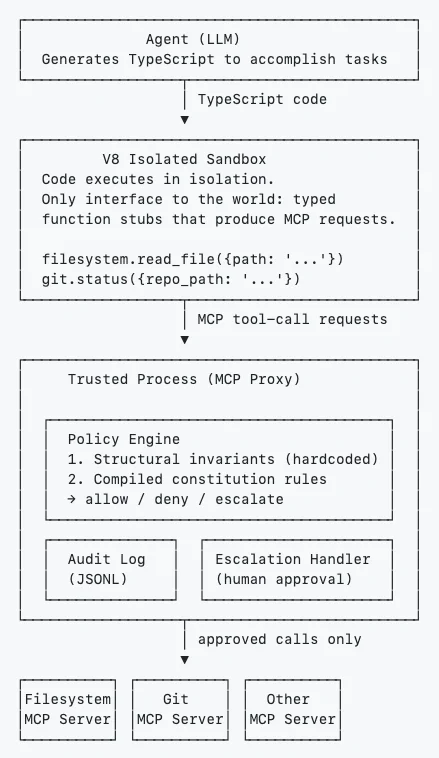
    Once the user gives it an instruction, the agent writes TypeScript code that runs inside a V8 isolated virtual machine, and issues typed function calls that map to MCP tool calls (i.e., requests an AI sends to external tools through the Model Context Protocol so they can do things).

    These tool-call requests are forwarded to the trusted process – a MCP proxy – that acts as a policy engine, and will “decide” whether each call should be allowed, denied (blocked), or escalated to a human for approval.
    OPIS

    The four layers of IronCurtain (Source: Niels Provos)

    The decisions of this policy engine rely on a “constitution”: a set of guiding principles and concrete guidance written in plain English by the user and “translated” into a security policy by IronCurtain.

    “A compiler LLM translates the English into per-interface rules using a library of verified policy primitives. A test scenario generator creates cases designed to find gaps and contradictions. A verifier checks that the compiled rules match the original intent. A judge iteratively refines the policy until it meets the spirit of the constitution as well as it can,” Provos explains.

    “Evaluation happens in two phases. First, structural invariants: protected paths (like the constitution itself and audit logs) are always denied, sandbox-contained paths are auto-allowed, and unknown tools are rejected. Second, compiled policy rules: each argument is checked against the rules generated from your constitution. Each argument role is evaluated independently and the most restrictive result wins.”

    Once the tool-call requests have been allowed either by the trusted process or by the human, they are forwared to standard Model Context Protocol servers that provide filesystem access, git operations, and other capabilities. They instruct tools to execute the asked-for actions.

    Results flow back through the trusted process to the agent, which is never allowed to access the user’s filesystem, sensitive credentials (e.g,. OAuth tokens, API keys, service account secrets), or environment variables. It is also prevented from accessing and modifying its own policy files, audit logs, or configuration.

    IronCurtain is still in development, and Provos describes it as an early research effort. The code has been released publicly so developers and security researchers can test the approach and suggest improvements.

    Subscribe to our breaking news e-mail alert to never miss out on the latest breaches, vulnerabilities and cybersecurity threats. Subscribe here!

    Assistants autonomous IronCurtain layer opensource safeguard
    Share. Facebook Twitter Pinterest LinkedIn Tumblr Telegram Email
    Previous ArticleLenovo has a wild foldable project that it could reveal at MWC 2026
    Next Article Nano Banana is here to eat the Pixel Studio’s lunch
    admin
    • Website

    Related Posts

    You’re Using AI At The Execution Layer. The Value Is In The Judgment Layer

    May 28, 2026

    Riverbed expands autonomous AI capabilities for Aternity platform

    May 20, 2026

    Encryption Consulting launches CertSecure Manager v3.3 with zero-touch certificate renewals

    May 20, 2026
    Add A Comment
    Leave A Reply Cancel Reply

    Search Blog
    About
    About

    At WifiPortal.tech, we share simple, easy-to-follow guides on cybersecurity, online privacy, and digital opportunities. Our goal is to help everyday users browse safely, protect personal data, and explore smart ways to earn online. Whether you’re new to the digital world or looking to strengthen your online knowledge, our content is here to keep you informed and secure.

    Trending Blogs

    6 Ways to Automate International Marketing with Agent A

    June 10, 2026

    What Is Network Experience Management? A Guide for IT Teams

    June 10, 2026

    Google Search Sends 23% Of Queries To The Open Web

    June 10, 2026

    Residential proxies are hiding in plain sight inside enterprise networks

    June 10, 2026
    Categories
    • Blogging (92)
    • Cybersecurity (1,955)
    • Privacy & Online Earning (249)
    • SEO & Digital Marketing (1,437)
    • Tech Tools & Mobile / Apps (1,796)
    • WiFi / Internet & Networking (345)

    Subscribe to Updates

    Stay updated with the latest tips on cybersecurity, online privacy, and digital opportunities straight to your inbox.

    WifiPortal.tech is a blogging platform focused on cybersecurity, online privacy, and digital opportunities. We share easy-to-follow guides, tips, and resources to help you stay safe online and explore new ways of working in the digital world.

    Our Picks

    6 Ways to Automate International Marketing with Agent A

    June 10, 2026

    What Is Network Experience Management? A Guide for IT Teams

    June 10, 2026

    Google Search Sends 23% Of Queries To The Open Web

    June 10, 2026
    Most Popular
    • 6 Ways to Automate International Marketing with Agent A
    • What Is Network Experience Management? A Guide for IT Teams
    • Google Search Sends 23% Of Queries To The Open Web
    • Residential proxies are hiding in plain sight inside enterprise networks
    • How to Advertise on Facebook in 8 Steps: The Visual Guide
    • How Taegan Goddard Turned Political Wire’s 4 to 5 Million Monthly Visitors Into a Subscription Opportunity
    • How to make prompt tracking much more accurate
    • Claude Is The Fastest-Growing AI Traffic Source, Per New Data
    © 2026 WifiPortal.tech. Designed by WifiPortal.tech.
    • Home
    • About Us
    • Contact Us
    • Privacy Policy
    • Terms and Conditions
    • Disclaimer

    Type above and press Enter to search. Press Esc to cancel.