


AI workflows need storage that supports repeated movement across the model lifecycle. Large datasets are ingested, transformed, exported for training, pulled back for evaluation, and refreshed as models evolve. Backblaze’s Q1 2026 Network Stats report says this creates a shift from diffuse internet-style traffic to large, high-bandwidth flows between fewer endpoints.
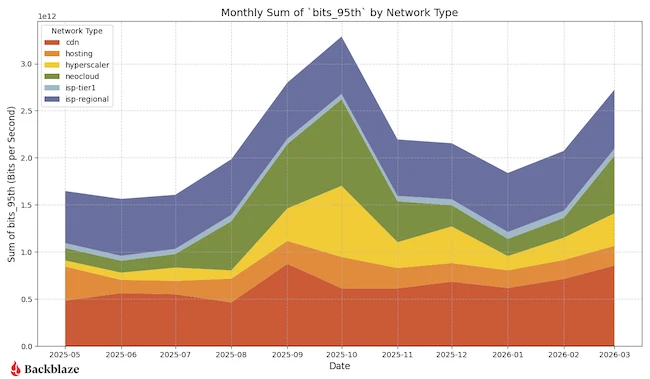
Monthly view of all bits transferred to each network type (2025-05 to current) (Source: Backblaze)
“From a network perspective, this represents a meaningful shift from diffuse, internet-style traffic patterns to large, high-bandwidth flows between a smaller set of endpoints typical of AI-centric infrastructure,” Brent Nowak, Manager of Network Engineering at Backblaze, explained.
The report shows that this traffic pattern is becoming an operational factor for cloud infrastructure teams. Neocloud, or AI-focused compute networks, and hyperscaler traffic behave differently from content delivery networks (CDN), hosting, and ISP regional traffic.
Traffic slowed, then rebounded
Q1 2026 showed a winter slowdown in neocloud and hyperscaler traffic, followed by an upward trend in March. Backblaze also recorded an increase in CDN traffic during the winter months. Hosting and ISP traffic stayed largely within historical norms, reflecting steady usage patterns.
The report suggests two possible explanations. The slowdown may reflect a seasonal business cycle, with more downtime during the winter months. Another possibility is tied to dataset movement. If a large dataset is already stored, network traffic may remain low until a later update or training cycle sends a new volume of data across the network.
Traffic distribution by region
Quarter-over-quarter heatmaps show how traffic distribution changes by region and provider type. The analysis combines total traffic with the number of active endpoints to measure flow magnitude.
Q1 2026 showed lower neocloud and hyperscaler traffic during the winter months, followed by renewed activity in March. Neocloud traffic maintained high magnitude through the quarter, indicating large transfers across a small number of endpoints.
Northern Virginia, including the Ashburn and Reston corridor, remains a primary location for neocloud activity. Activity also expanded into US-West and EU-Central in March after lower levels earlier in the quarter.
Hyperscaler traffic followed a similar pattern, with a winter decrease and continued visibility in US-East.
CDN, hosting, and ISP regional traffic remained more predictable and spread out over time. These traffic types involve more sources and destinations, which makes them easier to model and load balance.
Network flow characteristics
Neocloud traffic is concentrated in regions tied to dense data center and compute infrastructure.
The United States shows the highest concentration of neocloud, hyperscaler, and CDN traffic. Backblaze notes that the U.S. contains about 40% to 45% of global data centers, which aligns with the traffic patterns observed in its network data.
Within the U.S., neocloud traffic is concentrated in California. Hyperscaler activity aligns with California and Virginia, including the Ashburn and Reston corridor.
Outside the United States, neocloud activity appears in Finland, Brazil, France, and Canada. CDN traffic shows concentration in the Netherlands, while hosting activity appears in Germany.
Neocloud and hyperscaler traffic are more dynamic than CDN, hosting, and ISP regional traffic. They move large volumes of data across fewer endpoints, appear in bursts, and require network planning around high-magnitude flows.
