


Close Menu
    Facebook X (Twitter) Instagram
    Wifi PortalWifi Portal
    • Blogging
    • SEO & Digital Marketing
    • WiFi / Internet & Networking
    • Cybersecurity
    • Tech Tools & Mobile / Apps
    • Privacy & Online Earning
    Facebook X (Twitter) Instagram
    Wifi PortalWifi Portal
    Home»Cybersecurity»Kyber ransomware gang toys with post-quantum encryption on Windows
    Cybersecurity

    Kyber ransomware gang toys with post-quantum encryption on Windows

    adminBy adminApril 23, 2026No Comments3 Mins Read
    Facebook Twitter LinkedIn Telegram Pinterest Tumblr Reddit WhatsApp Email
    Ransomware
    Share
    Facebook Twitter LinkedIn Pinterest Email

    Ransomware

    A new Kyber ransomware operation is targeting Windows systems and VMware ESXi endpoints in recent attacks, with one variant implementing Kyber1024 post-quantum encryption.

    Cybersecurity firm Rapid7 retrieved and analyzed two distinct Kyber variants in March 2026 during an incident response. Both variants were deployed on the same network, with one targeting VMware ESXi and the other focusing on Windows file servers.

    “The ESXi variant is specifically built for VMware environments, with capabilities for datastore encryption, optional virtual machine termination, and defacement of management interfaces,” explains Rapid7.

    image

    “The Windows variant, written in Rust, includes a self-described “experimental” feature for targeting Hyper-V.”

    Both variants share the same campaign ID and Tor-based ransom infrastructure, so they were deployed by the same ransomware affiliate, who likely sought to maximize impact by encrypting all servers simultaneously.

    BleepingComputer has found only one listed victim on the Kyber data extortion portal at the time of writing, which is a multi-billion-dollar American defense contractor and IT services provider.

    Kyber ransomware extortion portal
    Kyber ransomware victim extortion portal
    Source: BleepingComputer.com

    Rapid7 says the ESXi variant enumerates all virtual machines (VMs) on the infrastructure, encrypts datastore files, and then defaces the ESXi interfaces with ransom notes to guide victims through the ransom payment and recovery process.

    Although it advertises ‘post-quantum’ encryption based on Kyber1024 key encapsulation, Rapid7 has found that these claims are false for the Linux ESXi encryptor.

    For the Linux version, the ransomware uses ChaCha8 for file encryption and RSA-4096 for key wrapping. 

    Small files (<1 MB) are encrypted in full and appended with the ‘.xhsyw’ extension, while files between 1 MB and 4 MB have only the first MB encrypted. Files larger than 4MB are intermittently encrypted based on the operator’s configuration.
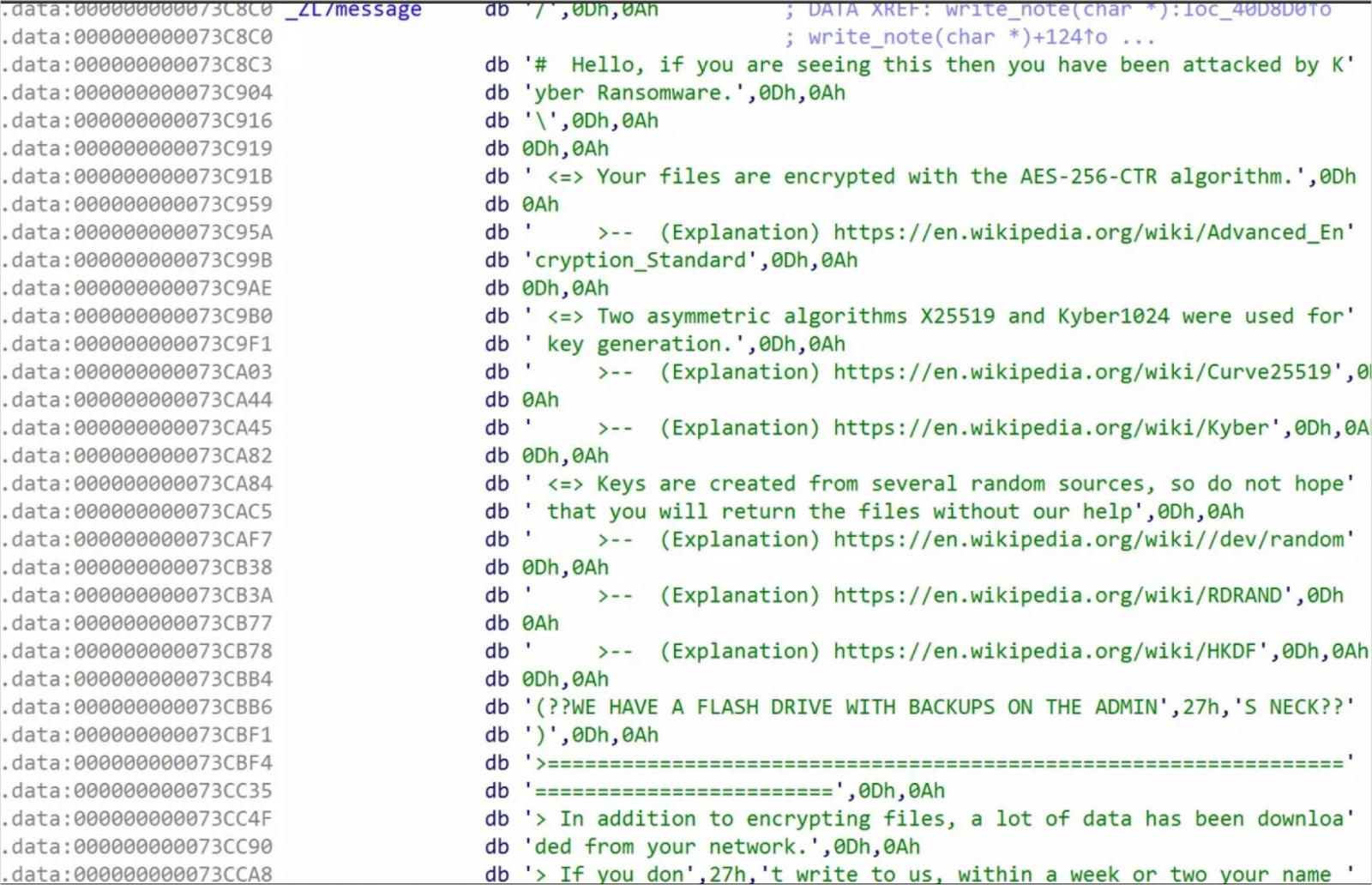
    Ransom note embedded in the ELF binary
    Ransom note embedded in the ELF binary
    Source: Rapid7

    The Windows variant, written in Rust, implements Kyber1024 and X25519 for key protection, aligning with the ransom note’s claims.

    “This confirms that Kyber is not used for direct file encryption. Instead, Kyber1024 protects the symmetric key material, while AES-CTR handles bulk data encryption,” Rapid7 explains.

    While the use of post-quantum cryptography is notable, it does not change outcomes for victims. Whether the encryptor uses RSA or Kyber1024, files remain unrecoverable without access to the attacker’s private key.

    The Windows variant appends the ‘.#~~~’ extension to encrypted files, terminates services, deletes backups, and includes an experimental feature to shut down Hyper-V virtual machines.
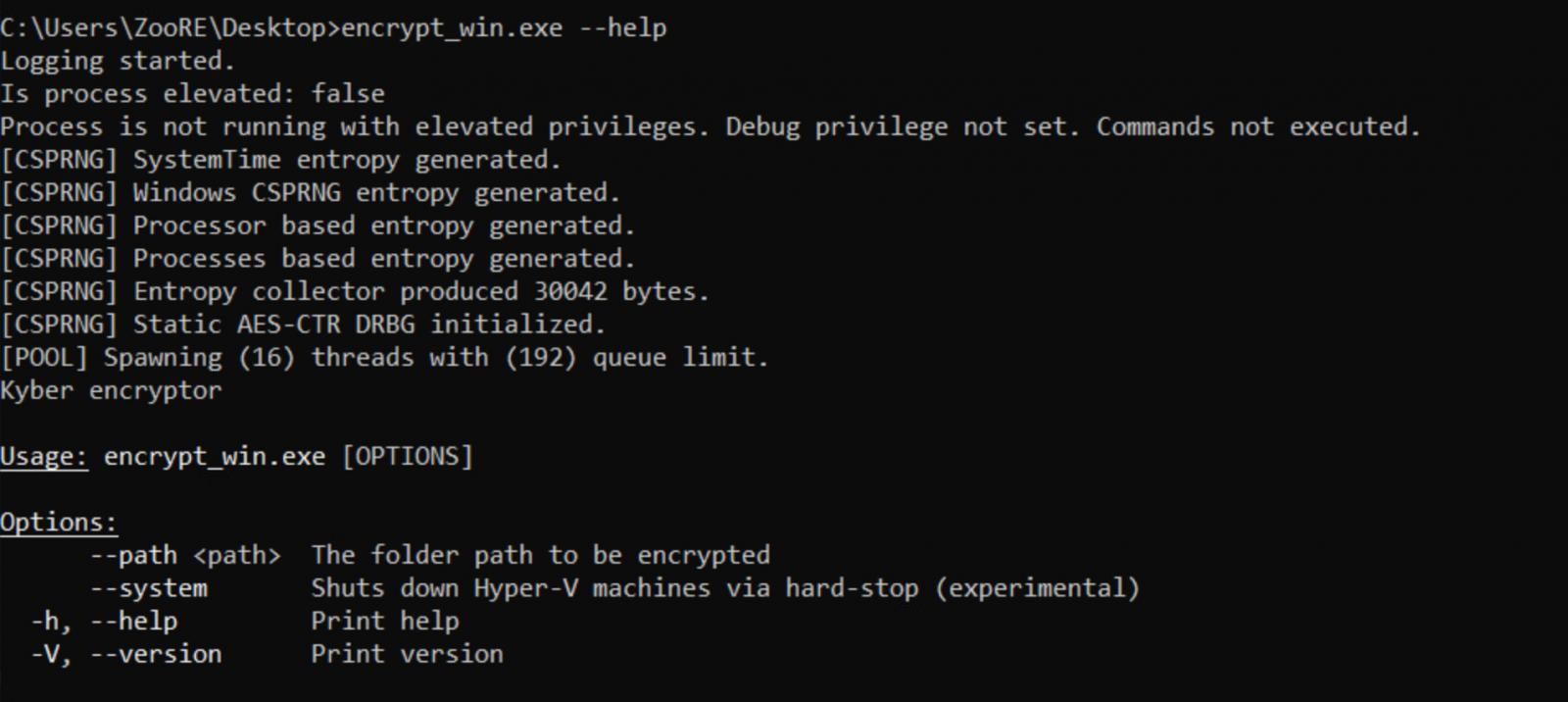
    Kyber for Windows CLI
    Kyber for Windows CLI
    Source: Rapid7

    It is designed to eliminate a broad range of data recovery paths, deleting shadow copies, disabling boot repair, killing SQL, Exchange, and backup services, clearing event logs, and wiping the Windows Recycle Bin.

    Rapid7 highlighted an unusual choice of a mutex in the Windows variant of Kyber, which appears to reference a song on the Boomplay music platform.

    Overall, the Windows variant appears more technically mature, while the ESXi variant currently lacks some of its features.


    article image

    AI chained four zero-days into one exploit that bypassed both renderer and OS sandboxes. A wave of new exploits is coming.

    At the Autonomous Validation Summit (May 12 & 14), see how autonomous, context-rich validation finds what’s exploitable, proves controls hold, and closes the remediation loop.

    Claim Your Spot

    encryption gang Kyber PostQuantum ransomware Toys Windows
    Share. Facebook Twitter Pinterest LinkedIn Tumblr Telegram Email
    Previous ArticleConnected TV Advertising Explained
    Next Article This small Gemini update solves a surprisingly big problem
    admin
    • Website

    Related Posts

    Your SSD is slowing down, and Windows has been quietly hiding the fix

    April 25, 2026

    Researchers Uncover Pre-Stuxnet ‘fast16’ Malware Targeting Engineering Software

    April 25, 2026

    Compromised everyday devices power Chinese cyber espionage operations

    April 25, 2026
    Add A Comment
    Leave A Reply Cancel Reply

    Search Blog
    About
    About

    At WifiPortal.tech, we share simple, easy-to-follow guides on cybersecurity, online privacy, and digital opportunities. Our goal is to help everyday users browse safely, protect personal data, and explore smart ways to earn online. Whether you’re new to the digital world or looking to strengthen your online knowledge, our content is here to keep you informed and secure.

    Trending Blogs

    Why GEO is a reputation problem

    April 25, 2026

    Your SSD is slowing down, and Windows has been quietly hiding the fix

    April 25, 2026

    Researchers Uncover Pre-Stuxnet ‘fast16’ Malware Targeting Engineering Software

    April 25, 2026

    Google Clock 8.8 APK Download by Google LLC

    April 25, 2026
    Categories
    • Blogging (68)
    • Cybersecurity (1,505)
    • Privacy & Online Earning (183)
    • SEO & Digital Marketing (924)
    • Tech Tools & Mobile / Apps (1,789)
    • WiFi / Internet & Networking (246)

    Subscribe to Updates

    Stay updated with the latest tips on cybersecurity, online privacy, and digital opportunities straight to your inbox.

    WifiPortal.tech is a blogging platform focused on cybersecurity, online privacy, and digital opportunities. We share easy-to-follow guides, tips, and resources to help you stay safe online and explore new ways of working in the digital world.

    Our Picks

    Why GEO is a reputation problem

    April 25, 2026

    Your SSD is slowing down, and Windows has been quietly hiding the fix

    April 25, 2026

    Researchers Uncover Pre-Stuxnet ‘fast16’ Malware Targeting Engineering Software

    April 25, 2026
    Most Popular
    • Why GEO is a reputation problem
    • Your SSD is slowing down, and Windows has been quietly hiding the fix
    • Researchers Uncover Pre-Stuxnet ‘fast16’ Malware Targeting Engineering Software
    • Google Clock 8.8 APK Download by Google LLC
    • Compromised everyday devices power Chinese cyber espionage operations
    • Why Great Content Is No Longer Enough & What Beats It In AI Search
    • Windows Update gets new controls to reduce forced restarts
    • Melitta AromaFresh Therm Pro review: an almost-great drip coffee maker that’s let down by its most novel feature
    © 2026 WifiPortal.tech. Designed by WifiPortal.tech.
    • Home
    • About Us
    • Contact Us
    • Privacy Policy
    • Terms and Conditions
    • Disclaimer

    Type above and press Enter to search. Press Esc to cancel.