Key Takeaways
- CTV advertising delivers video ads within streaming content on internet-connected TV devices, with targeting and measurement precision that linear TV never had.
- Streaming accounted for 45.6 percent of all ad-supported TV viewing in Q4 2025, while only 36 percent of U.S. adults still subscribe to cable or satellite.
- Inventory is expanding fast. Amazon has repositioned its demand-side platform (DSP) as a cross-screen programmatic platform, and Pinterest’s acquisition of tvScientific has brought discovery-based audience data into the CTV mix.
- CTV advertising rewards intentional spend. Set clear outcome goals, keep frequency under control, and track metrics that connect to real business results rather than just impressions.
- Not every business is a natural fit for CTV advertising, but self-serve buying tools have lowered the barrier significantly, making meaningful tests possible without a traditional TV budget.
According to Pew Research, 83 percent of U.S. adults watch streaming services, while only 36 percent subscribe to cable or satellite TV at home. In Q4 2025, 74.2 percent of all TV viewing was ad-supported, with streaming accounting for 45.6 percent of that share, the largest of any category, per Nielsen.
Ad dollars are following the audience. According to IAB, CTV ad spend grew 16 percent year over year in 2024, and digital video surpassed linear TV (traditional scheduled television delivered via cable or satellite) for the first time that year, capturing 51 percent of total TV and video ad spend.
Here is what you need to know about CTV advertising to reach the right viewers on the biggest screen in the house.
What is Connected TV?
Connected TV (CTV) is exactly what it sounds like; televisions that connect to the internet. But it’s so much more than just smart TVs. CTV encompasses any device that allows you to stream content on your TV screen—think Roku, Amazon Fire Stick, and gaming consoles as well.
The shift towards CTV has been dramatic. In 2023, cable TV subscribers dropped to 72.2 million from 98.7 million in 2016. Why? Because 82% of American adults say streaming entertains them more than cable TV. It’s not just about cutting the cord—it’s about gaining control over what, when, and how we watch.
What Is CTV Advertising?
CTV refers to internet-connected devices that enable viewers to stream video content on a TV screen. This includes smart TVs like LG and Samsung, streaming sticks like Roku and Amazon Fire TV, and video game consoles like Xbox or PlayStation.
CTV advertising is a form of digital advertising that delivers video ads within that TV streaming content. Ads can appear across ad-supported tiers of streaming services like Hulu and Peacock, free ad-supported streaming TV (FAST) channels like Pluto TV and Tubi, and apps on streaming devices.
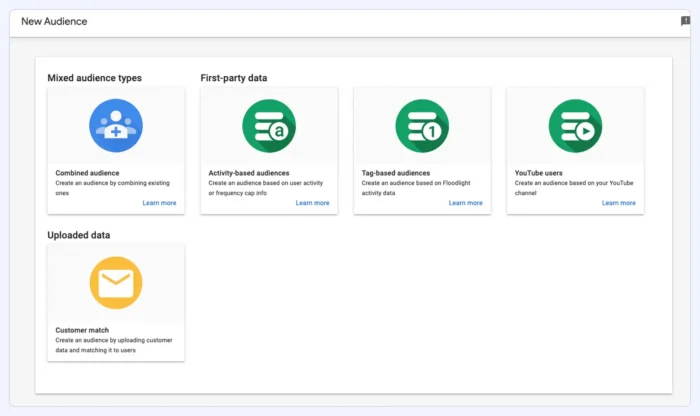
CTV ads give you the full-screen, lean-back viewing experience of traditional TV ads, with the reporting and optimization of paid digital. Google Display & Video 360 (DV360), for example, lets advertisers layer CTV-specific audience segments on top of first- and third-party data, going well beyond the demographic filters available in standard Google Ads campaigns.
The screenshots below show the difference in targeting controls between the two platforms. Google Ads operates within Google’s own data signals, while DV360 lets you bring in your own customer relationship manager (CRM) lists and third-party data on top of that.
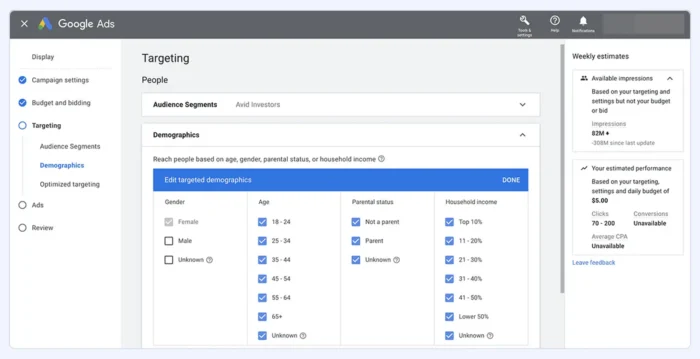
Source: https://improvado.io/blog/dv360-vs-google-ads
That kind of targeting sophistication is becoming the standard across the industry, and the major players have taken notice. Amazon has repositioned itself not just as a streaming platform but as a full-funnel, cross-screen programmatic ecosystem, reflective of broader trends in paid media.
Through Amazon’s DSP, advertisers can now access inventory across its own distribution channels and third-party platforms like Netflix and Disney. Layering Amazon’s first-party shopper data on top of that inventory creates targeting and attribution capabilities that go well beyond standard streaming buys.
CTV advertising’s reach is expanding just as quickly as its targeting capabilities. Netflix’s ad tier generated $1.5 billion in revenue in 2025 and is expected to nearly double to roughly $3 billion in 2026. CTV ads on LinkedIn have also entered the mix, enabling B2B advertisers to reach professional audiences on connected TV screens through partners like Roku, Samsung, and NBCUniversal.
Metro Vein Centers is a good illustration of what CTV advertising precision looks like in practice. The clinic used CTV’s geotargeting to reach women in specific demographic groups near its physical locations, layering in a retargeting campaign to re-engage previous site visitors. The result was an 85 percent reduction in cost per site visitor.
How Does CTV Advertising Work?
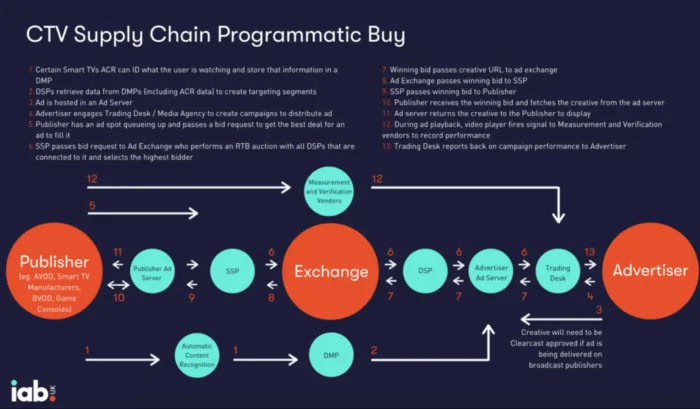
Here’s how the CTV advertising process works from the moment a viewer hits play:
- Viewer Initiates: A viewer selects content to watch on their connected device. This could be anything from a Netflix show on a smart TV to a YouTube video on a gaming console.
- Publisher Transmits Data: The publisher (like Hulu or Roku) sends available viewer information to an ad exchange. This data might include device type, content genre, and any known viewer demographics.
- Auction Begins: An automated bidding process, known as real-time bidding (RTB), starts for this specific ad opportunity. This happens in milliseconds, before the content even begins to load.
- Platforms Share Information: Supply-side platforms (SSPs) provide more detailed information to potential buyers. This could include the viewer’s approximate location, the time of day, and the type of content being watched.
- DSPs Bid: DSPs with matching criteria automatically bid for the ad slot. If you’ve set up a campaign to target, say, sports fans in Chicago, your DSP will bid on this opportunity if it matches.
- Exchange Selects Winner: The highest-bidding DSP wins, and their ad is placed. If that’s your ad, it’s then served to the viewer as part of their streaming experience.
This entire programmatic advertising process happens in less than a second, across millions of devices simultaneously, matching your ad to the right viewer before content even loads.
There are three main ways to buy CTV ads:
- Open auction or RTB: Prices are determined during a real-time auction.
- Private marketplace (PMP): An invite-only version of an open auction.
- Programmatic direct: Direct sales at a fixed price, bypassing the auction.
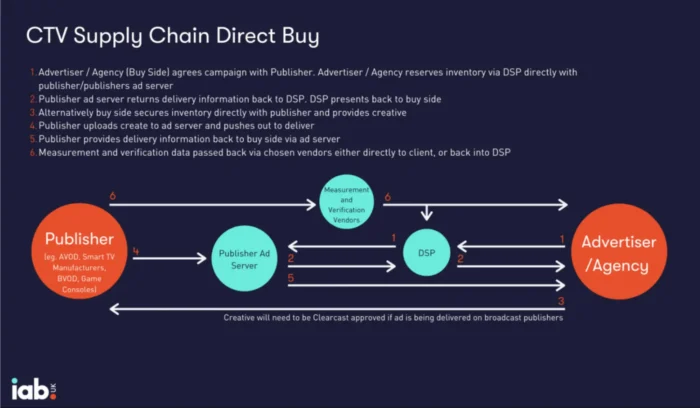
The key players in this process are:
- DSPs: Advertisers use them to manage bids and targeting.
- SSPs: Publishers use them to make inventory available to buyers.
- Ad exchanges: These are the digital marketplaces where SSPs and DSPs transact.
The buying process is getting smarter, too. NBCUniversal teamed up with agency RPA and ad server FreeWheel to test agentic AI systems that handle campaign planning, activation, and execution across both linear TV and streaming, including live sports. The goal is to let AI handle the operational grunt work so teams can focus on strategy.
Benefits of CTV Advertising
Here’s what CTV advertising can do for your marketing:
- Precise targeting: You can reach specific audiences based on interests, behaviors, and locations.
- Real-time measurement: You’ll see who watched your ad, for how long, and what they did afterward. This instant feedback tells you what to change and when.
- Reach expansion: CTV advertising lets you connect with viewers who’ve switched to streaming.
- Higher completion rates: CTV advertising’s targeting means your message is more likely to resonate, keeping viewers engaged to the end.
- Agile campaigns: Unlike traditional TV, you can adjust CTV ads quickly. Spot an underperforming element? Change it immediately and see the impact.
You’ll need enough budget to generate meaningful signal, creative built for a full-size screen, and a clear sense of your target outcome. Self-serve buying tools have made entry more accessible than ever, but you still need enough spend to generate data worth acting on.
How to Plan and Execute a Connected TV Campaign
A strong CTV campaign doesn’t happen by accident. Here is what the CTV advertising planning and execution process looks like step by step:
- Develop your strategy.
- Choose the right platform.
- Create compelling content.
- Set your budget and bidding strategy.
- Monitor and optimize your campaign.
1. Develop Your Strategy
Before you spend a dime, you need a clear plan:
- Define your objectives: Are you aiming for brand awareness, lead generation, or direct sales? Be specific.
- Identify your target audience: Who are you trying to reach? Provide as much detail as possible about your target audience’s demographics, interests, and viewing habits.
- Set clear KPIs: Decide how you’ll measure success. It could be:
- Impressions: Tracks how many times your ad is displayed.
- Completion Rate: Measures the percentage of viewers who watch your entire ad.
- Cost Per Completed View (CPCV): Tracks the cost for each viewer who watches your ad through to the end.
- Brand Lift: Measures changes in brand awareness, perception, or purchase intent after viewing your ad.
- Reach and Frequency: Tracks how many unique viewers saw your ad and how often.
- Website Visits: Measures traffic to your website after running the CTV campaign.
- Conversion Rate: Tracks the percentage of viewers who take a desired action after seeing your ad.
- Return on Ad Spend (ROAS): Measures the revenue generated relative to your ad spend.
- Foot Traffic: Tracks increases in in-store visits attributed to your CTV campaign for brick-and-mortar businesses.
- Align with other marketing efforts: CTV works best when it reinforces messaging across your other paid and organic channels. If you’re running paid search or paid social, make sure your CTV creative is telling the same story.
2. Choose the Right Platform
Source: https://about.ads.microsoft.com/en/blog/post/june-2024/making-ctv-accessible-to-everyone
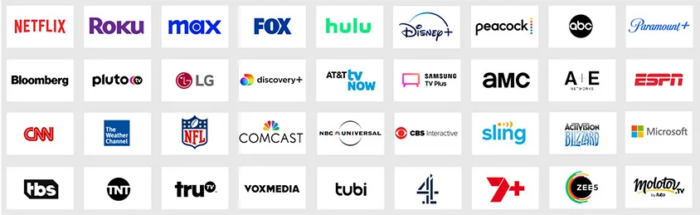
Once your strategy is set, the next decision is where to run your ads. Here are your main options:
- Smart TV manufacturers: These are TV brands, like VIZIO and Samsung, that have built-in streaming capabilities. They offer ad inventory across their native apps and sometimes partner channels.
- Streaming devices: These are external devices that connect to TVs to enable streaming. Roku, Apple TV, and Amazon Fire TV are a few choices, though Roku and Amazon also manufacture their own smart TVs. They provide ad opportunities across their platforms and partner apps.
- Video streaming services: These content providers stream content directly to viewers and offer ad inventory within their programming streams. Hulu and YouTube are a couple of major players when it comes to CTV, but other apps like Netflix and Disney+ also offer advertising options.
- DSPs: These technology platforms enable you to buy ad inventory across multiple CTV sources, offering broader reach and more advanced targeting options. Amazon’s DSP and DV360 are two examples.
- Over-the-top (OTT) aggregators: OTT refers to video content delivered over the internet, bypassing traditional cable or satellite providers. CTV is the device used to view that content, like a smart TV or game console. In short, OTT is the delivery method, while CTV is the screen. Platforms like FreeWheel and Magnite aggregate ad inventory from multiple streaming services and devices, giving buyers a single point of access to diverse CTV inventory. Unlike DSPs, which operate on the demand side, aggregators work on the supply side, connecting publishers to potential buyers across multiple platforms.
- FAST platforms: Free ad-supported services like Tubi, Pluto TV, and The Roku Channel have expanded rapidly into mainstream viewing. Tubi is already reaching more than 100 million monthly viewers, offering broad reach at competitive CPMs.
- Social platforms: Social media platforms are increasingly entering the CTV space, extending their audience data and ad products to the television screen. Pinterest, for example, announced the acquisition of tvScientific, connecting its discovery-based audience data to TV reach. The platform’s first original CTV series, “Bring My Pinterest to Life,” launched on Roku in March 2026, giving brands a shoppable format that bridges upper-funnel inspiration with connected TV exposure.
Each platform type has its strengths, and the right choice depends on your campaign goals, audience, and budget. Smart TVs and streaming devices give you direct access to viewers, while DSPs and aggregators offer broader reach and more granular targeting. FAST platforms and newer entrants like Pinterest add scale and audience data that didn’t exist in CTV a few years ago. Most advertisers find that a mix works better than any single path.
3. Create Compelling Content
Good CTV creative has one job. It must earn attention on a screen where the viewer did not invite it in. A few principles separate the ads that work from the ones that get ignored.
- Hook fast, stay clear. You have seconds before a viewer mentally checks out. Lead with the problem, the product, or a visual that demands attention. The message should land cleanly, even if speakers are muted.
- Design for one takeaway. CTV is a lean-back environment. Viewers are not scrolling past your ad, but they are not taking notes, either. Pick one thing you want them to remember and build everything around it.
- Give viewers somewhere to go. A QR code, a branded search term, or a simple URL gives engaged viewers a direct path to act. According to Innovid, interactive ads earn an average of 71 additional seconds of viewer time over standard pre-roll, suggesting that engagement formats are worth the extra production effort.
- Match the creative to the audience. CTV targeting is precise enough to serve different messages to different household segments. A generic spot wastes that advantage. Tailor the message to those watching.
- Think beyond the 30-second spot. Pause ads, overlay formats, and shoppable units are all part of the modern CTV creative toolkit.
- Overlay formats appear during content and let viewers scan a QR code or click through to take an action like visiting a site or making a purchase.
- Pause ads appear when a viewer pauses content and can include QR codes or direct response prompts.
- Shoppable units let viewers buy directly from their TV when their retail accounts, such as Walmart or Amazon, are linked to their device.
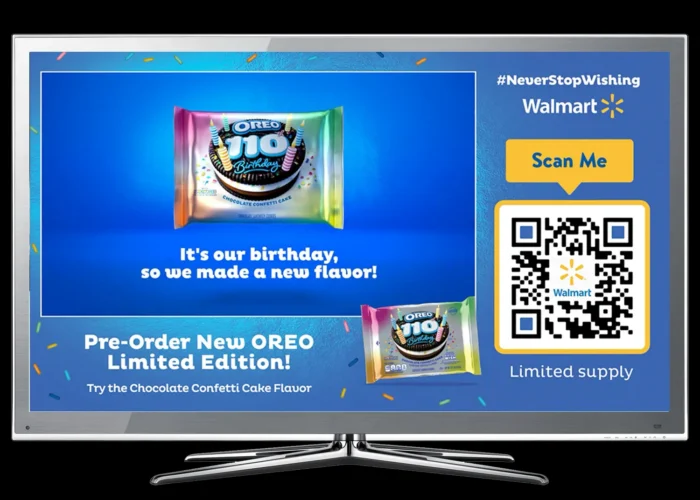

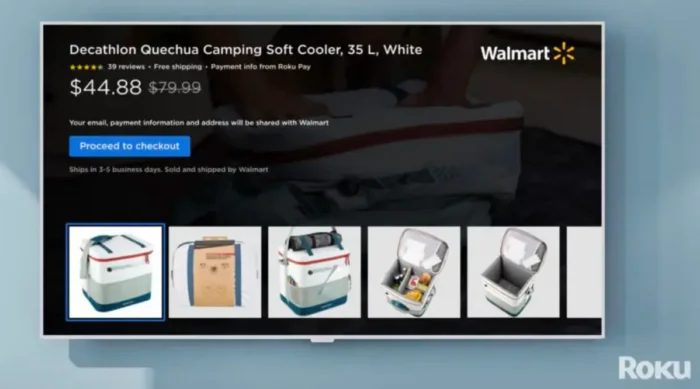
Sources:https://www.sabioctv.com/blog/top-8-ctv-ad-creative-units-to-boost-engagement, https://strikesocial.com/blog/getting-started-with-youtube-pause-ads-what-you-need-to-know/, https://www.collectivemeasures.com/insights/ctv-and-the-addition-of-shoppable-ads
Examples worth studying
Lexus used dynamic countdown creatives paired with a home screen roadblock on LG Smart TVs during the U.S. Open, reaching viewers the moment they launched the app before content even began. The campaign drove a 64 percent lift in brand perception, which is a strong illustration of how matching creative format to a high-attention moment can move brand metrics in a way a standard pre-roll spot cannot.
Another automotive brand used Vizio’s Inscape platform to target households identified as “auto intenders” on CTV, running seven campaigns across six models over three months. The campaign resulted in more than 2,600 vehicle purchases and delivered an average ROAS of $31.91, showing that CTV can drive high-value conversions when targeting is built around purchase intent rather than broad demographics.
Both cases illustrate what separates effective CTV from wasted spend. One shows how matching creative format to a high-attention moment moves brand metrics, while the other shows how building targeting around purchase intent drives measurable conversions.
4. Set Your Budget and Bidding Strategy
CTV advertising rewards intentional spending over volume.
- Start with a test budget, not your full commitment. Give the campaign enough room to generate real traction across audiences and placements before scaling. Industry guidance generally points to dedicating 15 to 30 percent of your digital video budget to CTV advertising as a starting point for meaningful testing.
- Understand how CTV advertising is priced. Most CTV inventory is bought on a cost per mille (CPM) basis, with rates for most U.S. campaigns ranging from $20 to $40 per thousand impressions and many settling around $25 CPM, depending on targeting depth, content type, and inventory quality. Premium direct deals, such as those on Netflix, can push rates significantly higher. Cost per acquisition (CPA) is better thought of as an outcome goal than a bidding model, or something you optimize toward rather than bid on directly.
- Allocate budget across platforms based on performance. If you are running across multiple publishers or buying paths, let delivery data drive where the money goes. Do not set it and walk away.
- Set frequency caps. This prevents ad fatigue and stops you from burning budget on viewers who have already seen your ad enough times. Research suggests three to seven exposures optimize impact, while more than 10 can reduce purchase intent.
Spend less time chasing the lowest CPM and more time making sure your budget is working against the right audiences in the right environment.
5. Monitor and Optimize Your Campaign
CTV advertising gives you real-time performance data that most traditional TV buys never could. Here’s how to use it:
- Track key metrics. Monitor impressions, completion rates, and conversions to understand whether the campaign is delivering and whether viewers are watching through to the end.
- Analyze viewer behavior. Look at engagement patterns and drop-off points to understand where creative is losing attention and where it is holding it.
- Adjust in real-time. Many platforms enable you to optimize campaigns while they’re running, rotating creative, or tightening targeting based on what the data is telling you.
- Test and learn. Try different creative versions or bid strategies. Small tests compound into meaningful performance gains over time.
- Connect online and offline data. Use attribution tools to understand how CTV exposure influences actions taken on other devices or in physical locations.
Run incrementality tests. Platform-reported metrics often undercount CTV’s true contribution. Comparing exposed households against a control group gives you a cleaner read on whether your campaign is changing behavior, not just reaching people who were already going to convert.
FAQs
What is connected TV (CTV)?
Connected TV (CTV) refers to any device that connects a TV screen to the internet to stream video content, including smart TVs, streaming sticks, and game consoles.
How does connected TV (CTV) advertising work?
Connected TV (CTV) advertising works by placing video ads within streaming content on connected TV devices, either through direct publisher deals or programmatic buying. Advertisers can then target, measure, and optimize campaigns using platform and publisher data.
What is the difference between CTV and OTT?
Connected TV (CTV) refers to devices that connect a TV screen to the internet, such as smart TVs, streaming sticks, and game consoles. Over-the-top (OTT) is the broader method of delivering video over the internet and can include phones, tablets, and desktops. A CTV buy targets that living room device specifically, while a broader OTT buy reaches audiences across all screens.
How much does CTV advertising cost?
Most connected TV (CTV) inventory is priced on a cost per mille (CPM) basis, with rates for most U.S. campaigns ranging from $20 to $40 per thousand impressions and many settling around $25 CPM, depending on targeting depth and inventory quality. Self-serve platforms have made it possible to test CTV without a traditional TV budget, though you still need enough spend to generate data worth acting on.
Conclusion
CTV has earned its place as a core part of any modern media mix. The brands winning on CTV right now are the ones applying the same discipline to testing and measurement that they bring to search and paid media.
If CTV is not yet part of your 2026 media mix, start by defining your audience and picking a platform that fits your buying model. Strong video creative that holds attention on the biggest screen in the house will do the rest.
Are You Using Google Ads? Try Our FREE Ads Grader!
Stop wasting money and unlock the hidden potential of your advertising.
- Discover the power of intentional advertising.
- Reach your ideal target audience.
- Maximize ad spend efficiency.