


For a long time, content marketing strategies for many businesses followed a simple playbook:
- Publish strong, opinion-led thought leadership to stand out.
- Build tightly focused pages around specific keyword intent.
- Assume the buyer’s understanding forms after they land on your site.
That approach worked because search worked that way. People clicked, compared, read multiple pages, and slowly built their understanding inside your funnel.
But AI changes how that understanding gets built now.
Explanations are now reused and summarized, related questions get merged into one answer, and, in many cases, the first version of your business a prospect encounters is assembled before they ever visit your website.
That doesn’t mean content stopped working. It means the assumptions behind how it works need to be updated.
In this article, we’ll look at three huge ways AI is impacting content strategies and what businesses need to rethink if they want their content to shape decisions instead of reacting to them.
Contents
3 ways AI search is impacting content marketing and what to do about it
Let’s take a deep dive into three issues plaguing content strategies right now and how to fix them to see better results.
1. Thought leadership performs worse in AI search
For years, thought leadership has been the gold standard of content marketing. Have a strong point of view, challenge assumptions, lead with perspective, and you’ll win attention. That model worked extremely well in a click-driven environment. And it still works for brand building. Once someone lands on your site, a sharp perspective helps you stand out and build trust, but AI search changes where the explanation happens.
The issue is not that thought leadership lost value. The issue is that AI systems are not trying to persuade, but to explain.
Why this is the case
AI systems reuse content to build clear explanations, not to win arguments.
When a user asks:
- “How much do dental implants cost?”
- “Should I repair or replace my AC?”
- “What does managed IT support include?”
The system doesn’t surface the boldest take. It pulls from multiple sources and synthesizes one answer whose primary objective is to precisely satisfy the query, with (if possible) zero ambiguity.
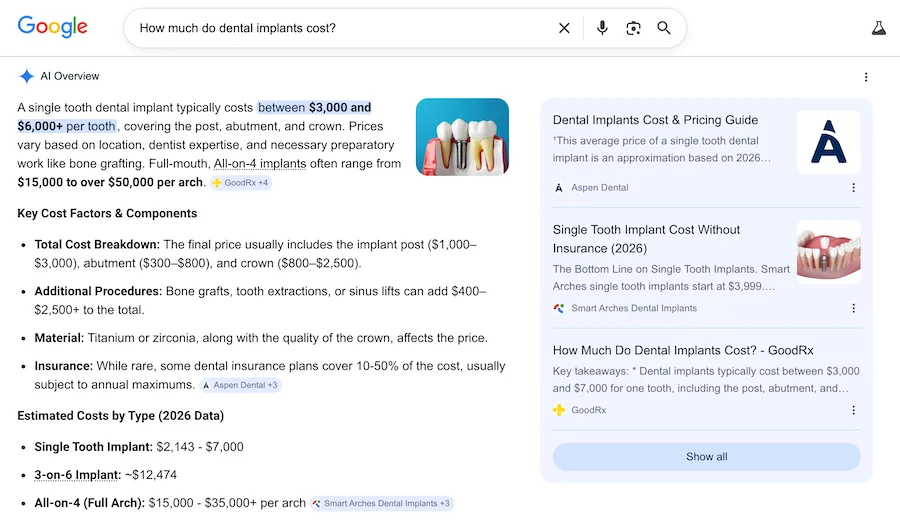
To do that reliably, AI has to favor content that provides:
- Clear definitions
- Clear scope
- Clear conditions
- Clear mechanics
Opinion-led content doesn’t offer that. Most thought leadership content follows a familiar pattern:
- Lead with a bold claim
- Critique the industry
- Frame a problem
- Introduce your perspective
The more interpretation a piece requires, the harder it becomes to merge it safely with other sources. And when AI merges information across websites, it avoids statements that might introduce conflict or judgment.
Here’s a simple example that makes this obvious. Compare these two statements about HVAC replacement:
- “Most HVAC companies push replacements you don’t actually need.”
- “HVAC replacement is usually recommended when a system is 15 to 20 years old, requires frequent repairs, or when repair costs exceed 50% of the price of a new unit.”
The second version is easier for AI to reuse because it explains when replacement makes sense. It gives conditions and numbers, and, overall, removes ambiguity.
The first version makes a claim, then introduces judgment, and that makes it harder to merge cleanly with other sources.
When AI builds a combined answer from several websites, it defaults to the explanation that aligns cleanly across them. That is why definition-first content gets reused more often, even when opinion-led content ranks well.
Data backs this up:
- A Semrush study analyzing AI Overview-triggered queries found that informational searches were far more likely to generate synthesized summaries instead of click-through behavior. Those summaries heavily favored structured, definition-first content.
- Moz research shows something similar. AI-generated summaries disproportionately pull from pages that provide direct, concise answers within the first 100 to 200 words.
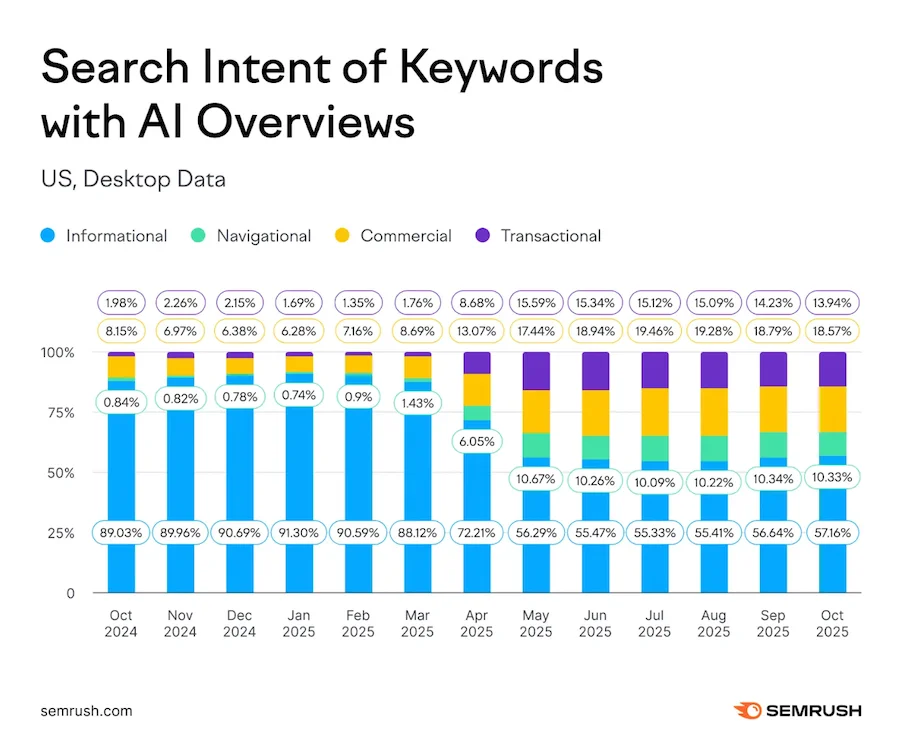
The pattern is consistent: AI prefers a low-ambiguity explanation over perspective.
What the experts are seeing
Maeva Cifuentes, Founder & CEO of Flying Cat Marketing, has seen this shift play out across multiple clients.
“For a long time, the SEO formula was simple: more traffic meant more leads, and you could calculate it almost linearly. AI broke that correlation. It took over the informational layer of search, the research, the synthesis, the ‘what should I think about this’ questions, and started answering them directly,” Maeva said.
That informational layer used to be where thought leadership content lived. It captured researchers, nurtured awareness, and generated top-of-funnel sessions that could later convert.
AI now owns that layer, but that does not mean your content has stopped being used.
As Maeva explains: “What changed technically is that content is still being used, it’s just not generating the value exchange it used to. We see client pages getting cited in AI responses, which means the content was useful enough to reference, but the user got the answer inside the AI and never clicked through. The citation replaced the click.”
That sentence reframes the problem clearly.
The issue is not usefulness, but where the value exchange now happens. Your explanation may still shape understanding, but it may do so without sending traffic.
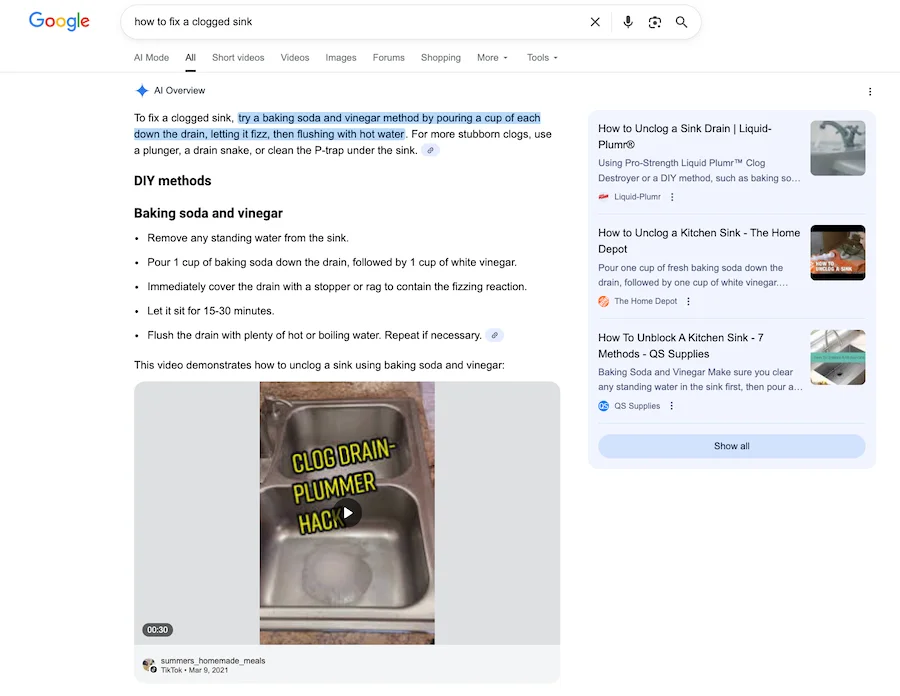
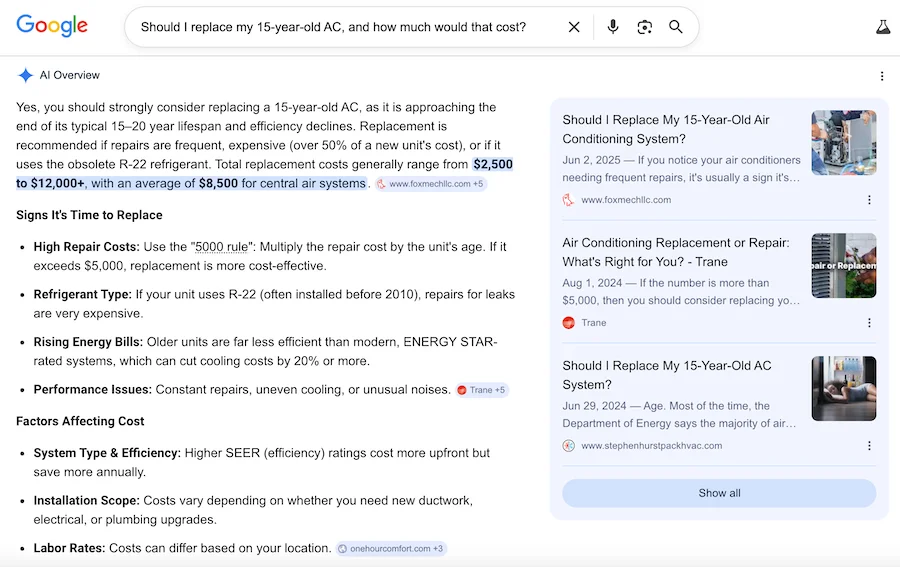
For a query like this, the searcher may get all the information they need from the AIO, even though expert content was needed to guide the steps listed here.
Claudia Bird, Senior Content Writer at Grizzle.io, adds an important nuance here. She has seen thought leadership content perform well in AI environments, but only under specific conditions.
“One of our enterprise clients got a ton of citations and traffic from content that was only meant to be a thought leadership and sales enablement play. But it spoke directly to a crucial pain point for their audience,” Claudia said.
The format itself was not the deciding factor. Authority and clarity were.
She cautions against oversimplifying the conversation. “It’s not as simple as a standalone format that ‘does or doesn’t work.’ There’s a lot more happening in the background—based on perceived authority—that impacts performance,” she said.
This reinforces the structural issue: Thought leadership is not dead, opinion is not banned, perspective still differentiates, but if explanation is weak, fragmented, or buried beneath commentary, AI will skip it in favor of clearer sources. And when AI skips your explanation layer, it builds the upstream understanding from someone else’s.
⬇️ What are the biggest challenges businesses are facing when it comes to AI search and SEO? Free download >> Small Business Website Trends Report
What this means for businesses
If your content strategy leans heavily on opinion-led thought leadership without anchoring it in clear explanation, you risk losing control over how your business is described upstream.
You may still rank, but AI may build its summary from someone else’s clearer explanation.
And that’s a problem because by the time a buyer reaches your site, they already carry a synthesized understanding of what your service includes, what it costs, who it’s for, and how it compares. If your voice didn’t shape that explanation layer, you inherit generic expectations.
How to adjust your strategy
You don’t need to stop publishing perspectives, but you do need to change the order in which you present it.
Start with a plain-language explanation. Define the scope clearly. Explain who the service applies to and who it does not apply to. Walk through the mechanics before you introduce critique. Once the foundation is clear, then layer in your point of view.
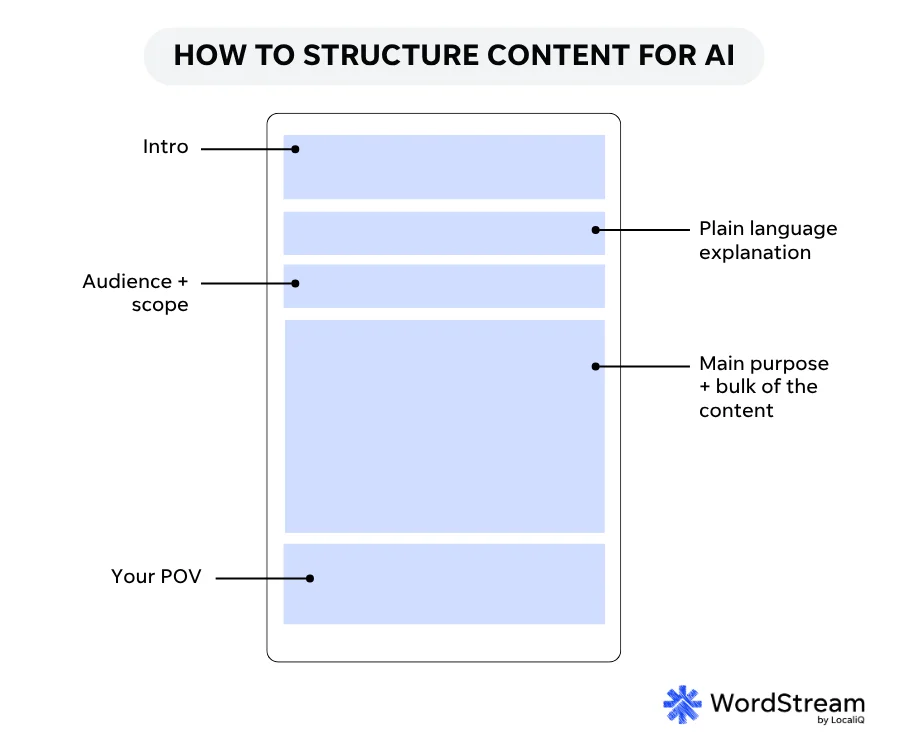
For example, instead of opening with a headline like, “Why Most Agencies Waste Your Marketing Budget,” begin by explaining what marketing agencies typically do, how retainers are structured, what affects pricing, and when agency support actually makes sense. Clarify when it does not. After that groundwork is laid, introduce your critique.
That sequence does two important things. It allows AI systems to reuse your explanation safely, and it still gives human readers your differentiated perspective.
Keep explanation and commentary distinct. Anchor your viewpoint in specific scenarios. For small HVAC companies serving one metro area, the economics look different. For dental practices focused on complex implant cases, candidacy rules matter more. For SaaS companies under $5 million in ARR, agency support carries different tradeoffs.
Specificity reduces ambiguity. And ambiguity reduces reuse.
In the AI search environment, explanation earns visibility first. Perspective earns differentiation second.
If you reverse that order, your content may persuade someone who lands on your page, but it may never shape the explanation that brought them there.
🔎 Need help understanding the modern rules for SEO? Download our free guide >> How to Do SEO Right—Right Now!
Building and ranking one page per intent no longer holds
For years, good SEO meant discipline. You identified keyword intent, mapped one page to one intent, and built tightly focused content that answered a specific query type.
- If someone searched “what are dental implants,” they landed on a definition page.
- If they searched “dental implant cost,” they landed on a pricing page.
- If they searched “best dental implants,” they landed on a comparison or positioning page.
Each page did one job. That structure made sense in a blue-links environment because the user journey was fragmented by design. A buyer would search, click, return to the SERP, refine the query, click again, compare, and slowly assemble understanding across multiple visits.
But AI doesn’t behave that way. It doesn’t respect your segmentation.
Why this is the case
When someone asks, “Should I replace my 15-year-old AC, and how much would that cost?” the system doesn’t give them three separate answers. It produces one consolidated explanation that blends lifespan expectations, repair thresholds, cost drivers, timelines, and tradeoffs into a single response.
Definition, fit, pricing, and comparison all show up together. That is where the old SEO model quietly starts to break down. This change is not subtle.
SparkToro’s clickstream research shows that nearly 60% of Google searches now result in zero clicks. Since this data is almost two years old, it’s safe to assume that the numbers are even greater now.
Simply put, when AI Overviews appear, that number rises further. Semrush’s research into AI Overview-triggered keywords found that queries experiencing AI summaries saw more zero-click searches than those without an AIO present.
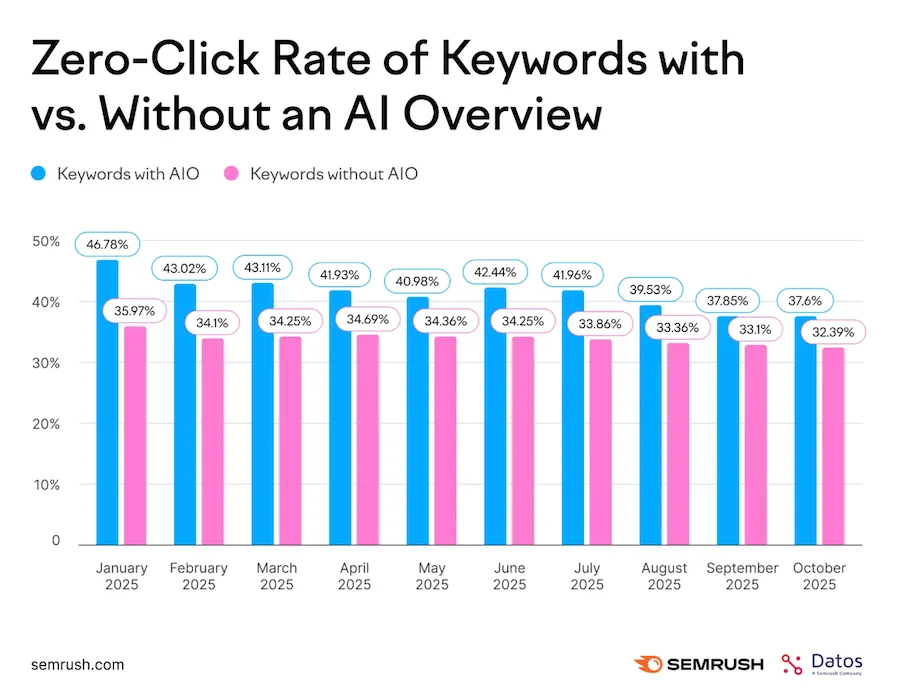
What that means in simple terms is this: More people are forming their understanding before they ever visit your site.
If your site spreads core context across five different URLs, AI merges fragments. And when fragments are merged, nuances are created.
The system pulls the definition from one source, pricing averages from another, eligibility conditions from a third, and general best practices from a fourth. It reconciles them into a safe, consensus-driven explanation.
Consensus tends to flatten differentiation. That flattening is subtle. But for smaller businesses, it’s expensive.
How this impacts businesses
The real issue is not simply that intent collapses. It is what that collapse does to how you compete.
In a traditional search environment, competition happened page by page. If you ranked for “dental implant cost,” you shaped how pricing was understood. If you ranked for “HVAC repair vs replacement,” you influenced how that tradeoff was framed. Each query represented a moment you could control.
AI changes that structure entirely.
When multiple intents are merged into one synthesized answer, you are no longer competing for an individual keyword. You are competing to have your positioning survive inside a compressed summary that blends input from several sources.
And compression rarely preserves nuance.
When AI combines definition, pricing, eligibility, and comparison into a single explanation, it gravitates toward what appears broadly consistent across sites. It does not prioritize edge cases, narrow specialization, or detailed boundaries unless those elements are clearly integrated into the core narrative.
This is where competitive consequences begin to surface.
If your expertise lives in secondary pages, blog posts, or scattered FAQs, it often does not survive synthesis. The model leans toward the middle of the market, not toward the margins where differentiation typically lives.
A practice that focuses on advanced surgical implant cases becomes summarized as a general dental implant provider. An HVAC company that specializes in high-efficiency systems for older homes becomes framed as a standard replacement provider.
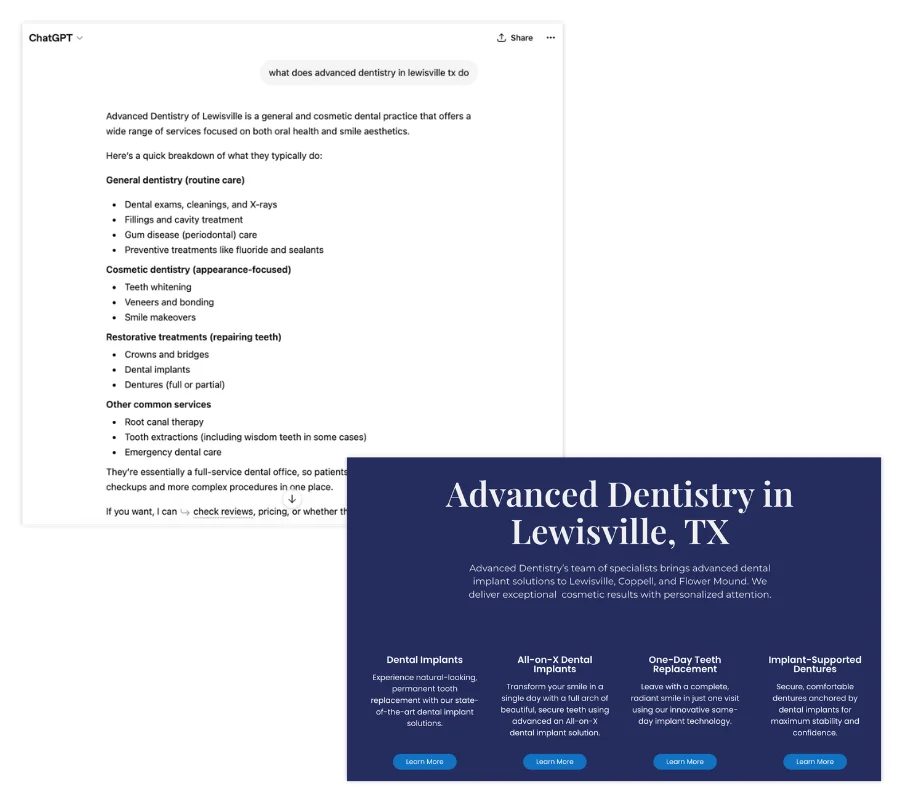
The services ChatGPT lists for this dentist are a little different than the services listed on the website.
Over time, this subtle flattening shifts how buyers perceive you before they ever engage.
Instead of competing on specialization, you compete on category averages. Instead of standing out on positioning, you blend into consensus language.
That is the deeper cost of intent collapse. It is not primarily about rankings or traffic. It is about the erosion of differentiation inside the explanation layer that forms upstream.
And once that differentiation erodes, the impact shows up in slower sales cycles, greater price sensitivity, and conversations that begin with generic assumptions rather than informed interest.
That is the competitive consequence most businesses underestimate.
✍️ Need help crafting the perfect AI prompts? We’ve got you covered >> 200+ Best AI Prompts Any Business Can Use
How to adjust your strategy
Rethinking page structure is not about adding more content. It’s about changing what a single page is responsible for.
In the past, it made sense to separate definition, pricing, eligibility, comparison, and objections into different URLs. Each page targeted a specific query, and the buyer stitched everything together over time.
That stitching no longer happens the same way.
When AI collapses multiple intents into one answer, it expects your content to hold together as one coherent explanation. If your core service logic is scattered across several thin or loosely connected pages, the model will assemble that logic for you. And when it does, it may rely on outside sources to fill the gaps.
That is why your most important service pages need to operate more like comprehensive decision hubs than isolated keyword targets.
A high-value service page should clearly explain what the service is, who it is for, what affects pricing, what the timeline looks like, what tradeoffs exist, and what alternatives a buyer should consider. It should also surface the objections that consistently appear in real conversations, not hide them in a separate FAQ or blog post.

This service page has a lot of information about emissions testing for prospective customers to read through.
This does not mean writing long, bloated pages. It means accepting that buyers and AI systems now encounter your offering as a complete story, not as a sequence of disconnected answers.
If pricing variability causes confusion in sales calls, that explanation belongs directly in the main narrative. If repair versus replacement is always a decision point, that logic should live inside the core service page. If qualification rules determine fit, they should be explicit and visible.
When the full context lives together, the explanation that gets synthesized is more likely to reflect your real positioning. When context is fragmented, AI reconstructs the story using external averages and generalized advice.
And once your story is reconstructed externally, you are no longer fully shaping how your business is understood.
Your website is no longer the starting point of explanation
In many cases, buyers no longer begin their understanding on your website.
They start by asking AI a broad question and receive a consolidated answer that blends definition, pricing context, comparisons, and tradeoffs. That summary becomes their baseline. By the time they click through to your site, they are not learning from scratch. They are checking whether you match what they already believe.
Stephanie Yoder, Director of Content at Rebrandly, has seen this shift clearly.
“Technical searches, factual queries, and how-to content are migrating rapidly to AI platforms, while commercial searches still largely happen on traditional search engines,” Stephanie said.
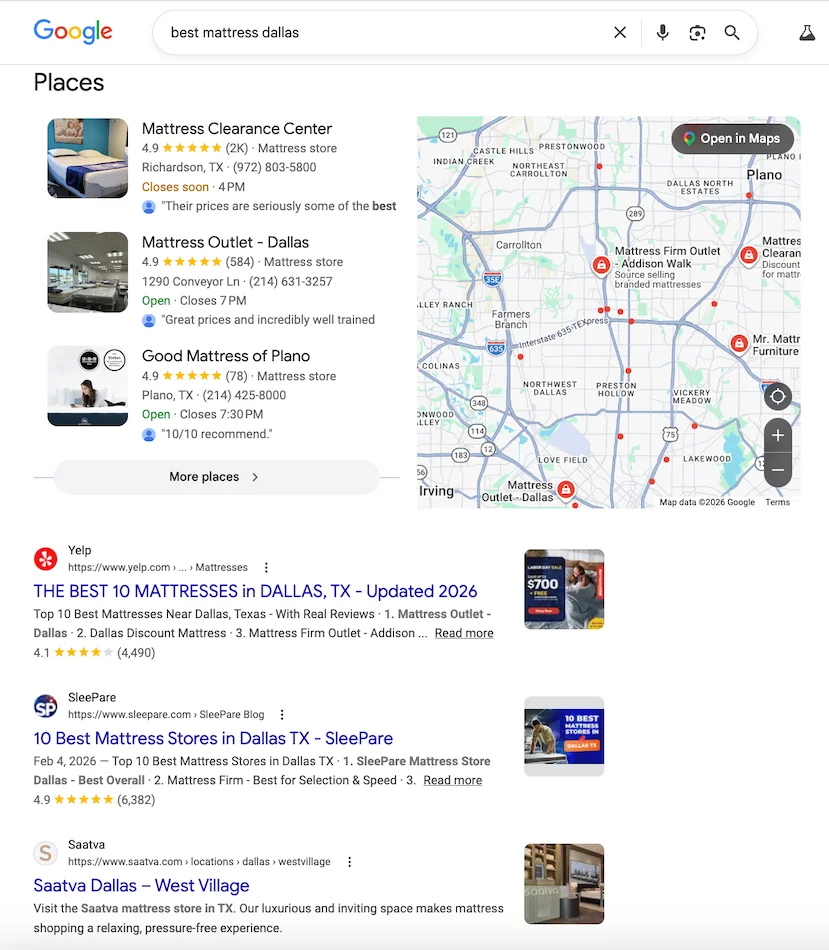
This search with purchase intent doesn’t include an AI Overview.
She also notes how compressed research has become. “People who used to spend 15–20 minutes reading multiple articles now get a synthesized answer from AI in under five minutes,” she said.
That compression shifts the order of influence. Your site now operates as validation, not introduction.
When that happens, your messaging is evaluated against an existing frame. If it aligns, conversations move forward. If it conflicts, you spend time correcting assumptions you didn’t create.
The starting point moved. Your content strategy has to account for that.
Why this is the case
Maeva’s team has seen this pattern play out.
“What we noticed first was that traffic dropped but leads didn’t. That was the signal. AI was filtering out the researchers and delivering the buyers. That told us the formula had changed—not broken—changed,” she said.
That distinction is important.
How this impacts businesses
AI absorbs much of the early-stage exploration. It compresses comparison. It filters out some of the casual researchers who once clicked through multiple informational pages.
As a result, fewer visitors may reach your site. But the ones who do are often further along in their decision process.
If you look only at session counts, it may feel like decline. If you look at lead quality, objection patterns, and sales conversations, you see something different.
The funnel hasn’t disappeared. It has just shifted upward.
And once the first layer of understanding happens before the click, your content strategy can no longer assume it controls the opening frame of the conversation.
Now, the buyer’s understanding is being shaped upstream by a synthesized answer that may not reflect your specialization, boundaries, or positioning.
When your website contradicts that pre-assembled explanation, trust wobbles. When it confirms it clearly, trust accelerates.
This shift is subtle because it does not always show up as traffic loss. It shows up as narrative misalignment, and narrative misalignment affects revenue long before it affects rankings.
👀 Looking for more ways to drive people to your site? Free guide >> 25 Ways to Increase Traffic to Your Website
How to adjust your strategy
At this point, the strategic objective changes. The goal is no longer persuasion first. The goal is confirmation.
If a buyer arrives with a summary already in their head, your page needs to quickly answer: “Is what I read accurate here?”
That means:
- Restating the service clearly at the top.
- Defining scope immediately.
- Making exclusions explicit.
- Aligning pricing language with realistic ranges.
- Addressing common edge cases in structured FAQs.
The first 150–200 words of your core service page now carry disproportionate weight.
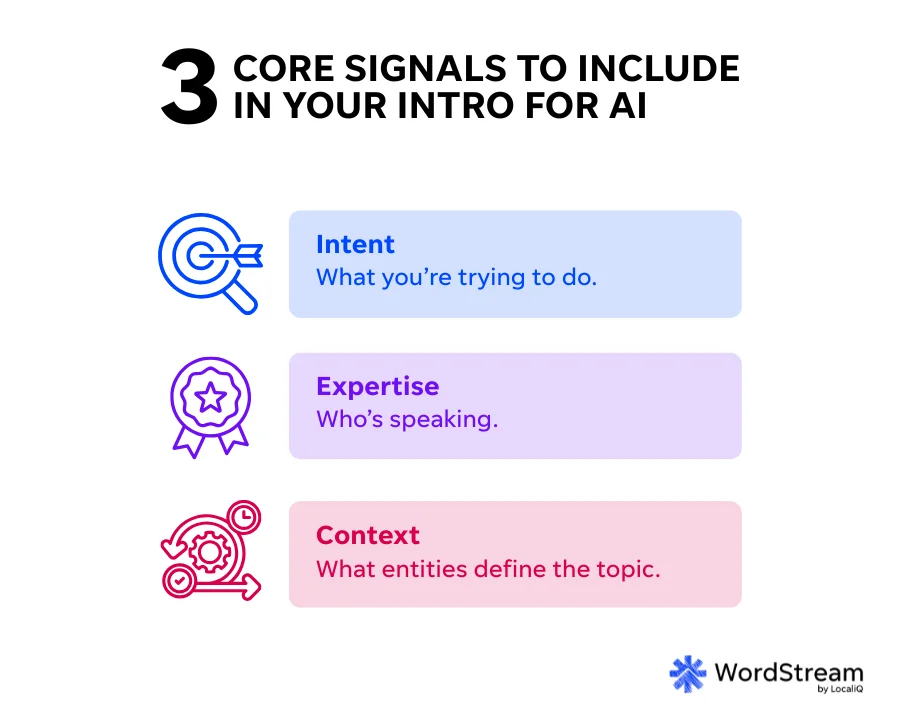
If those paragraphs are vague, aspirational, or overly promotional, the system—and the buyer—will default to external framing.
Clarity reduces friction, friction reduction improves alignment, and alignment improves close rates.
How the three problems compound
Each of these shifts on its own is manageable. You can adjust thought leadership structure, rethink page segmentation, and refine your service pages.
But when all three shifts happen at the same time, the effect compounds.
When opinion-heavy content gets skipped in summaries, when intent is fragmented across multiple URLs, and when AI forms the first explanation before the click, something subtle but serious happens: you lose control over how your business is described upstream.
And that’s a problem. Accuracy is everything. Consider:
- If you are a dental practice that specializes in complex surgical cases but AI frames you as a general implant provider, you attract the wrong inquiries.
- If you are an HVAC company focused on high-efficiency systems for older homes, but AI summarizes you using broad national averages, you inherit price objections that do not reflect your positioning.
- If you are a B2B SaaS platform built for mid-market companies, but AI describes you generically as a “small business tool,” your demo requests become misaligned from the start.
How to address these content problems for better AI results
The solution is to rethink what your core pages are responsible for. You need revenue-driving pages that are structurally built for synthesis.
That means pages that explain clearly before offering perspective. Pages that combine related intent instead of isolating it. Pages that define boundaries as explicitly as they define benefits. Pages that can survive being summarized without losing their nuance.
A useful starting point is to audit your most important service pages and ask hard questions.
- Is the service defined plainly in the first section, or does the explanation assume prior knowledge?
- Are fit criteria clearly stated, including who is not a good fit?
- Are exclusions visible, or are they buried?
- Are cost drivers explained in context, rather than isolated on a thin pricing page?
- Are common objections addressed within the main narrative, or pushed to separate content?
Then ask one more uncomfortable question: If an AI system extracted only the first portion of this page and summarized it, would that summary accurately reflect how we want to be positioned?
If the answer is no, the structure needs to change.
AI-proof your content strategy
AI did not eliminate content. It reassigned its responsibility.
In this environment, clarity outperforms cleverness. Explanation must come before differentiation. Accuracy matters more than originality in the first layer of understanding.
Content for small businesses no longer exists only to attract clicks. It exists to shape the explanation that forms before the click ever happens.
If your pages control that explanation layer, traffic becomes less fragile and sales conversations become more aligned. If they don’t, you will spend more time correcting upstream assumptions than moving deals forward.
In a zero-click environment, the business that shapes the explanation shapes the pipeline.
