

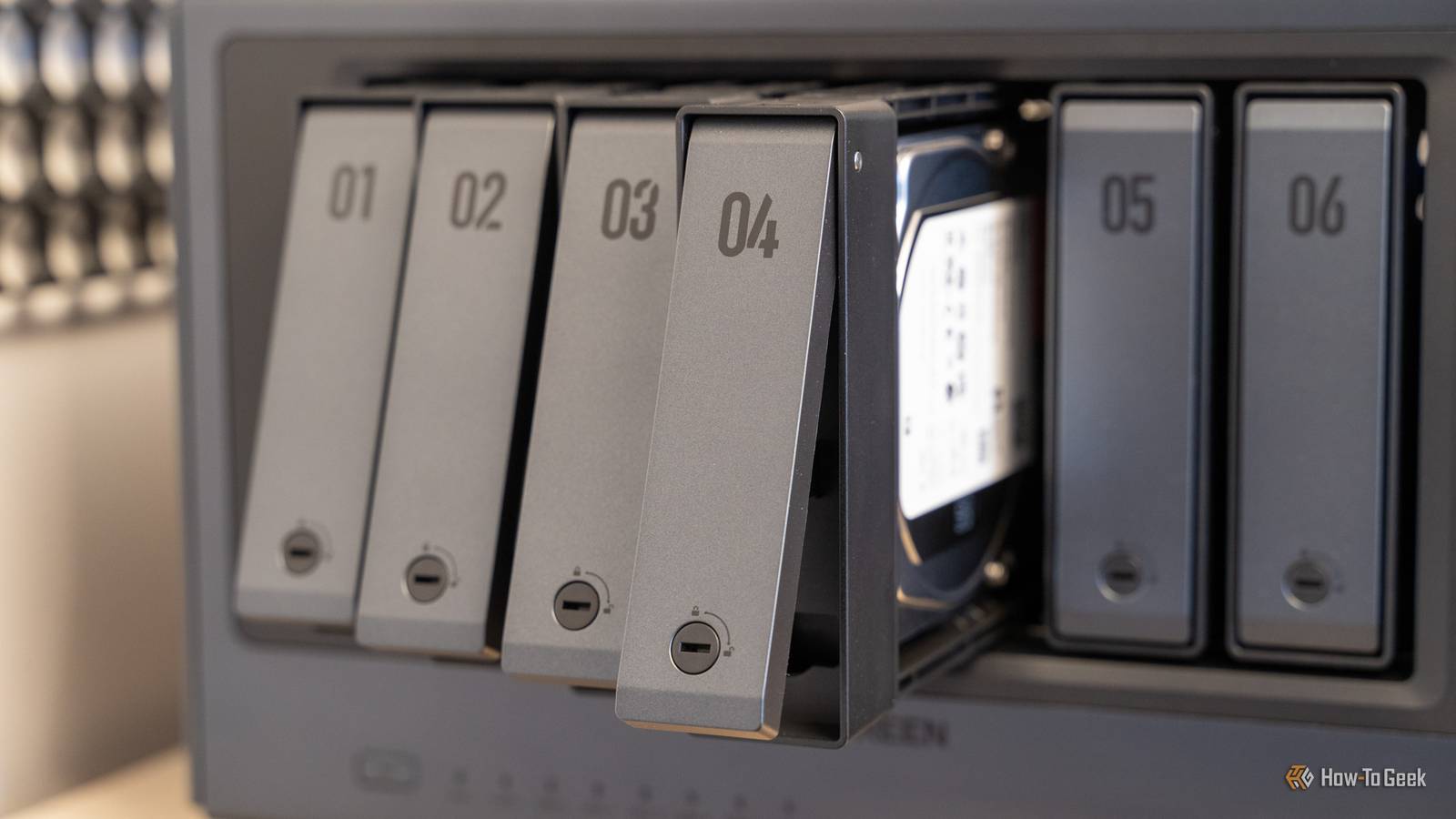
Your NAS is, a lot of the time, the kind of device that you normally keep out of sight as you only hook up to it over a network. Whatever you do, though, don’t think the perfect “out of sight” place is a closet. Let me explain.
Why thermals are a problem
Heat buildup is killing your hardware
NAS devices are compact powerhouses, continuously juggling data transfers, backups, and media streaming. But as you might imagine, all this constant electronic activity generates a substantial amount of heat. The primary culprits are the mechanical hard disk drives spinning endlessly inside the chassis, closely followed by the internal processor managing complex tasks like video transcoding or background indexing. When you take this heat-generating machine and shut it inside a cramped, unventilated closet, you are essentially placing it in an insulated oven. The ambient air temperature within that small, enclosed space rises rapidly because the heat has absolutely nowhere to escape.
As the temperature climbs, your NAS inevitably hits a critical thermal threshold. To prevent catastrophic hardware failure and literal melting, the system initiates thermal throttling. The processor deliberately slows its clock speed, and the drives reduce their operational pace. For you, this means painfully sluggish file transfers, interrupted backups, and constant buffering when trying to stream your favorite movies.

Quiz
Network attached storage (NAS)
From basement file servers to enterprise data vaults — test how much you really know about NAS technology.
HistoryHardwareUse CasesProtocolsSecurity
Which company is widely credited with introducing one of the first commercially successful NAS appliances in the early 1990s?
Correct! Auspex Systems released the NS3000 in 1989, widely regarded as one of the earliest dedicated NAS appliances. They pioneered the concept of a standalone file server accessible over a network, laying the groundwork for the modern NAS industry.
Not quite. The answer is Auspex Systems, which launched one of the first dedicated NAS appliances — the NS3000 — back in 1989. While companies like Synology and QNAP are household names today, Auspex was breaking new ground decades before them.
Which network file sharing protocol is primarily used by NAS devices to serve files to Windows-based clients?
Correct! SMB (Server Message Block) is the dominant protocol for file sharing with Windows clients. Originally developed by IBM and later popularized by Microsoft, SMB is what allows Windows machines to seamlessly browse and access NAS shares as if they were local drives.
Not quite. The answer is SMB (Server Message Block). NFS is the protocol of choice for Linux and Unix clients, iSCSI is used for block-level storage, and FTP is a general file transfer protocol not optimized for seamless file system integration.
What does the RAID level ‘5’ specifically require as a minimum number of drives to function?
Correct! RAID 5 requires a minimum of three drives. It stripes data and parity information across all drives, meaning it can tolerate the failure of one drive without any data loss — making it a popular choice for NAS users who want a balance of performance, capacity, and redundancy.
Not quite. RAID 5 requires a minimum of three drives. The parity data distributed across all drives allows one drive to fail without losing data. RAID 1 only needs two drives, while RAID 6 requires four — so options vary depending on your redundancy needs.
What is ‘media server’ functionality on a NAS most commonly used for in a home environment?
Correct! Media server functionality — often powered by software like Plex, Emby, or Jellyfin running on the NAS — allows you to stream your locally stored media collection to TVs, phones, tablets, and more. It essentially turns your NAS into a personal Netflix for your own content library.
Not quite. The core use of a NAS media server is streaming locally stored movies, music, and photos to other devices on your network. Software like Plex or Jellyfin handles the heavy lifting, including transcoding video on the fly for devices that need it.
What is the ‘3-2-1 backup rule’ that NAS users are often advised to follow?
Correct! The 3-2-1 rule means: keep 3 total copies of your data, store them on 2 different types of media (e.g., NAS and external drive), and keep 1 copy in an offsite or cloud location. This strategy protects against hardware failure, theft, fire, and other disasters that could wipe out local backups.
Not quite. The 3-2-1 rule stands for: 3 copies of your data, stored on 2 different media types, with 1 copy kept offsite. It’s a best-practice framework designed to ensure your data survives almost any disaster scenario, from a failed hard drive to a house fire.
Which protocol allows a NAS to present storage to a computer as if it were a locally attached block device, rather than a file share?
Correct! iSCSI (Internet Small Computer Systems Interface) transmits SCSI commands over IP networks, allowing a NAS to present raw block storage to a host computer. The computer then formats and manages that storage like a local disk — making iSCSI ideal for virtual machines and databases that need low-level disk access.
Not quite. The answer is iSCSI. Unlike SMB or NFS, which share files over a network, iSCSI exposes raw block storage — the host computer sees a NAS volume as though it were a physically attached hard drive, which is critical for workloads like virtual machine datastores.
Which of the following best describes a ‘surveillance station’ use case for a NAS?
Correct! Many NAS brands — including Synology and QNAP — offer dedicated surveillance station software that turns the NAS into a Network Video Recorder (NVR). It can connect to multiple IP cameras, record footage continuously or on motion detection, and store months of video locally without a subscription fee.
Not quite. A surveillance station on a NAS refers to software that connects to IP security cameras, records video footage, and stores it locally. This makes a NAS a powerful and cost-effective alternative to cloud-based security systems, since you own and control all your recorded footage.
Synology, one of the most recognized NAS brands today, was founded in which year and country?
Correct! Synology was founded in Taiwan in 2000 and has grown into one of the most beloved NAS manufacturers in the world. Their DiskStation Manager (DSM) operating system is frequently praised for its polished interface and rich feature set, making Synology a top choice for both home users and businesses.
Not quite. Synology was founded in Taiwan in 2000. Taiwan has become a major hub for NAS hardware development, with competitors like QNAP also headquartered there. Synology’s DiskStation Manager software helped set the standard for what a user-friendly NAS experience could look like.
Your Score
/ 8
Thanks for playing!
The problem extends far beyond immediate performance drops. Prolonged exposure to high heat is the silent killer of consumer electronics. Mechanical hard drives are particularly sensitive to thermal stress, operating best within a very specific temperature window. When a NAS is forced to recycle its own hot exhaust air in a closed closet, the internal components bake. This sustained thermal strain degrades the delicate read and write heads inside the drives, dries out the lubricating oils in the spinning platters, and drastically accelerates the overall hardware wear and tear. Ultimately, hiding your system away to save a little space or reduce noise almost guarantees premature drive failure, putting your critical data at severe risk.

- Type
-
Network-attached storage
- Dimensions
-
10.14″D x 7.01″W x 7.01″H
UGREEN’s NASync DXP4800 Plus offers exceptional power for the price. It features four drive bays, a pair of M.2 NVMe slots, 10GbE and 2.5GbE Ethernet jacks, an SD card reader, and upgradable DDR5 RAM.
What you can do instead
Just relocate it

The most effective fix for a thermally choked storage system is simply changing its environment. Pulling your NAS out of the closet and placing it in a well-ventilated, open room instantly resolves the majority of overheating issues. Ideal locations include a sturdy shelf in your home office, a dedicated utility rack in an open basement, or even an entertainment center, provided the back is completely open to the air. The golden rule of placement is ensuring the device has at least a few inches of unobstructed clearance on all sides. This breathing room allows the intake vents to pull in fresh, cool ambient air while giving the rear exhaust fans plenty of space to expel the trapped heat without obstruction.
If the noise of clicking hard drives absolutely forces you to keep the unit hidden away, you might need to find a new location, or actively fix the airflow in your current hiding spot. You cannot rely on passive seepage through the cracks of a door. Instead, you need to install active ventilation. This typically involves cutting into the closet door to mount a louvered intake grille near the floor, where the air is coolest, and installing an exhaust fan near the ceiling to actively push the rising hot air out into the surrounding hallway.
Even in a well-ventilated room, dust also acts as a highly effective, unwanted insulator. Over time, dust coats the internal heat sinks and clogs the fan blades, severely diminishing the system’s cooling capacity. Regularly powering down the unit and clearing out the dust with compressed air ensures that, whatever environment you choose, your system can breathe freely and maintain its peak performance speeds.
Passively cooled NAS devices don’t work, either
It’s still a mistake

If you’re hiding your NAS because it’s noisy, passively cooled NAS devices eliminate the acoustic dilemmas entirely by rethinking how a storage server is built. Unlike traditional enclosures that rely on whirring fans to push air across cramped components, these specialized units are engineered to dissipate heat naturally. They achieve this by utilizing their entire exterior chassis—typically crafted from thick, extruded aluminum—as a massive, silent heat sink. The metal absorbs the thermal energy from the internal chips, mostly high-speed NVMe solid-state drives, and seamlessly radiates it out into the surrounding environment.
Because they lack mechanical fans and spinning platters, passively cooled systems operate in absolute silence. This acoustic invisibility removes the primary incentive for hiding the NAS in a closet in the first place. Do not, however, think that this makes it safe to put it inside a closet. In fact, passively cooled electronics are even more dependent on their surrounding environment than fan-cooled units.
A passive heat sink works strictly by transferring heat to the cooler ambient air immediately surrounding the device. If you place a fanless NAS inside a closed closet, the device will simply heat up the small volume of trapped air. Because there are no internal fans to force that hot air away or push it out of the closet, a thermal equilibrium is quickly reached where the surrounding air becomes just as hot as the chassis itself. Once this happens, the heat dissipation process completely stops. The internal components will rapidly overheat, leading to severe thermal throttling or sudden shutdowns.
While a silent NAS perfectly solves the noise problem, it must absolutely remain out in the open, relying on the natural airflow of a standard room to keep your data moving safely.
Keep storage breathing for optimal speed and longevity
Locking your NAS in a stuffy closet compromises both its immediate performance and long-term lifespan. If you prioritize proper room airflow and modify your closet’s ventilation — or upgrade to a silent and fan-less flash system — you go a long way towards ensuring your data remains accessible, fast, and completely secure.

- Dimensions
-
8.74″D x 7.05″W x 6.06″H
- CPU
-
Intel x86 Quad-Core CPU
Powerful 4-bay NAS with fast 5GbE speeds, 16GB DDR5, and up to 144TB storage for advanced setups
