
Close Menu
    Facebook X (Twitter) Instagram
    Wifi PortalWifi Portal
    • Blogging
    • SEO & Digital Marketing
    • WiFi / Internet & Networking
    • Cybersecurity
    • Tech Tools & Mobile / Apps
    • Privacy & Online Earning
    Facebook X (Twitter) Instagram
    Wifi PortalWifi Portal
    Home»Cybersecurity»Microsoft adds Windows protections for malicious Remote Desktop files
    Cybersecurity

    Microsoft adds Windows protections for malicious Remote Desktop files

    adminBy adminApril 15, 2026No Comments3 Mins Read
    Facebook Twitter LinkedIn Telegram Pinterest Tumblr Reddit WhatsApp Email
    Windows
    Share
    Facebook Twitter LinkedIn Pinterest Email

    Windows

    Microsoft has introduced new Windows protections to defend against phishing attacks that abuse Remote Desktop connection (.rdp) files, adding warnings and disabling risky shared resources by default.

    RDP files are commonly used in enterprise environments to connect to remote systems because admins can preconfigure them to automatically redirect local resources to the remote host.

    Threat actors have increasingly abused this functionality in phishing campaigns. The Russian state-sponsored APT29 hacking group has previously used rogue RDP files to remotely steal data and credentials from victims.

    Wiz

    When opened, these files can connect to attacker-controlled systems and redirect local drives to the connected device, allowing the attacker-controlled device to steal files and credentials stored on disk.

    They can also capture clipboard data, such as passwords or sensitive text, or redirect authentication mechanisms like smart cards or Windows Hello to impersonate users

    New RDP protections roll out

    As part of the April 2026 cumulative updates for Windows 10 (KB5082200) and Windows 11 (KB5083769 and KB5082052), Microsoft has now released new protections to prevent malicious RDP connection files from being used on devices.

    “Malicious actors misuse this capability by sending RDP files through phishing emails,” warns Microsoft.

    “When a victim opens the file, their device silently connects to a server controlled by the attacker and shares local resources, giving the attacker access to files, credentials, and more.”

    After installing this update, when users open an RDP file for the first time, a one-time educational prompt is shown that explains what RDP files are and warns about their risks. Windows users will then be prompted to acknowledge that they understand the risks and press OK, which will prevent the alert from being shown again.
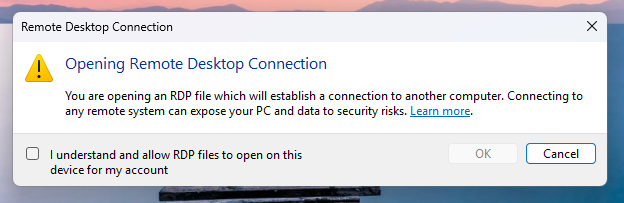
    Educational dialog warning about the risks of RDP files
    Educational dialog warning about the risks of RDP files
    Source: Microsoft

    Future attempts to open RDP files will now display a security dialog before any connection is made.

    This dialog shows whether the RDP file is signed by a verified publisher, the remote system’s address, and lists all local resource redirections, such as drives, clipboard, or devices, with every option disabled by default.

    If a file is not digitally signed, Windows displays a “Caution: Unknown remote connection” warning and labels the publisher as unknown, indicating there is no way to verify who created the file.
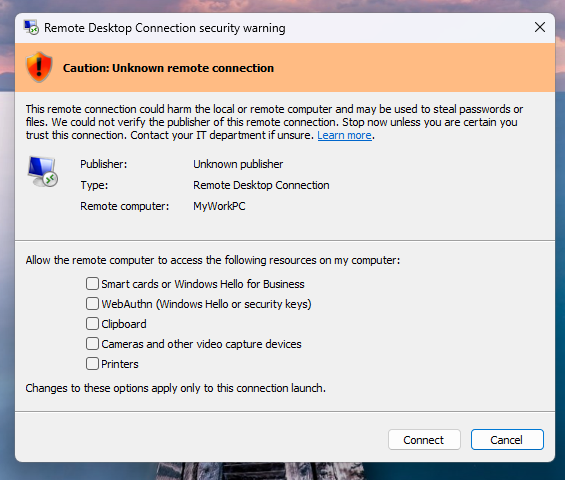
    Windows warning that an RDP file is from an unverified publisher
    Windows warning that an RDP file is from an unverified publisher
    Source: Microsoft

    If the RDP file is digitally signed, Windows will display the publisher, but still warn you to verify their legitimacy before connecting.

    It should be noted that these new protections apply only to connections initiated by opening RDP files, not to those made through the Windows Remote Desktop client.

    Microsoft says that Administrators can temporarily disable these protections by going to the HKLM\Software\Policies\Microsoft\Windows NT\Terminal Services\Client Registry key and modifying the RedirectionWarningDialogVersion value so it is set to 1.

    However, as RDP files have historically been abused in attacks, it is strongly recommended to keep these protections enabled.


    tines

    Automated pentesting proves the path exists. BAS proves whether your controls stop it. Most teams run one without the other.

    This whitepaper maps six validation surfaces, shows where coverage ends, and provides practitioners with three diagnostic questions for any tool evaluation.

    adds desktop Files Malicious Microsoft Protections Remote Windows
    Share. Facebook Twitter Pinterest LinkedIn Tumblr Telegram Email
    Previous ArticleStuck on a sketchy site? Google is finally putting a stop to it
    Next Article 12 quantum training courses from ISC2, IBM, AWS and more
    admin
    • Website

    Related Posts

    Broadcom introduces zero-trust runtime for scalable AI agents

    April 15, 2026

    FCC exempts Netgear from foreign router ban

    April 15, 2026

    Signed software abused to deploy antivirus-killing scripts

    April 15, 2026
    Add A Comment
    Leave A Reply Cancel Reply

    Search Blog
    About
    About

    At WifiPortal.tech, we share simple, easy-to-follow guides on cybersecurity, online privacy, and digital opportunities. Our goal is to help everyday users browse safely, protect personal data, and explore smart ways to earn online. Whether you’re new to the digital world or looking to strengthen your online knowledge, our content is here to keep you informed and secure.

    Trending Blogs

    Broadcom introduces zero-trust runtime for scalable AI agents

    April 15, 2026

    Large solar farms in the UAE may accidentally create rainstorms that could reshape how deserts manage water shortages

    April 15, 2026

    FCC exempts Netgear from foreign router ban

    April 15, 2026

    Google Is Replacing Dynamic Search Ads With AI Max

    April 15, 2026
    Categories
    • Blogging (63)
    • Cybersecurity (1,332)
    • Privacy & Online Earning (168)
    • SEO & Digital Marketing (816)
    • Tech Tools & Mobile / Apps (1,593)
    • WiFi / Internet & Networking (224)

    Subscribe to Updates

    Stay updated with the latest tips on cybersecurity, online privacy, and digital opportunities straight to your inbox.

    WifiPortal.tech is a blogging platform focused on cybersecurity, online privacy, and digital opportunities. We share easy-to-follow guides, tips, and resources to help you stay safe online and explore new ways of working in the digital world.

    Our Picks

    Broadcom introduces zero-trust runtime for scalable AI agents

    April 15, 2026

    Large solar farms in the UAE may accidentally create rainstorms that could reshape how deserts manage water shortages

    April 15, 2026

    FCC exempts Netgear from foreign router ban

    April 15, 2026
    Most Popular
    • Broadcom introduces zero-trust runtime for scalable AI agents
    • Large solar farms in the UAE may accidentally create rainstorms that could reshape how deserts manage water shortages
    • FCC exempts Netgear from foreign router ban
    • Google Is Replacing Dynamic Search Ads With AI Max
    • I tried this Gemini feature and haven’t opened Canva, PowerPoint, or Notion since
    • Signed software abused to deploy antivirus-killing scripts
    • EFF Calls on Kuwait to Release Journalist Ahmed Shihab-Eldin
    • How to Show Up in ChatGPT Results and Get Noticed by Customers
    © 2026 WifiPortal.tech. Designed by WifiPortal.tech.
    • Home
    • About Us
    • Contact Us
    • Privacy Policy
    • Terms and Conditions
    • Disclaimer

    Type above and press Enter to search. Press Esc to cancel.