

Privacy laws are tightening, browser extensions are blocking data, and ad platforms are demanding cleaner data. As a result, how you track user behavior online is changing fast.
Server-side tagging can help you reduce data loss while collecting cleaner, privacy-compliant data.
Here’s what server-side tagging is, when it makes sense to implement it, and our experience with providers like Elevar and Littledata.
What is server-side tagging?
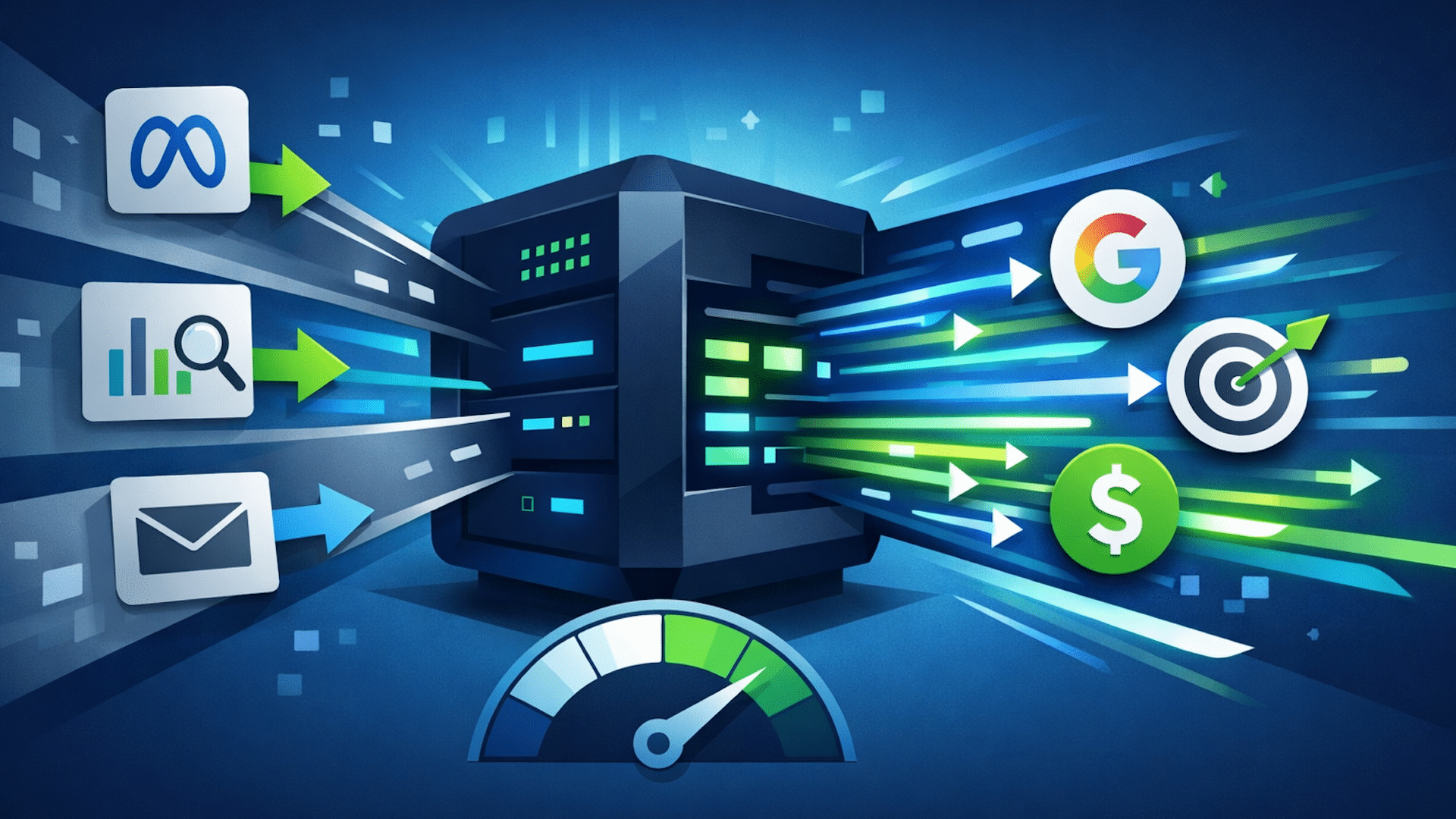
Traditionally, tracking scripts like Meta Pixel or Google Analytics run in the browser. This is client-side (browser-side) tagging. With server-side tagging, those scripts run on a server you control instead of the visitor’s browser.
Instead of the browser sending data directly to multiple third parties, it sends events to a first-party server endpoint (often a Google Tag Manager server-side container). The server processes, enriches, and forwards the data to tools like Meta and Google Analytics — on infrastructure you host (such as Google Cloud Run) or through managed providers like Elevar or Stape.
This allows for:
- More control over your data.
- Cleaner page performance.
- Better alignment with privacy laws.
Beyond these benefits, server-side tagging gives you more flexibility in how you enrich and transform data before it reaches ad platforms.
You can standardize event names, filter out low-quality events, and add custom parameters to improve audience segmentation. This creates a more reliable, unified data foundation across tools like Meta, Google Ads, and Klaviyo, leading to stronger optimization signals and more confident decisions.
Your customers search everywhere. Make sure your brand shows up.
The SEO toolkit you know, plus the AI visibility data you need.
Start Free Trial
Get started with

Is server-side tagging right for you?
Server-side tagging isn’t a one-size-fits-all solution, but for many brands it’s becoming essential. It may be the right choice for you if:
You need to meet strict privacy or compliance requirements
Server-side setups don’t automatically anonymize data, but they give you more control over how it’s processed and shared.
This makes it easier to support compliance with regulations like GDPR, CCPA, and platform consent requirements.
You can apply consent logic, filter or hash sensitive fields, and control which events and parameters you send to each platform based on user permissions.
You want faster website performance
Client-side tracking can slow page load times.
Server-side tagging helps your site run faster by shifting data processing off the browser and onto the server, boosting user experience and SEO.
Faster pages can improve conversion rates and reduce bounce rates, especially on mobile, where every millisecond counts.
You want more accurate tracking (despite ad blockers)
Ad blockers can disrupt client-side scripts, but server-side tagging bypasses many of these limits.
It helps platforms like Meta and Google Ads collect more reliable data for attribution and optimization.
It doesn’t eliminate blocking or consent requirements or recover all lost data, but it can improve signal reliability compared to browser-only setups.
You’re investing heavily in paid media
If you’re spending heavily on Meta, Google, or other paid channels, better data accuracy can directly impact your return on ad spend.
Server-side tagging helps ensure conversion events are delivered consistently, allowing algorithms to learn faster and optimize toward higher-value users.
Get the newsletter search marketers rely on.
How to implement server-side tagging
You have two main options: build it yourself or use a service provider.
Option 1: Internal setup
Building your own setup gives you full control but requires technical expertise and ongoing maintenance. You’ll also need clear documentation and QA processes to keep events accurate as your site evolves and new features launch.
Your setup might look like:
- Set up a GTM server-side container
- Host on a platform like Google Cloud Run or Stape
- Migrate key tags (GA4, Meta CAPI, etc.)
- Add logic for PII hashing, cookie consent, and filtering
- Monitor server costs, performance, and data integrity
Option 2: Use a server-side tagging service
Platforms like Elevar, Littledata, and Triple Whale simplify this by offering turnkey solutions that integrate with tools like Shopify, Klaviyo, Meta, and Google Ads. They handle infrastructure, updates, and many edge cases, so you can focus on strategy instead of engineering.
Our direct experience: Littledata vs. Elevar
We’ve implemented Littledata and Elevar across multiple Shopify environments. Each serves a different type of brand, and understanding the difference is key.
Littledata: For simpler technology stacks and budget-conscious brands
We first implemented Littledata for a Shopify brand focused on improving visibility into Klaviyo and strengthening owned marketing channels. In that context, it performed well, passing additional Klaviyo events and improving email-driven reporting.
Littledata is a strong fit for:
- Early-stage or emerging Shopify brands
- Teams with moderate paid media budgets
- Teams prioritizing email/SMS over aggressive paid scaling
- Brands with relatively simple tech stacks
- Businesses that want better tracking without enterprise-level cost
Littledata’s affordability makes it accessible if you want better attribution without highly customized, platform-specific data engineering.
In more performance-intensive environments — especially where paid media relies on precise in-platform reporting — we’ve seen limitations with fully aligned Meta conversion data and consistent GA4 session and revenue reporting. At scale, even small discrepancies can affect bidding strategies.
Littledata’s support is relatively lean, so resolving nuanced discrepancies may require additional internal validation. If you have in-house technical resources or less aggressive optimization needs, this may not be a major concern.
Elevar: When brands outgrow entry-level solutions
As you scale paid media spend and demand more precise attribution in Meta and Google Ads, the margin for tracking error shrinks.
You’ll likely reach a point where you:
- Spend heavily on paid acquisition.
- Optimize toward blended ROAS across channels.
- Make bid decisions based on in-platform conversion data.
At that point, you need more advanced infrastructure, deeper data enrichment, and specialized troubleshooting support. When your needs shift, so should your solution.
This is where a solution like Elevar comes in.
Set yourself up for success with server-side tagging
Server-side tagging is a technical and strategic upgrade. It:
- Supports privacy compliance.
- Speeds up your site.
- Improves performance by making your data more accurate and reliable.
- Future-proofs your measurement stack as browsers limit third-party cookies and platforms prioritize first-party data.
As privacy restrictions grow and ad platforms evolve, this setup only becomes more valuable. If you invest early, you’re better positioned to maintain strong attribution, build richer audiences, and make smarter media buying decisions.
The goal isn’t just to recover lost data. It’s to build a more resilient measurement framework that adapts as platforms and regulations change.
Server-side tagging gives you ownership over your data pipeline and reduces reliance on fragile browser-based signals. When implemented well, it becomes a long-term advantage, enabling clearer insights, stronger attribution, and more confident optimization across every channel you invest in.
Contributing authors are invited to create content for Search Engine Land and are chosen for their expertise and contribution to the search community. Our contributors work under the oversight of the editorial staff and contributions are checked for quality and relevance to our readers. Search Engine Land is owned by Semrush. Contributor was not asked to make any direct or indirect mentions of Semrush. The opinions they express are their own.
