


Google used to rank individual pages that targeted the right keywords. Now it increasingly features sites that own the right topics.
Topical authority is what separates those two outcomes. It’s about becoming the site search engines trust most on a given subject. The more that trust is established, the better your rankings, your visibility in AI search results, and your ability to weather algorithm updates.
In this guide, you’ll learn what topical authority is, how Google measures it, and how to build it.
Topical authority is when search engines recognize your site as the expert source on a specific subject, not just for individual keywords, but for the full range of related queries within a topic.
It’s built by covering a subject comprehensively and connecting that content together so search engines can understand how it all relates. It’s also closely tied to E-E-A-T (Google’s framework for evaluating Expertise, Experience, Authoritativeness, and Trustworthiness) applied specifically to a topic rather than your site as a whole.
Strategies that focus on topical authority include:
Pro Tip
Topical authority is distinct from domain authority (or Domain Rating in Ahrefs), which measures your site’s backlink strength.
A site with a low DR can outrank a much stronger domain simply by covering a niche more completely.
For example, Bicycle Motor Works, a specialist e-bike retailer with a DR of 15, outranks Amazon (DR 96) for competitive e-bike keywords.
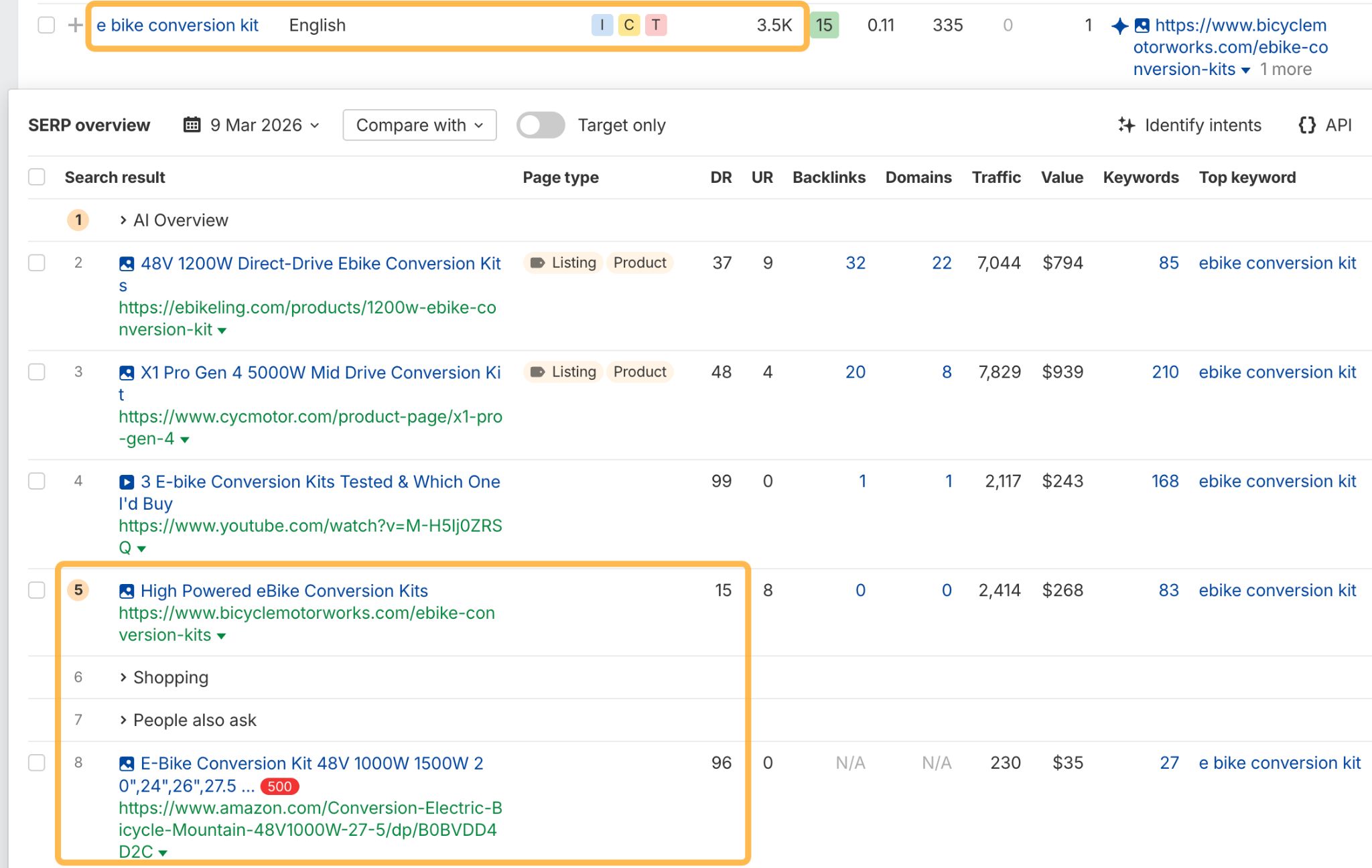
It also earns regular AI Overview appearances simply because it owns the topic better than larger brands with a diluted focus on e-bikes.
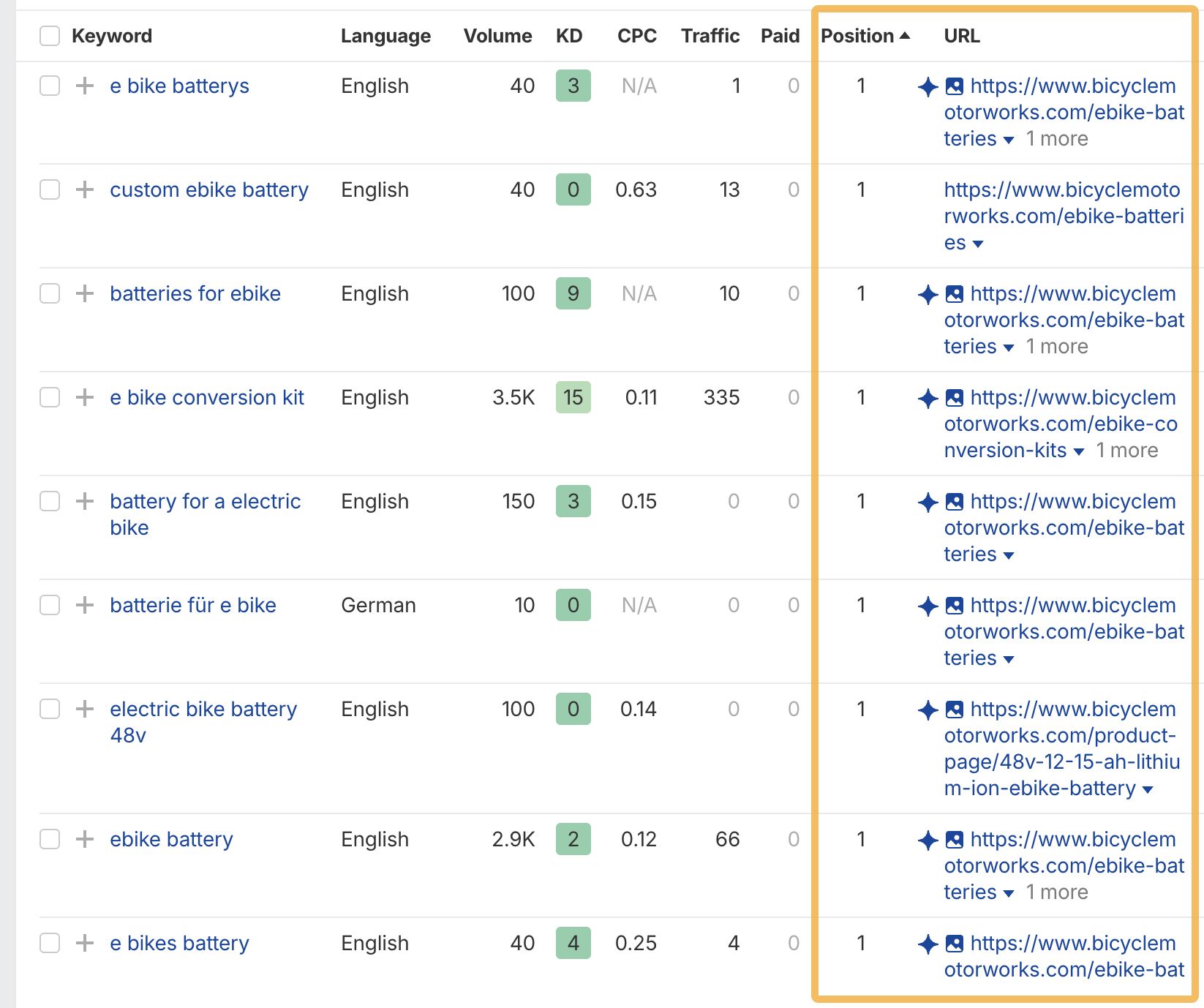
When Google and AI search platforms associate your site with a core topic, they become more willing to rank your pages for a much broader range of related queries, including ones you never explicitly optimized for.
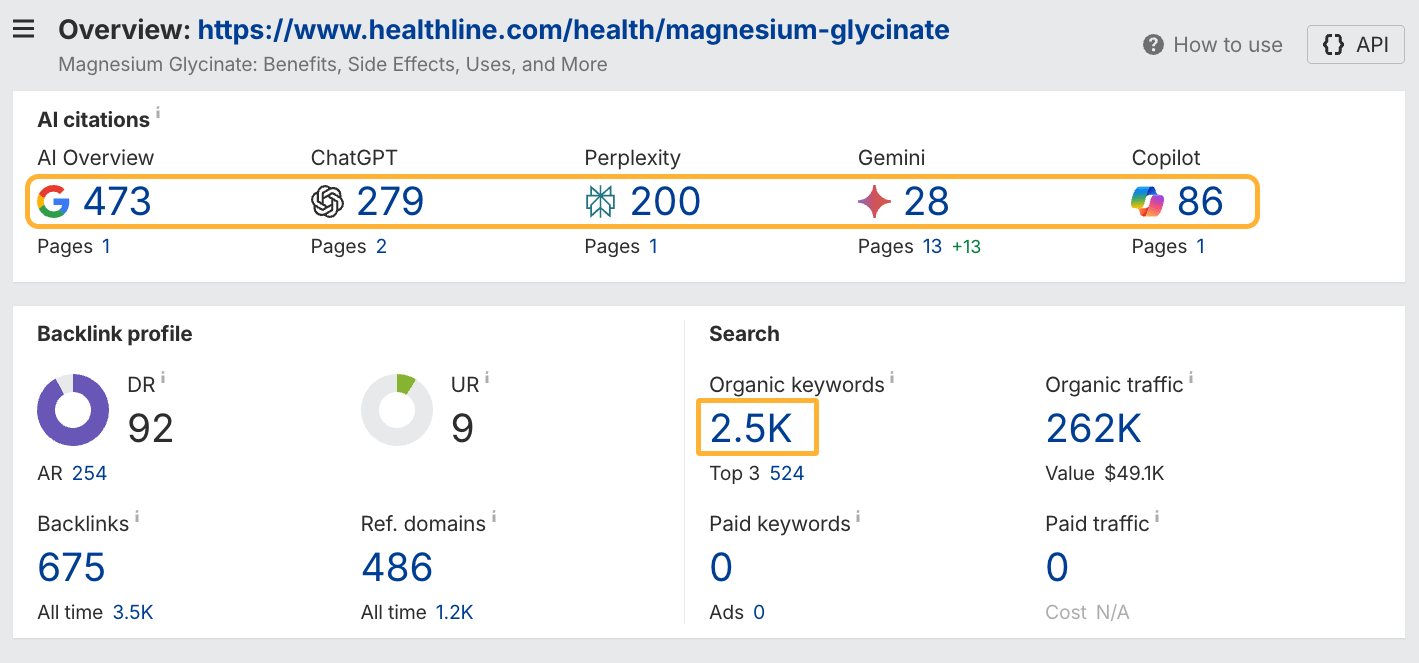
For example, Healthline is an authoritative health resource. Many of its articles rank for far more keywords than there are words in the content. Its page about magnesium glycinate alone shows up for:
- 2,500 keywords on Google
- 473 queries in AI Overviews
- 279 prompts on ChatGPT
- 200 prompts on Perplexity
- 28 prompts in Gemini
- 86 prompts in Copilot
Each piece of content you publish within a topic cluster benefits from the authority already built by the pages around it. That effect compounds over time.
The practical outcomes are significant:
- You rank for more keywords with less effort: Sites with strong topical authority naturally rank from a wider range of related searches, not just for the specific keywords they optimized for.
- You’re more resilient to algorithm updates: Google’s Helpful Content updates have consistently hit shallow, broad content strategies the hardest. Sites with genuine topical depth have been more likely to hold their positions.
- You can compete with much bigger sites: Topical authority is niche-specific. A small specialist site can outrank a much larger generalist on the topics it owns.
Building topical authority comes down to:
- Doing keyword research to find all the talking points within a topic
- Organizing that data into topic clusters
- Producing content that meets the search intent of those topic clusters
- Building relevant internal and external links to your content
- Keeping your content fresh and your clusters complete
- Tracking performance over time
Let’s go through each one.
1. Do topic-based keyword research
The starting point for building topical authority is keyword research.
To be recognized as a topical authority, you need to find and write about all the talking points within a topic, not just the head term, but also all the questions and angles that surround it.
Choose your seed keywords
A seed keyword is the broad term that represents the topic you want to own. The key is picking something specific enough to stay focused but broad enough to have meaningful subtopics beneath it.
| Topic | Good seed keywords | Bad seed keywords |
|---|---|---|
| Coffee roasting | coffee roasting, coffee roasters | coffee, roasting |
| Dog care | dog care, dog health | animals, dogs |
| Mountain biking | mountain bikes, mountain biking | bicycles, mountains |
Good seed keywords clearly represent the topic. Bad ones are either too broad (pulling in irrelevant results) or too narrow (missing the bigger picture).
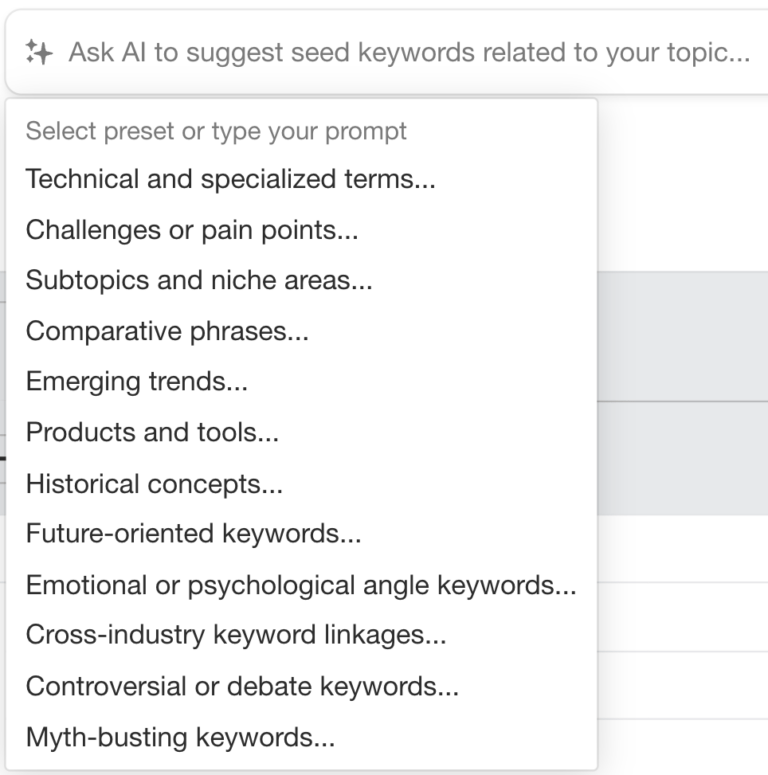
Struggling to think of useful seed terms? Try using Ahrefs’ AI keyword suggestion feature in Keywords Explorer to get a starting list of ideas.
Expand your keyword list to find sub-topics
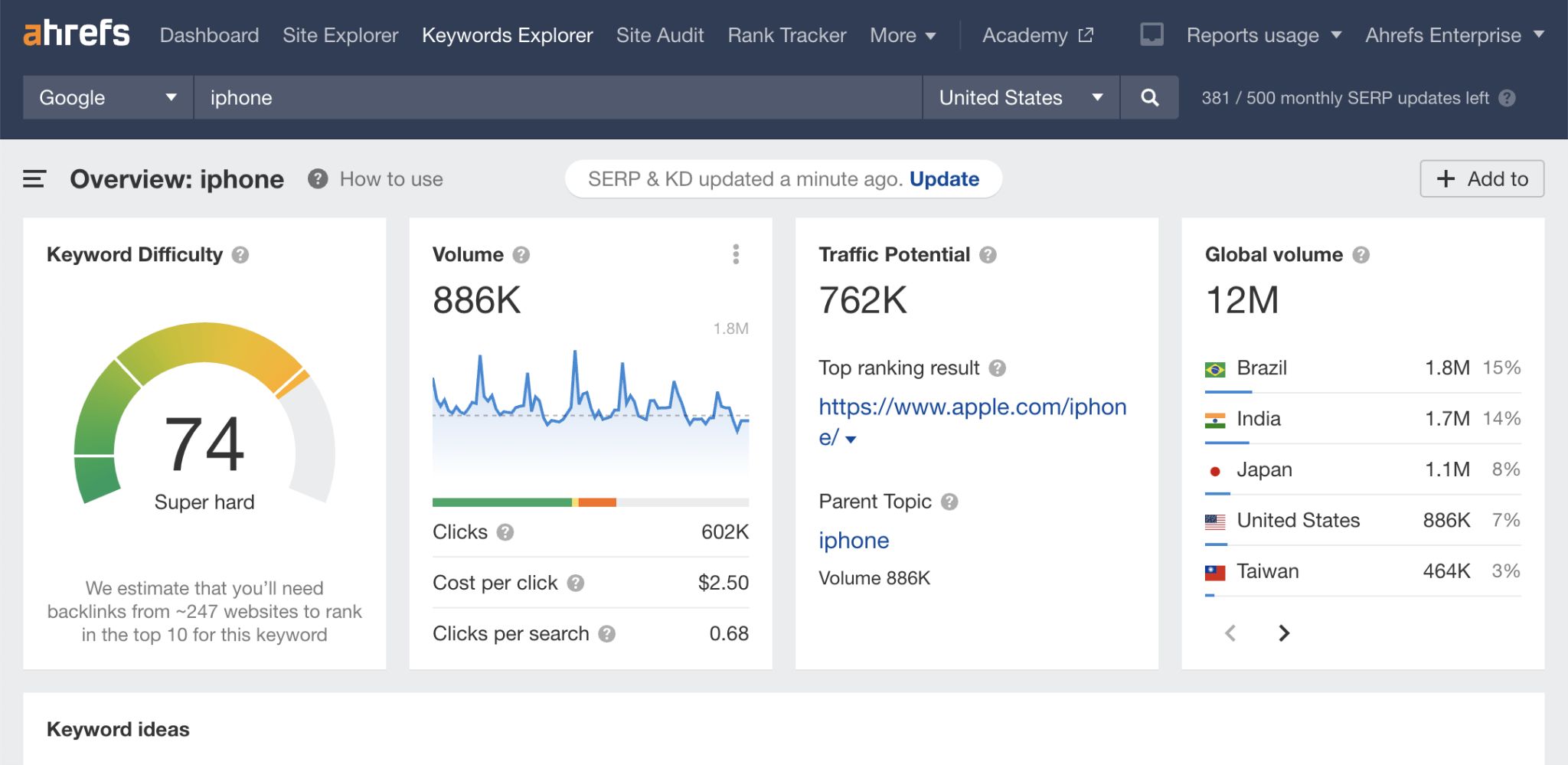
Once you have a seed keyword, check out the Overview report. It gives you an immediate snapshot of the topic, including its search volume, traffic potential, and the top-ranking pages.
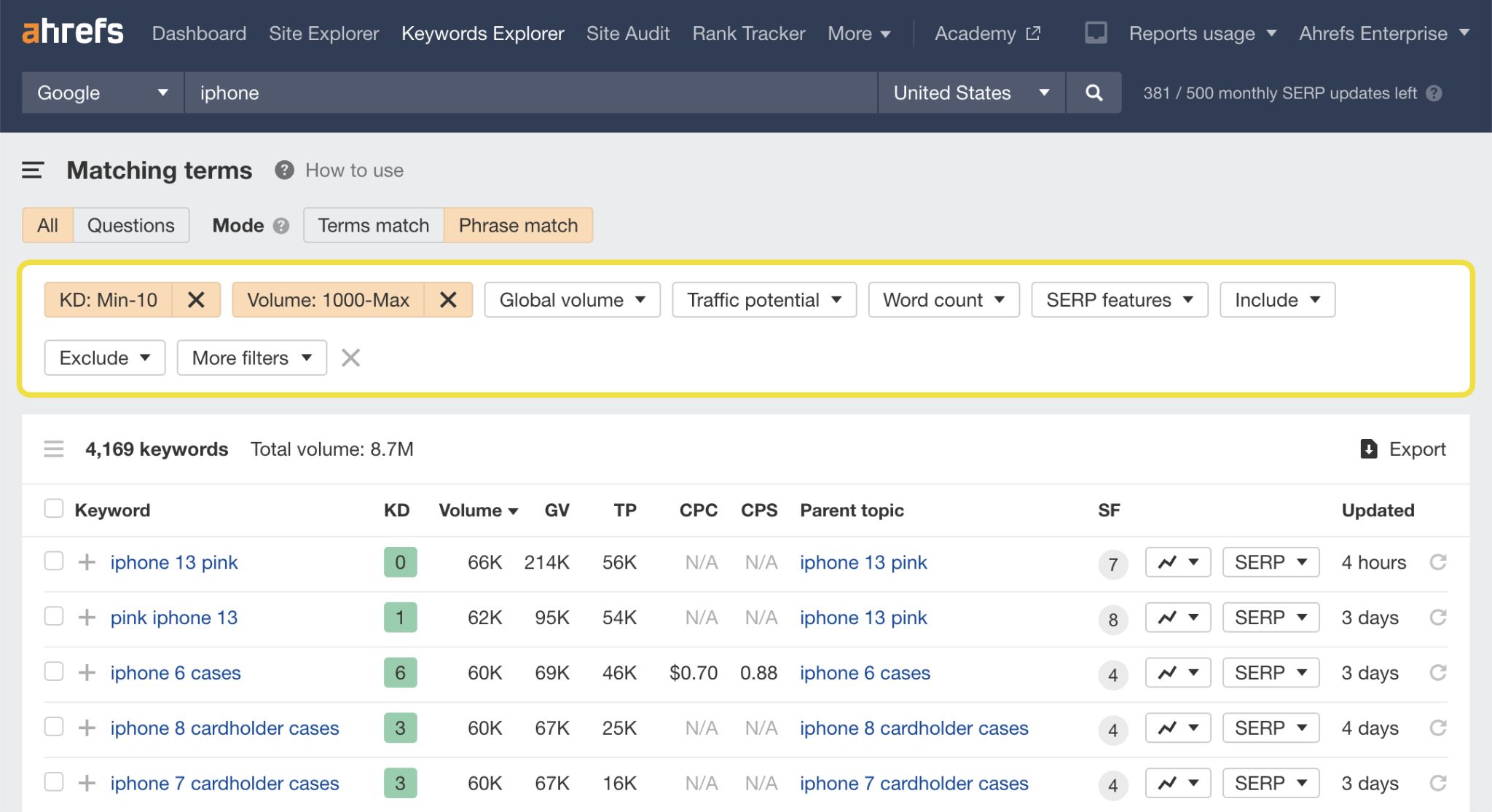
To expand your keyword list, check out the Matching Terms report. It will give you a larger list of keywords connected to your main topic and a place to start identifying sub-topics.
You can also apply filters to narrow down your keyword list and remove irrelevant topics:
Find competitive topic gaps
You can also look at competitor websites to find topic gaps to close within your content, too. The Traffic share by domains report shows which sites get the most organic traffic for your seed keyword.
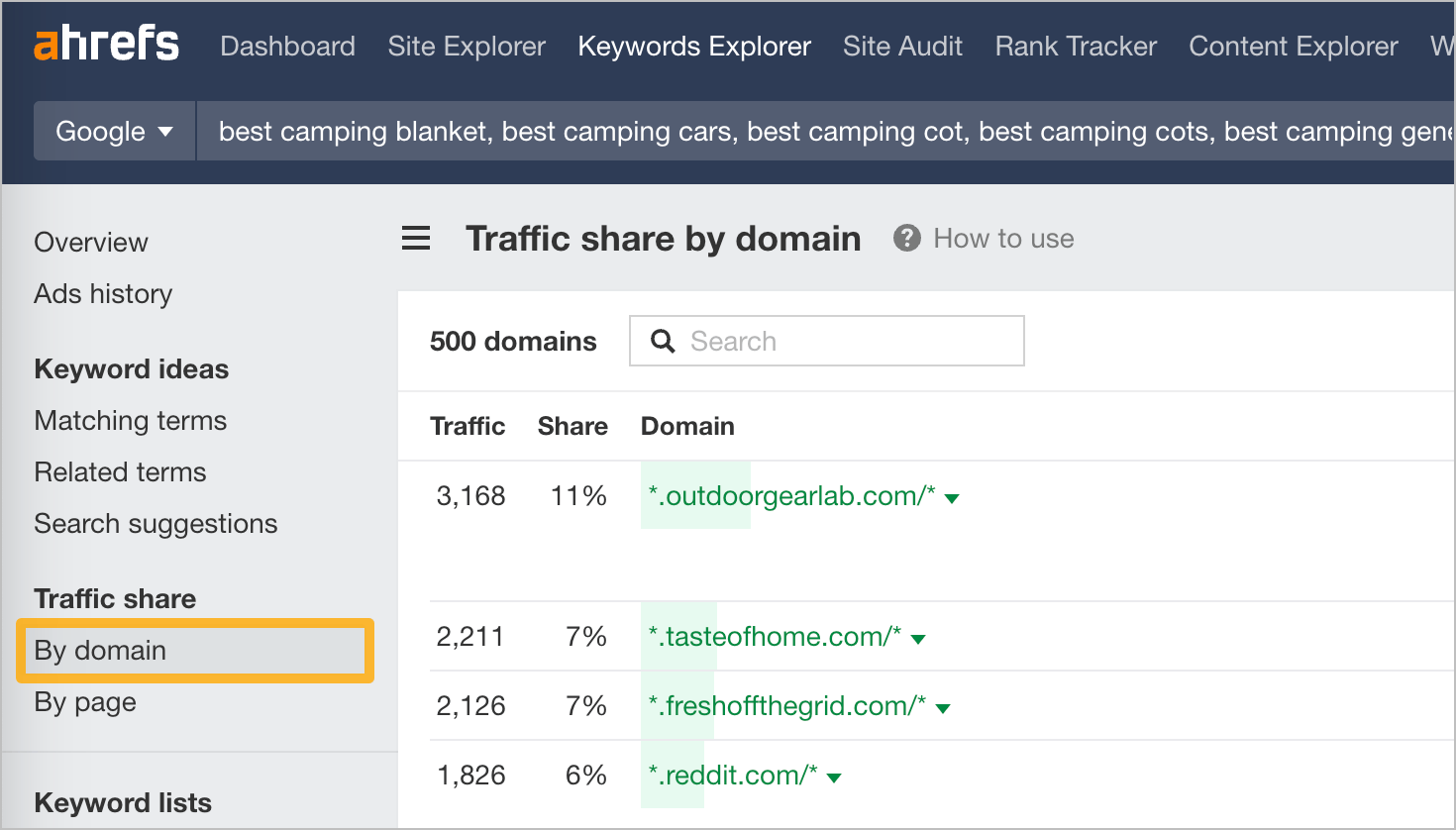
These are your topical competitors, and their content is a goldmine for finding keywords you’re missing. To uncover their keywords:
- Open the Competitive Analysis tool in Ahrefs and set it to “Keywords”
- Enter your domain in the first field, then add 1–3 competitors from the Traffic share report
- Click Show keyword opportunities to see all keywords they rank for that you don’t
- Refine by topic keyword and minimum volume to keep results focused
- Export — these are the subtopics worth adding to your content plan
You can also use our content gap analysis template to help you prioritize topics and close the biggest gaps.
Find topic opportunities in AI responses
Before finalizing your keyword list, it’s worth checking which topic angles your brand is already visible in across AI platforms, and where you’re missing.
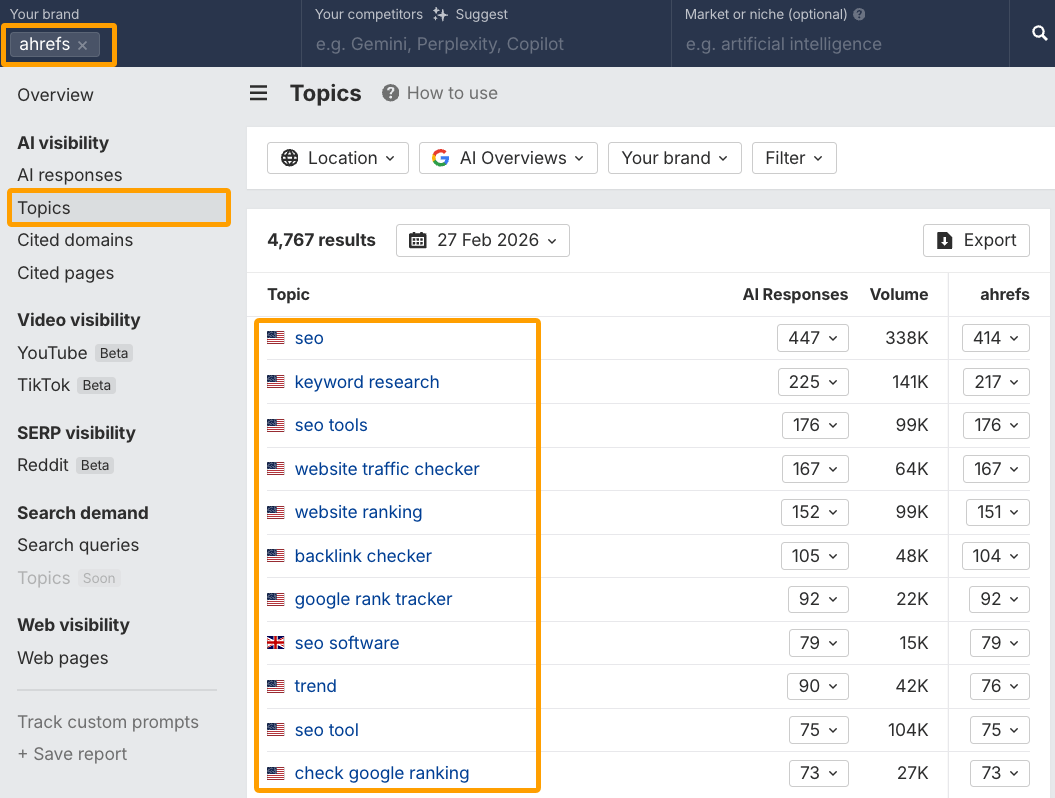
You can also compare this to your competitors to see if they are associated more or less with certain topics than you are.
Or you can search for your main topic (without your brand) and explore what sub-topics are included in it by AI systems:
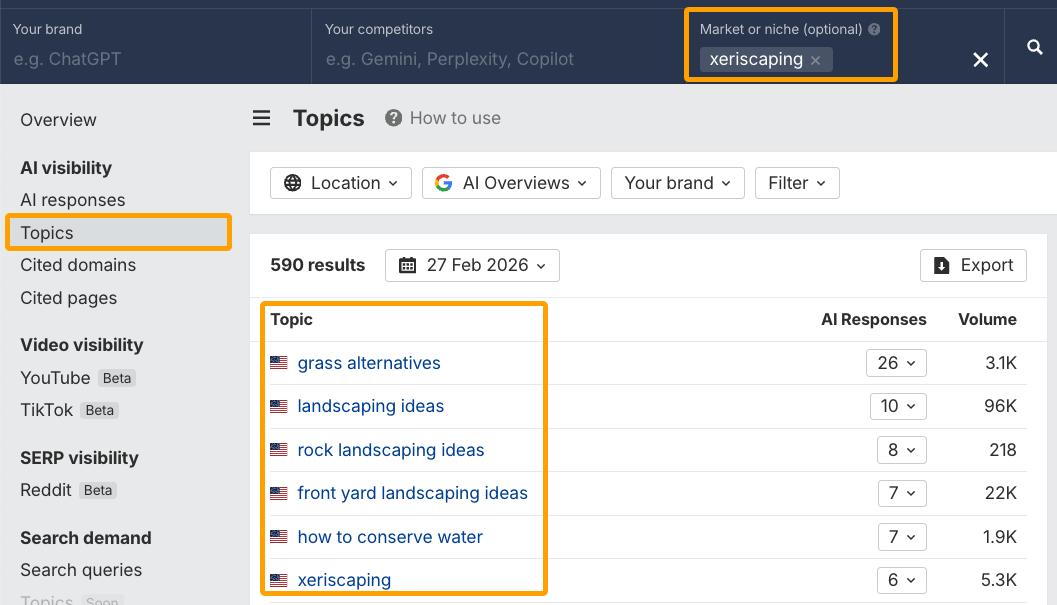
The goal is to find relevant topics where your brand can be recognized as an authoritative source.
2. Map out your topic clusters and pillar pages
A topic cluster is a group of interlinked pages that cover the same subject from different angles.
The purpose is to show Google that your site covers a topic comprehensively, not just with one page, but with a connected set of content that goes deep.
Armed with your keyword research, you’ll want to organize your list of terms into clusters based on search intent while also considering traffic potential.
Your topics should have good traffic potential, which you can assess in Keywords Explorer:
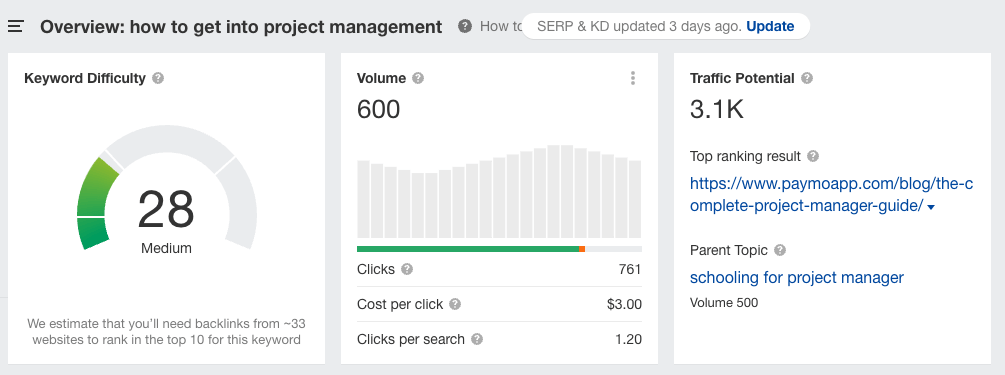
You can easily group your full keyword list from the previous step in Keywords Explorer, too. Gather all the keywords you found from competitor research, AI research, and keyword research into a list. You can add up to 10,000 keywords in one go.
Then, instantly cluster them with the Clusters by Parent Topic feature:
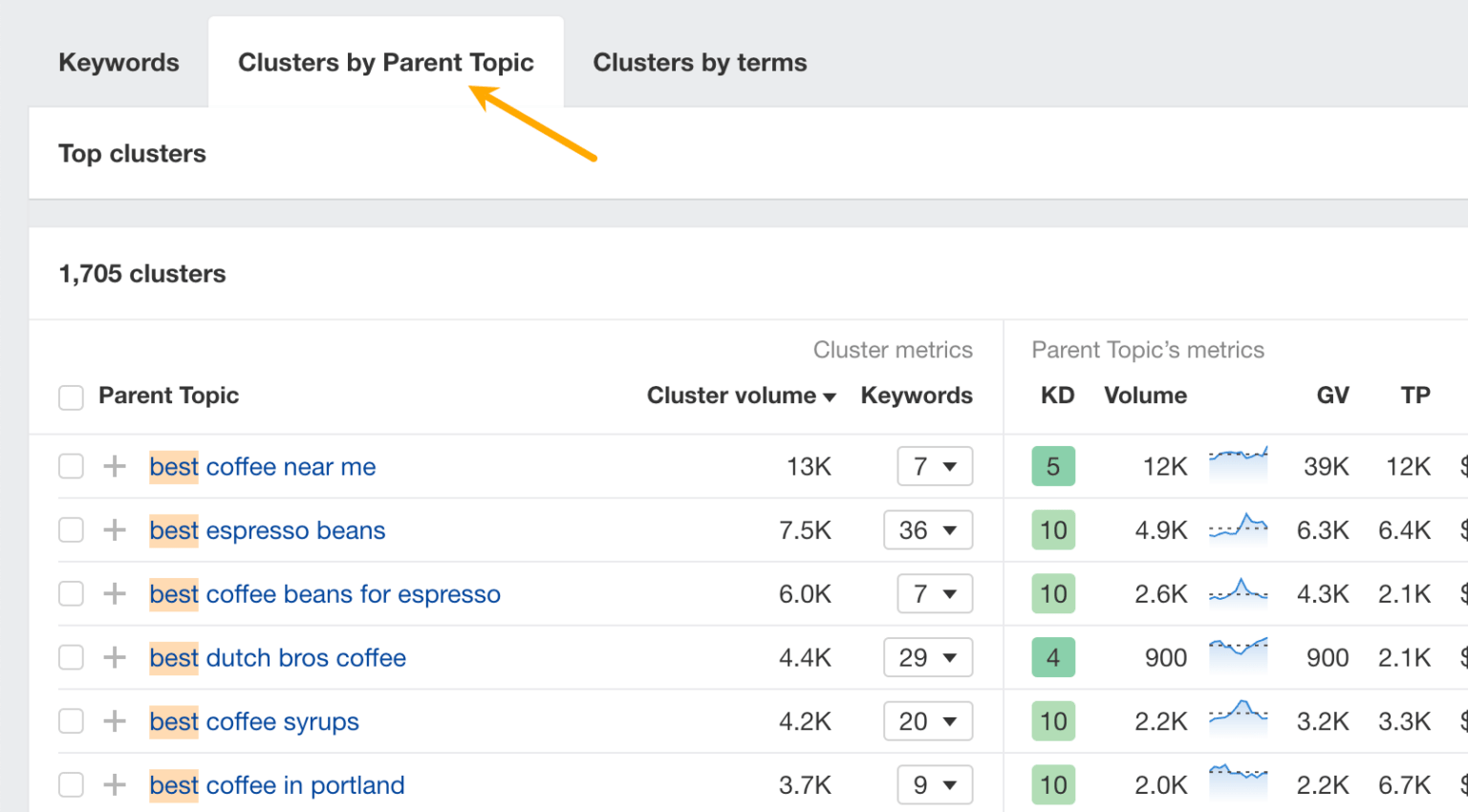
You can see the total search volume for all keywords in each cluster, along with metrics for the Parent Topic, such as keyword difficulty, search volume, and traffic potential.
To see the actual keywords in a cluster, just hit the caret.
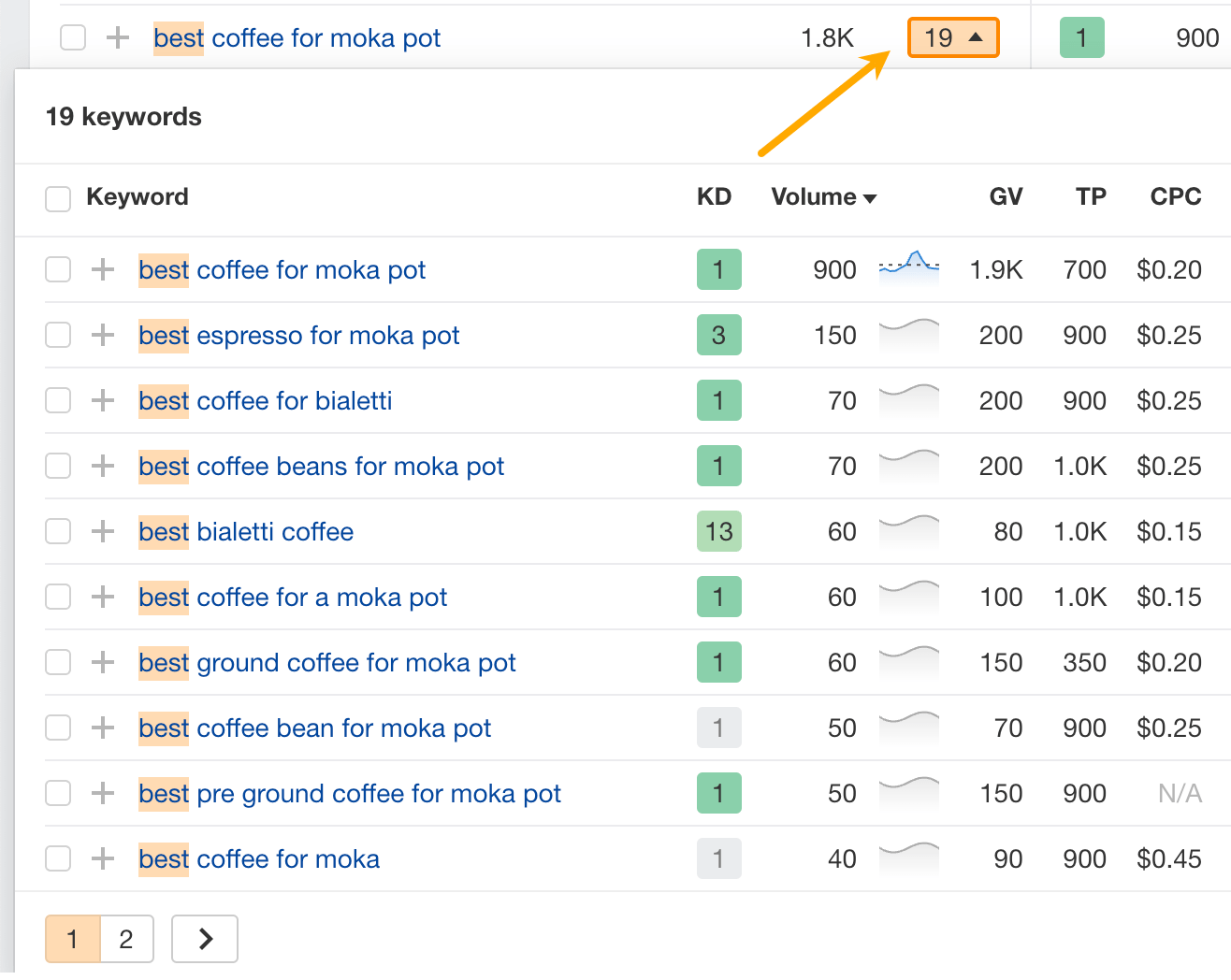
Next, identify each cluster’s pillar page. Pillar pages provide a broad overview of the main topic, linking to more specific cluster pages beneath it. Think of them as hubs, with each cluster page as a spoke.
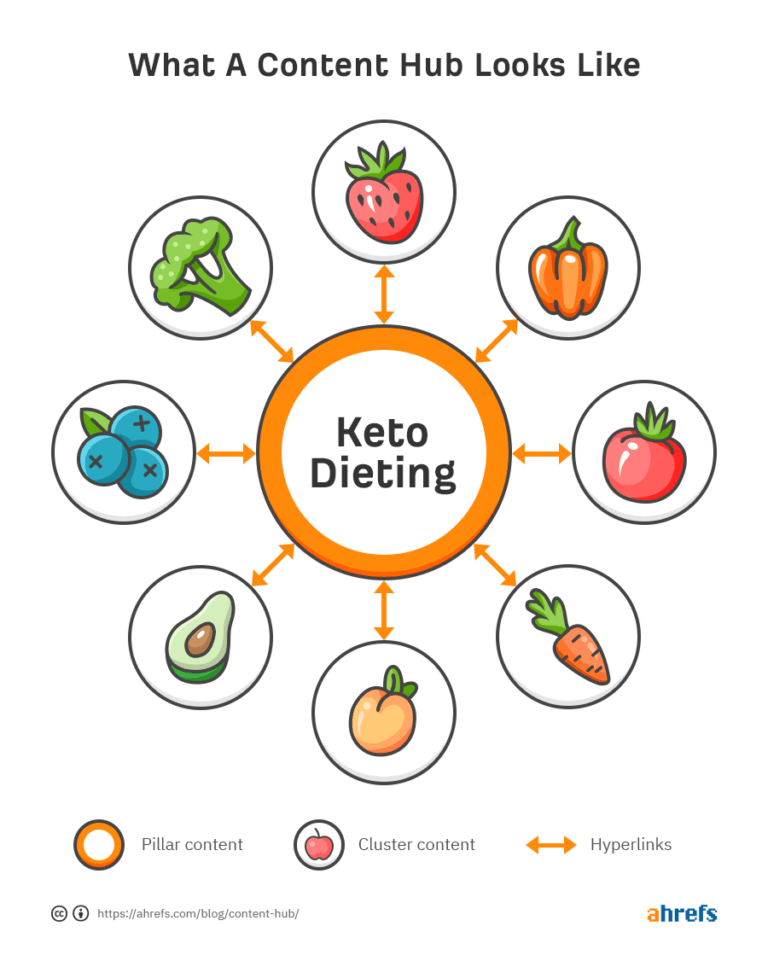
Your pillar page covers the topic at a high level. Your cluster pages go deeper into each subtopic, targeting the more specific questions your audience is searching for.
Pick the most appropriate format for each pillar page based on what’s already ranking for the topic. Common formats include:
- Guides — evergreen content that fully covers a specific topic
- What is X — a definition or answer to a common question
- How to X — a step-by-step tutorial
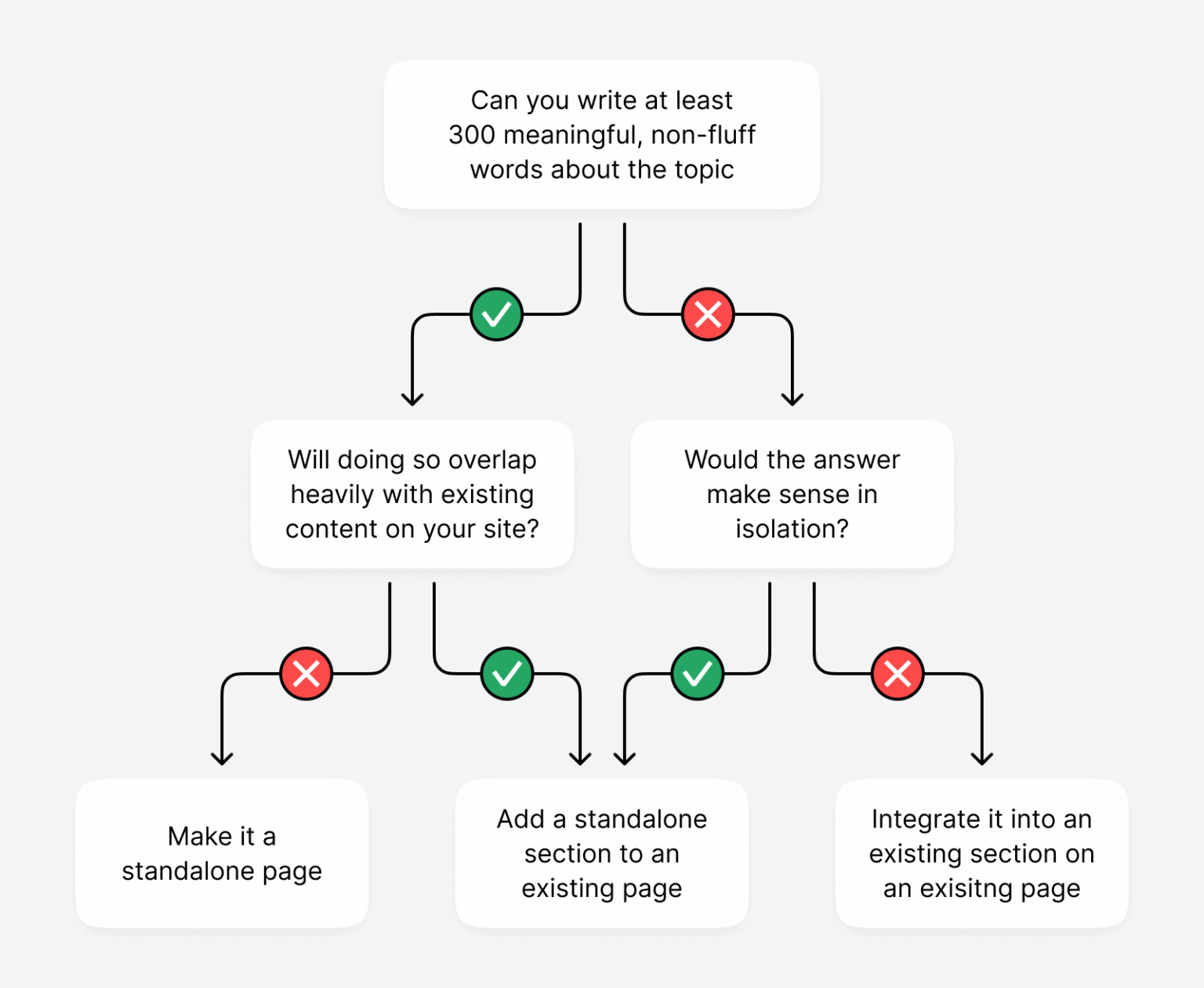
Not every subtopic needs its own page within the topic cluster. If two subtopics are closely related and neither has enough depth to stand alone, combine them into one piece rather than publishing thin content that weakens your overall cluster quality.
With your clusters identified and your pillar structure clear, the last step is to organize everything into a content map that your team can follow.
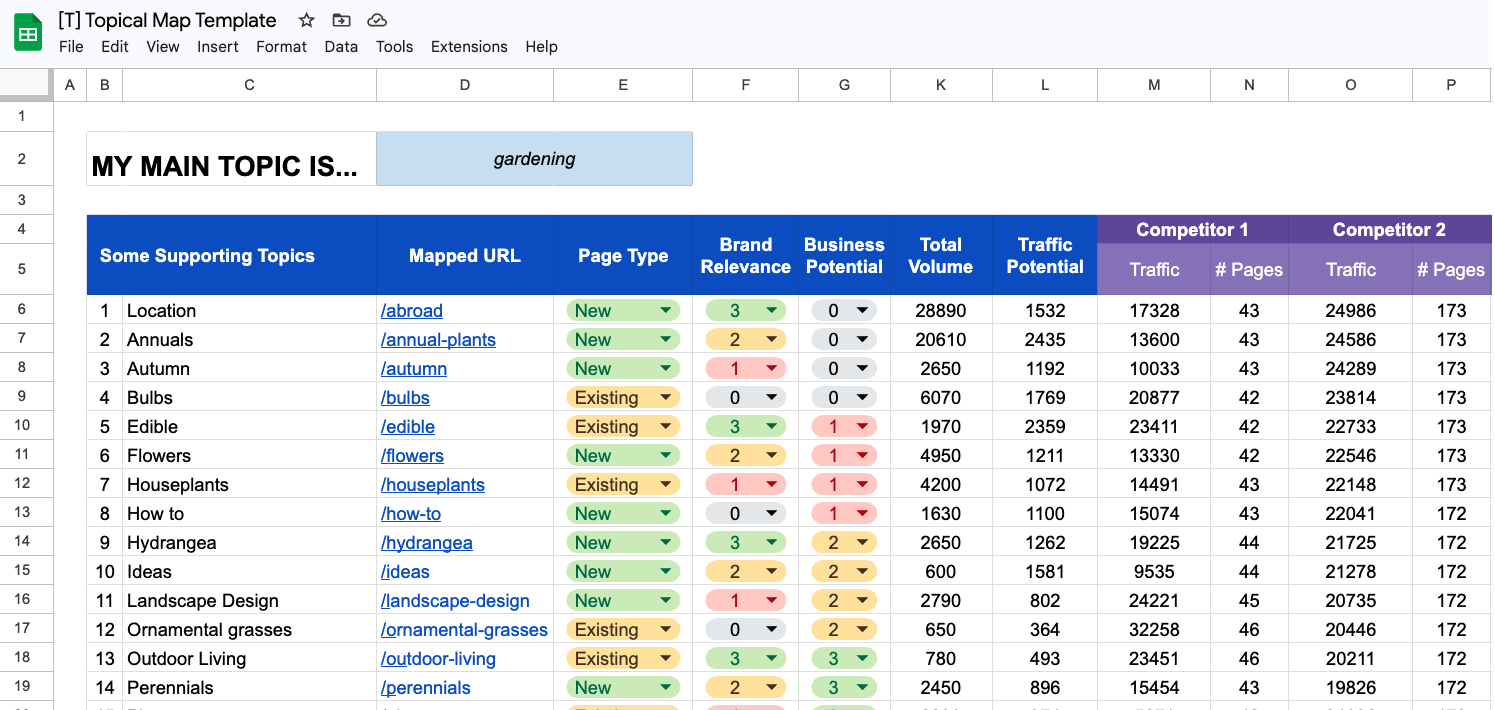
This becomes the blueprint your team can actually work from, aligning them on what to create, in what order, and how it all connects.
Before finalizing, run each subtopic through three quick filters:
- Does it have meaningful search demand?
- Is it relevant to your business?
- Does it stay within your topical focus?
Discard anything that fails any of these checks.
Be selective: know which topics to leave out
Building topical authority is equally about the topics you don’t cover as it is about those you do.
The instinct to chase every keyword with decent volume is understandable, but publishing content that sits outside your core topic doesn’t just fail to build authority. According to signals revealed in Google’s 2024 API leak, it may actively dilute it.
Google can measure how far your content strays from your site’s topical center. The further it strays, the weaker your focus signal becomes.
A useful heuristic before commissioning any new piece of content is to ask “would a first-time visitor to this page immediately understand what your site is about?”
If the answer is no, that’s a signal that the topic doesn’t belong.
Before locking in your content map, ask the following for each cluster to ensure they all belong:
- Is this topic semantically close to your core subject? Not just related in a loose sense, but genuinely within the same topical neighborhood.
- Does your brand have a credible reason to cover it? Traffic potential alone isn’t a good enough reason. Relevance and genuine expertise matter.
- Would covering this topic confuse Google about what your site is for? If you’re an SEO tool writing about project management productivity, probably yes.
The sites that weather algorithm updates best aren’t necessarily the ones that published the most. They’re the ones that stayed focused enough for search engines to build a clear, confident model of what they’re about.
Further reading
3. Write authority content and build each topic cluster
Authority content is the definitive resource on a topic. It’s the kind of content that earns links naturally, gets cited by AI, and outranks competitors not because it was optimized more, but because it genuinely covers the subject better than anything else.
It’s built on firsthand experience, original insight, and real expertise rather than a synthesis of what’s already out there.
With your topical map in place, it’s time to create such content. Start with your pillar pages and work outward into the rest of the cluster’s content.
Generally, you will want a pillar page for every type of product or service you provide, or for the main area where you want to be seen as an authority.
For example, Ahrefs’ beginner’s guide to SEO does a good job of acting as an overview of the topic, and then directing users to more specific parts of the topic (in the stand-alone chapters):
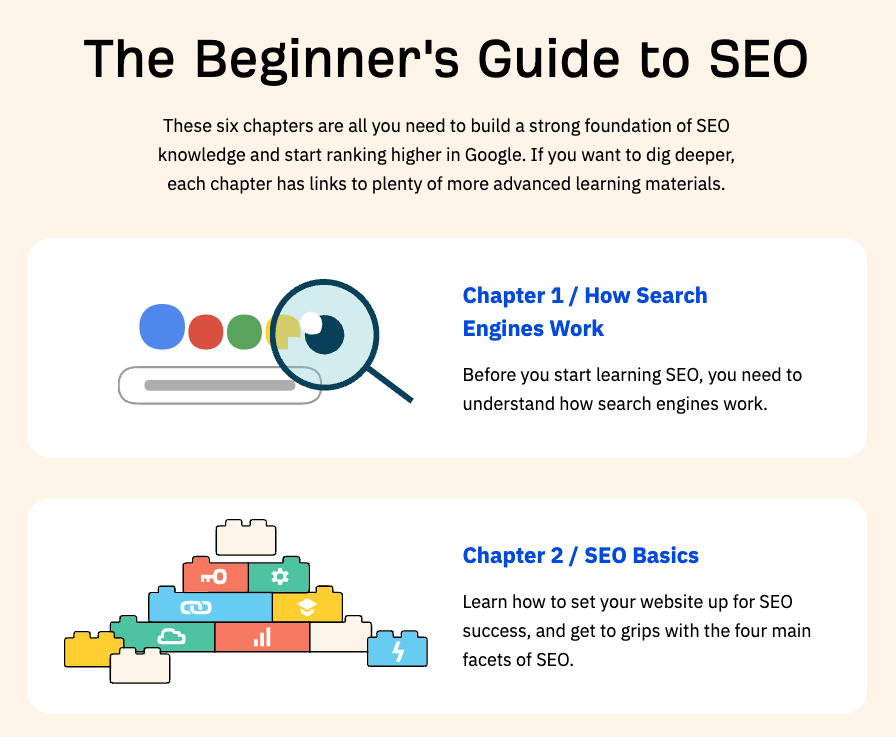
Then, you’ll need to write the supporting content for the cluster.
Cluster pages go deeper into specific subtopics. These are where you answer the precise questions your audience is searching for and demonstrate genuine expertise.
Depth matters more than length here. A focused, well-evidenced article on a narrow subtopic is more valuable than a long article that skims across several.
For each piece of content you create, make sure to:
- Match search intent: write a how-to guide for “how to X” keywords, a list for “best X” keywords, and so on
- Cover relevant subtopics thoroughly: use Ahrefs’ AI Content Helper to check you’re not missing anything important
- Keep E-E-A-T in mind: demonstrate real experience and expertise, not just a summary of what others have said
- Internally link to related pages in your cluster: this is what ties the cluster together, allowing search crawlers to follow the connections you build between pages
Publishing thin, AI-generated, or programmatic content at scale to fill keyword gaps is not the same as genuinely useful content. A site full of shallow articles can suppress the quality signal of your entire domain. Instead, prioritize depth and usefulness over volume.
4. Build relevant links (internal and external)
Even the best content needs links to rank, but not all links are equal. When it comes to topical authority, relevant links matter more than chasing a high volume of unrelated links.
External links
External links are like votes for your content. They signal to Google that others are actively sharing your content and recommending it to their communities.
Focus your link-building efforts on topically relevant sources. If you run a coffee blog, a link from another coffee site is ideal. A link from a finance blog carries far less weight for topical authority purposes.
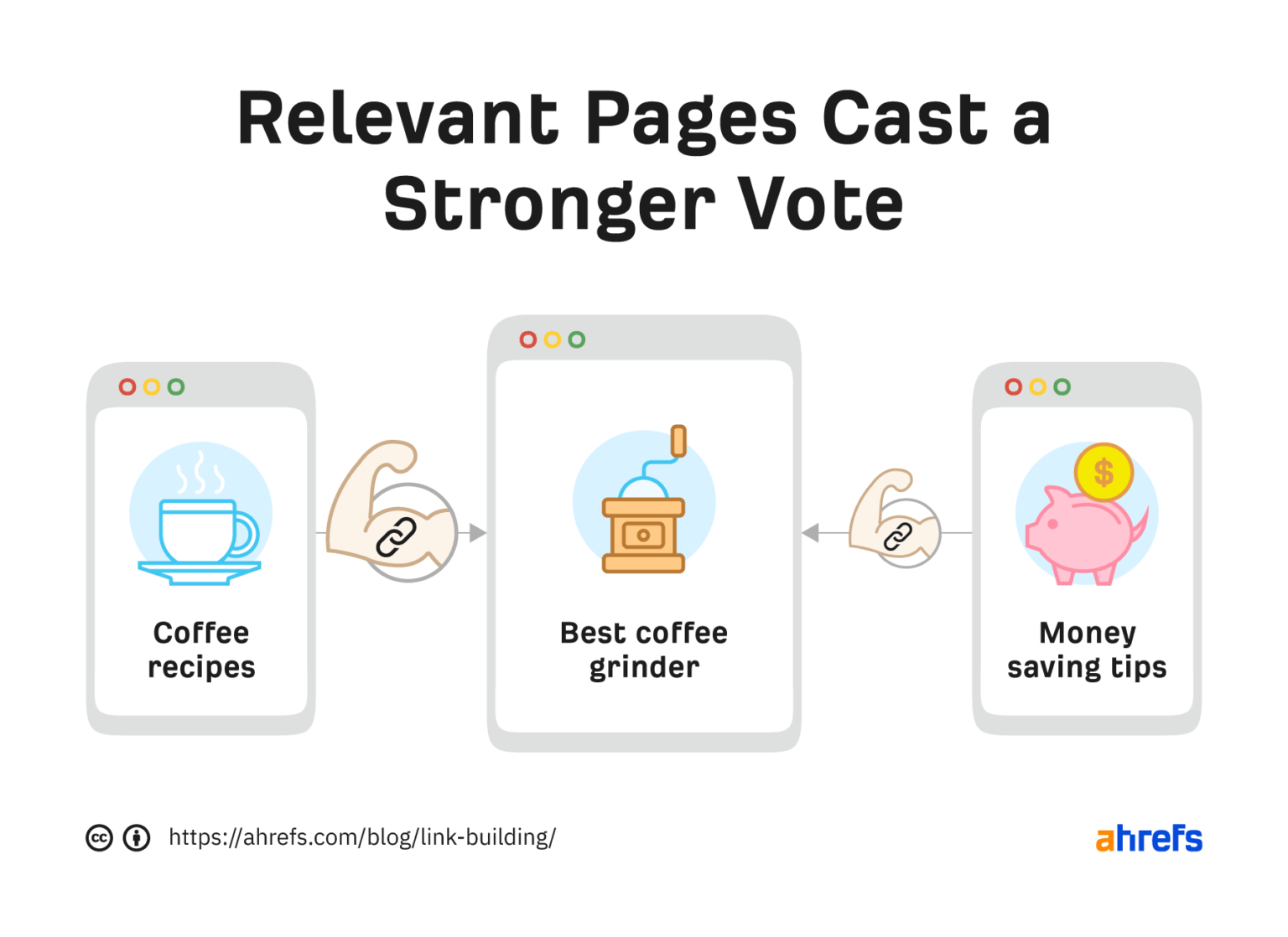
Effective tactics for earning topically relevant links include:
- Guest blogging: create useful content for topically related websites
- Linkable assets: create helpful resources on a topic so other sites naturally reference them
- Ego bait: Mention key players in your niche and reach out to them.
- HARO: Get “expert quotes” for your article.
- Digital PR: expert commentary, podcast appearances, and thought leadership in your niche build the off-site association between your brand and your subject
Internal links
Internal links point from one page on your website to another.
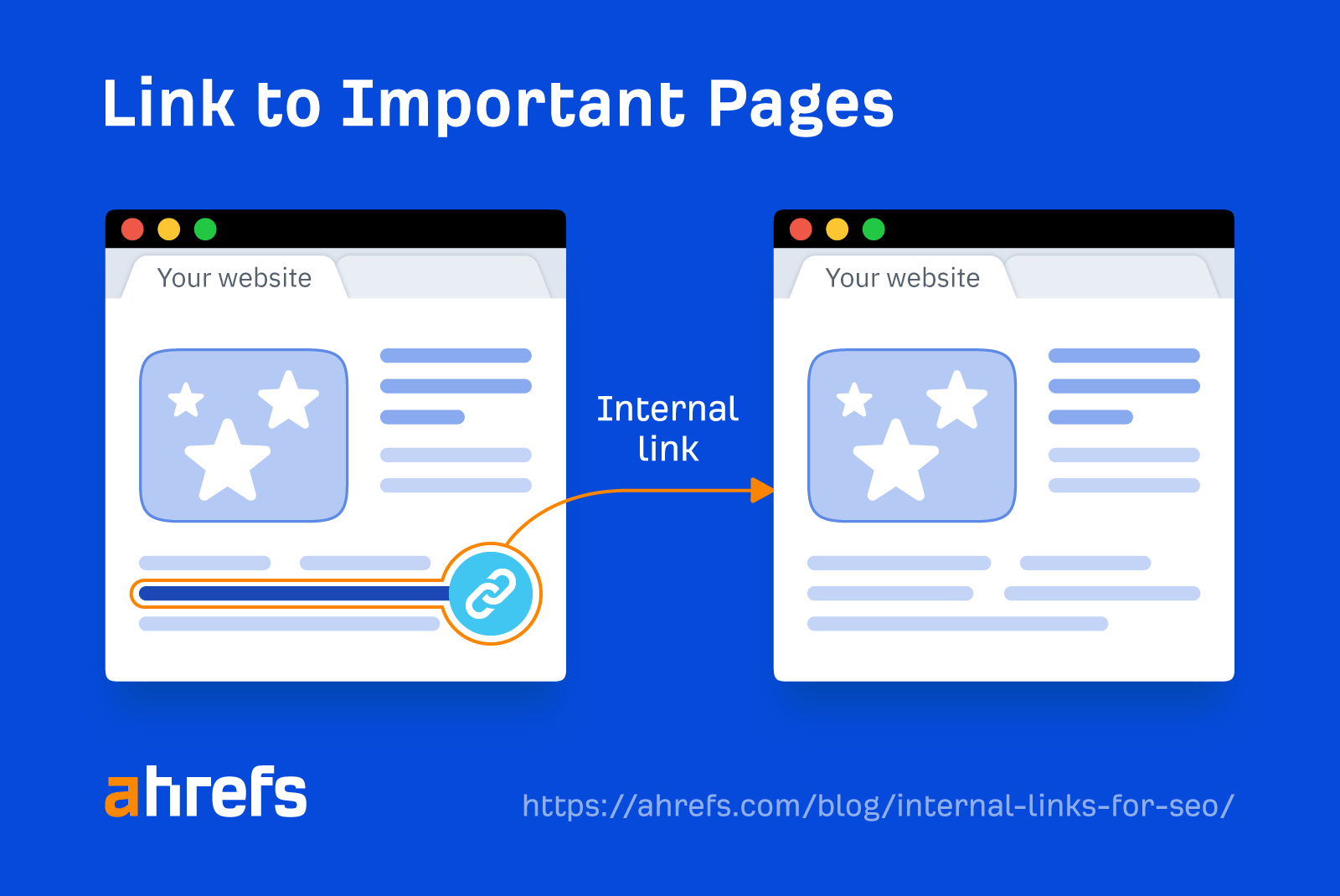
They are just as important as external ones since Google uses them to discover new content and understand the topical relationships between your pages.
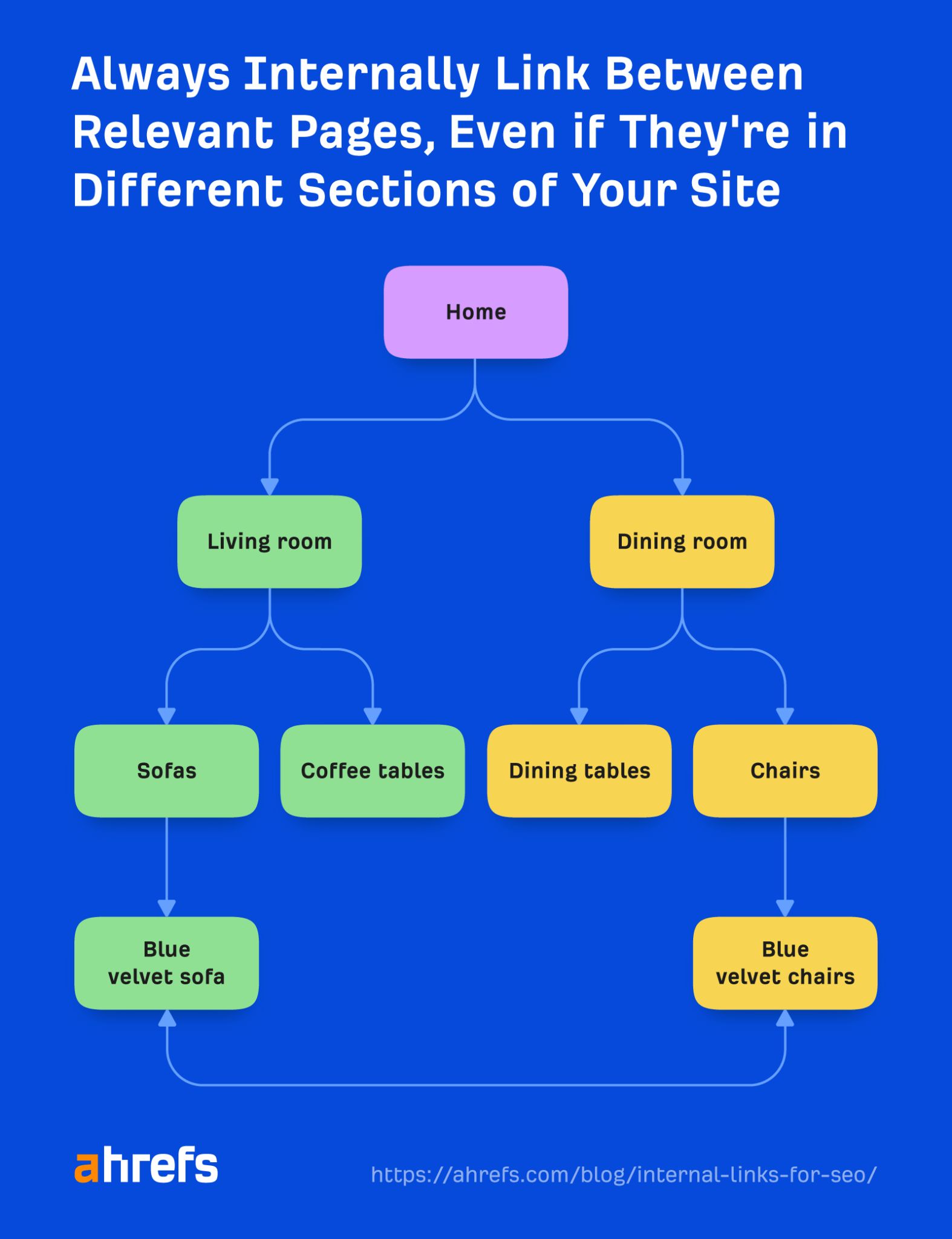
Each pillar page should act as a hub, linking to every cluster page beneath it and linked back to from every cluster page.
Where two cluster pages cover closely related subtopics, cross-link those too.
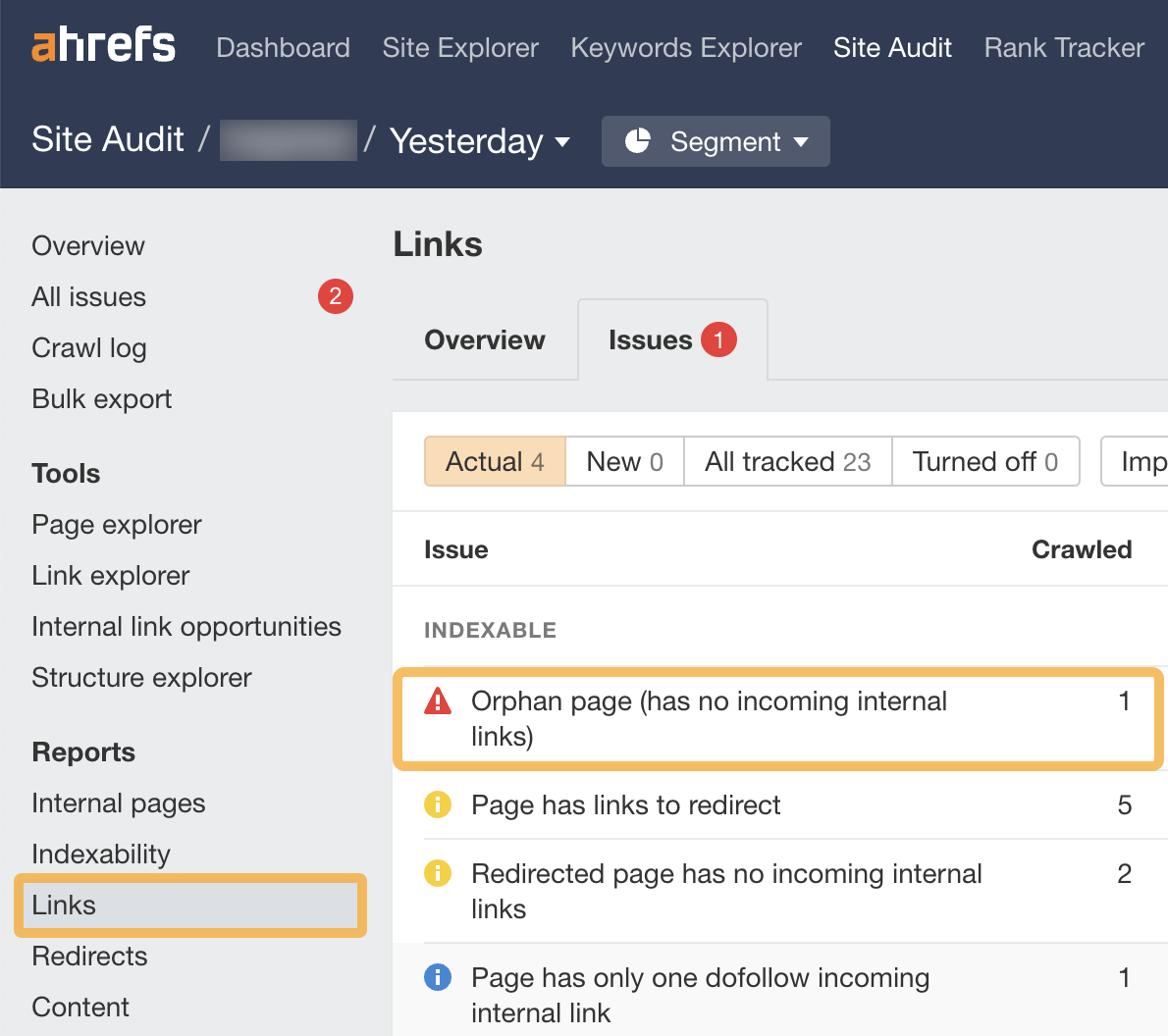
Orphaned pages (those with few or no internal links pointing to them) represent gaps in your internal links within topical clusters. Prioritize linking to these pages first.
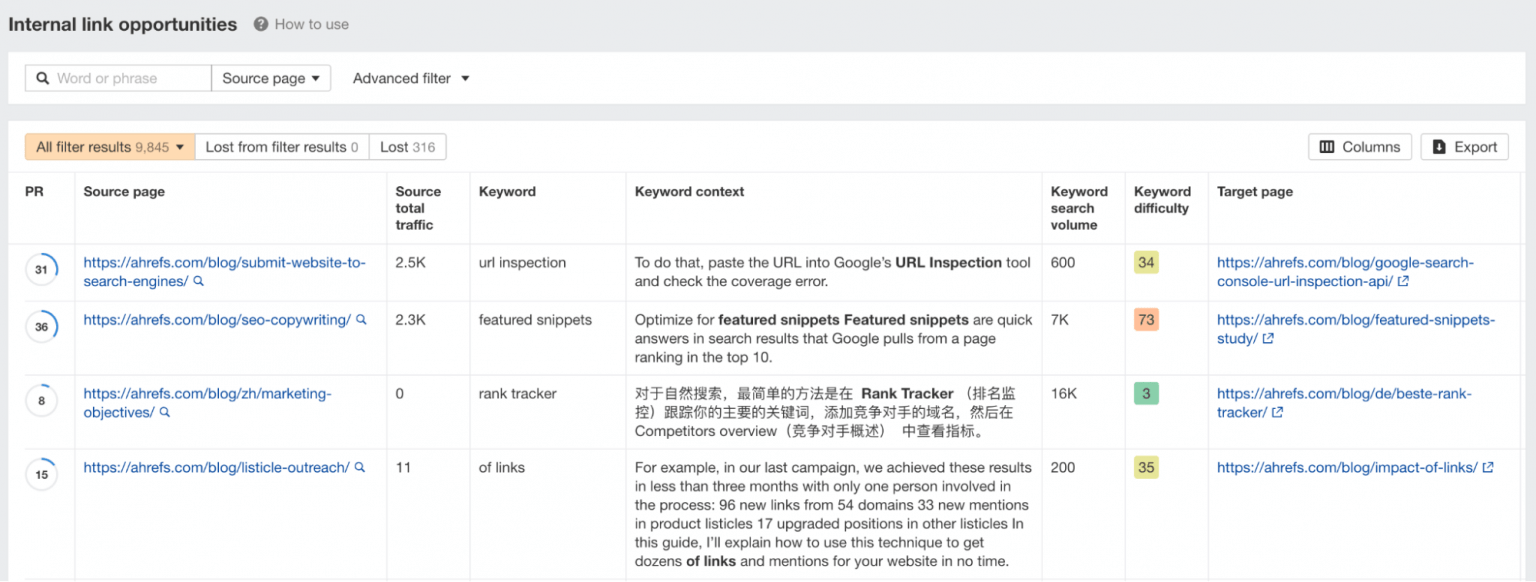
Then, check out the Internal link opportunities report as a shortcut for finding more places where you can naturally link between related content.
5. Keeping your content fresh and your clusters complete
Building topical authority isn’t a one-time project. Two things erode it over time if left unchecked: content that becomes outdated, and clusters with gaps that competitors fill before you do.
Refresh existing content
Outdated stats, broken examples, and old screenshots quietly undermine the credibility of otherwise strong content. A regular refresh keeps your existing pages competitive and sends freshness signals to both Google and AI search platforms, often improving performance.
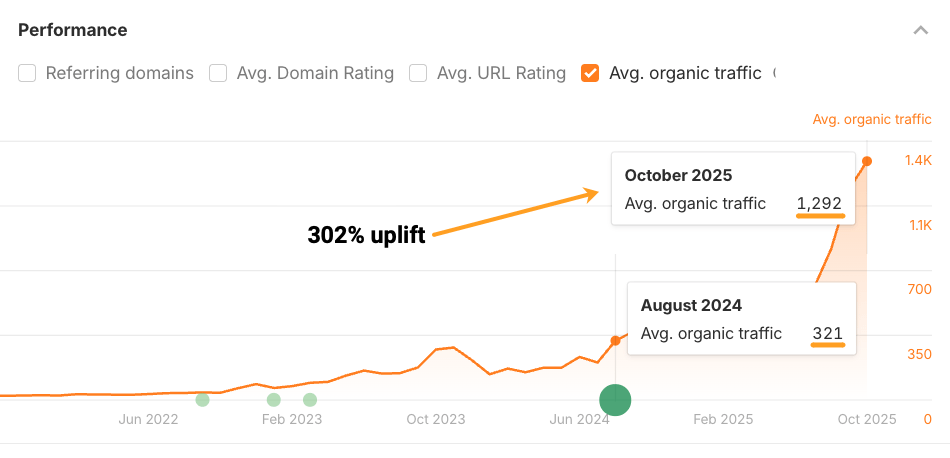
A few triggers worth acting on immediately rather than waiting for a scheduled review:
- Organic traffic drops noticeably from its peak
- A key stat or study you cite has been superseded
- A tool or product you reference has changed significantly
- A competitor has published a substantially updated version of a page targeting the same keyword
- You’ve dropped out of an AI Overview you previously appeared in
Close topic coverage gaps
As your niche evolves, new questions emerge that your content cluster may not yet answer.
Run a content gap analysis against your top competitors every few months to catch these before they become a disadvantage.
New subtopics worth adding are those that have emerged since you last built out the cluster, including new tools, new techniques, and new questions your audience is asking.
In an AI search environment, this matters even more. AI systems expand a single query into multiple related sub-queries when constructing answers through a process called query fan-out.
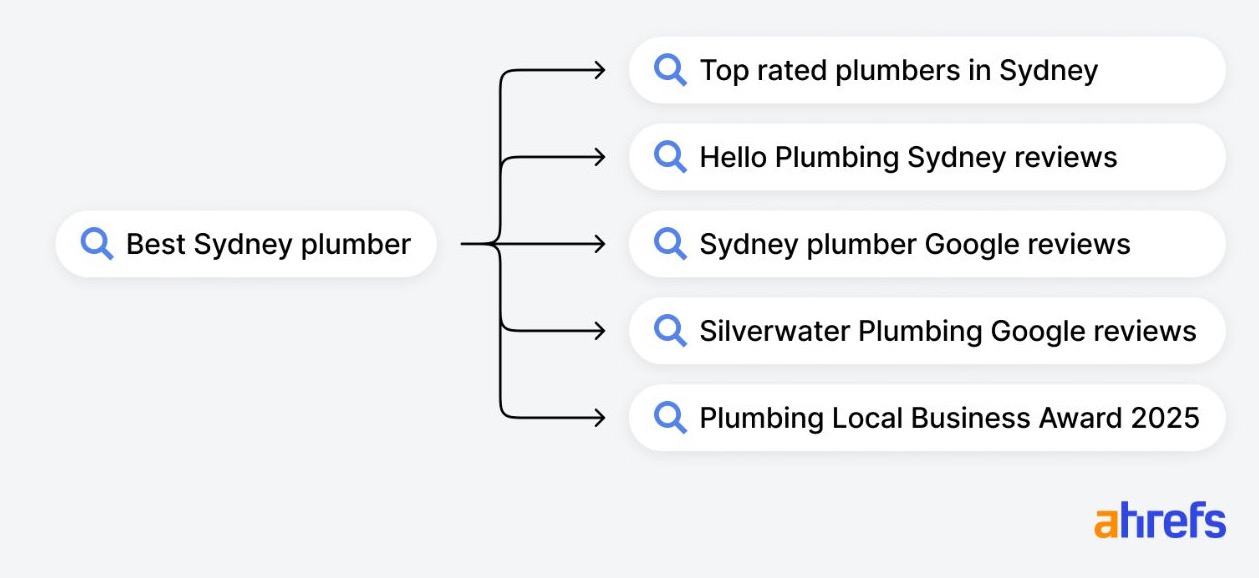
The more subtopics your cluster covers, the more of those sub-queries you appear in, increasing your visibility in AI search responses.
6. Track your topical authority over time
Topical authority builds slowly. Tracking the right signals helps you spot what’s working, catch drops before they compound, and make the case for continued investment in your content strategy.
There are three ways to measure your brand’s topical authority:
- Growth in branded topic searches
- Rankings within your target keyword clusters
- Increasing AI visibility for your core topics
You can measure growth in branded topic searches in Google Search Console. Look for queries combining your brand name with your core topic, like “Ahrefs keyword research”.
You can also check the Organic Keywords report in Ahrefs’ Site Explorer and filter to branded keywords that contain your brand name.
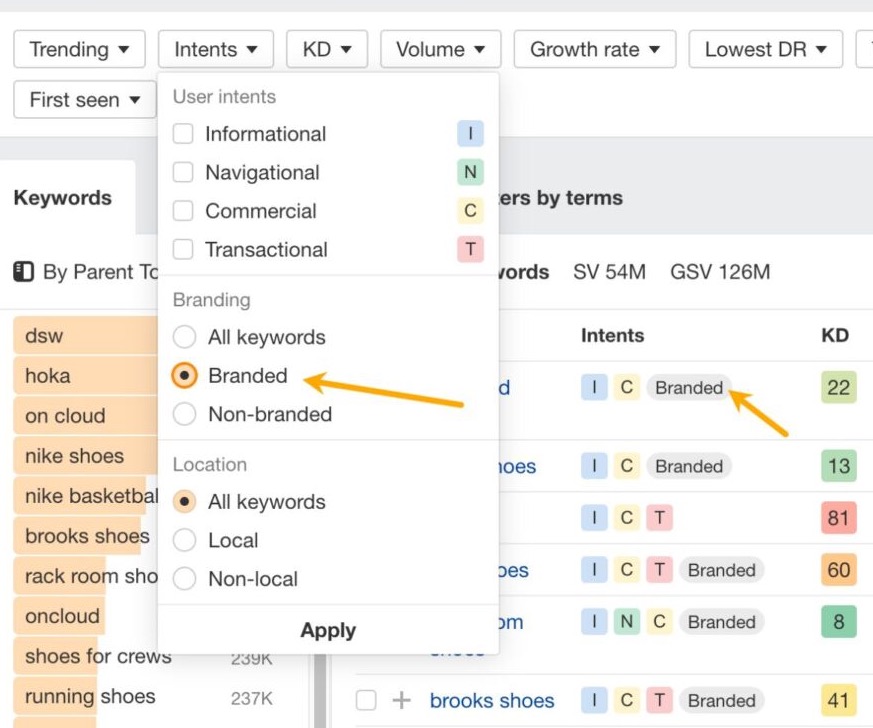
Growth for branded searches appears as an increase in the number of monthly searches for branded terms and/or an increase in the variety of branded keywords connecting you to specific topics.
For example, as Ahrefs built topical authority around SEO and content marketing, branded searches evolved from generic queries like “Ahrefs” into topic-specific ones like “Ahrefs keyword research,” “Ahrefs backlink checker,” and so on.
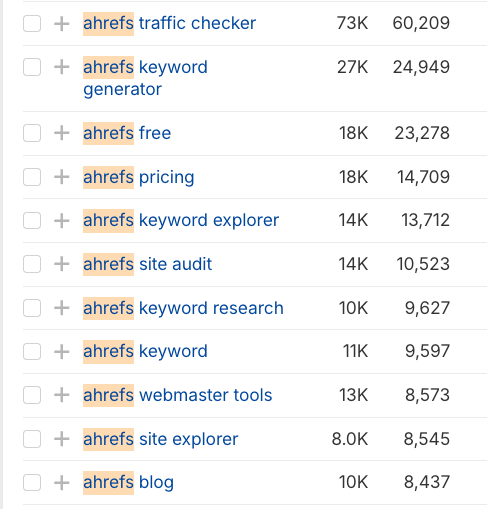
Each of those queries is a signal that a segment of the audience already associates the brand with a specific capability or subject.
A site building authority around personal finance might see the same pattern — starting from brand-name searches alone, then accumulating variants like “[brand] budgeting app,” “[brand] mortgage calculator,” “[brand] investing for beginners.”
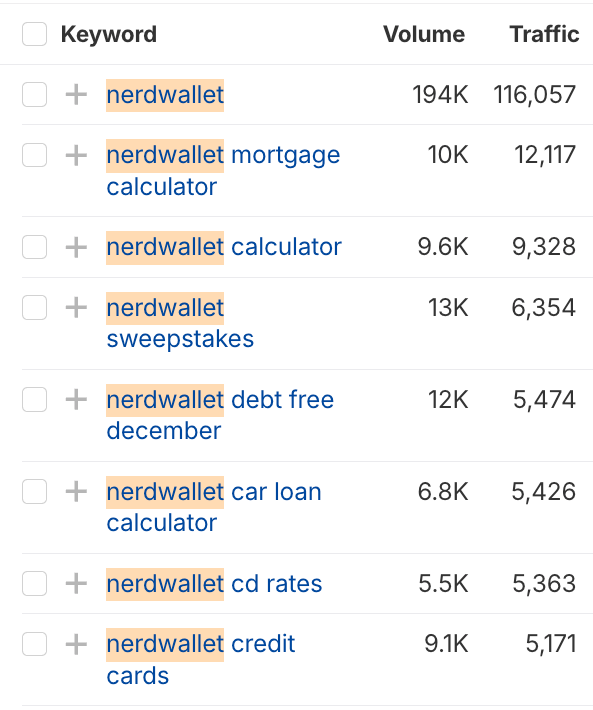
The variety matters as much as the volume. A growing list of distinct topic-branded queries is stronger evidence of topical authority than a single branded term with rising search volume.
This growth is one of the strongest signals that topical authority is genuinely taking hold, because it means your audience is actively associating your brand with your core subject.
You can also monitor your coverage of unbranded keywords related to your topic by tracking:
- Total unbranded keywords ranking
- Top position 1–3 rankings
- New keywords entering the top 10 month over month
- Growth in your topical share of voice compared to competitors
Growing coverage for long-tail terms you never explicitly optimized for is a clear sign your content efforts are compounding.
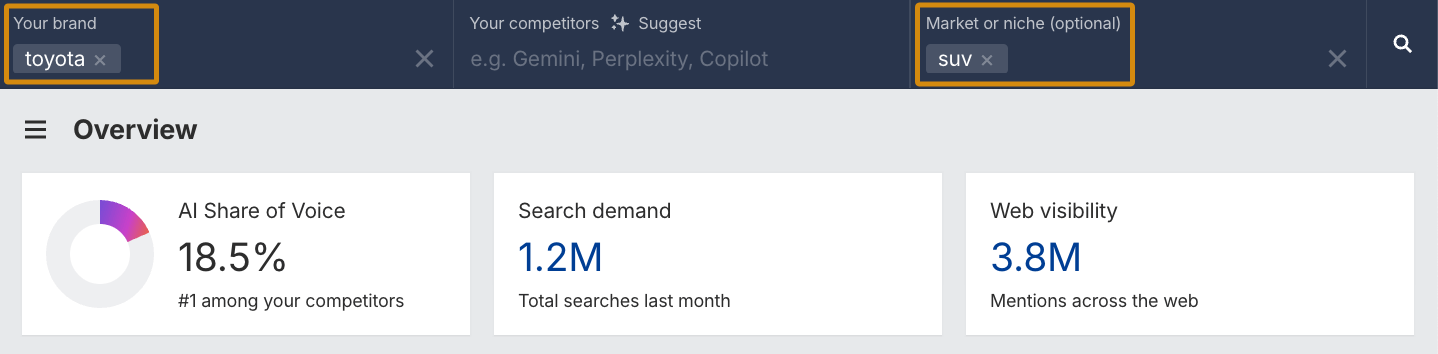
Finally, track your AI topic visibility using Brand Radar. You can manually enter priority topics and track your AI Share of Voice:
Key factors that influence topical authority
Understanding what Google actually measures helps you prioritize where to focus. For each signal below, we’ve included what you can actually do about it:
| Factor | What it means | What to do |
|---|---|---|
| Content coverage | How many relevant subtopics you address and how thoroughly. Gaps in coverage are often gaps in topical authority. | Run a content gap analysis against your top competitors and identify clusters you haven’t built out yet. |
| Internal linking structure | How clearly your content is connected. A well-linked cluster helps search engines map relationships between pages. | Audit for orphaned pages and missing cross-links between cluster content using Ahrefs’ Site Audit. |
| E-E-A-T signals | Experience, Expertise, Authoritativeness, and Trustworthiness — evaluated relative to a specific topic, not your site as a whole. | Strengthen bylines, add methodology sections, and cite primary sources across your core cluster pages. |
| Off-site brand signals | Backlinks and brand mentions from topically relevant sources reinforce your subject-matter association. | Prioritize link-building from sites in your niche over high-DR sites with no topical relevance. |
| Branded topic searches | Queries combining your brand with a topic signal to search engines that your audience already associates you with that subject. | Track branded keyword variety in GSC or Ahrefs — growth in topic-specific branded queries is a strong authority signal. |
| Site focus score | An internal Google signal (revealed in the 2024 API leak) measuring how concentrated your content is around a core subject. | Audit your content map for topics that sit outside your core niche and consider whether they belong. |
| Site radius | A companion signal from Google’s API leak that measures how far your content strays from your core topic. Publishing off-topic content may actively dilute your authority. | Before commissioning new content, ask whether it would confuse a first-time visitor about what your site is for. |
Google has never published a formal specification for topical authority. But the evidence for how it evaluates subject-matter expertise has accumulated through algorithm updates, quality guidelines, and the 2024 API leak.
| Year | Update | What it meant for topical authority |
|---|---|---|
| 2013 | Hummingbird | Shifted ranking from keyword matching to query intent. Google could now understand what a page was about, not just which words it contained. |
| 2015 | RankBrain | Introduced machine learning to interpret ambiguous queries. Relevance to a topic became more important than the presence of exact keywords. |
| 2018 | Medic update | YMYL content required demonstrable expertise, authority, and trustworthiness to rank. Topic-specific credibility became a measurable quality signal. |
| 2019 | BERT | Enabled Google to understand the relationships between words and concepts in natural language, making topical context significantly more influential in ranking decisions. |
| 2021 | MUM | Introduced multimodal understanding across text, images, and video. Google could now evaluate topic coverage across many content formats, not just written pages. |
| 2022 | Helpful Content system | Introduced site-wide quality signals. Thin or unhelpful content anywhere on a site could suppress rankings across the whole domain and topic. |
| 2023 | SGE / AI Overviews launch | Google began generating AI-written answers sourced from trusted sites. Topical authority became a prerequisite for AI search visibility, not just traditional rankings. |
| 2024 | Google API leak | Internal signals, including site focus score and site radius, confirmed Google models each site’s topical identity and rewards those that stay tightly relevant to it. |
| 2024 | Helpful Content rolled into core updates | Google formally integrated its helpful content signals into its core ranking system, cementing the importance of content depth and topical relevance. |
| 2025–26 | AI Mode and query fan-out | AI search platforms now expand a single query into multiple related sub-queries to construct answers. Sites with comprehensive topic coverage appear across more of these sub-queries, compounding their visibility advantage. |
The consistent direction across all of these updates is the same: Google (and AI search platforms by extension) are getting better at evaluating whether a site genuinely understands a subject and surfacing those that do.
The framework underpinning all of this is E-E-A-T, evaluated not as a site-wide score, but relative to a specific topic.
A site doesn’t earn topical authority by being generally credible. It earns it by being credibly and consistently expert in a specific subject.
The 2024 API leak added the most concrete evidence to date, identifying two internal signals: site focus score (how concentrated your content is around a core subject) and site radius (how far it strays).
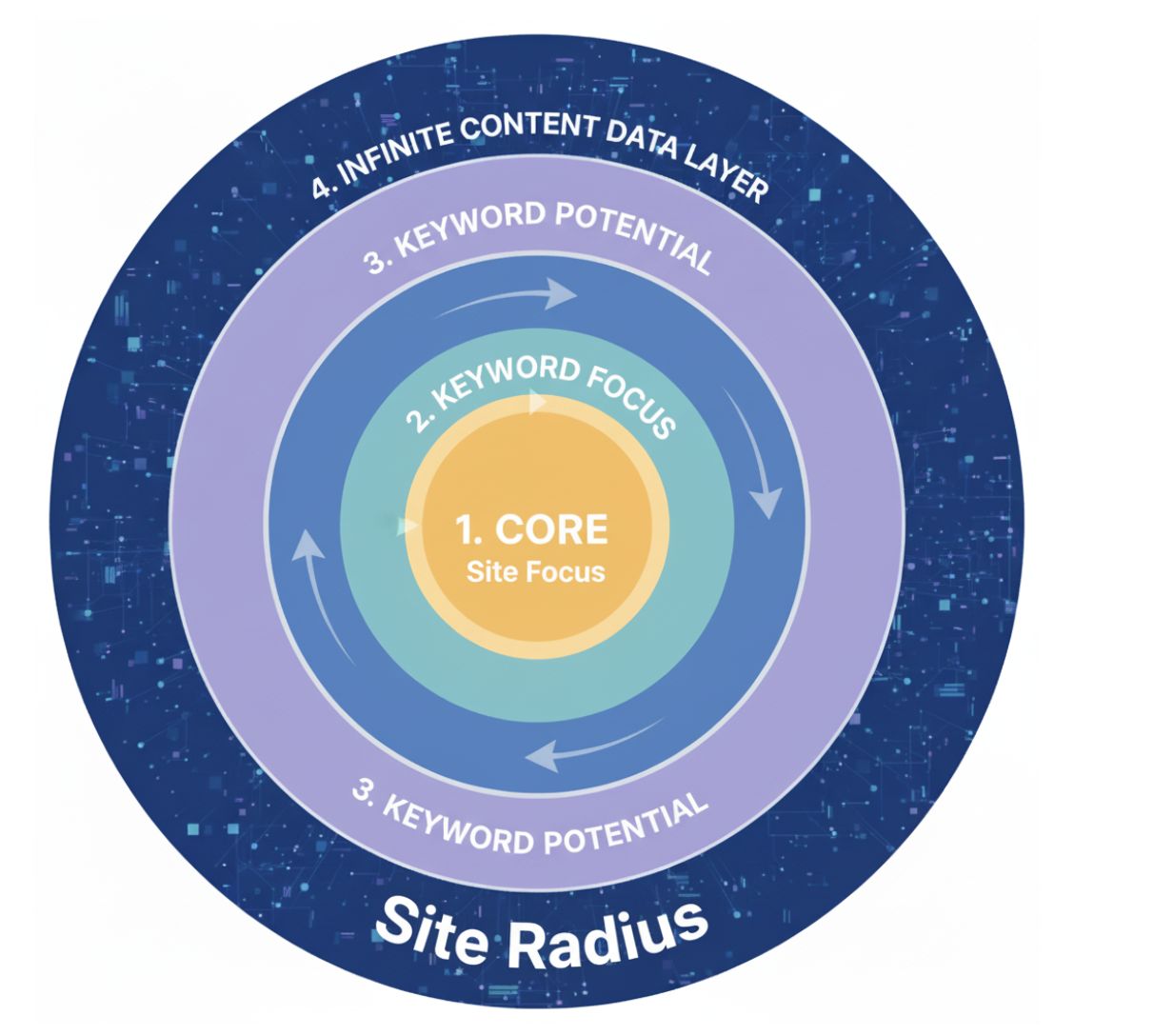
Publishing content outside your core topic may actively dilute your authority signal not just fail to strengthen it.
Approximating your site focus score
Google can measure how semantically concentrated your content is, and with the right tools, so can you.
You can use your preferred LLM connected to Ahrefs’ MCP, (or use Agent A which is automatically plugged into your Ahrefs data).
Ask it to generate a semantic map of your entire site. For instance, you can ask for vector embeddings for each page, find the average to establish your site’s topical center, and plot every page based on its distance from it. It will look something like this (from a topical authority visualizer built in Agent A by Ryan Law, our Director of Content Marketing):
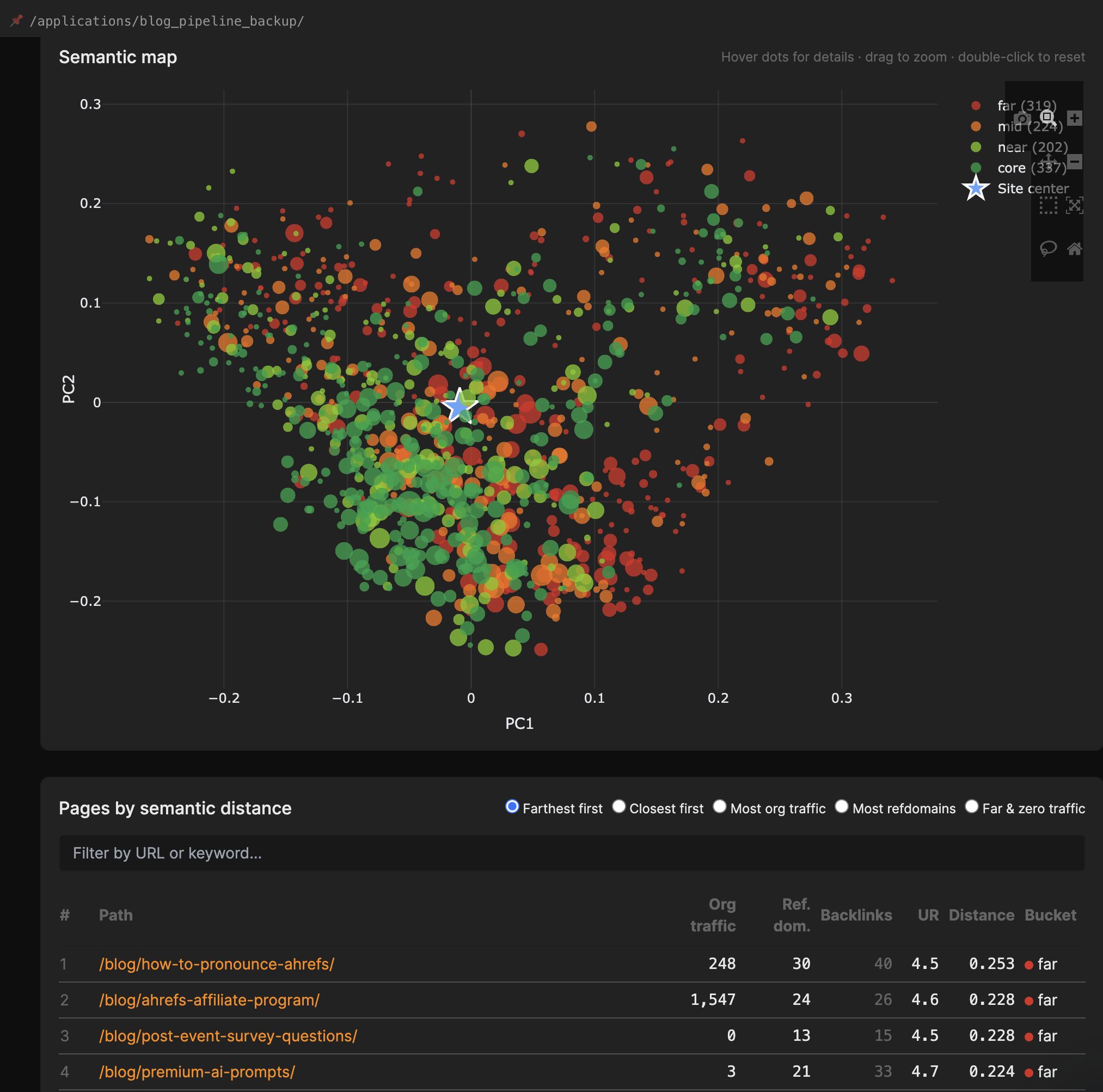
Each dot is an embedding of your content. It translates your content into numerical representations that capture meaning, making semantic distance mathematically measurable.
The output tells you more than any spreadsheet can.
Pages clustered near the center are reinforcing your authority. Pages in the “far” bucket are your site radius problem, and they’re perfect candidates for consolidation, redirection, or removal if they can’t be brought back on-topic.
Frequently asked questions
Does topical authority replace the need for backlinks?
No. Backlinks remain a significant ranking factor. What’s changed is that a site with strong topical coverage can regularly outrank a generalist with stronger links in a niche it doesn’t own. The most competitive sites have both.
How long does it take to build topical authority?
Expect 6–12 months before seeing significant movement. The first three months establish coverage, months four through six show initial ranking improvements, especially for competitive topics, and months six through twelve deliver compounding gains.
How many articles do you need?
There’s no fixed number of articles required to earn topical authority. A specialized niche might need 15–20 well-connected pieces; a broader subject could need 50 or more. The better question is whether your content covers the topic more comprehensively than your competitors’.
Is topical authority the same as a domain’s rating?
No. Domain Rating measures backlink strength. Topical authority is about subject-matter depth in a specific niche. A low-DR site can (and regularly does) outrank a much stronger domain by covering a topic more completely.
Can a new site build topical authority?
Yes. Topical authority is niche-specific. A new site with a precisely defined focus and comprehensive coverage can outrank established generalists. The DR 15 e-bike site outranking Amazon is a real example of this.
Does topical authority help with AI search visibility?
Yes, topical authority significantly affects a brand’s AI visibility. AI platforms preferentially cite sources they have evidence to trust on a subject. Strong topical authority, evidenced by consistent content coverage, relevant off-site mentions, and clear brand-topic association, earns more citations in AI-generated answers.
Final thoughts
Topical authority is one of the most reliable paths to sustainable search visibility in traditional and AI search alike.
It takes time and consistent effort, but sites built on genuine topical expertise are more resilient to algorithm updates and more visible in AI-generated results than those that aren’t.
Pick your subject, cover it completely, and build your reputation as the most credible source on it.
Any questions? Feel free to ping us on X.
