Key Takeaways
- The TikTok sale is complete. TikTok USDS Joint Venture LLC closed on January 22, 2026, placing majority control in the hands of American investors Oracle, Silver Lake, and MGX. The ad infrastructure and auction mechanics are still running.
- User deletions spiked nearly 150 percent post-announcement, but active usage held flat. Sentiment and platform health are two different things.
- Governance shifts hit auction dynamics before they touch the product. Watch CPM and conversion rate week over week, not month over month.
- Pulling budget reactively during platform transitions destroys learning phase momentum and costs more to rebuild than staying in.
- Platform governance is now a media planning variable. The TikTok sale set a precedent that extends to every major platform in your media mix.
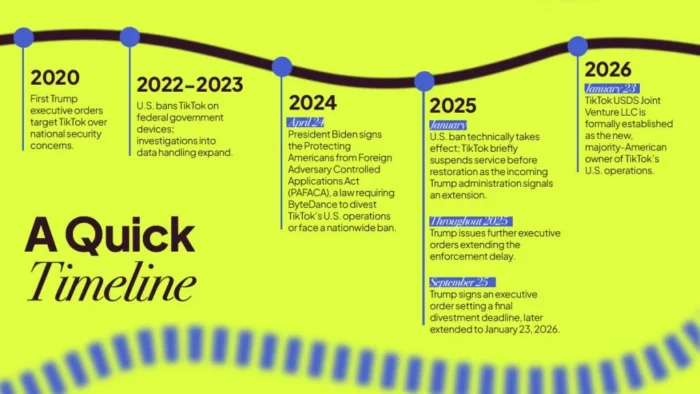
On January 22, 2026, TikTok USDS Joint Venture LLC officially purchased TikTok’s U.S. operations from ByteDance, transferring control to an American-led investor group anchored by the tech giant, Oracle, and investment groups Silver Lake and MGX.
What does this mean for advertisers on the platform?
The app isn’t shutting down. This is a governance restructuring, and TikTok’s ad products and auction mechanics are still running for its 170 million U.S. users. That said, regulatory shifts like this create real volatility risks that deserve a structured response.
This guide breaks down what did and didn’t change, and how to protect your performance without abandoning one of the most powerful paid channels in your media mix.
What the TikTok U.S. Sale Actually Changes
After the sale, TikTok USDS Joint Venture LLC now owns the U.S. aspects of the platform. ByteDance still owns a 20 percent stake, but the governing majority is now American.
Here’s what that means in practical terms.
What changed
Data governance is the biggest structural shift. U.S. user data is now stored and managed under American oversight, with Oracle handling cloud infrastructure. The new joint venture is also retraining TikTok’s recommendation algorithm on U.S. user data exclusively, to keep the content feed free from outside manipulation. Users won’t notice that change immediately, but it’s significant.
The American-owned entity now sets content moderation. The transition introduced additional compliance review processes for ad targeting parameters and audience segments, requiring some targeting options to be re-approved as the platform rebuilt its ad infrastructure.
What didn’t change
The TikTok ads infrastructure is intact. TikTok Ads Manager, Smart+, TopView, and In-Feed formats are all still live. At the 2026 NewFronts, TikTok unveiled new ad formats, including Logo Takeovers and Prime Time placements, showing that new ownership isn’t slowing down on advertising anytime soon.
Creator monetization is also unchanged. The TikTok algorithm still powers discovery through the For You Page, so its rules are still critical for anyone trying to make money on the app. Per TikTok CEO Shou Chew’s internal memo, ByteDance’s global entity continues to manage the platform’s e-commerce operations and broader marketing functions on the new U.S. platform.
Early User Signals: Noise or Real Risk?
According to Sensor Tower data shared with CNBC, the daily average of U.S. users deleting TikTok jumped nearly 150 percent in the five days following the joint venture announcement, compared with the previous three months.
A drop that sharp could raise serious concerns for advertisers, but it deserves some context before we decide whether it signals real risk.
Three things fueled the spike, and none of them signal structural collapse:
- A data center power outage caused failed uploads and For You feed irregularities, which TikTok publicly acknowledged.
- An updated privacy policy prompted in-app backlash, though the flagged language was present in an archived August 2024 version of the same policy.
- Uncertainty around the new ownership’s content moderation approach prompted some creators to hedge their distribution across other platforms.
Competing platforms saw temporary bumps. U.S. downloads for UpScrolled increased more than tenfold, and platforms like Skylight Social and Rednote climbed 919 and 53 percent week over week, respectively.
Monitor trends like these. A sustained shift in creator behavior matters far more to your campaigns than a short-term uninstall spike driven by a data center outage and a misread privacy policy.
Here’s what most advertisers miss during a major platform transition: governance changes hit auction dynamics before they touch the product.
TikTok operates on an auction system where costs fluctuate based on competition, targeting choices, and ad quality. Your cost per mille (CPM) isn’t a fixed rate. It moves with how many advertisers are competing for the same audience at any given time, which makes the post-sale period worth watching closely.
Two forces are working in opposite directions right now.
The first is upward CPM pressure from the algorithm retraining cycle. The new joint venture is retraining TikTok’s recommendation algorithm on U.S. user data exclusively. As that process plays out, ad delivery patterns can shift mid-campaign. Campaigns optimized against the previous algorithm’s behavior may see performance move before any creative or targeting change explains it.
The second force is a temporary drop in auction competition. Some marketers were already planning to scale back spending heading into the transition. That window won’t stay open long. As advertiser confidence returns and paused budgets resume, CPM pressure will rise again.
Three things to monitor right now:
- Watch your week-over-week CPM movement. Any sustained spike signals a shift in auction dynamics, not just creative underperformance.
- Monitor conversion rates independently of volume, since algorithm retraining can compress efficiency without changing impression counts.
- Track creative fatigue aggressively. TikTok’s auction dynamics and creative decay rates punish advertisers who let assets run too long without refreshing.
Why Overreacting Hurts Performance
Pulling budget in response to platform uncertainty feels like risk management, but it’s often the riskiest move you can make in practice.
TikTok’s algorithm depends on a learning phase to optimize ad delivery. During this window, it tests bidding by evaluating your audience and creative to identify who is most likely to convert. Full optimization stability is generally reached around 50 conversions per ad group.
Any significant change, like pausing campaigns or cutting budgets sharply, pushes an ad group back into the learning phase, resetting the optimization progress already built.
The cost of underfunding is equally concrete. Campaigns that don’t meet effective spending thresholds show CPMs 40 to 60 percent higher than properly funded ones, because the algorithm cannot optimize without sufficient data volume.
The post-sale period sharpens this dynamic considerably. With the algorithm retrained on U.S. data, cost per acquisition may increase 20 to 40 percent before stabilizing. Pausing during this window causes the algorithm to stop learning from your account entirely. Advertisers who read that temporary cost-per-action (CPA) spike as a signal to exit will reset their learning phase mid-cycle, compounding the problem they were trying to solve.
There’s also a competitive angle worth considering. Brands that maintained their presence through the transition period emerged with stronger relative positioning as competitors pulled back. When auction competition drops, CPMs follow. Advertisers who stayed in captured that efficiency. Those who paused paid higher costs to re-enter a recovering auction.
Volatility creates both inefficiency and opportunity. Which one you experience depends on whether you plan for it or react to it.
How to Protect Performance Without Abandoning TikTok
Here’s the operating model to build so you can capitalize on TikTok’s volatility now, or another platform’s in the future.
1. Pre-Approve Budget Flex Scenarios
Making significant budget changes reactively can ruin campaign performance. Deciding your triggers now means you respond with a plan instead of scrambling.
Don’t wait for a performance drop to decide how you’ll respond. Define your thresholds in advance, like a sustained CPM increase of 20 percent or more week-over-week or a conversion rate drop held across two consecutive weeks.
2. Keep Meta and YouTube Shorts Warm
A channel you haven’t run in months is a cold channel. Meta and YouTube Shorts require the same data runway as TikTok to reach full optimization stability, roughly 50 conversion events per ad group. Maintain enough spend on both to keep your audiences warm and your algorithms learning, so you’re never rebuilding from zero.
3. Increase Creative Velocity
On TikTok, creative has a short shelf life. Volatile auctions accelerate that decay further. Volatile auctions accelerate that decay. Have new creative variations ready to deploy before you need them, not after performance has already dropped.
4. Tighten Weekly Reporting Cadence
Temporarily shift from monthly to weekly performance reviews. CPM movement and conversion rate shifts during algorithm retraining happen fast. Catching them early gives you time to adjust bids before small inefficiencies compound.
5. Audit Platform Dependency
You want to ensure you’re spending enough to gain traction, but not so much that one platform can make or break your marketing success. Roughly 13 percent of agencies’ social spend over the past 12 months has gone to TikTok. If TikTok represents more than 30 percent of your paid social budget, you have concentration risk that deserves a contingency plan.
The TikTok case underscores a growing tension between digital privacy and free speech in the government’s approach to technology platforms. As apps collect vast amounts of user data, governments will likely continue scrutinizing foreign-owned platforms.
Source: Metricool
That scrutiny isn’t going away, and it won’t stay limited to TikTok. If another foreign-owned platform gains popularity, Congress may revisit this model of ownership-based restrictions. The legal and regulatory architecture built around TikTok is now a template.
Meanwhile, data sovereignty pressures are intensifying globally. Governments worldwide are restricting cross-border transfers and asserting jurisdiction over data within their borders, possibly touching every major platform operating at scale in the U.S. market.
Platform risk is no longer purely a performance question. Ownership structure and data governance now belong in the same due diligence conversation as CPM benchmarks and audience sizing. A channel that delivers strong return on ad spend (ROAS) today can face structural disruption tomorrow for reasons unrelated to its ad product.
FAQs
Did TikTok Sell?
On January 22, 2026, TikTok closed a deal to divest its U.S. entity to a joint venture controlled by American investors, with Oracle, Silver Lake, and MGX collectively owning 45 percent of the new entity. ByteDance retained nearly 20 percent. The platform continues operating under U.S. majority ownership as TikTok USDS Joint Venture LLC.
How Much Did TikTok Sell For?
How Much Did TikTok Sell For?
The deal valued TikTok U.S. at approximately $14 billion, a figure widely considered low given that TikTok’s U.S. entity generates roughly $14 billion annually in advertising revenue alone.
Analysts have noted that the $14 billion price tag gives the company a price-to-sales ratio comparable to that of mature, low-growth companies, far below the multiples commanded by Meta and Alphabet. Most independent estimates put TikTok U.S.’s true market value significantly higher.
Conclusion
TikTok remains a Tier 1 paid media channel. The U.S. market accounts for roughly 38 percent of TikTok’s entire global advertising income, a concentration that reflects genuine advertiser confidence. That doesn’t change because of a governance restructuring.
What does change is how you should think about it. Tier 1 status doesn’t mean risk-free. The TikTok sale established a precedent for how governments can intervene in platform ownership, and that precedent applies beyond TikTok. Every major platform you rely on now carries some version of this risk.
The smart move is better planning.
Stay active on TikTok while the auction competition is still recovering. Build a paid media strategy that lets you flex budgets quickly when conditions shift. Define your thresholds now so you don’t make reactive decisions under pressure, and keep your creative velocity high. Short-form content gives you a low-cost way to keep creative cycling regardless of what’s happening at the platform level.
The platforms that attract 170 million users don’t disappear overnight. Build your strategy around that reality.
Are You Using Google Ads? Try Our FREE Ads Grader!
Stop wasting money and unlock the hidden potential of your advertising.
- Discover the power of intentional advertising.
- Reach your ideal target audience.
- Maximize ad spend efficiency.