


The common advice is to build authority off your own site through digital PR, mentions, and high-authority links. Grow your third-party mentions, grow your AI visibility, right?
Right instinct. But the source-set that an AI relies upon differs for every topic, so your off-property authority building efforts must also be topic-driven.
This week:
- Why AI trusts a different set of sources for every topic, and what that changes about where you build it.
- Why scattered off-property authority wastes budget, and how to aim it.
- How to find the exact sources AI cites for your topic and earn your way in.
AI builds a different trusted-source set for every topic
AI search engines rebuild which sources to trust around the subject of the question. Ask about invoicing, and it leans on one set. Ask about starting a business, and it leans on a mostly different one.
This data is a sample set from an anonymous pool of clients, but it illustrates the gap is large. AI citations follow a source-type pattern specific to the topic.

In invoicing questions, competitor domains hold 33.5% of what AI cites. In starting-a-business questions, that same source type holds 7%. Same model, two topics, and the kind of source it reaches for nearly flips.
This small sample analysis confirms something I wrote about in “Operationalizing your topic-first SEO strategy”:
- “You should be employing a topic-based backlink strategy, too. You don’t just want backlinks. You want links that have authority in your target topics and/or with your audience.”
Meanwhile, video and social surfaces run on separate mechanics and deserve their own separate play in your visibility mix, cited at ~6.5% across this sample set.
YouTube remains an exception across LLMs, and UGC platforms like Reddit behave differently again. But this memo sets aside the video/social/UGC slice deliberately and covers the publisher, research, and expert sources that behave like earned media.
So where you build authority depends on the topic you want to win. Lift a PR plan from a neighboring topic or vertical, and you’re likely to aim at the wrong sources.
AI trusts entities it already recognizes
AI does not form a fresh opinion about your brand on every query. It reuses the trust already attached to the sources it pulls from, and it favors documents and entities it already associates with authority on that topic. (Which is why, yes, building topical authority still matters.)
Your owned blog/site is one input. It’s a crucial input, but it’s likely one of the weakest. The publications, analysts, experts, competitors, and communities that mention you carry significant weight.
That gap is why two brands with identical on-page optimization can get cited at different rates: off-property reputation the model already trusts.
Add to that, a named author with a byline appears to beat the same content published under a brand. We don’t have a clean dataset on this across platforms yet and it’s based on one-off qualitative findings via clients and industry chatter, so treat this as a working belief, not a measured finding.
LinkedIn’s own analysis of AI visibility factors reported that authorship and timestamps tracked with better performance: fresh, expert-authored, clearly time-stamped content earned the fastest visibility and citation gains in their testing.
“Our early testing showed meaningful lift in visibility and citations across the topics we focused on, with owned content delivering the fastest and most scalable gains so far…. Publishing authoritative, fresh content improves visibility. LLMs favor content that signals credibility and relevance, authored by real experts, clearly time-stamped, and written in a conversational, insight-driven style on platforms like LinkedIn.”
— “How LinkedIn Is Adapting to AI-Led Discovery”
The mechanism is reasonable: A human author with a track record (someone who has written on the topic across other sites, has an active social presence, holds a license, or sits on your executive team) gives the model an entity to attach authority to. A faceless brand post gives it less to anchor on.
Authority pays out in steps, so depth in your topic beats spread
More quality mentions should mean more citations. Authority does not pay evenly, though. It pays in steps.
Our analysis of 1,000 domains with Semrush showed this for backlinks: Authority Score is the strongest backlink predictor of AI mentions in the study at 0.65 Pearson, ahead of raw link count, and the curve bends rather than climbing straight.
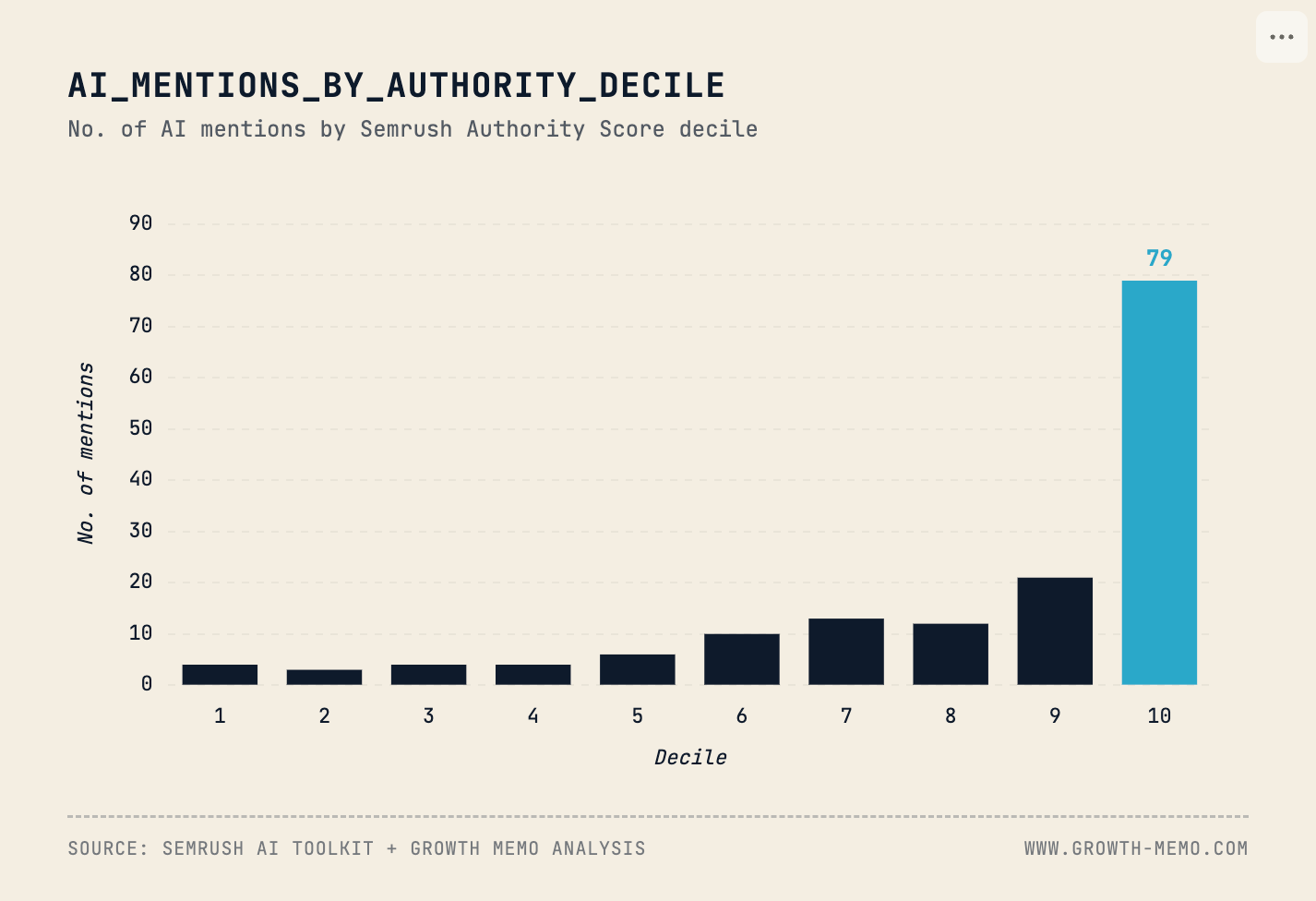
Why it matters: A “little more” third-party authority in a crowded middle tier probably won’t change how often AI cites you. The thing that changes citation is getting into the top tier of authoritative sources for your topic.
Read alongside the topic finding, the move is clear. Depth in your topic’s top-tier sources beats spread. Three placements in a top-decile source move you more than a dozen scattered across low-authority sites. That’s where you invest.
One question stays open: whether citation rises smoothly with mentions or trips past a tipping point, a volume of in-topic mentions after which a brand gets cited consistently instead of occasionally. We don’t know yet. More data and time will tell.
Whatever the tipping-point answer turns out to be, building authority through authoritative third-party sources in your topic is not an open-ended ask to your executives. It’s a target you can budget for and measure against.
How to build authority in the sources AI cites for your topic
Not every third-party signal carries equal weight. A research publication picked up across high-authority industry blogs likely moves citation more than a few executive podcasts a year, while YouTube remains an exception across LLMs. (UGC will be tackled in a later post as part of this building authority series.)
Test these moves, in order.
1. Pick 2 to 3 willing SMEs
They don’t need an existing audience, and they don’t need to be a founder or on the executive team. They need:
- Credibility in your topic.
- Deep understanding of your brand and product.
- Willingness to publish.
Give them a process (and permission) to develop sharp, branded content with a strong point of view, tailored to specific personas.
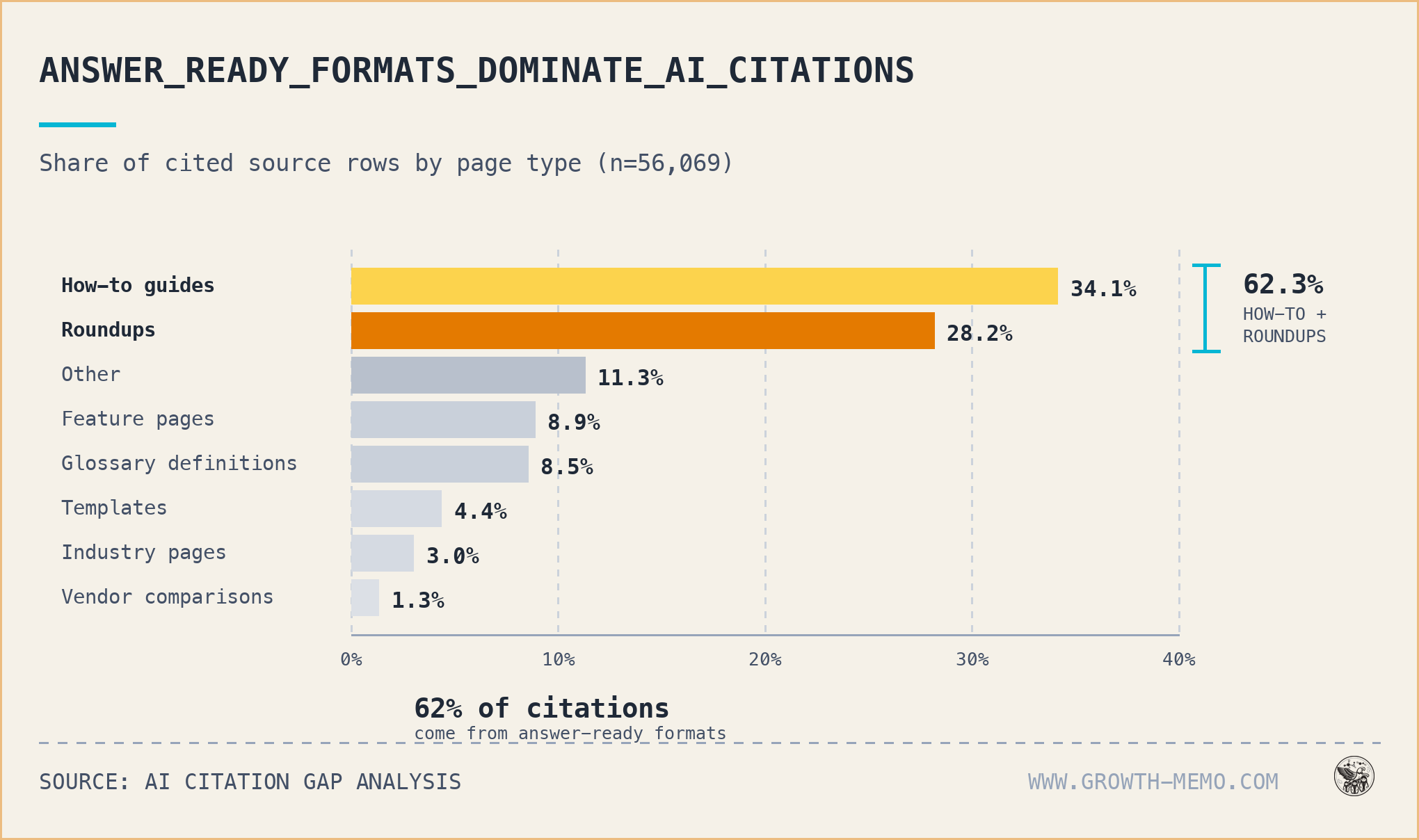
How-to guides and roundups together account for 62.3% of cited source rows (see chart below), so build your SME’s work in those shapes.
2. Map the set AI already cites, then target the entity, not the logo
Run your highest-intent prompts through an audience research tool like SparkToro and record which domains, social accounts, YouTube channels, and named authors show up. Do the same across AI search engines, and note overlap or inconsistencies in who gets cited and when.
Then chase the people, not only the publications. Get your SME quoted by the same journalist, booked on the same webinar series, or co-authoring with the author the model and your audience already trust. Co-occurrence with a trusted entity pulls you into the candidate set faster than a standalone post.
3. Concentrate on the authority tier
Depth beats spread: 3 placements in a top-decile source move you more than a dozen scattered across low-authority sites. Rank your target set by authority and spend there first. Use tools like Qwoted and HARO to discover opportunities.
4. Mine nofollow on purpose
Don’t skip these. The Semrush link study found nofollow pulls almost the same weight as follow for AI mentions (0.509 Spearman vs 0.504). They are easier to earn, and the models still count them. Build a list of the nofollow-heavy sources your category links to and pitch them deliberately.
5. Ship embeddable data under your expert’s name
Publish original charts and infographics bylined to your SME and let other sites embed them with attribution. One chart can earn citations across dozens of pages you never pitched. The format matters: AI leans hard on answer-ready pages.
6. Use LinkedIn as one fast lane
According to their own testing, named-author posts get indexed and surfaced quickly, and first-hand reports in our space describe brands entering AI answers within weeks of consistent publishing under a person rather than a page (sometimes days, depending on a built-in LinkedIn audience). Possible play: Partner with LinkedIn experts and influencers in your area of authority.
This post first appeared on the author’s website and is republished here with permission.
Contributing authors are invited to create content for Search Engine Land and are chosen for their expertise and contribution to the search community. Our contributors work under the oversight of the editorial staff and contributions are checked for quality and relevance to our readers. Search Engine Land is owned by Semrush. Contributor was not asked to make any direct or indirect mentions of Semrush. The opinions they express are their own.
