

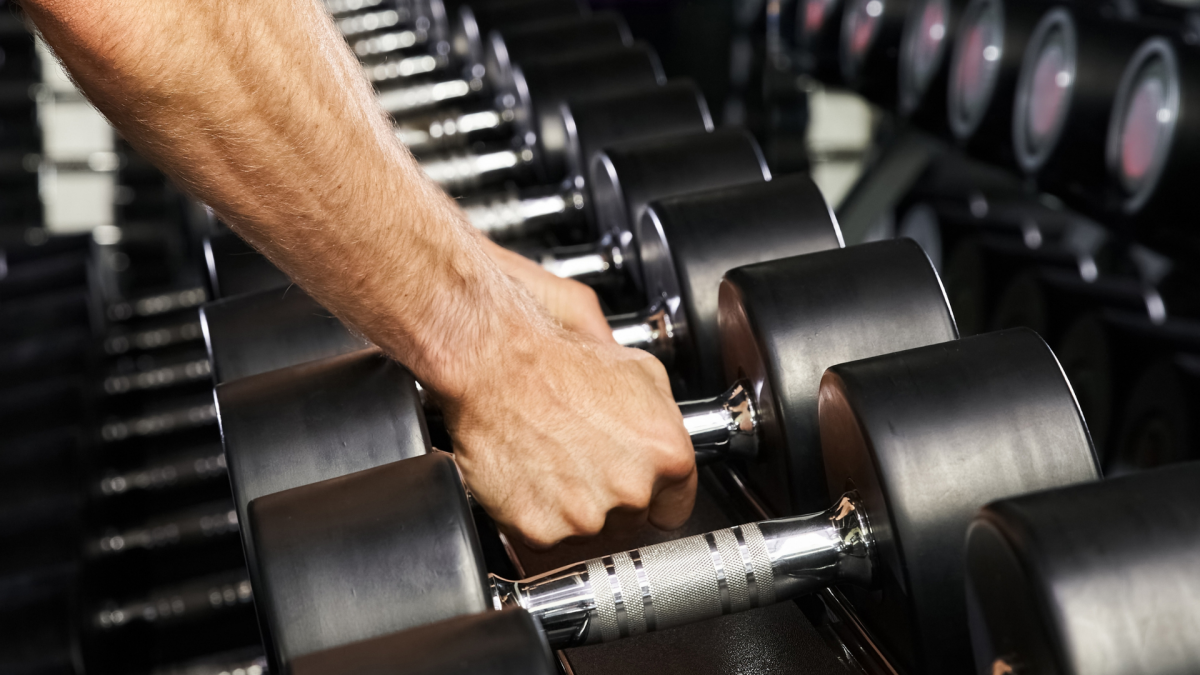
Most of us don’t do enough strength training to realize the health benefits it can bring. The American College of Sports Medicine has released a new guideline on strength training that gives more realistic advice than what you may have heard about strength training elsewhere. Aside from outlining the amount of training we need, the new guidelines also come with a few surprises, in the form of debunking many long-held “rules” of strength training. Among them: training to failure isn’t essential, and unstable surfaces aren’t necessary to improve your balance.
I keep seeing fitness professionals celebrating these new ACSM guidelines as a major improvement on previous advice. Certainly the new version gets more specific about how to achieve different benefits of training (like strength versus muscle size), but it also tells us how not to overthink the details. I’ll give the highlights below, and then you can read the press release and the full list of guidelines.
Why strength training matters
If you’re interested in fitness for its own sake, you should know that cardio and strength training are both important—you can’t just do one and ignore the other. But even if you’re only interested in health benefits, strength training is crucial.
I’ve previously written about the benefits of gaining muscle mass, which include improvements to your metabolism, overall health, and the ability to stay active and independent as you get older. The ACSM writes in its paper that resistance training (its preferred term for what I call strength training) has positive effects on health outcomes, including cardiovascular disease, cancer, diabetes, depression, and sleep quality.
How much strength training to plan for
We should all be doing some strength training, as all exercise guidelines tell us. (Specifically, here are the most recent U.S. guidelines, which advise that we all strength train twice a week.) The ACSM agrees with the minimum of twice per week, per muscle group. That means you can do a full-body workout twice a week, or split up your workouts so that each muscle gets at least two days of work.
Six things not to overthink when strength training
I find that some of the most interesting things in the new ACSM guidelines are where it tells us what not to worry about. According to the evidence the authors have reviewed, there’s a lot of stuff that isn’t conclusively supported, and you can safely stop worrying about it:
-
Training “to failure” isn’t necessary. You don’t have to keep going with an exercise until you physically can’t. You should work pretty hard, but hitting the point of failure is not critical.
-
Instability training isn’t better for balance. You don’t need to stand on unstable surfaces to train your balance; balance gets better as people get stronger, regardless of whether they used stable or unstable surfaces to train.
-
Time under tension isn’t important. Some gym bros will tell you that the amount of time your muscle spends doing an exercise is the most important thing, and thus slow reps are better than fast ones. The ACSM review did not find any benefit of maximizing time under tension for either strength or muscle growth.
-
Beginner/intermediate/advanced routines aren’t needed. The same basic advice applies to everyone, the ACSM concludes. That doesn’t mean you have to train the same way as an advanced lifter as you did as a beginner, but it also means you can just keep doing what works for you as long as it’s working.
-
Any equipment you use to strength train is fine. Gym workouts, home workouts, resistance bands, bodyweight exercises—anything that gives you a good strength workout is fine. You should make sure you can do challenging sets of exercise with whatever you choose, but there’s no inherent reason to prefer barbells over, say, resistance bands at home.
-
Progressive overload isn’t always needed. This will be a shocker to a lot of fitness buffs! Gradually increasing the difficulty of your workouts is a way to get stronger, but it’s not always necessary to get the basic health benefits. That said, if you start out with very light or easy exercises at the beginning, you’ll need to increase the difficulty to make sure you’re training hard enough.
Ultimately, the guidelines emphasize that doing something is better than nothing, and that finding something you will stick to is more important than optimizing the details of your routine. Only about 30% of us do any strength training twice a week, and that number may be as low as 10% for older people.
What do you think so far?
How to meet your strength training goals, according to the ACSM
Here’s the basic breakdown that the ACSM gives for different goals:
-
For strength, lift heavy loads (at least 80% of your one-rep max) for at least 2 to 3 sets per exercise.
-
For muscle gain (hypertrophy), aim to get 10 sets of strength exercises per muscle group, per week.
-
For power (explosiveness), use loads that are between 30% to 70% of your one-rep max, and try to move the weight as fast as possible during the concentric (lifting) portion of the exercise.
If you’ve never thought of these things separately, let me break them down:
-
Power is probably the easiest to ignore, but as exercise scientist Jason Sawyer told Medical News Today, it’s one of the things older adults lose fastest, and rarely train. Power refers to how fast, or how explosively, you can contract a muscle. Jumping onto a box is an exercise that works on power in your legs; standing up a barbell squat as quickly as possible is another power exercise for the legs.
-
Strength is pretty much what it sounds like—the ability to handle heavy weights or to apply a lot of force. The stronger you are, the easier it will be to carry a child or a bag of dog food or cement (to put it into real-world terms).
-
Hypertrophy refers to building muscle. We all lose muscle as we age, so some amount of hypertrophy training is helpful to counteract that trend. Muscle tissue is good for our body, including our metabolism, as I’ve told you before.
You can work on all three of these areas by using a variety of exercises and loads, but you may find it simplest to focus on one of them at a time.
