

For a long time, SEO had the simplest math in marketing:
- Rank higher → Get more traffic → Fill the sales pipeline
To the dissatisfaction of marketing executives, that linear world is breaking fast.
Between AI Overviews, zero-click SERPs, and users getting answers directly from LLMs, the old “rank to get traffic and leads” equation is failing.
Today, holding a top keyword position often yields significantly fewer clicks than it did just two years ago.
This has forced many uncomfortable conversations in boardrooms. CMOs and CEOs are looking at traffic dashboards and asking tough questions, especially:
- “If traffic is down… how do we know SEO is actually working?”
The answer forces us to confront a hard truth: The traffic model has collapsed, but executives still want measurable ROI.
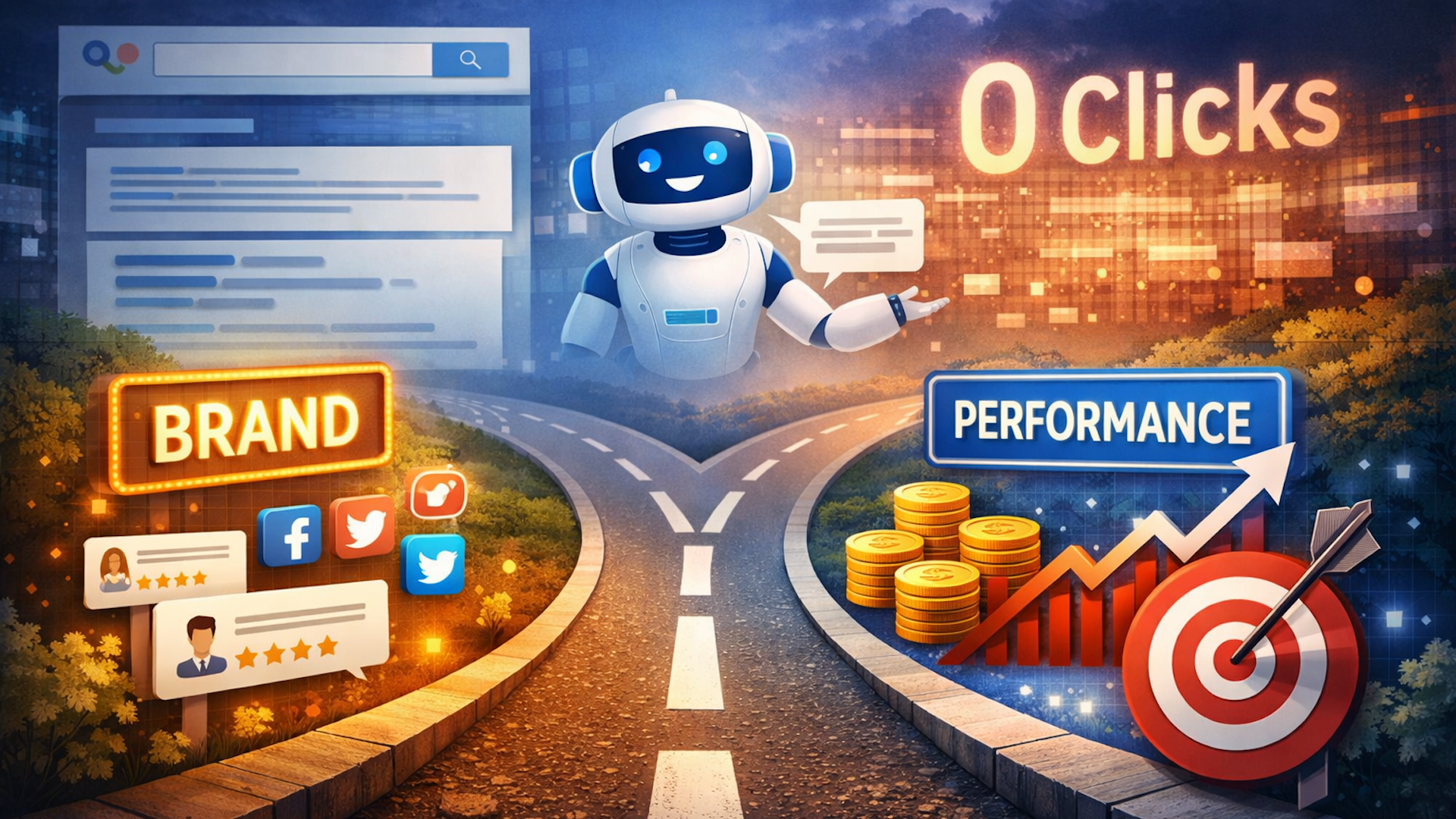
We have to stop treating SEO like a traffic faucet and start treating it like what it actually is: a brand-dependent performance channel.
Why traffic and pipeline are no longer in lockstep
Linear attribution has never fully captured the reality of organic search.
ChatGPT is not replacing Google; rather, it is expanding its use.
And that’s because users are skeptical of search and LLM results, so they need to validate the information they find on both platforms.
In the past, the research loop happened inside Google’s ecosystem (clicking back and forth between results).
Today, organic search behaves like a pinball machine. Buyers bounce across channels and interfaces in ways that traditional attribution software cannot track.
A user might find an answer in an AI Overview, verify it on Reddit, check a competitor comparison on G2, and finally convert days later via a direct visit.
This complexity has broken the correlation marketing executives are hungry for.
In the past, if you overlaid traffic and pipeline charts, the lines moved together. Now, they often diverge.
Across B2B SaaS portfolios, I am seeing a consistent pattern:
- Organic sessions are flat or declining year over year.
- Rankings for high-intent terms remain stable.
- Pipeline and inbound demos from organic search are going up.

Dig deeper: How to explain flat traffic when SEO is actually working
This divergence doesn’t mean SEO is failing. It means that traffic is no longer a reliable proxy for business impact.
The traffic being lost to zero-click searches is often informational and low-intent. The remaining traffic is higher-intent and closer to conversion.
We are witnessing the “atomization” of search demand.
As Kevin Indig notes in his analysis of The Great Decoupling, demand for short-head, broad keywords is in permanent decline.
Users are either bypassing search entirely for AI interfaces, or they are refining their queries into specific, long-tail questions that have lower volume but significantly higher intent.
The “fat head” of search – the generic terms that used to drive massive vanity traffic – is being eaten by AI. The long tail is where the pipeline lives.
The mistake many leaders make is seeing the sessions drop and instinctively pushing to “get the numbers back up.”
But chasing lost clicks usually leads to publishing broad, top-of-funnel content that inflates session counts (and other vanity metrics) without actually driving qualified leads.
Dig deeper: How to align your SEO strategy with the stages of buyer intent
Get the newsletter search marketers rely on.
SEO ROI is now the downstream outcome of brand traction
This is where the debate between “brand” and “performance” breaks down.
For a decade, SEO masqueraded as a pure performance channel.
We convinced ourselves that if we just optimized the H1s and built enough backlinks, we could rank for anything.
We treated brand awareness as a nice bonus, but not a prerequisite.
In reality, SEO has always been downstream of brand. AI interfaces are simply exposing that truth.
The rise of LLM-based search has flipped the script. These engines don’t just match keywords to pages; they synthesize reputation.
When an LLM constructs an answer, it is looking for verification across the entire web:
- What do actual customers say on G2 and Reddit?
- Is the brand cited in expert, non-affiliate content?
- Is the product mentioned alongside category leaders?
You cannot brute-force these outcomes via SEO techniques.
If your brand lacks digital authority, no amount of technical optimization will save you. That is why I call this brand-conditioned performance.
It means that your brand strength sets the ceiling for your organic performance. You can no longer out-optimize a weak reputation.
The search engines are looking for consensus across the web, and if the market doesn’t already associate your brand with the solution, the algorithm won’t recommend you.
So, what does brand strength actually mean to an LLM? In this new environment, brand strength is composed of four specific signals:
- Topical authority: Do you own the complete conceptual map of your industry, or just a few disconnected keywords?
- Ideal customer profile (ICP) alignment: Are you answering the specific, messy questions your actual buyers ask, or just publishing generic definitions?
- Validation: Are you cited by the category-defining sources that LLMs use as training data?
- Positioning clarity: Can an AI clearly summarize exactly what you do? As Indig points out, “Vague positioning gets skipped; sharp positioning gets cited.”
Bottom line: SEO doesn’t create demand out of thin air. It captures the demand your brand has already validated.
Dig deeper: The new SEO imperative: Building your brand
The new defensibility metrics for SEO
When traffic stops being the headline KPI, leadership still needs proof that SEO is working.
The strongest teams are pivoting to defensible signals that track revenue and reputation rather than just volume.
We need to anchor on metrics that prove business impact, even if top-of-funnel sessions are leaking:
- Top-10 rankings for commercial and BOFU keywords remain stable. (You hold the ground where money changes hands).
- Ahrefs traffic value increases, even if sessions decline. (You are trading high-volume informational traffic for high-value commercial traffic).
- Product, solution, and comparison page traffic stabilizes. (Buyers are still finding your money pages).
- Homepage traffic grows YoY. (The strongest proxy for brand demand).
- LLM referral traffic emerges and accelerates. (The newest frontier. Tracking referral sources from ChatGPT, Gemini, or Perplexity indicates that you are part of the new conversation, even if the volume is currently low.)
- Inbound demos and pipeline from organic growth relative to traffic.
That last point is the one that changes executive thinking.
When you show that pipeline per organic visitor is rising – even as sessions fall – the conversation shifts from “SEO is broken” to “SEO is evolving.”
Dig deeper: Why AI availability is the new battleground for brands
Modern SEO is moving from acquisition to influence
The most successful SEO teams are no longer asking, “How do we get the traffic back?”
They understand that the game has changed from acquisition to influence.
They are asking:
- How does our brand show up for buying questions?
- How do we dominate consideration-stage queries?
- How do we turn organic visibility into real buying influence?
They recognize that in an AI-first world, zero-click does not mean zero-value.
If a user sees your brand ranked first in an AI Overview, reads a snippet that positions you as the expert, and remembers you when they are ready to buy – SEO did its job.
SEO is no longer a hack for cheap traffic; it is the primary way brands condition the market to buy.
Contributing authors are invited to create content for Search Engine Land and are chosen for their expertise and contribution to the search community. Our contributors work under the oversight of the editorial staff and contributions are checked for quality and relevance to our readers. Search Engine Land is owned by Semrush. Contributor was not asked to make any direct or indirect mentions of Semrush. The opinions they express are their own.
