

Can “vibe coding” truly democratize game development? This was the central question I was left with after a weekend spent testing the latest iterations of LLMs, from Codex to Google Antigravity and Claude Code. After Claude demonstrated a surprising edge in spinning up a functional Python-based platformer with very limited context, I decided to push the experiment a little further.
This time would be a little different, though. Instead of acting as a proctor, I would act as a collaborative partner, providing a bit of fine-tuning wherever I deem necessary. The results, well, were nothing short of striking, and it’s hard to attribute such a smooth and enjoyable gaming user experience to someone who didn’t spend any time writing a line of code.
Establishing the ‘minimum context’ baseline
How well does the model perform with a basic outline?

To get started, I had to establish what I call the ‘minimum context baseline’ to see how effectively Sonnet 4.6 could take a raw feature list and turn it into a playable prototype, without any hand-holding. My earlier experiments revealed that Claude performs remarkably well under this condition, so I decided to give it a run with a basic prompt.
“Create a functional platformer game using Python 3 and Pygame featuring a playable cat as the protagonist. It should include gravity-based jumping, left/right movement, and a projectile-based combat system. Enemy AI should be other “Pirate Cats” that roam back and forth on their designated platforms. Level design should include static platforms and moving platforms that oscillate horizontally or vertically. Include a basic game loop with a “Game Over” screen if an enemy is touched thrice and a ‘Win’ condition (example, reaching an object on the map). Use a class-based approach, with distinct classes for enemies, players, platforms and projectiles.”
Although this may sound excessively wordy or context-rich for an initial prompt, these details are essentially the natural language shorthand required for the model to register exactly what’s under the works. Through various experiments, I’ve found the level of detail to be the functional “sweet spot” for Sonnet 4.6 to respond as intended. As expected, the prompt yielded a skeletal structure of a game, with a little more than blobs for characters. Only some of the minor details from the prompt seemed to reflect, but this was expected. Impressively enough, though, the controls for traversal, physics, enemy AI, and win and lose conditions worked as intended, which was a solid foundation to work further upon.

I finally found a local LLM I actually want to use for coding
Qwen3-Coder-Next is a great model, and it’s even better with Claude Code as a harness.
Then came the fine-tuning
Could it get better?

The next logical step in the evolution of the platformer was to collaborate further with the model, through meticulous fine-tuning. I began with a light nudge, asking the model to “make light enhancements to character sprites” and “aesthetically improve UI elements”; both of which were the glaring issues with the game at this point.
The results did represent a major aesthetic leap from where I began. The little “amorphous” blobs finally began to take shape, and the character sprites began to bear the semblance of the characters I had envisioned. Another striking improvement, however, were the UI elements. The model replaced the numeric “lives” counter with a classic “hearts” system, which made it look far less like a prototype.
The overall design still had a ways to go, though, and it would take an incredibly incompetent developer to assume the game was anywhere near completion, especially when I’m dropped straight into gameplay without a title screen or on-screen prompts telling me what to do, or how to progress.
Finally, it was time for the major “vibe-coded” overhaul
Going from “prompt to prototype”
The final touches were the ones that perhaps afforded the game the most definitive “upgrades”, representing the peak of what I could achieve purely through vibe-coding. For this, I pushed the model to “transform this into a complete, polished, 90s-inspired retro arcade experience, with all the bells and whistles, including a title screen.”
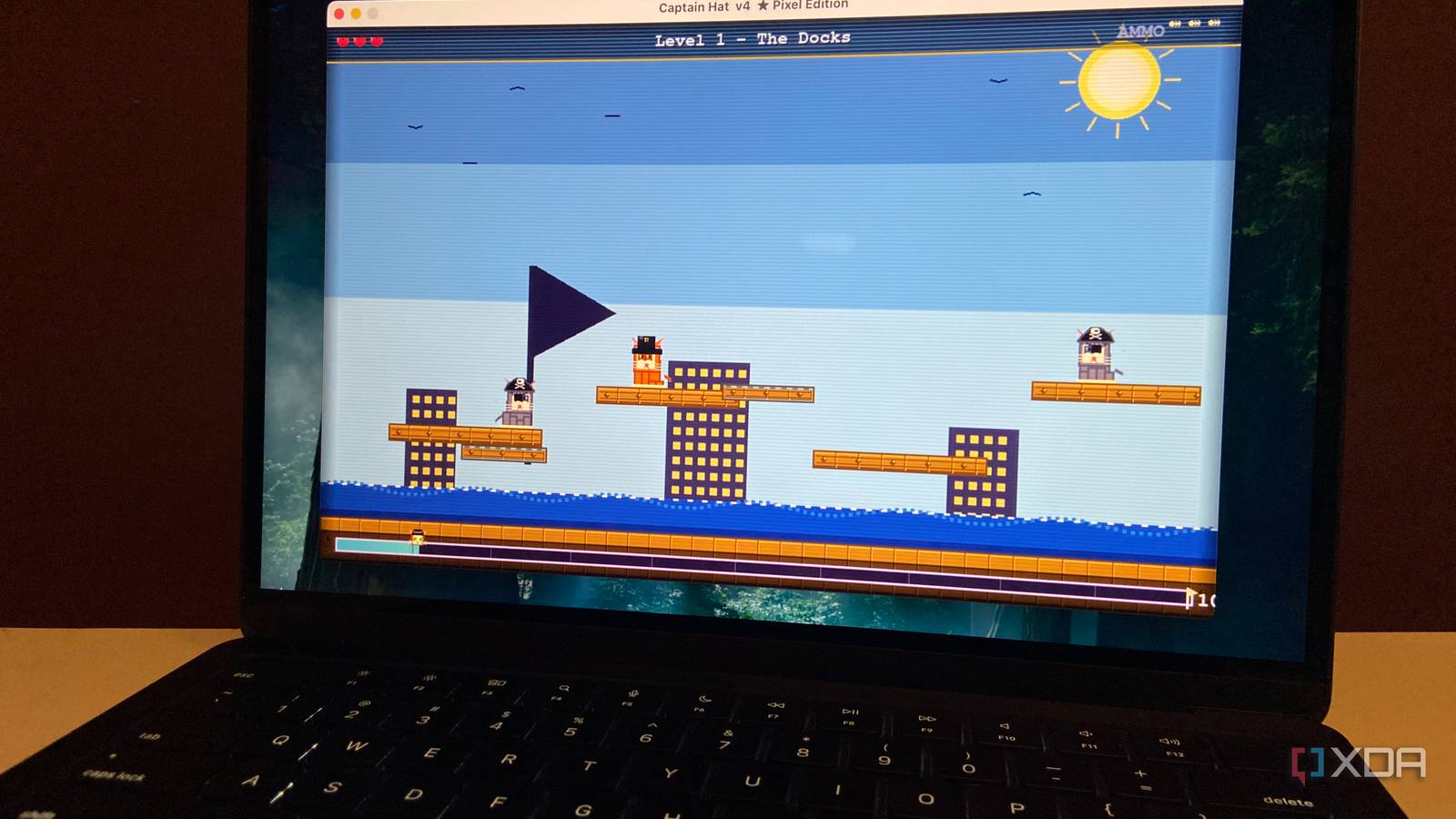
Needless to say, Sonnet 4.6 delivered and exceeded expectations in all respects. Perhaps the first and the most noticeable was how different the game environment felt. With the inclusion of CRT scan lines to add to the “retro” vibe (which, the model surfaced entirely on its own), the visual fidelity went from “passable” to something you’d expect to encounter in an old arcade parlor. The characters felt alive, and both the protagonist and pirate cats now had lively walk cycles and expressive, shifting eyeballs that made the world feel reactive and alive.
The UI elements surpassed expectations, too. The bottom of the screen now included a clever progress indicator that featured a small icon of the cat’s face, tracking my journey across the map in real time. The top right also included some neat additions, where I noticed that ammo was now exhaustible. The numeric life indicators were replaced in favor of three vibrant hearts, too.
I was without doubt that, with three distinct (and glitch-free, I might add), this was as close to a finished game as I could realistically “vibe-code”.
While Claude Code certainly is, by no means, a replacement for creative development process, it does a pretty convincing job being a catalyst for it.
A catalyst, but not a crutch
After exhausting several session limits on Claude’s free tier, the promise of “vibe-coding” seems undeniably effective. For the right person with the right skill set, I can see it acting as a productivity multiplier, solving complex problems one would otherwise spend a long time scratching their head over. While it certainly is, by no means, a replacement for creative development process, it does a pretty convincing job being a catalyst for it.
