

By now, you probably know that batteries are consumable components that degrade over time. Even if a battery is rechargeable, it will eventually lose capacity and stop working with enough normal usage. For consumer electronics, that’s a problem. If a battery-powered device isn’t designed with repair and replacement in mind, it’s destined to end up in a recycling center (or worse, a landfill) sooner rather than later. While phones, tablets, and laptops are engineered to make battery replacements possible, wireless earbuds have historically been a repair disaster.
Your favorite wireless earbuds are built using soldered connections, water-resistant seals, and tons of glue. The most popular models, including AirPods, aren’t designed to be repaired when the battery dies — they’re designed to be replaced. With small batteries, you’ll start to feel the effects of battery degradation sooner. Even if you take your earbuds to get “repaired,” the company is probably just replacing your earbuds with a new pair. Unless you buy one with repairability in mind.
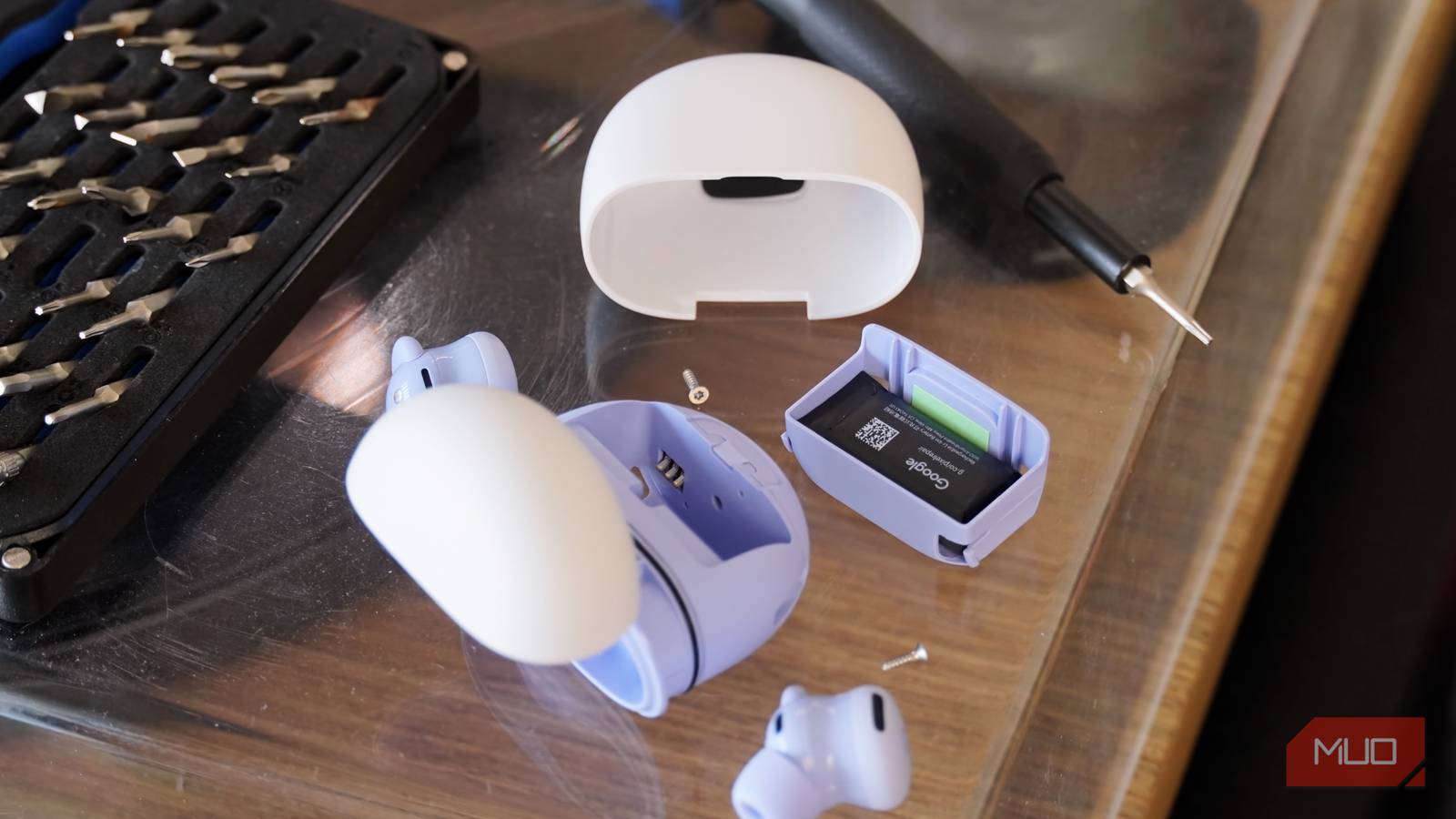
The Google Pixel Buds 2a aren’t perfect. They feature tiny earbuds with minuscule batteries secured by adhesive that can’t be replaced. However, Google did something special while making the charging case. It sports a removable battery held in place by only two screws — no glue — that takes minutes to replace. So, I did just that.

I Love Earbuds, but They Have These 5 Undeniable Problems
As convenient as earbuds are, they’re certainly not perfect.
Wireless earbuds are a ticking time bomb
Their batteries will die, expand, or explode — and there’s no replacing them
The overwhelming majority of wireless earbuds are, for all intents and purposes, disposable. When their batteries die, they die. That’s the opposite of what you want from a consumer electronics device. Your phone, for example, doesn’t have to die when its battery degrades. A simple ~$100 replacement a few years into ownership can easily extend your smartphone’s life by another couple of years. As long as replacement parts remain available, you can keep a phone, tablet, or laptop alive. It’s a completely different story for wireless earbuds.
Only a handful of wireless earbuds have even tried to offer repairability as a feature. Samsung’s Galaxy Buds Live featured replaceable batteries, but newer Galaxy Buds models proved them to be a fluke rather than a trendsetter. Fairbuds, made by the company behind the repairable and private Fairphone 6, are even easier to repair. However, name a pair of wireless earbuds from any popular brand in 2026, and you’ll be hard-pressed to find any semblance of battery repairability.
In a functional sense, this means that your earbuds eventually won’t hold a charge. If a pair lasts for six hours on a charge today, it’ll lose capacity over time, until that capacity is zero. Worse, you can expect batteries to occasionally expand or even combust during the degradation process. That’s why it’s crucial for companies to design and consumers to buy products that actually make battery replacements easy.

I was checking my old tech cupboard, and what I found was horrifyingly dangerous
There is an old device, hidden in your cupboard, and it needs sorting.
The Pixel Buds 2a are trying to change that
I took out the case battery in less than a minute
When you open the Google Pixel Buds 2a, you’ll notice something odd. Remove each earbud, and there are two T5 Torx screws completely exposed. This is unusual — most companies do everything they can to hide screws or avoid using them at all. Make no mistake, this is a good thing. It’s a preview of the Pixel Buds 2a’s best hidden feature, which is the user-replaceable case battery. Aside from the charging case battery, the USB-C connector board and bottom shell can also be replaced.
It’s seriously impressive how easily the Pixel Buds 2a battery can be removed. It can be taken out in seconds and the entire battery replacement only takes a few minutes. I unscrewed the two T5 Torx screws, and used a magnetic bit to pull them out of the way. Without one, you might need to flip the case over for the screws to drop out. The bottom shell then slides clean off with no force required. I pulled the green tab on the back of the battery compartment with a bit of force, and the charging case battery popped out.
The removal process is really that quick. If you don’t believe me, check out the official Google Pixel Buds 2a repair manual (Warning: download link) for yourself. To complete the replacement, simply follow the steps in reverse.

I found the best budget Android phone and earbuds combination, and it’s glorious
Samsung and OnePlus put forward valiant efforts, but nothing can beat the Google Pixel 10a and Pixel Buds 2a.
Repairability is the Pixel Buds 2a’s best feature
Being able to replace the charging case battery is an incredible perk

To complete the battery replacement, you need a new one to swap in, and that’s the best part. Google sells Pixel Buds 2a charging case batteries at iFixit for just $30. That’s the price for an official Google battery in new condition, complete with the battery compartment that slots right into the Pixel Buds 2a charging case. The earbuds just came out last year, and the batteries are already available. This is crucial, because a device’s potential to be repaired is only useful if you can find official parts and repair manuals.
While almost every other brand is chasing higher sound quality or better ANC, Google is after something much more grounded. The Google Pixel Buds 2a have a charging case that’s built to last thanks to easily replaceable batteries. My hope is that Google one day designs the earbuds themselves to be just as repairable as the charging case, but this is a superb start. If you’re interested in owning tech that has a chance at standing the test of time, consider the Pixel Buds 2a for this niche feature alone.

- Microphones
-
2
- Charging
-
USB-C
- Driver size
-
11 mm dynamic speaker drivers
- Chip
-
Google Tensor A1
- Bluetooth
-
Bluetooth 5.4
The Pixel Buds 2a are Google’s cheapest earbuds, and they offer solid sound quality and ANC for the price. They’re powered by the same Google Tensor A1 chip you’ll find in the more-expensive Pixel Buds Pro 2. You get custom-designed 11mm dynamic audio drivers and up to seven hours of listening time with ANC active.
