

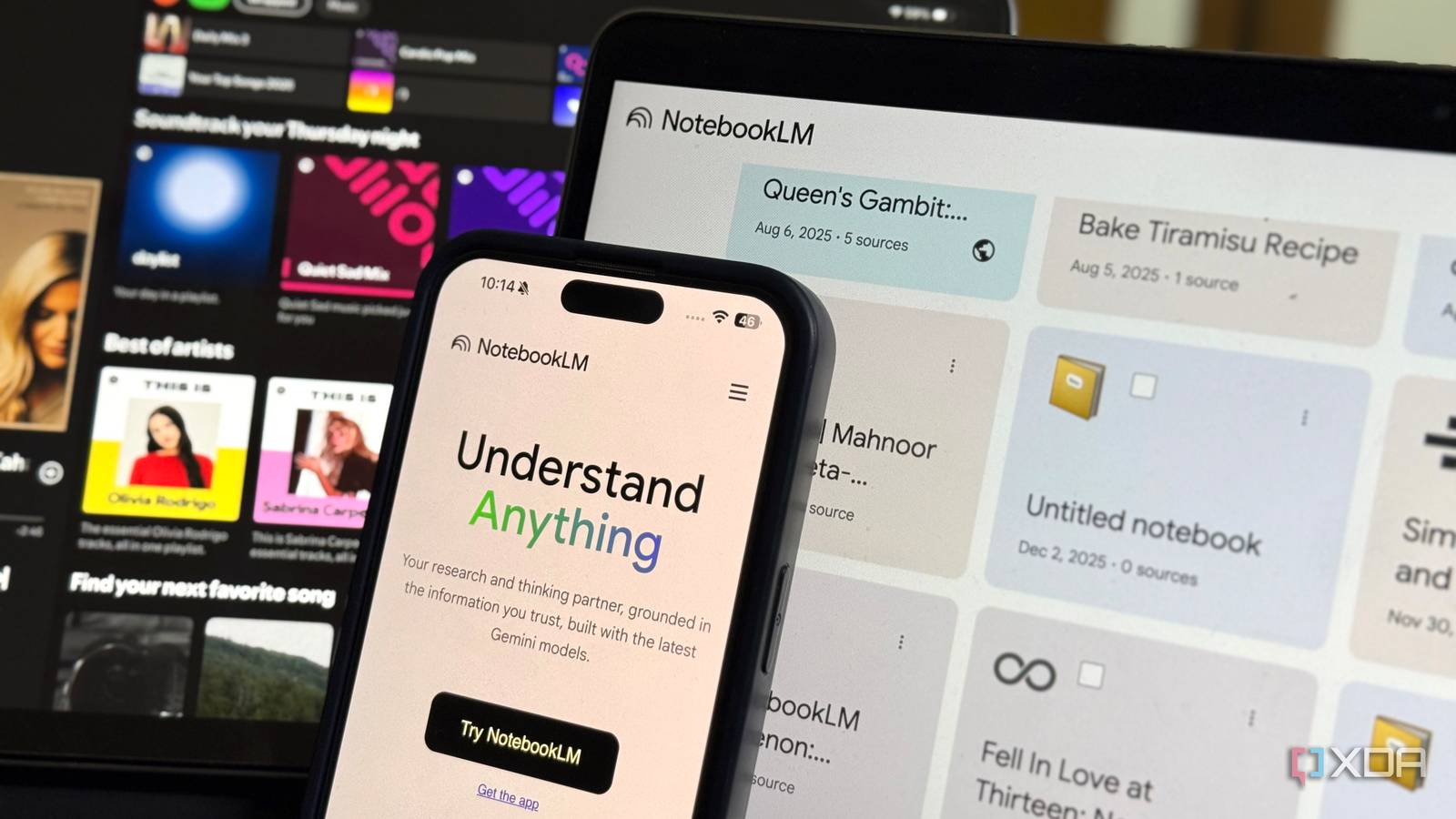
NotebookLM is the one AI tool I never get tired of talking about. It’s unlike anything else I’ve tried. It serves a genuinely unique purpose and isn’t trying to cram every trending feature into a single tool. Instead, every update feels intentional, and it just keeps getting better in ways that actually matter.
A personal knowledge base is absolutely essential for me, and I’ve been exploring ways to AI-fy mine for months now. I settled on using NotebookLM as my go-to hub for it. After spending time building it out, I’m more convinced than ever that it was the right call.
NotebookLM is the perfect searchable knowledge base
No more playing keyword roulette
A knowledge base is essentially a place where you dump information and then retrieve it. For me, searchability is a major part of what makes a knowledge base actually useful. If you can’t find what you need when you need it, you just have a place where you’re dumping links and notes…and that’s it. If you need to spend time sifting through each link trying to find the one thing you’re looking for, your knowledge base isn’t really doing its job.
The reason why NotebookLM works incredibly well as a searchable knowledge base links heavily back to this. Most tools still rely on keyword search, folders, and tags. I’m not saying these aren’t important (and I wish NotebookLM had better organizing features), but they only get you so far. For keyword search to work, you need to remember the right keywords. With tags and folders, you need to know exactly where you added something to be able to retrieve it later.
Now, my memory is worse than a goldfish’s. Keyword search has seldom worked for me for this reason, and I’ve had to spend so much time playing a guessing game by entering every possible keyword I can think of until something finally comes up.
With NotebookLM, this isn’t a problem. You can just ask a question in plain language, and it’ll pull the relevant information directly from your sources. Every answer includes citations pointing to the sources NotebookLM picked the information from, too — which makes the AI-searching aspect a lot easier to trust.
Mind maps help you see how your knowledge connects
Your notes can talk to each other

Beyond being able to find the information you save a lot quicker, NotebookLM also has excellent features that help you find how all your sources connect (which is another key quality of a great knowledge base). Once you’ve stored and retrieved your information, you also need to understand how all your knowledge fits together. I find the tool’s Mind Maps feature particularly useful for this.
If you’re familiar with Obsidian’s Knowledge Graph, it’s a similar concept — essentially a visual map of how your ideas and sources relate to each other. The Mind Map is completely interactive, and you can click on any of the nodes generated to get an in-depth summary about it. You can even ask follow-up questions from there, which makes it incredibly simple to dive deeper into a specific connection.
The Mind Maps feature is perfect for when you have a content-heavy notebook and need to figure out how your sources work together. There have been a few times when NotebookLM has helped me find connections I’d have completely missed otherwise, and I think it’s a perfect example of how AI is actually meant to work into your workflow.
Cinematic Video Overviews turn my own knowledge into mini videos
YouTube-quality explainers, but with your own stuff
The next NotebookLM feature that makes it the perfect tool for building a knowledge base is its newly launched Cinematic Video Overviews. If you’ve used NotebookLM before, you’ve definitely used the Audio Overviews feature that lets you convert your sources into full-fledged engaging podcasts at least once. Video Overviews is Google’s extension of the same concept and turns your sources into short videos that walk you through the key ideas instead of a podcast!
While the podcast feature has been my go-to for learning passively on the go, I’ve always found it easier to retain information when I’m watching videos, and Video Overviews fits that perfectly. Instead of asking text questions and then having a back-and-forth conversation with NotebookLM to understand a specific source, I’ve been generating Video Overviews to get a quick, digestible walkthrough of a source before diving deeper into it.
Two months ago, if you told me to do this, I’d simply say no (despite how much I love NotebookLM). That’s because the tool hadn’t launched its Cinematic Video Overview feature back then, which uses three Google AI models to generate the visuals, narration, and structure of the actual video.
Before this launch, NotebookLM Video Overviews were essentially slide decks with a narration on top of them — and it felt more akin to a professor reading out lecture slides! The Cinematic Video Overviews, though, feel like a video you’d find on a YouTube explainer channel and just feel more polished overall. They have fluid animations, relevant visuals, and smooth transitions that actually make you want to keep watching. This is a feature I’m betting you won’t find in any other app that people use to build knowledge bases, yet it adds so much value to the system and brings it all together.
The only complaint I have with this feature is that the limits are quite disappointing, to say the least. It was initially restricted to Google AI Ultra users, and users on the AI Pro plan can currently only generate two Cinematic Video Overviews daily. Unfortunately, it’s also not available on the free NotebookLM tier just yet.
NotebookLM has a lot more to offer
Source-grounded knowledge bases, AI-powered search, Mind Maps, and Video Overviews are just a few of the reasons why I think NotebookLM is the best tool for building a personal knowledge hub! We at XDA absolutely love the tool and have plenty of coverage about it that should help you keep up to speed.
