

This is part one of a three-part series on how HubSpot transformed with AI. Part two covers how we grow with Agent-first GTM. Part three is how we operate as an AI-first company.
Everything we build at HubSpot exists to help our customers grow. So when generative AI emerged, our engineering team didn’t just see a productivity tool; we saw an opportunity to build better products and get more value into customers’ hands sooner.
And when off-the-shelf AI tools hit their ceiling, we didn’t just look for better ones. We built the platform underneath them. That decision compounded faster than we expected. Because all of our AI is built on a shared foundation, every new capability we ship makes the whole system more powerful and customers get a more consistent experience across everything they use.
Today, we’re able to innovate at a pace that simply wasn’t possible before. 100% of our engineers use AI, and we’ve seen a 73% increase in lines of code written by our engineers.
We didn’t get here overnight. It took three phases, real infrastructure investment, and a willingness to build what didn’t exist yet. Here’s how we did it.
Phase 1: Productivity with Co-pilots (2023-2024)
In 2023, large language models had just crossed the threshold of being genuinely useful in a coding context. The best solution for using AI in engineering was to start with what was proven. At that time, it was code completion: a human writes code, and AI copilots suggest what comes next.
We rolled out a coding copilot and got to 30% adoption quickly. Then we pulled the incident data, compared teams using the copilot against teams that weren’t, and proved AI adoption did not negatively impact the reliability of the product.
With that data in hand, we removed the guardrails and gave everyone copilot access. Adoption shot past 50% overnight. This taught us a lesson in how we make decisions. Measure, prove, then scale.
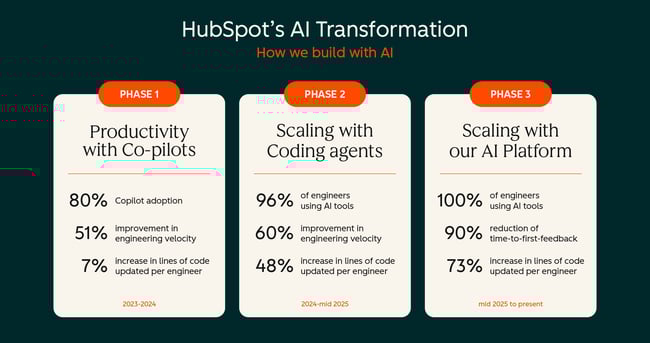
By the end of Phase 1, 80% of engineers were using AI tools. We saw a 51% improvement in engineering velocity, meaning engineers were shipping working code to production significantly faster, and a 7% increase in lines of code updated per engineer. We proved AI could make every engineer faster without compromising product reliability.
Phase 2: Scaling with Coding Agents (2024-Mid 2025)
The next step was autonomous coding with agents. Our teams could prompt the tools to complete end-to-end tasks. The agents could read context, write code, run tests, and fix errors, all while the engineer reviewed and steered. We felt strongly this was the future of engineering and committed fully.
The real constraint came quickly. Off-the-shelf coding agents could not access internal build systems, our libraries, or verify that code actually worked in our environment. So, we built those agent integrations ourselves using MCP, a standard that allows AI agents to connect to external tools and systems, and deployed them to every engineer. To drive adoption, we organized events to give engineers dedicated space to learn, experiment, and build confidence with new tools. Agent usage went from zero to 80% adoption in a month.
The next challenge was scale. Engineers wanted multiple agents running in parallel, overnight, without supervision. So we built an agent execution platform on top of our Kubernetes infrastructure. Every agent runs inside an isolated container that replicates a real HubSpot developer environment. Agents compile the code, run automated tests, read error outputs, and iterate on their own until everything works. No human intervention required.
By the end of Phase 2, 96% of engineers were using AI tools, engineering velocity was up 60%, and lines of code updated per engineer had increased 48%. We were starting to ship better products faster with agents. But that was just the beginning.
Phase 3: Scaling with our AI Platform (Mid 2025-Present)
HubSpot’s platform approach to product development has always been how we’ve created more customer value. When we built reporting and automation at the platform level, we didn’t just ship one feature; we shipped that capability across every hub simultaneously. That’s how innovation compounds.
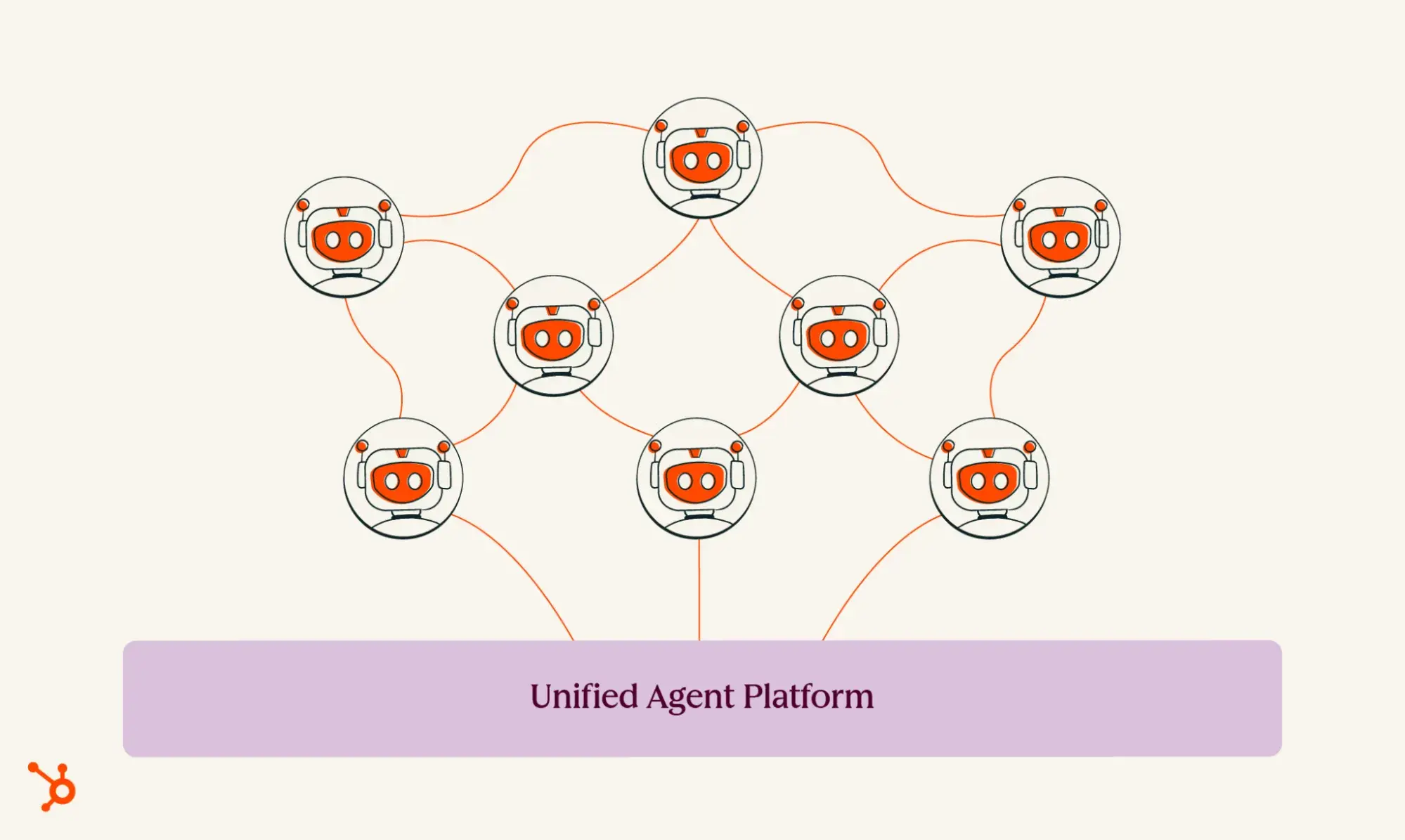
We applied that same logic to our AI infrastructure in Phase 3. Instead of building every agent from scratch, we built the shared foundation once: how agents access data, what actions they can take, how they connect to the rest of HubSpot. Everything runs on top of it.
The result is that all of our agents are interoperable. They speak the same language, share the same toolsets, and draw from the same context. A customer gets a consistent experience regardless of which agent they’re using because, underneath, they’re all built on the same infrastructure. And because they’re all connected, every new capability we add makes the whole system more valuable. That’s something a collection of point solutions cannot replicate.
And it was made possible by how we’ve scaled engineering with AI. Today, 100% of our engineers use AI, lines of code updated per engineer are up 73%, and time-to-first-feedback on pull requests has dropped by 90%. That means less time waiting and more time shipping things customers actually use.
Why this matters: Compounding customer value
Having the right infrastructure accelerates the pace of innovation. For HubSpot, every agent we build makes the platform more powerful. Every piece of context we add to the platform makes each agent more effective. For customers, that means the product keeps getting better, faster, and more connected.
What used to take months now takes weeks, and those weeks translate directly into new capabilities in the hands of marketers trying to reach the right audience, reps trying to close deals, and Customer Success Managers trying to retain customers. They don’t need to think about the platform underneath. They simply get to experience the result.
