


Search has changed, and so should your audience personas.
Your audience searches across Google, ChatGPT, Reddit, YouTube, and many other channels.
Knowing who they are isn’t enough anymore. You need to know how they search.
Search-focused audience personas fill gaps that traditional personas miss.
Think insights like:
- Where this person actually goes for answers
- What triggers them to look for solutions right now
- Which proof points win their trust
And you don’t need months of research or expensive tools to build them.
In this guide, I’ll walk you through nine strategic questions that dig deep into your persona’s search behavior. I’ve also included AI prompts to speed up your analysis.
They’ll help you spot patterns and synthesize findings without the manual work.
By the end, you’ll have a complete audience persona to guide your content strategy.
1. Where Is Your Audience Asking Questions?
Knowing where your persona hangs out tells you which channels influence their decisions.
So, you can show up in places they already trust.
It also reveals how they think and what will resonate with them.
For example, someone posting on Reddit wants honest advice based on lived experiences. But someone searching on TikTok wants visual content like tutorials or unboxing videos.

How to Answer This Question
Start with an audience intelligence tool that lets you identify your persona’s preferred platforms and communities.
I’ll be using SparkToro.
For this example, we’re building out one of Podlinko’s core personas: Marcus, a marketing professional on a one-person or small team team, so he’s scrappy and in-the-weeds.
In SparkToro, enter a relevant keyword that describes your persona’s professional identity or core interests.
This could be their job title, industry, or a topic they care deeply about.
I went with “how to start a podcast.” Marcus would likely search for this early in his journey.

The report gives a pretty solid overview of Marcus’s online behavior.
For example, Google, ChatGPT, YouTube, and Facebook are his primary research channels.

But it could be worth testing a few other platforms too.
Compared to the average user, he’s 24.66% more likely to use X and 12.92% more likely to use TikTok.

The report also tells me the specific YouTube channels where he spends time.
He’s watching automation, editing, and business tutorials.

He’s also active in multiple industry-related Reddit communities.
Maybe he’s posting, commenting, or even just lurking to read advice.

Since Marcus uses ChatGPT, I also did a quick search on this platform to see which sources the platform frequently cites.
I searched for some prompts he might ask, like “Which podcast hosting platforms should I use for marketing?”
If you see large language models (LLMs) repeatedly mention the same sources, they likely carry authority for the topic.
And by extension, they influence your persona’s research as well.

Compare these sources to the ones you identified earlier. If they match, you have validation.
If they’re different, assess which ones to add to your persona document.
Here’s how I filled out the persona template with Marcus’s search behavior:

2. What Exact Questions Are They Asking?
Your buyer persona’s language rarely matches marketing jargon.
Companies might talk about “podcast production tools” and “integrated workflows.”
But personas use more personal and specific language:
- What’s the cheapest way to record remote podcasts?
- How long does it take to edit a 30-minute podcast?
Knowing your audience’s actual questions reveals the gap between how you describe your solution and how they experience the problem.
And shows you exactly how to bridge it.
How to Answer This Question
Start by going to the platforms and communities you identified in Question 1.
Search 3-5 topics related to your persona.
Review the context around headlines, posts, and comments:
- How they phrase questions (exact words matter)
- What emotions do they express
- What outcomes they’re trying to achieve
For example, I searched “how to start a podcast for a business” on Google.
Then, I checked People Also Ask for related questions Marcus might have:

On YouTube, I searched “how to edit a podcast” and reviewed video comments.
Users asked follow-up questions about mic issues and screen sharing.
This gave me insight into language and questions beyond the video’s main topic.

In Facebook Groups, I found users asking questions related to their goals, constraints, and challenges.
It also provided the unfiltered language Marcus uses when he’s stuck.

Now, use a keyword research tool to visualize how your persona’s questions connect throughout their journey.
I used AlsoAsked for this task. But AnswerThePublic and Semrush’s Topic Research tool would also work.
For Marcus, I searched “Best AI podcasting editing software,” which revealed this path:
Which AI tool is best for audio editing? → Can I use AI to edit audio? → Which software do professionals use for audio editing? → How much does AI audio editor cost?

It’s helpful to visualize how Marcus’s questions change as he progresses through his search.
Next, learn the questions your persona asks in AI search.
You’ll need a specialized tool like Semrush’s AI Visibility Toolkit for this task.
It tells you the exact prompts people use when searching topics related to your brand.
(And if your brand appears in the answers.)
If you don’t have a subscription, sign up for a free trial of Semrush One, which includes the AI Visibility Toolkit and Semrush Pro.
Since Podlinko is fictional, I used a real podcasting platform (Zencastr.com) for this example.

This brand appears often in AI answers for user questions like:
- What equipment do I need to create a professional podcast setup?
- Can you recommend popular tools for managing and promoting online radio or podcasts?

You’ll also see citation gaps — questions where your brand isn’t mentioned. These reveal content opportunities.
For this brand, one gap includes:
“Which AI tools are best for recording, editing, and distributing an AI-focused podcast?”

After reviewing all the questions I gathered, I narrowed them down to the top 5 for the template:

3. What Challenges Influence Their Search Behavior?
Challenges are the ongoing issues driving your persona’s search behavior. These overarching problems shape their decisions to find a solution.
Understanding these challenges can help you:
- Position your solution in the context of these pain points
- Anticipate and address objections before they come up
- Structure your campaigns to speak directly to their limitations
How to Answer This Question
Review the questions you collected in Question 2 to identify underlying pain points.
For example, this Facebook Group post contains some telling language for Marcus’s persona:

Specific phrases highlight ongoing challenges:
- “Tech support is no help”
- Can’t find an editing software that consistently works”
Now, visit industry-specific review platforms.
Check G2, Capterra, Trustpilot, Amazon, Yelp, or another site, depending on your niche.
Look for reviews where people describe recurring frustrations.
Positive reviews may mention what drove a user to seek a new solution. For example, this one references poor audio and video quality:

Negative reviews reveal what users constantly struggle with.
Unresolved pain points often push people to find workarounds or alternatives.
This user noted issues with a podcasting tool, including loss of backups, unreliable tech, and more.

Pay close attention to the language people use. Word choice can signal underlying feelings and constraints.
When someone asks for the “easiest” and “most cost-effective” solution, they’re signaling:
- Limited resources
- Low confidence
- Risk aversion
After reviewing conversations and communities, you’ll likely have dozens of data points.
Copy the reviews, questions, and phrases into an AI tool to identify your persona’s top challenges.
Use this prompt:
This analysis helped me identify Marcus’s recurring challenges:

4. What Triggers Them to Search Right Now?
Search triggers explain why your audience is ready to take action.
But they’re not the same as challenges.
Challenges are ongoing constraints your persona faces. This could be a limited budget, small team, or skill gap.
Triggers are the specific events or goals that push them to act right now. Like a looming deadline or a competitor launching a podcast.
Understanding triggers helps you reach your persona when they’re most receptive.

How to Answer This Question
If you have access to internal data, start there.
Your sales and customer support teams can spot patterns that push prospects from browsing to buying.
For example, your sales conversations might reveal that one of Marcus’s triggers is urgency. His manager might ask him to improve the sound quality by the next episode, prompting his search.
If you don’t have internal intel, use tools like AnswerThePublic, AlsoAsked, or Semrush’s Keyword Magic Tool.

This will help you identify the language people use when they’re ready to act.
For Marcus, my AlsoAsked research led to questions like:
- “Can I record a podcast with just my phone?” This may suggest a desire to start immediately, without professional equipment.
- “How to make a podcast with someone far away” could suggest the trigger of a sudden need to work with a remote guest/host

You can also refer back to your research on community spaces.
(Or conduct additional audience research, if needed.)
These spaces are where people describe the exact moments they decide to take action. Aka plateaus, milestones, and failed attempts.
When I searched “podcast marketing” on Reddit, I found a post from someone experiencing clear triggers:

This user has been unable to get a consistent flow of organic listeners despite high-quality content.
Trigger: A growth plateau that pushed him to ask for help.
He’s also trying to hit his first 1,000 listeners.
Trigger: A goal that pushed him to look for solutions.
If you collected a lot of content, upload it to an AI tool to quickly identify triggers.
Use this prompt:
After analyzing the content I gathered, I identified the key triggers pushing Marcus to search:

5. What Language Resonates (and What Turns Them Off)?
The words you use can affect whether your persona trusts you or tunes out.
The right language makes people feel understood. The wrong language creates friction and drives them away.
When you know what resonates, you can create messaging that builds trust and motivates your personas to act.
How to Answer This Question
Refer back to your research from Questions 3 and 4.
This time, focus specifically on language patterns in reviews and community discussions.
Look at:
- Exact phrases people use to describe success, relief, or satisfaction
- Words highlighting frustration, disappointment, and concerns
For example, on Capterra, users praised podcasting platforms that “do a lot” and let them “distribute with ease.”

This language signals Marcus’s preference for all-in-one platforms.
He would likely connect with messaging that emphasizes functionality without complexity.
Next, review the content you previously gathered from community spaces.
In r/podcasting, users like Marcus write with direct, benefit-focused language:

Notice what he values: simplicity and concrete outcomes (“automatic transcripts”).
He’s not mentioning jargon like “AI-powered transcription engine” or “enterprise-grade recording infrastructure.”
Plain language that emphasizes quick results over technical capabilities works best with this persona.
Once you have enough data, use this LLM prompt to identify language patterns:
This analysis revealed the specific language that Marcus reacts to positively (and negatively).

6. What Content Types Do They Engage With Most?
Knowing the content types your audience prefers has multiple benefits.
It lets you create content that captures your persona’s attention and keeps them engaged.
Think about it: You could write the most comprehensive guide on podcast equipment.
But if your ideal customer prefers video reviews, they’ll scroll right past it.
How to Answer This Question
You identified your persona’s most-used platforms in Question 1. Now analyze which content formats perform best on each.
Conduct a few Google Searches to identify popular content types.
You’ll learn what users (and search engines) prefer for specific queries. Look at videos, written guides, infographics, carousels, podcasts, and more.
For example, when I search “how to set up podcast equipment,” the top results are a mix: long-form articles, video tutorials, and community discussions.

But organic search rankings don’t tell the full story.
Analyze content directly on your persona’s preferred platforms, too.
I searched “How to distribute a podcast” on YouTube and assessed the top 20 videos and Shorts for:
- Video length
- Views
- Comments
- Engagement patterns
Look at the creators your persona follows on each platform. (From the SparkToro report in Question 1).

Pay attention to:
- Content types drive the most engagement (videos vs. carousels vs. threads)
- How these creators structure content (length, style, tone)
- Which topics resonate most with their audience
Once you’ve collected this data, look for patterns.
Or drop your data into an LLM and ask it to find the patterns for you:
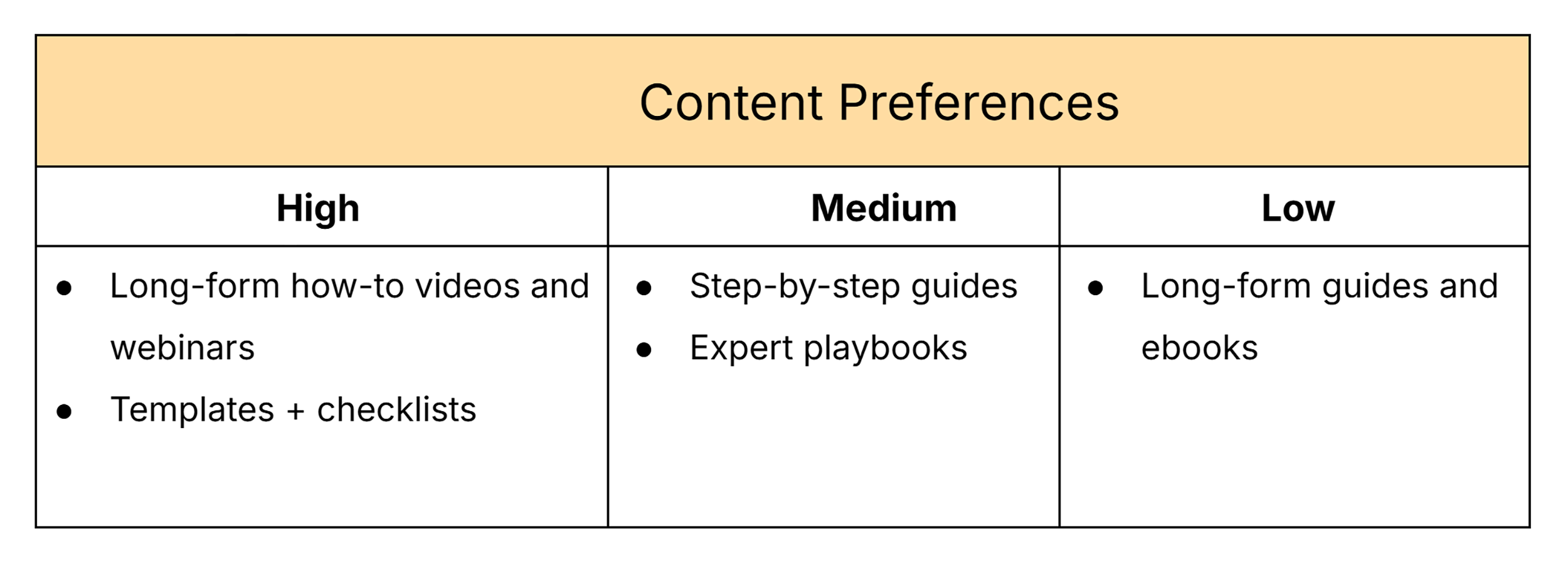
For Marcus, I learned that 5- to 15-minute video tutorials generated the highest engagement.
Shorts consistently underperformed for how-to queries, showing his preference for in-depth tutorials.
I documented my findings and ranked each content type by engagement level: high, medium, or low.
7. What Proof Points and Signals Matter?
Proof points can influence whether someone acts on your content or bounces.
They’re also a ranking factor.
Search engines and LLMs reward content that demonstrates Experience, Expertise, Authoritativeness, and Trustworthiness (E-E-A-T).

But different personas might value different proof points.
Understanding what matters to each persona is crucial to building trust and visibility.
How to Answer This Question
Identify the most common trust markers on your persona’s preferred sites.
Look for:
- Author credentials: Bylines with relevant expertise
- Methods: Transparency about the method for creating this content
- Citations: Links to studies, expert quotes, industry reports, original research
- Recency signals: Publication and last updated dates
- Visual proof: Screenshots, before/after comparisons, annotated walkthroughs
- Social validation: Comment sections, user discussions, engagement metrics
Use Semrush’s Keyword Overview tool to find this information.
Enter your keyword (I used “how to start a podcast”).
Scroll to the SERP Analysis report to view the ranking domains.
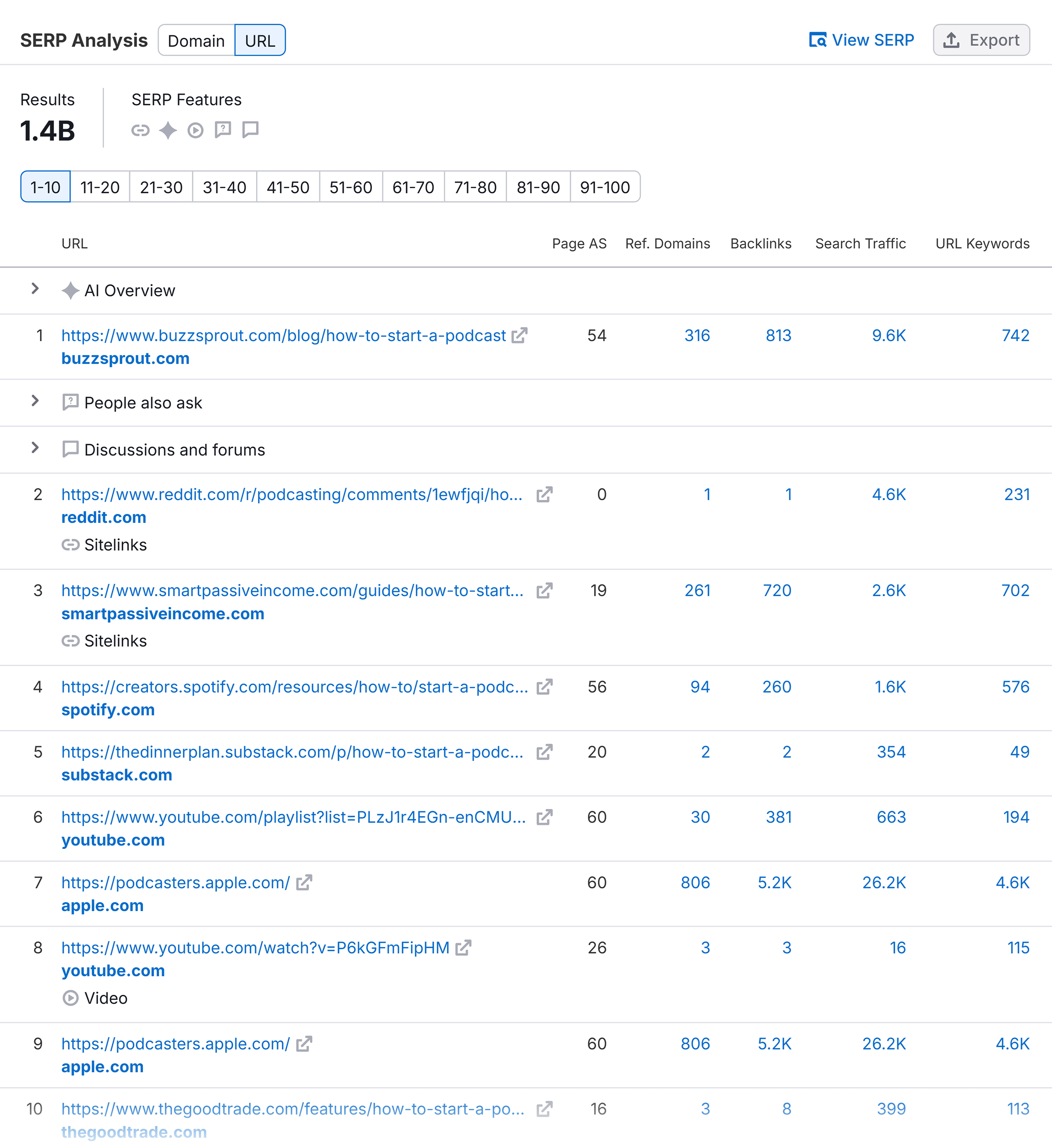
Aim to review 20 to 50 pages for the best results. (Create a spreadsheet to organize the information.)
Identify which proof points they use and how prominently they’re displayed.
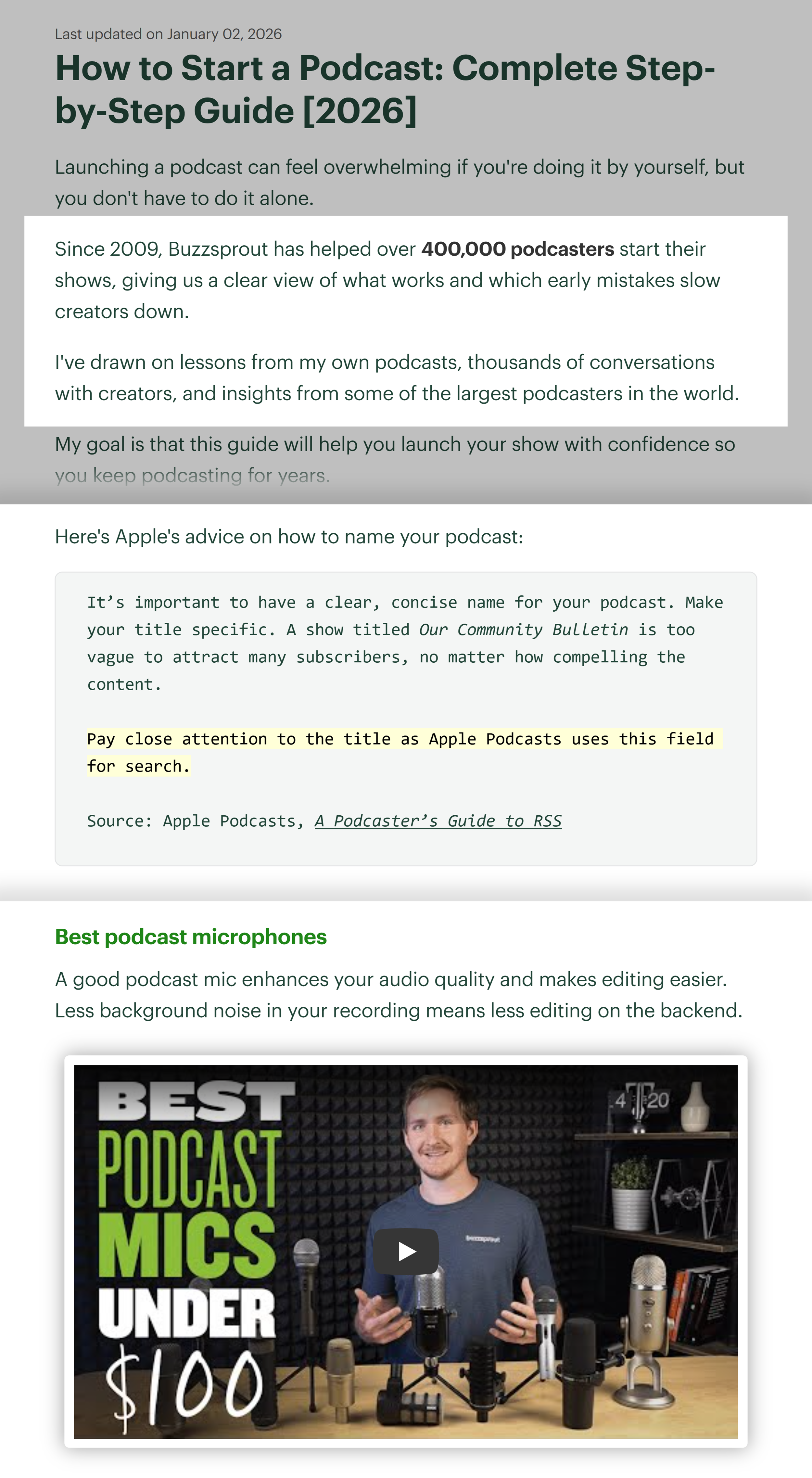
Here’s how I did this for one of the articles I assessed:
- Quantified track record: “Since 2009, Buzzsprout has helped over 400,000 podcasters”
- First-person experience: “I’ve drawn on lessons from my own podcasts and thousands of conversations with creators”
- Third-party sources: Expert advice cited from Apple Podcasts on naming conventions
- Visual demonstrations: Embedded tutorials showing recommendations in action
Then, use an LLM to quickly spot patterns:
Ultimately, you’ll want to infuse your content with these same trust markers to attract and convert your persona.
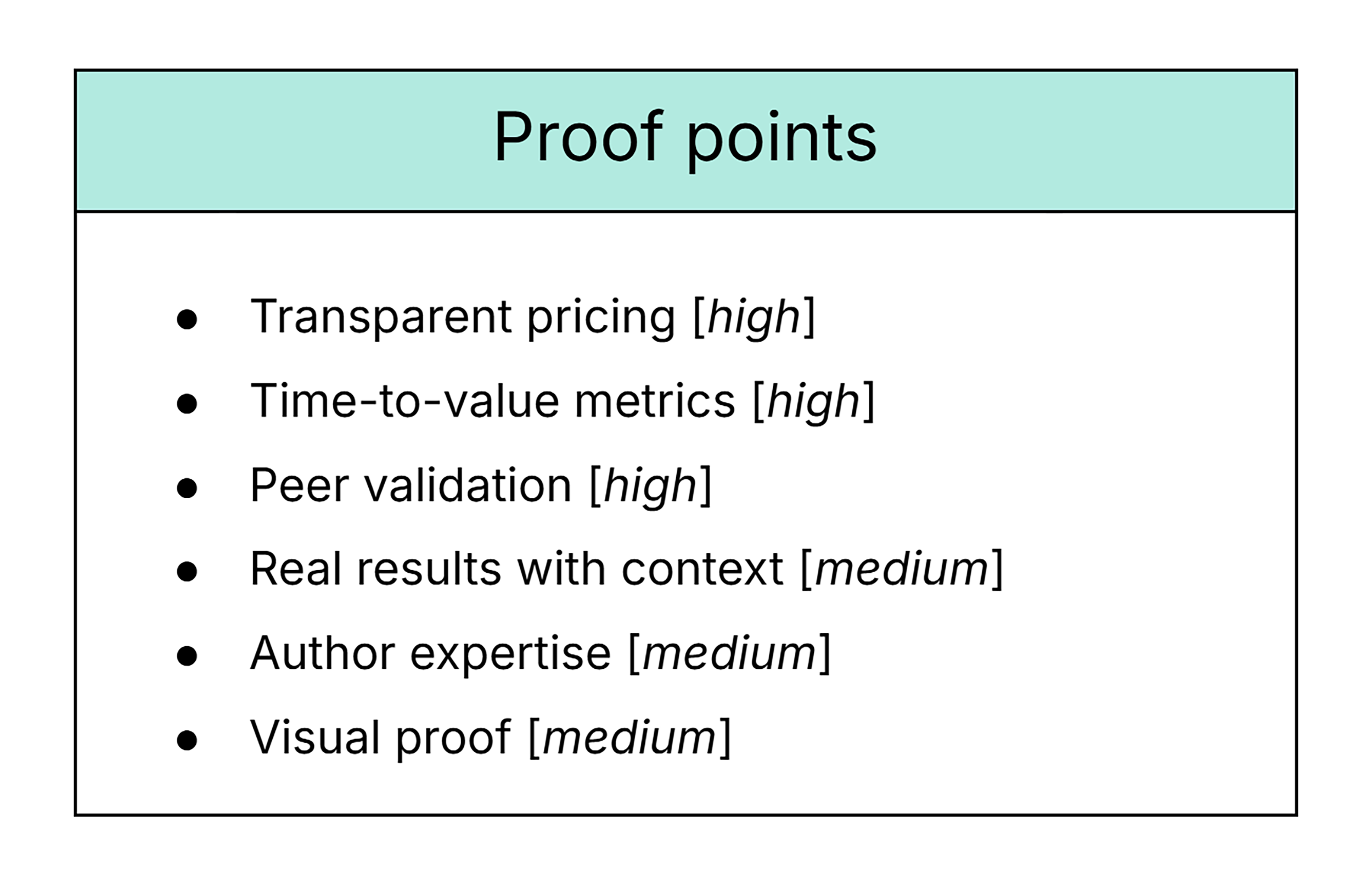
After identifying Marcus’s top proof points, I ranked them from medium to high in the template:
8. Where (and How) Should You Distribute Content to Reach This Persona?
Where you distribute content determines whether it reaches your audience.
If you only publish content on your website but buyers find solutions on LinkedIn, you’re overlooking key touchpoints.
Even worse, you’re invisible on major platforms that LLMs scan for answers, recommendations, and citations.
How to Answer This Question
By now, you know your audience persona’s top platforms.
These are your initial distribution targets.
But you’ll ideally be able to validate them against real behavioral data.
If possible, survey recent customers to find concrete patterns about their search behavior.
Send a short survey to customers who converted in the last 90 days:
- Where did you first hear about us?
- Where do you go for advice about [primary pain points]?
- What platforms do you use when researching [your product category]?
- How do you prefer to learn about new solutions in your workflow?
Once responses come in, look for patterns in how each segment discovers, researches, and evaluates solutions.
Here’s a prompt you can use in an AI tool for faster analysis:
Next, cross-reference your research against existing data in Google Analytics.
Open Google Analytics and navigate to Reports > Lifecycle > Acquisition > Traffic acquisition.

Sort by engagement rate or average session duration to see which channels drive genuinely engaged visitors.
Look for high time on site (2+ minutes) and multiple pages per session (3+).
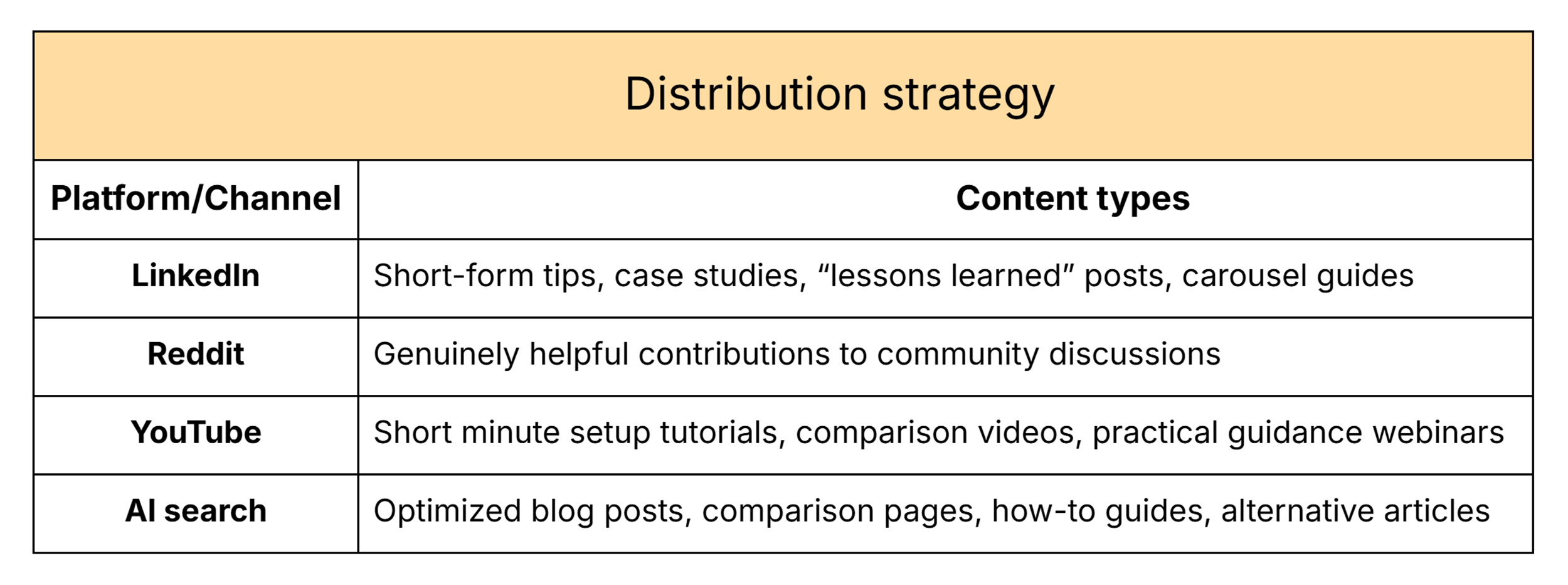
Then, map each platform to the content format that performs best there.
Combine insights from Question 1 (preferred platforms) and Question 6 (preferred formats) to build your distribution strategy.
Here’s what this looks like for Marcus:
9. What Keeps This Persona Coming Back?
Winning your audience’s attention once is easy. Earning it repeatedly is the real challenge.
Understanding what keeps your persona engaged is the key to getting them to return.
How to Answer This Question
Review all the audience persona insights you’ve gathered so far to identify recurring needs.
Look at triggers, pain points, content preferences, and community discussions.
Pinpoints problems that can’t be solved with a single article or resource.
This could include:
- Tasks they do every week (editing, distribution, promotion)
- Decisions they face with each piece of content (format, platform, messaging)
- Skills they’re continuously learning (new tools, changing algorithms)
- Friction points that slow them down every time
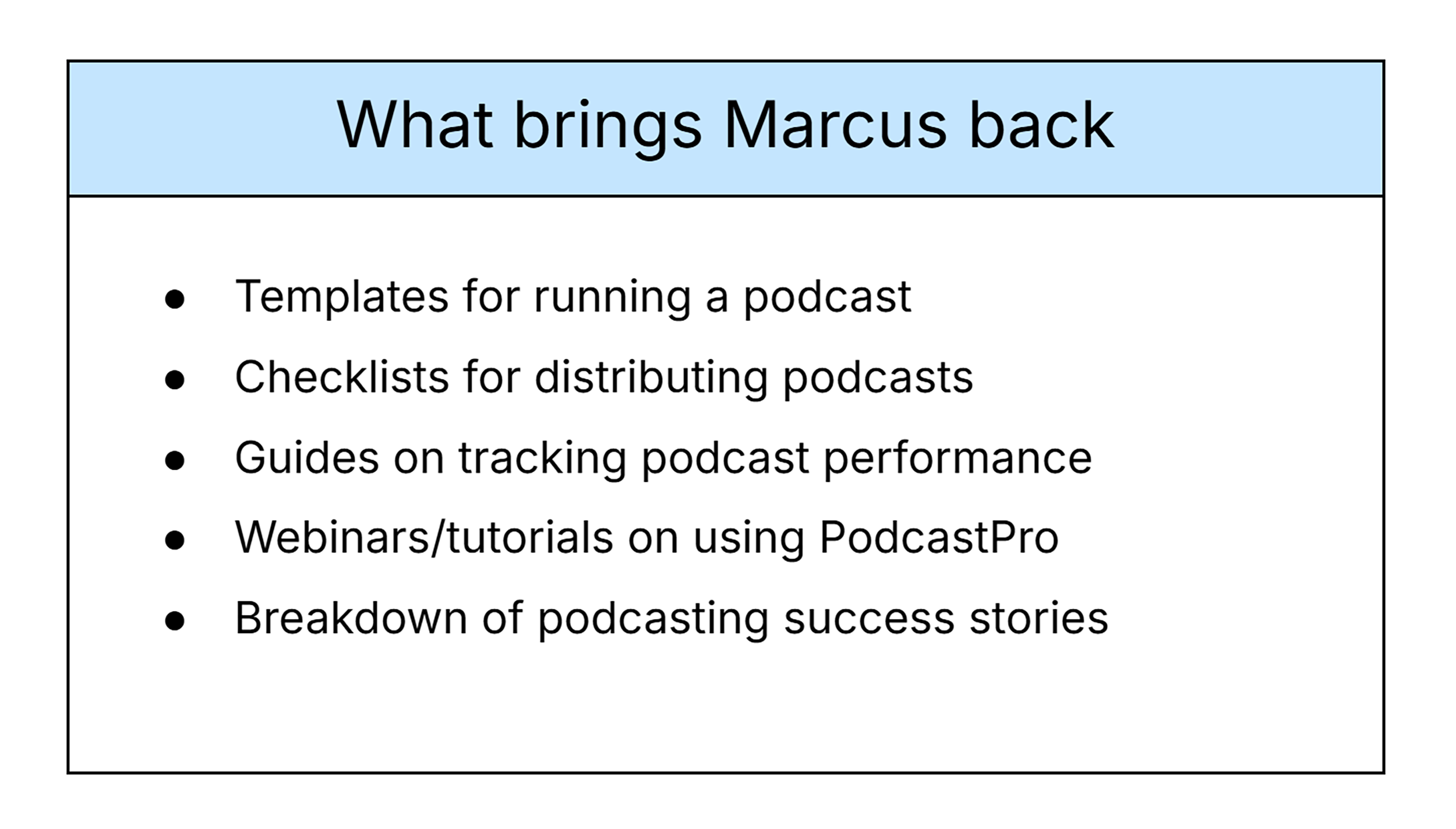
Then, outline the content types that repeatedly solve these problems.
Think tools, templates, checklists, and guides they’ll use repeatedly.
If you don’t want to do this manually, drop this prompt into an AI tool to synthesize your findings:
For Marcus, this could look something like this:
| Problem areas | Content assets |
|---|---|
| Marcus spends too long cleaning audio |
|
| Marcus wants consistent reach across platforms |
|
Every time Marcus faces these challenges, he can turn to them for a reliable solution.
These are the content types that have repeatable value for him:
Build Audience Personas That Win AI Visibility
Forget surface-level demographics.
These nine audience persona questions give you actionable, in-depth search intelligence.
You now know a lot about your persona.
You’ve uncovered where they search, what language resonates, and which proof points earn trust.
This is everything you need to show up in the right places with the right message.
If you haven’t already, download our audience persona template to organize your research.
Use it to guide your content creation, search strategy, and distribution efforts.
Your next move: Expand your visibility further with our guide to ranking in AI search. Our Seen & Trusted Framework will help you increase mentions, citations, and recommendations for your brand.
