



In early March, GitHub patched a critical remote code execution vulnerability (CVE-2026-3854) that could have allowed attackers to access millions of private repositories.
The flaw was reported on March 4, 2026, by researchers at cybersecurity firm Wiz through GitHub’s bug bounty program. GitHub Chief Information Security Officer Alexis Wales said the company’s security team reproduced and confirmed the vulnerability within 40 minutes and deployed a fix to GitHub.com less than two hours after receiving the report.
CVE-2026-3854 affects GitHub.com, GitHub Enterprise Cloud, GitHub Enterprise Cloud with Data Residency, GitHub Enterprise Cloud with Enterprise Managed Users, and GitHub Enterprise Server.

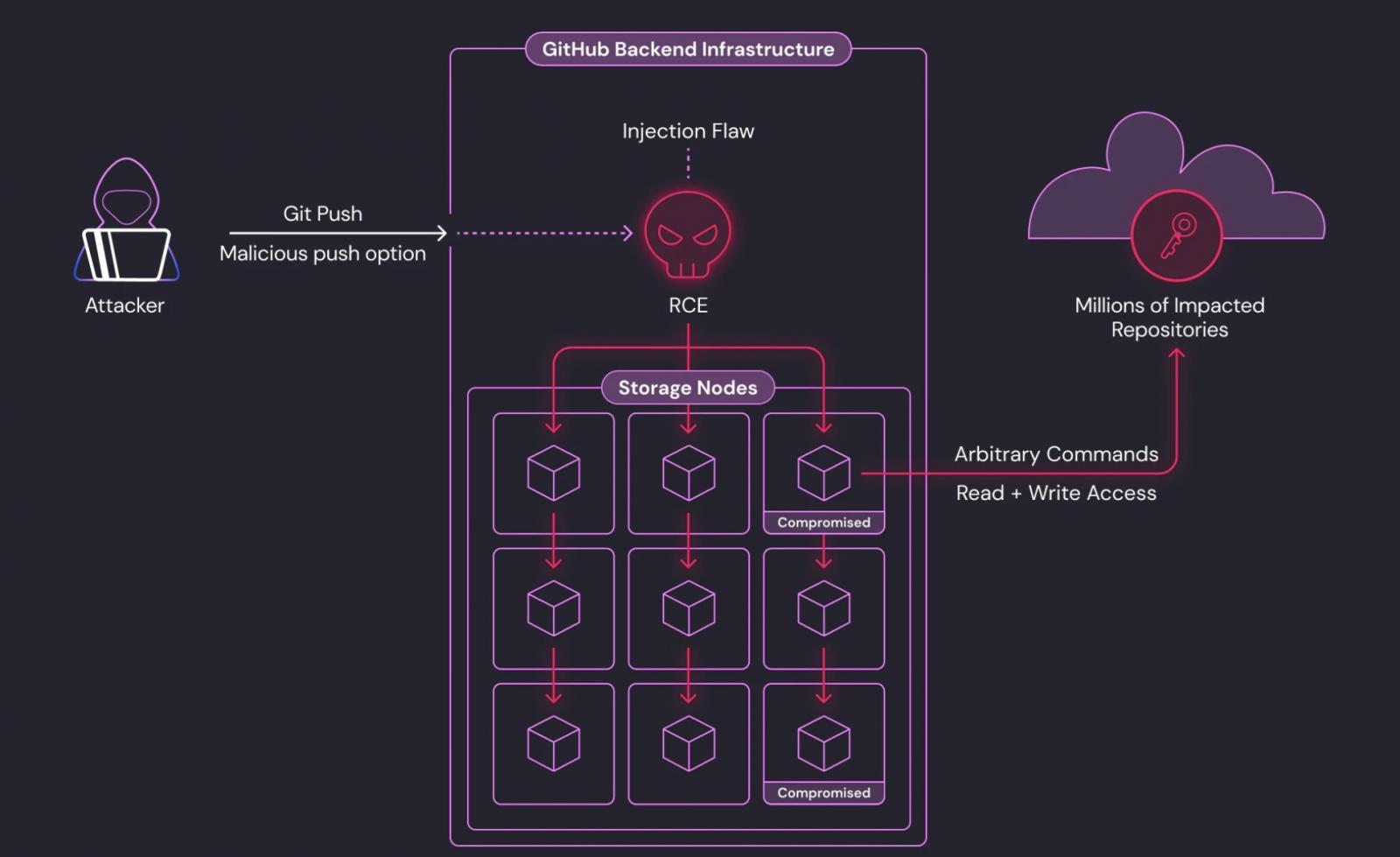
Successful exploitation requires only a single maliciously crafted ‘git push’ command and can grant full read/write access to private repositories on GitHub.com or vulnerable GitHub Enterprise servers to attackers with push access.
The vulnerability lies in how GitHub handles user-supplied options during git push operations, with values passed by users being incorporated into internal server metadata without sufficient sanitization, allowing attackers to inject additional fields trusted by the downstream service.
As Wales explained on Tuesday, an attacker could bypass sandboxing protections and execute arbitrary code on the server handling the push by chaining multiple injected values together.
”Exploitation could expose the codebases of nearly all of the world’s biggest enterprises, making this one of the most severe SaaS vulnerabilities ever found,” a Wiz spokesperson told BleepingComputer.
“On GitHub.com, this vulnerability allowed remote code execution on shared storage nodes. We confirmed that millions of public and private repositories belonging to other users and organizations were accessible on the affected nodes,” Wiz security researcher Sagi Tzadik added in a Tuesday report.
“On GitHub Enterprise Server, the same vulnerability grants full server compromise, including access to all hosted repositories and internal secrets.”
Tzadik also warned that while GitHub has patched this major security issue on GitHub.com within 6 hours, GitHub Enterprise Server (GHES) administrators should upgrade immediately, as around 88% of reachable GHES instances remain vulnerable.
However, despite the flaw’s severity, a forensic investigation found no evidence of exploitation before the Wiz disclosure, and GitHub said telemetry data confirmed that every instance of the anomalous code path triggered by the vulnerability was attributable solely to the Wiz researchers’ testing.
Wales added that no other users or accounts triggered the code path used to exploit this vulnerability, and that no customer data was accessed, modified, or exfiltrated as a result of CVE-2026-3854 exploitation before patches were deployed on GitHub.com.
“For GitHub Enterprise Server, we prepared patches across all supported releases (3.14.25, 3.15.20, 3.16.16, 3.17.13, 3.18.8, 3.19.4, 3.20.0, or later) and published CVE-2026-3854,” Wales said. “These are available today and we strongly recommend that all GHES customers upgrade immediately.”

AI chained four zero-days into one exploit that bypassed both renderer and OS sandboxes. A wave of new exploits is coming.
At the Autonomous Validation Summit (May 12 & 14), see how autonomous, context-rich validation finds what’s exploitable, proves controls hold, and closes the remediation loop.
