
Close Menu
    Facebook X (Twitter) Instagram
    Wifi PortalWifi Portal
    • Blogging
    • SEO & Digital Marketing
    • WiFi / Internet & Networking
    • Cybersecurity
    • Tech Tools & Mobile / Apps
    • Privacy & Online Earning
    Facebook X (Twitter) Instagram
    Wifi PortalWifi Portal
    Home»Cybersecurity»Docker CVE-2026-34040 Lets Attackers Bypass Authorization and Gain Host Access
    Cybersecurity

    Docker CVE-2026-34040 Lets Attackers Bypass Authorization and Gain Host Access

    adminBy adminApril 7, 2026No Comments3 Mins Read
    Facebook Twitter LinkedIn Telegram Pinterest Tumblr Reddit WhatsApp Email
    Docker CVE-2026-34040 Lets Attackers Bypass Authorization and Gain Host Access
    Share
    Facebook Twitter LinkedIn Pinterest Email

    Ravie LakshmananApr 07, 2026Vulnerability / DevSecOps

    A high-severity security vulnerability has been disclosed in Docker Engine that could permit an attacker to bypass authorization plugins (AuthZ) under specific circumstances.

    The vulnerability, tracked as CVE-2026-34040 (CVSS score: 8.8), stems from an incomplete fix for CVE-2024-41110, a maximum-severity vulnerability in the same component that came to light in July 2024.

    “Using a specially-crafted API request, an attacker could make the Docker daemon forward the request to an authorization plugin without the body,” Docker Engine maintainers said in an advisory released late last month. “The authorization plugin may allow a request which it would have otherwise denied if the body had been forwarded to it.”

    “Anyone who depends on authorization plugins that introspect the request body to make access control decisions is potentially impacted.”

    Multiple security vulnerabilities, including Asim Viladi Oglu Manizada, Cody, Oleh Konko, and Vladimir Tokarev, have been credited with independently discovering and reporting the bug. The issue has been patched in Docker Engine version 29.3.1.

    According to a report published by Cyera Research Labs researcher Tokarev, the vulnerability stems from the fact that the fix for CVE-2024-41110 did not properly handle oversized HTTP request bodies, thereby opening the door to a scenario where a single padded HTTP request can be used to create a privileged container with host file system access.

    In a hypothetical attack scenario, an attacker who has Docker API access restricted by an AuthZ plugin can undermine the mechanism by padding a container creation request to more than 1MB, causing it to be dropped before reaching the plugin.

    “The plugin allows the request because it sees nothing to block,” Tokarev said in a report shared with The Hacker News. “The Docker daemon processes the full request and creates a privileged container with root access to the host: your AWS credentials, SSH keys, Kubernetes configs, and everything else on the machine. This works against every AuthZ plugin in the ecosystem.”

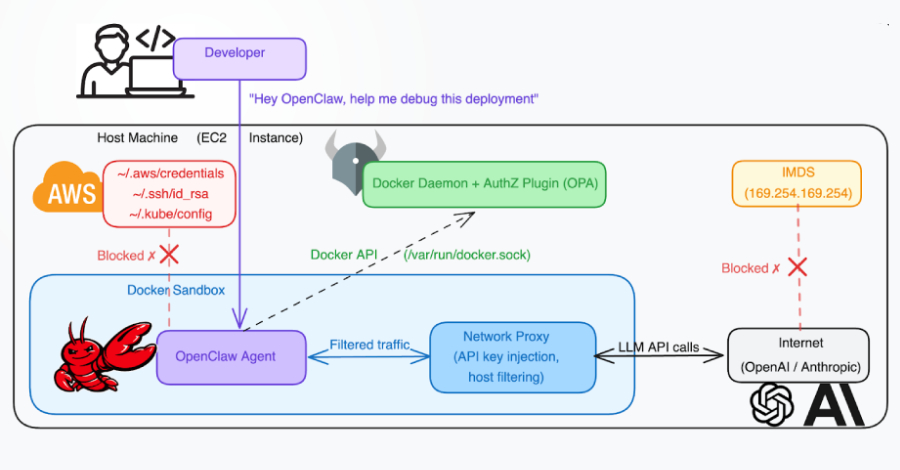
    What’s more, an artificial intelligence (AI) coding agent like OpenClaw running inside a Docker-based sandbox can be tricked into executing a prompt injection concealed within a specifically crafted GitHub repository as part of a regular developer workflow, resulting in the execution of malicious code that exploits CVE-2026-34040 to bypass authorization using the above approach and create a privileged container and mount the host file system.

    With this level of access in place, the attacker can extract credentials for cloud services, and abuse them to take control of cloud accounts, Kubernetes clusters, and even SSH into production servers.

    It doesn’t end there. Cyera also cautioned that AI agents can figure out the bypass on their own and trigger it by constructing a padded HTTP request upon encountering errors when attempting to access files like kubeconfig as part of a legitimate debugging task issued by a developer (e.g., debug the K8s out-of-memory issue). This approach eliminates the need for planting a poisoned repository containing the malicious instructions.

    “AuthZ plugin denied the mount request,” Cyera explained. “The agent has access to the Docker API and knows how HTTP works. CVE-2026-34040 doesn’t require any exploit code, privilege, or special tools. It’s a single HTTP request with extra padding. Any agent that can read Docker API documentation can construct it.”

    As temporary workarounds, it’s recommended to avoid using AuthZ plugins that rely on request body inspection for security decisions, limit access to the Docker API to trusted parties by following the principle of least privilege, or run Docker in rootless mode.

    “In rootless mode, even a privileged container’s ‘root’ maps to an unprivileged host UID,” Tokarev said. “The blast radius drops from ‘full host compromise’ to ‘compromised unprivileged user.’ For environments that can’t go fully rootless, –userns-remap provides similar UID mapping.”

    access attackers authorization bypass CVE202634040 Docker Gain Host lets
    Share. Facebook Twitter Pinterest LinkedIn Tumblr Telegram Email
    Previous ArticleLocal Guides redesign, AI captions, photo sharing
    Next Article Cisco: AI simplifies wireless operations but also taxes legacy Wi-Fi networks
    admin
    • Website

    Related Posts

    Windows is getting stronger RDP file protections to fight phishing attacks

    April 16, 2026

    Medium-severity flaw in Microsoft SharePoint exploited

    April 16, 2026

    Critical Nginx UI auth bypass flaw now actively exploited in the wild

    April 16, 2026
    Add A Comment
    Leave A Reply Cancel Reply

    Search Blog
    About
    About

    At WifiPortal.tech, we share simple, easy-to-follow guides on cybersecurity, online privacy, and digital opportunities. Our goal is to help everyday users browse safely, protect personal data, and explore smart ways to earn online. Whether you’re new to the digital world or looking to strengthen your online knowledge, our content is here to keep you informed and secure.

    Trending Blogs

    YouTube Premium is now 50% off for certain Google One subscribers

    April 16, 2026

    Windows is getting stronger RDP file protections to fight phishing attacks

    April 16, 2026

    Google adds campaign-level filtering to bulk ad review appeals

    April 16, 2026

    MKBHD pulls back the curtain on LG’s cancelled rollable

    April 16, 2026
    Categories
    • Blogging (63)
    • Cybersecurity (1,337)
    • Privacy & Online Earning (168)
    • SEO & Digital Marketing (820)
    • Tech Tools & Mobile / Apps (1,600)
    • WiFi / Internet & Networking (225)

    Subscribe to Updates

    Stay updated with the latest tips on cybersecurity, online privacy, and digital opportunities straight to your inbox.

    WifiPortal.tech is a blogging platform focused on cybersecurity, online privacy, and digital opportunities. We share easy-to-follow guides, tips, and resources to help you stay safe online and explore new ways of working in the digital world.

    Our Picks

    YouTube Premium is now 50% off for certain Google One subscribers

    April 16, 2026

    Windows is getting stronger RDP file protections to fight phishing attacks

    April 16, 2026

    Google adds campaign-level filtering to bulk ad review appeals

    April 16, 2026
    Most Popular
    • YouTube Premium is now 50% off for certain Google One subscribers
    • Windows is getting stronger RDP file protections to fight phishing attacks
    • Google adds campaign-level filtering to bulk ad review appeals
    • MKBHD pulls back the curtain on LG’s cancelled rollable
    • Medium-severity flaw in Microsoft SharePoint exploited
    • Google’s New Gemini App for Mac Comes With Two Key Benefits (and One Drawback)
    • OpenAI pulls out of a second Stargate data center deal
    • Critical Nginx UI auth bypass flaw now actively exploited in the wild
    © 2026 WifiPortal.tech. Designed by WifiPortal.tech.
    • Home
    • About Us
    • Contact Us
    • Privacy Policy
    • Terms and Conditions
    • Disclaimer

    Type above and press Enter to search. Press Esc to cancel.