


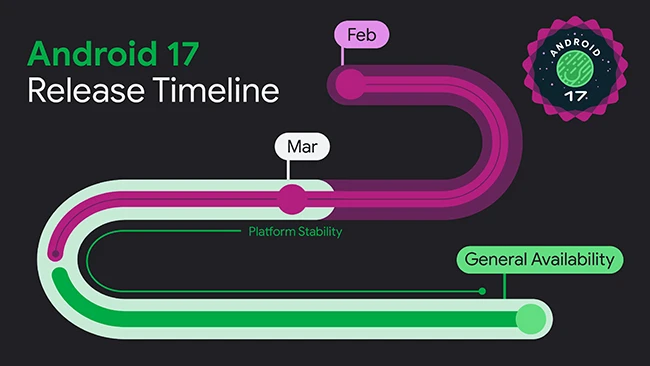
Google shipped Android 17 Beta 4 on April 16, marking the last scheduled beta in the Android 17 release cycle. The build targets app compatibility testing and platform stability ahead of the final release, and it carries several behavior changes that developers need to account for before the stable version ships.
Supported Pixel devices can enroll in the Android Beta program to receive the update over the air. Developers without a Pixel device can use the 64-bit system images with the Android Emulator in Android Studio. Google recommends using the latest preview of Android Studio Panda for the best development experience with Android 17.
Beta 4 is the compatibility deadline
SDK authors, library maintainers, tool developers, and game engine teams face the most urgent deadline. Any updates needed to support Android 17 should be ready now, so downstream app developers are not blocked when the final release arrives. Google recommends testing by installing production or test builds on a device or emulator running Beta 4 and exercising all app flows for functional and UI regressions.
Behavior changes targeting apps on Android 17
Several changes take effect when an app targets Android 17. Large-screen resizability restrictions are among the most visible: apps targeting Android 17 can no longer opt out of maintaining orientation, resizability, and aspect ratio constraints on large screens.
Dynamic code loading restrictions expand in this release. The Safer Dynamic Code Loading protection introduced in Android 14 for DEX and JAR files now extends to native libraries. Any native file loaded via System.load() must be marked read-only, or the system throws an UnsatisfiedLinkError.
Certificate Transparency is enabled by default on Android 17. On Android 16, it was available but required apps to opt in explicitly. Local network access is also blocked by default for apps targeting Android 17 or higher, with a new ACCESS_LOCAL_NETWORK permission available for apps that need broad, persistent access.
Background audio behavior changes in Android 17 as well. The audio framework enforces restrictions on background audio interactions, including playback, audio focus requests, and volume change APIs. Google updated these restrictions since Beta 2, adding targetSDK gating for while-in-use foreground service enforcement and exempting alarm audio from the restrictions.
App memory limits
Android 17 introduces per-app memory limits based on a device’s total RAM. The limits are set conservatively in this release, targeting extreme memory leaks and other outliers before they can trigger system-wide instability. Google says it expects minimal impact on the large majority of app sessions.
Developers can detect whether their app was affected by checking the getDescription() field in ApplicationExitInfo for the string “MemoryLimiter.” Trigger-based profiling with TRIGGER_TYPE_ANOMALY can collect heap dumps at the point a memory limit is hit.
Android Studio Panda adds a LeakCanary integration directly in the Profiler as a dedicated task, giving developers a view of memory leaks in context with their source code.
Profiling triggers for on-device anomaly detection
Android 17 adds an on-device anomaly detection service that works with ProfilingManager. The service monitors for resource-intensive behaviors, including excessive binder calls and excessive memory usage, and allows apps to receive profiling artifacts triggered by system-detected events.
The TRIGGER_TYPE_ANOMALY callback fires before any system enforcement, giving developers the opportunity to collect diagnostic data, such as heap dumps or binder transaction stack samples, before the system terminates an app.
Post-quantum cryptography in Android Keystore
Android Keystore now supports ML-DSA, the Module-Lattice-Based Digital Signature Algorithm standardized by NIST. On supported devices, developers can generate ML-DSA keys and produce quantum-safe signatures entirely within the device’s secure hardware. The implementation exposes the ML-DSA-65 and ML-DSA-87 algorithm variants through standard Java Cryptographic Architecture APIs: KeyPairGenerator, KeyFactory, and Signature.
