


Close Menu
    Facebook X (Twitter) Instagram
    Wifi PortalWifi Portal
    • Blogging
    • SEO & Digital Marketing
    • WiFi / Internet & Networking
    • Cybersecurity
    • Tech Tools & Mobile / Apps
    • Privacy & Online Earning
    Facebook X (Twitter) Instagram
    Wifi PortalWifi Portal
    Home»Cybersecurity»VoidStealer malware steals Chrome master key via debugger trick
    Cybersecurity

    VoidStealer malware steals Chrome master key via debugger trick

    adminBy adminMarch 22, 2026No Comments3 Mins Read
    Facebook Twitter LinkedIn Telegram Pinterest Tumblr Reddit WhatsApp Email
    VoidStealer malware steals Chrome master key via debugger trick
    Share
    Facebook Twitter LinkedIn Pinterest Email

    VoidStealer malware steals Chrome master key via debugger trick

    An information stealer called VoidStealer uses a new approach to bypass Chrome’s Application-Bound Encryption (ABE) and extract the master key for decrypting sensitive data stored in the browser.

    The novel method is stealthier and relies on hardware breakpoints to extract the v20_master_key,  used for both encryption and decryption, directly from the browser’s memory, without requiring privilege escalation or code injection.

    A report from Gen Digital, the parent company behind the Norton, Avast, AVG, and Avira brands, notes that this is the first case of an infostealer observed in the wild to use such a mechanism.

    Google introduced ABE in Chrome 127, released in June 2024, as a new protection mechanism for cookies and other sensitive browser data. It ensures that the master key remains encrypted on disk and cannot be recovered through normal user-level access.

    Decrypting the key requires the Google Chrome Elevation Service, which runs as SYSTEM, to validate the requesting process.
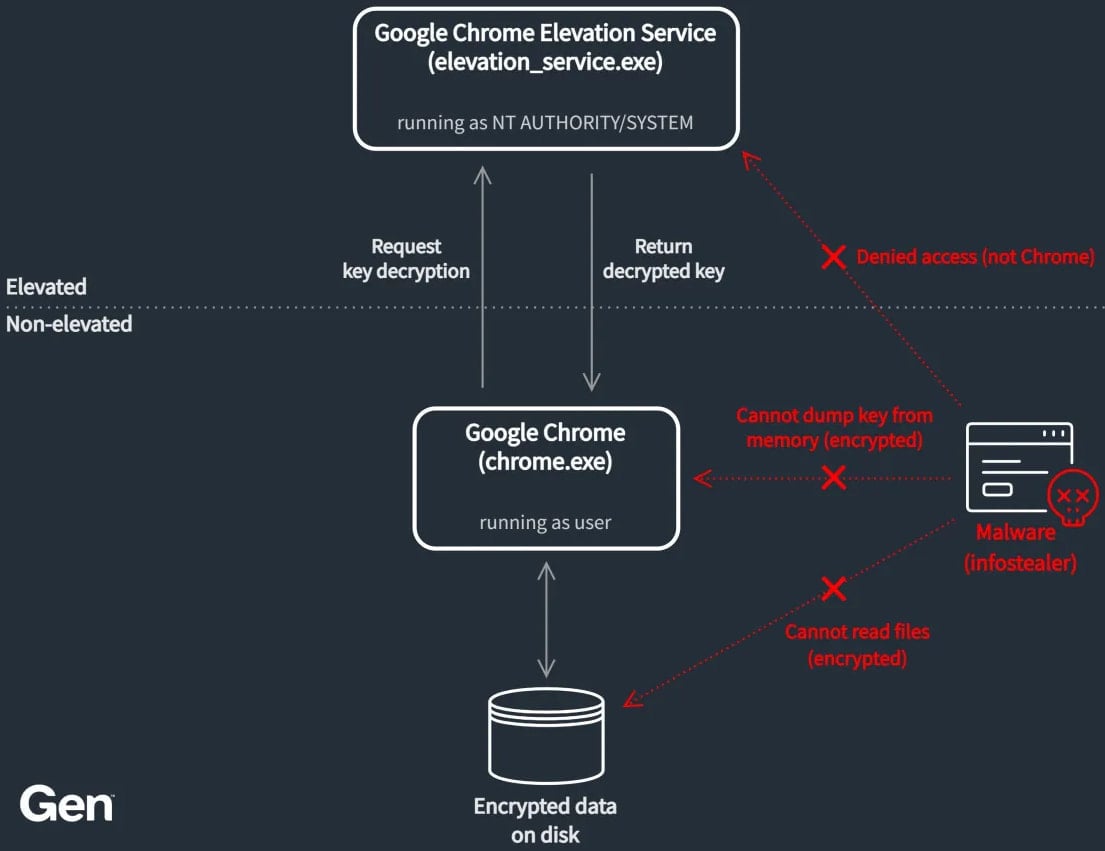
    Overview of how ABE blocks out malware
    Overview of how ABE blocks out malware
    Source: Gen Digital

    However, this system has been bypassed by multiple infostealer malware families and has even been demonstrated in open-source tools. Although Google implemented fixes and improvements to block these bypasses, new malware versions reportedly continued to succeed using other methods.

    “VoidStealer is the first infostealer observed in the wild adopting a novel debugger-based Application-Bound Encryption (ABE) bypass technique that leverages hardware breakpoints to extract the v20_master_key directly from browser memory,” says Vojtěch Krejsa, threat researcher at Gen Digital.

    VoidStealer is a malware-as-a-service (MaaS) platform advertised on dark web forums since at least mid-December 2025. The malware introduced the new ABE bypass mechanism in version 2.0.

    Cybercriminals announcing ABE bypass in version 2.0
    Cybercriminals advertising ABE bypass in VoidStealer version 2.0
    Source: Gen Digital

    Stealing the master key

    VoidStealer’s trick to extract the master key is to target a short moment when Chrome’s v20_master_key is briefly present in memory in plaintext state during decryption operations.

    Specifically, VoidStealer starts a suspended and hidden browser process, attaches it as a debugger, and waits for the target browser DLL (chrome.dll or msedge.dll) to load.

    When loaded, it scans the DLL for a specific string and the LEA instruction that references it, using that instruction’s address as the hardware breakpoint target.
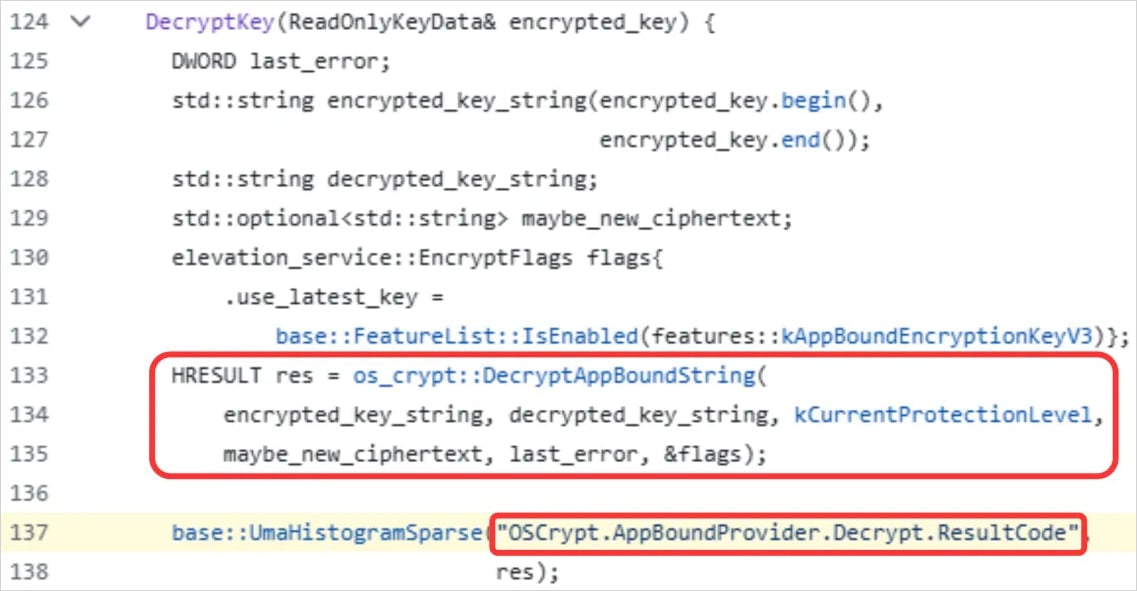
    VoidStealer's target string
    VoidStealer’s target string
    Source: Gen Digital

    Next, it sets that breakpoint across existing and newly created browser threads, waits for it to trigger during startup while the browser is decrypting protected data, then reads the register holding a pointer to the plaintext v20_master_key and extracts it with ‘ReadProcessMemory.’

    Gen Digital explains that the ideal time for the malware to do this is during browser startup, when the application loads ABE-protected cookies early, forcing the decryption of the master key.

    The researchers explained that VoidStealer likely did not invent this technique but rather adopted it from the open-source project ‘ElevationKatz,’ part of the ChromeKatz cookie-dumping toolset that demonstrates weaknesses in Chrome.

    Although there are some differences in the code, the implementation appears to be based on ElevationKatz, which has been available for  more than a year.

    BleepingComputer has contacted Google with a request for a comment on this bypass method being used by threat actors, but a reply was not available by publishing time.


    tines

    Malware is getting smarter. The Red Report 2026 reveals how new threats use math to detect sandboxes and hide in plain sight.

    Download our analysis of 1.1 million malicious samples to uncover the top 10 techniques and see if your security stack is blinded.

    Chrome debugger key Malware master Steals trick VoidStealer
    Share. Facebook Twitter Pinterest LinkedIn Tumblr Telegram Email
    Previous ArticleHere’s How Google’s ‘Safer’ Sideloading Works on Android
    Next Article The Kindle Colorsoft 16GB just dropped to its Black Friday price
    admin
    • Website

    Related Posts

    Fortinet fixes critical FortiSandbox vulnerabilities (CVE-2026-39813, CVE-2026-39808)

    April 16, 2026

    Cisco says critical Webex Services flaw requires customer action

    April 16, 2026

    NIST Prioritizes NVD Enrichment for CVEs in CISA KEV, Critical Software

    April 16, 2026
    Add A Comment
    Leave A Reply Cancel Reply

    Search Blog
    About
    About

    At WifiPortal.tech, we share simple, easy-to-follow guides on cybersecurity, online privacy, and digital opportunities. Our goal is to help everyday users browse safely, protect personal data, and explore smart ways to earn online. Whether you’re new to the digital world or looking to strengthen your online knowledge, our content is here to keep you informed and secure.

    Trending Blogs

    Who goes there? Your Ring doorbell can now recognise up to 50 familiar faces, and let you know if a caller is a friend or a stranger

    April 16, 2026

    COSMIC desktop surprised me, because it’s the Linux DE I’ve been waiting for

    April 16, 2026

    Fortinet fixes critical FortiSandbox vulnerabilities (CVE-2026-39813, CVE-2026-39808)

    April 16, 2026

    Search Ad Growth Slows As Social & Video Gain Faster

    April 16, 2026
    Categories
    • Blogging (63)
    • Cybersecurity (1,345)
    • Privacy & Online Earning (168)
    • SEO & Digital Marketing (824)
    • Tech Tools & Mobile / Apps (1,610)
    • WiFi / Internet & Networking (225)

    Subscribe to Updates

    Stay updated with the latest tips on cybersecurity, online privacy, and digital opportunities straight to your inbox.

    WifiPortal.tech is a blogging platform focused on cybersecurity, online privacy, and digital opportunities. We share easy-to-follow guides, tips, and resources to help you stay safe online and explore new ways of working in the digital world.

    Our Picks

    Who goes there? Your Ring doorbell can now recognise up to 50 familiar faces, and let you know if a caller is a friend or a stranger

    April 16, 2026

    COSMIC desktop surprised me, because it’s the Linux DE I’ve been waiting for

    April 16, 2026

    Fortinet fixes critical FortiSandbox vulnerabilities (CVE-2026-39813, CVE-2026-39808)

    April 16, 2026
    Most Popular
    • Who goes there? Your Ring doorbell can now recognise up to 50 familiar faces, and let you know if a caller is a friend or a stranger
    • COSMIC desktop surprised me, because it’s the Linux DE I’ve been waiting for
    • Fortinet fixes critical FortiSandbox vulnerabilities (CVE-2026-39813, CVE-2026-39808)
    • Search Ad Growth Slows As Social & Video Gain Faster
    • I’ve been using Android’s built-in focus modes wrong this whole time, and one setting fixed everything
    • Cisco says critical Webex Services flaw requires customer action
    • This one chart exposes how far Pixel has fallen behind in mobile gaming
    • NIST Prioritizes NVD Enrichment for CVEs in CISA KEV, Critical Software
    © 2026 WifiPortal.tech. Designed by WifiPortal.tech.
    • Home
    • About Us
    • Contact Us
    • Privacy Policy
    • Terms and Conditions
    • Disclaimer

    Type above and press Enter to search. Press Esc to cancel.