


Google penalties, also known as manual spam actions, are among the few events in search that can disrupt an otherwise healthy online business overnight.
For companies heavily dependent on organic traffic, the consequences often extend far beyond lost rankings. Revenue drops, customer acquisition costs rise, expansion plans stall, and the effects can linger long after the original policy violations have been remedied.
With a steady 90% market share, Google remains the primary traffic source for many publishers, ecommerce platforms, retailers, travel brands, affiliates, and lead generation businesses.
Direct traffic rarely compensates for a major visibility loss, and Bing seldom offsets the difference. As a result, a manual spam action carries serious operational implications, not merely SEO risks.
Manual actions aren’t algorithm updates
One point still misunderstood throughout the industry deserves clarification. Manual spam actions differ from algorithmic updates. They aren’t fluctuations caused by changes in relevance calculations or ranking system adjustments.
Google’s manual penalties involve direct enforcement after suspected violations against Google Search Essentials, formerly Google Webmaster Guidelines, have been identified and confirmed. The distinction matters because the response required is completely different.
A website affected by changing ranking systems requires analysis, adaptation, and recrawling. A website affected by a manual spam action requires remediation and applying for reconsideration. Those are separate situations entirely.
Google doesn’t issue manual spam actions casually. The process involves internal senior employee review cycles. Suspected violations must be investigated and confirmed first.
Google states clearly that manual actions are the consequence of proven policy transgressions. Despite frequent cries of foul, false positives are exceptionally rare. Once a manual action appears in Google Search Console, the enforcement is already in the production pipeline.
The operational problem is that many businesses fail to recognize how much unresolved policy exposure their web platforms have accumulated over time.
Be the brand customers find first.
Track, grow, and measure your visibility across Google, AI search, social, local, and every channel that influences buying decisions.
Start your free trial
How penalties develop
The initial steps that ultimately lead to a manual penalty and a website’s drop in search visibility often begin inconspicuously, gradually eroding policy compliance.
- An ecommerce business launches an aggressive link acquisition campaign during an early growth phase. Over the years, PageRank-passing spam links accumulate unchecked until eventually nobody remembers where thousands of exact-match backlinks originate.
- A publisher enters into commercial partnerships involving sponsored content or affiliate sections, which gradually become structurally integrated into the editorial architecture of the website.
- A SaaS company creates large numbers of low-quality location pages while expanding into new markets.
- A lead generation business scales supplemental SEO content through low-cost LLM production systems with limited editorial oversight because that appears to be what most competitors are doing.
The underlying patterns are remarkably similar across industries. In many cases, organic search visibility initially improves and may even generate measurable revenue gains attributable to the SEO initiative.
The short-term results reinforce the perception that the approach is working. However, as time passes, nobody revisits whether those earlier decisions remain aligned with evolving search quality standards and webmaster policies.
Why historical violations still matter
One reason manual spam actions create so much disruption is that policy violations often persist quietly for years before review. Many organizations incorrectly assume that questionable SEO tactics of the past lose their relevance over time.
Yet Google Search systems don’t forget historical footprints. Archived URLs remain crawlable. Legacy sections continue contributing content quality signals long after internal ownership was abandoned.
Most persistently, backlink patterns remain visible for decades. Large numbers of websites remain affected by backlinks generated through manipulative campaigns dating back many years.
Paid placements, article syndication networks, private blog networks, commercial keyword-heavy guest posting campaigns, expired domain backlinks, directory spam, and widget distribution schemes that once formed part of mainstream SEO activity are today’s liabilities.
Some of these practices continue to operate more or less openly for years, while enforcement may appear erratic or inconsistent. When left unaddressed, they represent an incalculable risk to the website publisher.
Get the newsletter search marketers rely on.
Time doesn’t eliminate the risk
This becomes particularly important during acquisitions. Businesses purchasing established domains frequently inherit unresolved compliance exposure alongside rankings and traffic. Google evaluates the website’s condition, not which employee, agency, or previous owner introduced the violations.
Traffic growth alone doesn’t confirm compliance health. A domain generating millions of clicks may still carry unresolved risks tied to old link schemes, expired sponsorship arrangements, deceptive user-agent cloaking, manipulative redirects, or scaled low-quality content sections. Those issues often go unnoticed until they’re brought to the surface by a Google manual spam action notification.

Reputation abuse and publisher liability
The mechanics behind reputation abuse are straightforward. A trusted brand with an established web platform allows third parties to publish unrelated, often unsupervised content under the same domain name. In many cases, publishers integrated discount coupon sections, casino reviews, affiliate content, or commercially motivated informational pages directly into existing editorial systems.
The problem frequently worsened significantly because the content wasn’t properly segmented. The consequence is that the distinction between trusted editorial work and commercially motivated material became blurred.
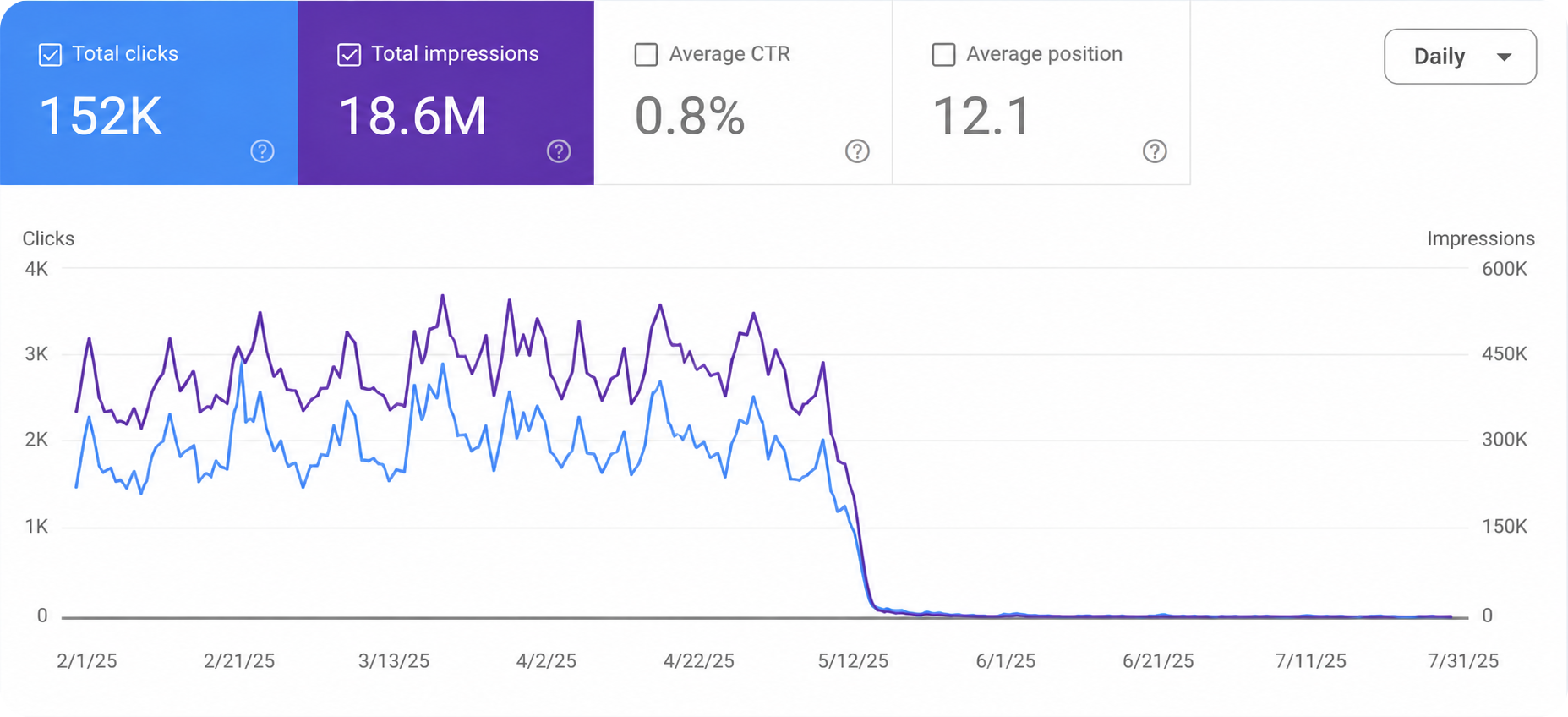
Once confronted with a site-wide penalty, affected publishers experience broad visibility declines across the entire platform, not merely within the originally offending sections of the website. The damage to a brand that lends its reputation to a disreputable third party is often substantial.
Recovery efforts frequently prove time-consuming and costly. Removing isolated pages rarely resolves the problem. Many organizations require broader structural changes, including archive cleanup, internal link reviews, crawl management adjustments, sponsorship governance reforms, the removal of spammy redirects, stronger editorial oversight, and stricter technical segmentation.
In short, recovering from such a penalty takes time, costs significant amounts of money, and is often a painful process.
The risks of scaled content
Google increasingly scrutinizes large-scale publishing systems that produce repetitive, low-value content without a unique selling proposition.
The issue isn’t maintaining many websites simultaneously. Large website portfolios have thrived in Google Search for years and continue to do so. The underlying problem involves quality control, editorial oversight, originality, and informational value.
- Affiliate networks produce near-identical product comparison pages across thousands of long-tail keywords.
- Local SEO operations deploy templated service pages across hundreds of regions with minimal differentiation.
- AI-assisted workflows publish large numbers of informational pages without factual oversight or genuine expertise to support them.
- Travel websites generate mass-produced destination pages through repetitive, generic content systems.
Most organizations don’t cross into problematic territory intentionally. The transition usually occurs gradually, often unbeknownst to the decision-makers who rely on outdated or misleading recommendations.
The resulting manual spam action in Google Search Console, followed by a sharp decline in rankings, frequently occurs after a prolonged period of spam signal accumulation rather than during the apparent growth phase.
Many site owners approach reconsideration requests as if they were negotiating with Google. That puts them at a significant disadvantage from the outset.
The reconsideration process exists for one purpose only: to demonstrate that the website has been restored to full compliance with Google’s guidelines. It’s important to note that Google expects complete compliance before lifting a manual spam action.
This means the requirement extends beyond the specific violation highlighted in Google Search Console. A site owner who addresses only one known spam issue while leaving unrelated policy violations unresolved elsewhere on the website will typically face rejection.
A common testing approach, such as a publisher removing some problematic sponsored content while retaining similar affiliate arrangements elsewhere, will fail. Likewise, a business that disavows recent manipulative backlinks while ignoring historical paid link schemes is unlikely to convince Google of its genuine commitment to complying with Google’s policies going forward.
Similarly, a website network that cleans up one property while continuing identical publishing practices across related domains signals incomplete remediation rather than meaningful operational reform. As a result, it stands little chance of regaining Google’s trust.
Why repeated rejections make recovery harder
Effective website recovery requires a comprehensive review rather than selective cleanup. Technical infrastructure, content quality, sponsorship structures, redirect behavior, link acquisition history, indexing patterns, archive sections, and ownership transparency all require examination during serious compliance recovery efforts.
The Google Search team expects compelling documentation detailing what has changed and how future violations will be prevented. Temporary cosmetic adjustments rarely persuade reviewers to lift a manual spam action.
Making matters worse, each rejection typically requires an even more comprehensive review and cleanup effort. At the same time, every reconsideration request that Google deems disingenuous further erodes Google’s trust in the publisher.
The cost of uncertainty
There’s no guaranteed turnaround time for reconsideration processing. Some reviews are completed within days. Others take weeks or months.
At the same time, large websites with extensive SEO legacies accumulated over many years often require longer assessment periods due to the substantial volumes of data that must be crawled and analyzed before changes can be evaluated.
For businesses that rely primarily on Google traffic, this uncertainty creates a potentially existential threat.
- An ecommerce business approaching a peak seasonal period with an unresolved manual spam action can face cash flow problems quickly.
- Publishers dependent on advertising revenue experience ranking losses that translate directly into declining commercial performance.
- Lead generation businesses often encounter immediate pipeline contraction once visibility declines significantly.
The operational risk becomes even greater when companies fail to build a strong brand capable of partially offsetting organic traffic declines through direct navigation or alternative revenue-generating channels. In this context, paid traffic is a poor substitute due to its associated costs.
In short, some online businesses can’t afford to be penalized in the first place.
Penalties can cripple operations
The issue extends beyond SEO performance. Search visibility directly affects commercial expansion, investor confidence, company valuation, partnership negotiations, and revenue stability.
Penalty expiration represents another commonly misunderstood aspect. Google manual spam actions may expire after prolonged periods, often years. However, this is rarely a viable strategy for an affected business.
Waiting passively through an extended period of declining visibility seldom aligns with commercial realities. More importantly, expiration alone doesn’t guarantee recovery or renewed growth, as the penalty could be reapplied not too long after it expired.
Google’s search systems continue evaluating overall site quality independently of manual enforcement status. A website carrying unresolved spam signals across its content, technical infrastructure, or off-page profile may continue to struggle long after the manual action itself has been lifted.
Compliance requires ongoing oversight
Compliance reviews can’t be considered optional or a luxury. Organizations heavily dependent on organic Google visibility require ongoing operational review cycles focused specifically on comprehensive policy compliance.
These reviews shouldn’t be conducted internally. Even the most talented in-house SEO teams are often hard-pressed to diligently identify shortcomings that may reflect on their own work or that of their colleagues. Policy compliance requires external expertise, sufficient authority, and a proven track record.
Purely technical SEO audits, while indispensable, are insufficient if commercial partnerships bypass oversight. Editorial standards alone won’t suffice if historical link manipulation remains unresolved. Planned growth initiatives require evaluation against established compliance frameworks before deployment, not after traffic has become dependent on questionable practices.
Mature organizations increasingly integrate compliance reviews into their operational governance. Sponsorship structures undergo search compliance review before launch. Scaled publishing systems are assessed for quality before expansion. Historical content is evaluated on a recurring basis. Acquisition due diligence includes policy exposure analysis alongside financial review.
Own the conversation before your competitors.
See where your brand appears, where it doesn’t, and exactly how to win more visibility across search, AI, local, social, and every channel that matters.
Start your free trial
Compliance is a business imperative
This level of discipline and vigilance matters because manual spam actions rarely arrive at convenient moments. More often than not, undesirable Google scrutiny coincides with critical periods: just before a long-planned commercial expansion, in the run-up to a migration project, ahead of an acquisition, as the peak retail season begins, or shortly before investor reporting deadlines.
This is hardly intentional. It’s simply a matter of unfortunate timing. Google doesn’t align search quality enforcement with business planning calendars. Google cares primarily about user experience. For every website that loses its top position, there is usually another capable of providing users with a similarly compelling experience.
Businesses that ignore unresolved policy exposure often discover the problem the hard way, only after search visibility has collapsed and online sales have followed suit. At that point, recovery becomes a far more prolonged, expensive, and operationally disruptive undertaking than ongoing compliance reviews would have been prior to penalization.
Nevertheless, the work must be done. The one silver lining is that, in many cases, the process proves cathartic. Once the penalty has been resolved and the website’s SEO signals have become more consistent, the removal of legacy issues often allows rankings not merely to recover, but to exceed their previous highs.
Contributing authors are invited to create content for Search Engine Land and are chosen for their expertise and contribution to the search community. Our contributors work under the oversight of the editorial staff and contributions are checked for quality and relevance to our readers. Search Engine Land is owned by Semrush. Contributor was not asked to make any direct or indirect mentions of Semrush. The opinions they express are their own.
