

Editor’s note: This research was conducted by Exploding Topics, the trend discovery platform owned by Semrush, and is republished here with permission. Data is drawn from a proprietary survey of 1,009 US consumers. Full methodology appears at the end of this article.
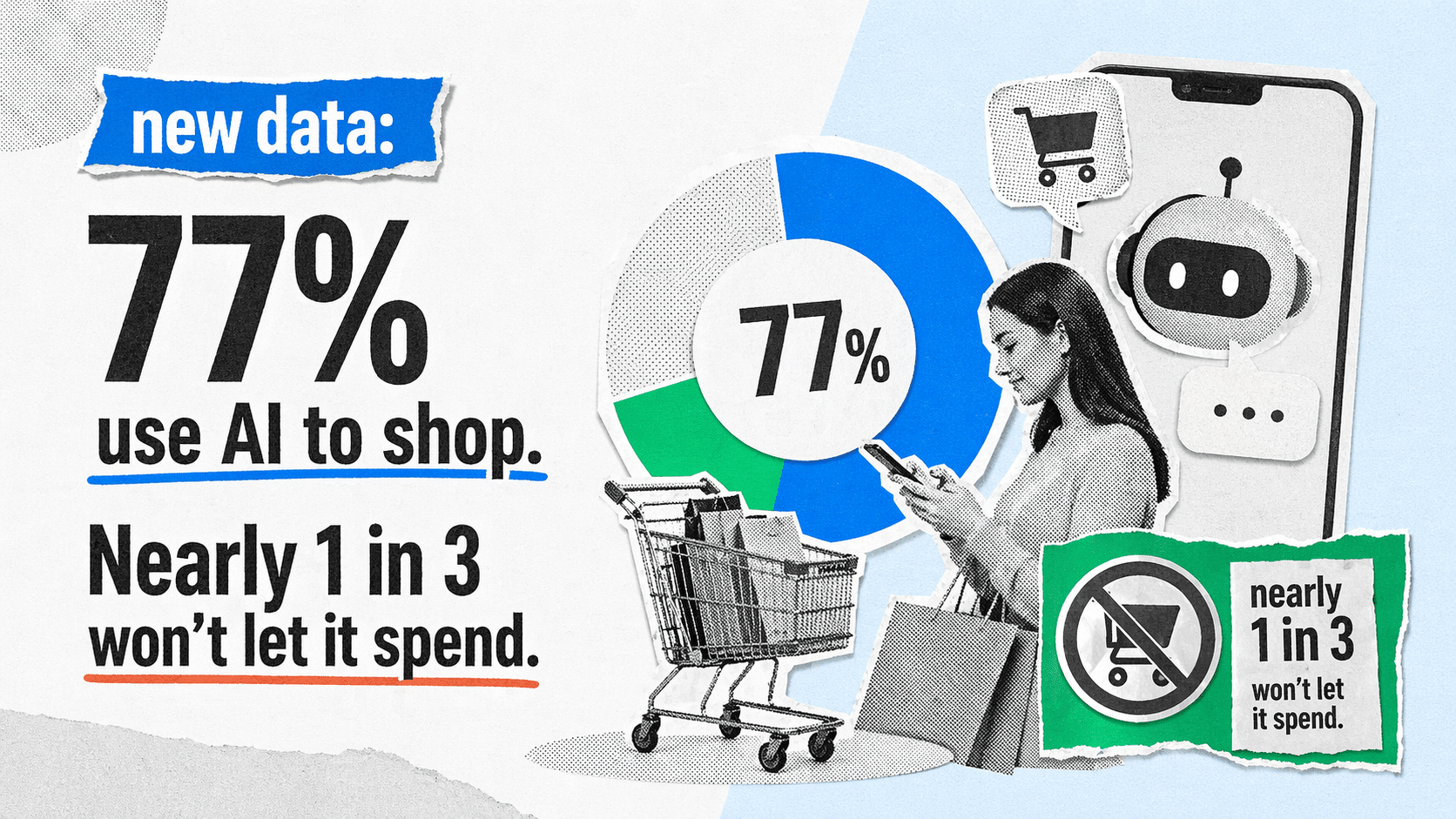
More than three in four consumers have used AI to help with shopping or purchasing decisions in the last six months, according to new research from Exploding Topics.
AI tools like ChatGPT and Google Gemini have been absorbed into weekly shopping routines. The technology has rapidly become a staple of product research and price comparison, for everything from clothing to groceries.
But at the same time, we found significant and widespread discomfort about the next chapter in AI commerce.
The very same people who are eagerly embracing AI to shop often draw the line at empowering AI to spend. “Skepticism” is the prevailing attitude about tools like ChatGPT’s short-lived Instant Checkout, while even something as simple as storing card details with an AI chatbot makes consumers uncomfortable.
Looking ahead, shoppers expect AI to become ever more prominent in their buying habits. But this research highlights some significant barriers that will need to be overcome before that can truly happen.
Discover rising topics first and own the conversation.
Spot emerging trends 12+ months early with data-driven insights, forecasting, and alerts.
Get Exploding Topics Pro
Part 1: The AI Commerce Surge
AI is an increasingly ubiquitous shopping tool
To get a baseline, we first asked respondents how they would describe their use of AI generally. This yielded a striking response.
Of the 1,000+ people we surveyed, almost half reported using AI frequently. But more eye-catchingly, only 9.81% had never used an AI tool.
High adoption was a recurring theme when we asked about AI commerce specifically. 43.21% of consumers are using AI to help with shopping at least once a week, with well over half of shoppers using the technology at least monthly.

Among “frequent” AI users, only 2.76% had never used the technology to help with shopping or purchasing decisions. That figure rose to 22.4% overall, leaving over three-quarters of consumers who have at least tried using AI for shopping.
Even among the over-60s, more than half (52.78%) reported using AI for shopping in the last six months. 18.75% of them use AI shopping tools weekly or more.
We put the next set of questions exclusively to the 77.6% of respondents who have adopted AI commerce, in order to better understand how they are using AI to shop.
How are consumers using AI to shop?
“AI commerce” is a broad term that can capture a wide range of consumer activities. We wanted to find out exactly how people are incorporating AI into their purchases.
Product research emerged as the leading use case, adopted by more than two-thirds (68.5%) of shoppers. More than half (55.19%) also reported using AI for finding the best price/deals.

Deciding between brands, getting gift ideas, and summarizing customer reviews were all also reasonably common (>353.3%).
Interestingly, shoppers also have clear preferences about what they will buy with the help of AI. Consumers are most likely to employ AI assistance when browsing for clothing or technology.
This data really underlines how embedded AI has become in shopping routines already. 44.62% have used it for something as mundane as grocery shopping.
More “exceptional” and potentially expensive purchases, where you might intuitively assume that consumers would turn to AI for a bit of extra assistance, tend to be less common use cases. Furniture (29.62%) and jewelry (28.08%) were among the least popular responses.
The AI shopping tools of choice
ChatGPT still enjoys the largest market share across most consumer AI functions, and shopping is no different. 77.56% of shoppers use ChatGPT when they want AI assistance.
The prevalence of Gemini is perhaps more surprising. 58.21% of shoppers reported using Google’s AI, well over twice as many as the next most popular tool.

Of course, Google has embedded Gemini in AI Overviews and AI Mode. Its search engine has long been the go-to tool for manual product research, so perhaps it should be no great surprise that its AI has now captured a lot of the same market.
But intriguingly, Gemini usage is actually most saturated among people who use AI to write shopping lists. 75.86% of AI list-writers report using Google’s tool to shop (compared to 60.49% of those who use AI for product research).
That’s not to say Gemini is necessarily being used to write these shopping lists. But the expected skew toward Gemini among those who reported using AI for product research simply did not materialize, suggesting that shoppers may well have a genuine preference for Google’s AI beyond just its embedded search features.
Fewer than one in five people using Claude for AI commerce was also notable. Anthropic’s tool actually overtook ChatGPT in an enterprise context last year, but adoption for everyday consumer tasks is still lower than competitors.
Grok remains the most highly gendered tool. It’s used by 31.98% of male shoppers, but just 15.16% of women.

Across the board, men were more likely than women to use AI tools for shopping. However, ChatGPT usage was close to equal (78.05% of men vs 77.51% of women).
[cal:aio]
Evolving AI shopping habits
It is remarkable how quickly AI has embedded itself as a standard shopping companion. Among those who are now using the technology, 39.1% say they use AI for shopping “much more” than they did six months ago.

A further 28.97% of consumers are using AI tools for shopping “a bit more” in the last half-year. Only 6.02% have decreased their usage.
Middle Atlantic residents stand out as the keenest adopters. Almost half (49.04%) are using AI for shopping much more in the past six months, and close to eight in 10 (78.98%) have at least somewhat increased their usage. West North Central is the least enamored with the technology, with over 13% using AI for shopping less frequently than they did previously.
Nationwide, the impact of the technology on purchasing habits is stark. 92.54% of consumers say it is at least possible AI has directly influenced them to buy something they wouldn’t have otherwise purchased.

Almost seven in 10 (68.64%) can definitely remember being directly influenced to make a purchase. That includes 36.89% who say they have been influenced “many times” by AI.
This trend is most pronounced among the highest earners. 61.9% of consumers with a household income of $125,000 or higher have made AI-influenced purchases “many times,” and only 13.19% cannot recall any such purchase.

Why the increased uptake?
Although the speed of AI shopping adoption is startling, the reasons behind it are ultimately no mystery. Quite simply, the majority of people who have tried using AI tools have found that they make product research easier.
37.18% say that AI makes shopping research much easier. A further 40.9% say AI makes it somewhat easier.
For the most part, consumers also trust AI as a shopping tool.
Only around one in five shoppers say that they trust AI completely. But that rises above 60% when also counting those who mostly trust AI as a shopping tool, with some manual fact-checking.

In many ways, this is the expected pattern, given that the question was only put to people who have tried using AI as a shopping tool. Those with the least trust may not have tried it in the first place.
However, it’s quite a sharp contrast from another of our original surveys, assessing attitudes to AI Overviews. In that context, 82% of respondents were at least somewhat skeptical of the outputs, and yet the vast majority continued to rely on them anyway (without routinely checking sources) for the sake of convenience.
When it comes to shopping, users seem to have more genuine faith in AI outputs: They are using it not only for its convenience, but because it generally works well. That could be a sign of general AI improvements in the ~nine months between the surveys, or it may be a sign that commerce is an area where the technology can really excel for consumers.
The typical AI purchase pipeline
So most people are using AI commerce tools, and uptake has only gotten higher in the last six months. But interestingly, there is no clear consensus about how to use AI for shopping.
We know that product research and price comparison is popular. But that doesn’t tell us too much about what a typical AI-assisted purchasing journey actually looks like.
We gave respondents four options:
- I use AI as a starting point and then consult other sources
- I start on traditional retail websites and then use AI as a supplement
- I use AI as my only source and then complete checkout externally
- I complete the entire shopping process in AI, from initial research to checkout
There was an almost exactly even split between the first two options. 44.8% start on retail websites and then add in AI, while 44.03% use AI as a starting point before looking externally.

This is notable for retailers, and underlines the paramount importance of Generative Engine Optimization (GEO).
A huge base of potential customers are using AI as a starting point, so it is imperative that your brand gets organically mentioned. And for those starting on your website but then double-checking with AI, brand sentiment could make or break a sale.
The other thing that stands out from this data is that using AI for the entire shopping journey is still a fringe use case. Only 8.99% of users are using AI as their only source before purchasing, and only 2.18% are checking out via AI.
In Part 2, we’ll examine the reasons why. Questions in the second part were put to all respondents, to get a better idea of the current attitudes held by both adopters and non-adopters of AI commerce.
Spot the next “AI commerce” 12 months early. Exploding Topics Pro tracks 11M+ trends with search volume, growth curves, and category filters. Start your 7-day free trial.
Part 2: The AI commerce red line
Instant Checkout: Don’t know it, don’t like it
Regardless of which stage in the shopping process users introduce artificial intelligence, the final step is nearly always external checkout. Given that consumers are clearly keen on using AI as part of the commerce journey, tools that eliminate this point of friction make superficial sense.
That was the idea behind Instant Checkout from ChatGPT; you can do all of your research within the app, and then complete your purchase there as well. In effect, the AI agent completes the transaction on your behalf.
OpenAI isn’t the only one to build something like this. Visa’s Intelligent Commerce is a similar payment-side solution, while Google has developed its own AP2 protocol for “agent-led payments.”
But awareness of new and upcoming tools that allow you to checkout from directly within an AI interface is quite low. 42.83% of people were not at all aware, with a further 23.01% only “vaguely aware.”

Unsurprisingly, those who use AI for shopping weekly or more are most likely to be “very aware” of Instant Checkout and similar tools (63.3%). But that drops to 25.19% among monthly users, and just 11.11% among those who have used AI shopping tools “a few times.”
Having been told about the existence of these tools, the response could best be described as mixed.
From a preset list of options, “skeptical” was chosen most often (41.083%), followed by “suspicious” (33.1%). But respondents could pick more than one answer, and “excited” (31.61%), “happy” (24.33%), and “impressed” (24.03%) were the next most-common answers.


Those who selected to fill in an answer of their own were overwhelmingly negative. Responses included “hunted/preyed upon,” “terrified,” “wary,” and “not interested.”
Crucially, there was significant negativity toward Instant Checkout even among those who are already routinely using AI tools for shopping.
29.82% of the most regular AI shopping users said they were suspicious of tools like Instant Checkout, and 29.59% reported being skeptical. Among monthly users, skepticism was the single most popular attitude (37.04%).
Meanwhile, only 2.22% of the people who aren’t currently using AI to shop reported being excited at the prospect of agents being able to carry out purchase orders.
In fact, the idea of AI purchasing power is actively making non-users less likely to try AI for shopping.

44.89% of AI shopping non-adopters are “much less likely” to try the technology as a result of these new tools. Over half are at least a bit less likely, and only 7.11% are more likely.
On the other hand, the most regular existing AI shoppers anticipate that tools like Instant Checkout will further increase their usage. 72.71% say that the innovations make them at least somewhat more likely to shop with AI more regularly.
Outside of power users and non-users, indifference is more common. 48.89% of monthly users anticipate Instant Checkout (and similar tools) will make no difference to their usage, as do 52.17% of occasional users.
And it seems OpenAI must have reached a similar conclusion. Mere months after launching Instant Checkout, it has rowed back on direct shopping features, doubling down on the discovery side of things.
Distrust of AI companies with payment data
One of the biggest hurdles when it comes to further integrating AI into commerce is that most people don’t feel comfortable trusting chatbots with their card details in order to make direct purchases easier in future.
In total, 51.45% of consumers are at least somewhat uncomfortable at the idea of AI tools storing their card details. Only around 1 in 4 are “very comfortable.”

As well as being the most popular response overall, “very uncomfortable” also cut across age groups to an unexpected degree. More than a third of consumers aged 18-29 said they would be very uncomfortable storing card details with an AI tool, despite being digital payment natives.
Even among the most frequent AI shoppers, barely more than half (50.69%) said they would be “very comfortable” with AI tools storing their card details. That dropped dramatically to 18.52% among monthly AI shoppers, 7.25% among those who use the technology occasionally, and just 0.89% among those who don’t currently use AI to shop at all.
Pacific residents are most likely to trust AI tools with their card details, with 64.48% at least somewhat comfortable, while the Middle Atlantic once again stands out as a distinctly pro-AI region. New England is the most distrustful (58.53% at least somewhat uncomfortable).

Who does AI commerce serve?
Tied in with this discomfort about payment details is the fact that consumers are skeptical of whether they are truly the intended beneficiaries of AI commerce technology.
Only 14.16% of respondents said consumers are the ones being primarily served by AI shopping tools right now.

The most common answer (27.52%) was that these tools are made to serve the interests of AI companies themselves. Brands and advertisers (27.32%) was another popular response.
And even among the most frequent users of AI shopping tools, only 23.85% of consumers believe they are the ones whom the tools are primarily serving. These power users were more likely to say that brands and advertisers are the ones being served.

Among less frequent users, skepticism rises sharply, to the point where just 2.22% of non-users believe AI shopping tools are primarily serving consumers right now.
“The mode amount a consumer would authorize AI to spend autonomously is $0.”
— Exploding Topics, 2026 consumer AI commerce survey
Hard spending cap for autonomous AI purchases
Given that some degree of skepticism cuts across multiple demographics, it isn’t too surprising to learn that consumers remain reluctant to empower AI to spend vast sums autonomously.
However, the extent of the reluctance is eye-catching: the mode amount a consumer would authorize AI to spend autonomously is $0.
Specifically, we asked how much consumers would trust AI to spend in the scenario where they were instructing an AI agent to buy something once it became available. This hypothetical aligns closely with the stated use cases of the latest AI commerce innovations, including Google’s AP2 Protocol:

But right now, our survey shows the appetite is simply not there. 31.21% of consumers would not allow any autonomous AI spend at all, 17.45% would cap it at $20, and 20.74% would cap it at $50.
This immediately all but wipes out another of Google’s proposed use cases: the example of instructing an AI to buy concert tickets the moment they go on sale. Assuming most such transactions would exceed $100 total, only 11.71% of consumers would currently be comfortable trusting AI with the purchase.
AI companies even face a hard sell among their regular users. 51.84% of weekly AI shoppers would cap autonomous AI spend at $50 or less, as would 67.41% of monthly shoppers.
Barely more than one in five (20.87%) of the most frequent AI shopping users would be prepared to authorize a spend over $100.
Unsurprisingly, the highest earners are the most likely to trust AI to make bigger purchases. But even then, 68.57% would cap agents at $100 or less: 1/2000th of their annual household income at most.
Agentic commerce is here to stay
The tension at the heart of these results is that despite this reluctance to sanction AI spend, there is widespread belief that AI’s role in commerce will continue to get bigger.
More than half of people (55.83%) think AI will play a bigger role in how they shop in five years’ time. Only 12.37% believe it will play a smaller role.

Even among non-users, almost a third (32.44%) predict that AI will play an at least somewhat bigger role in how they shop in five years’ time. And 74.77% of the most frequent AI shoppers believe the technology will take on an even bigger role in how they make purchases.
A future of expanded AI commerce would come with further questions. For instance, a landscape of ads and sponsored links has the potential to disrupt the quality of AI outputs.
However, most consumers seem satisfied that increased AI shopping features won’t actively impact the quality of responses. In fact, 48.35% believe the rollout of more shopping capabilities and the integration of ads will actually improve the overall standard of AI answers.
Only around one in 10 of the most frequent users predict that ads and shopping features will make AI outputs worse, a finding which AI companies could well interpret as something of a green light to push ahead with this kind of monetization.
The final sure sign that AI commerce will continue to grow is simply that shoppers like it. Even if there is some skepticism about whether consumers are truly the main beneficiaries, 55.83% agree that AI features make shopping at least somewhat better for consumers overall.

Among users and non-users alike, fewer than one in five people think AI has made the shopping experience any worse. That falls below one in 10 among those who have used the technology at all within the last six months.
Though there are disagreements about what direction this burgeoning technology should take next, it looks increasingly clear that AI shopping is here to stay.
If you’re a retailer, a tool like Semrush Enterprise AIO is more important than ever. 77% of your customers are using AI in their commerce journeys, and the visibility and reputation of your brand has the potential to transform your bottom line.
Methodology
This survey was completed by 1,009 respondents in total. After the general questions about frequency of AI usage and AI shopping usage, non-users were skipped for the remainder of Part 1, before being reintroduced for Part 2 (where the opinions of non-users offered valuable insights).
All respondents were from the US, spanning all regions (there were no respondents from the US Territories). 56.03% of respondents were female, and 43.97% were male.
10 different household income bands were represented, from $0-9,999 up to $200,000+. The median income range was $75,000-$99,999.
The age range was as follows:
- 14.76% aged 18-29
- 43.47% aged 30-44
- 27.42% aged 45-60
- 14.36% aged over 60
Want the key stats in a one-pager? Download the full summary.
