

The AEO benefits that matter most to marketing leaders have shifted from theoretical to measurable. As AI-powered search engines like ChatGPT, Google AI Overviews, and Perplexity handle a growing share of how buyers discover brands, the rise of AI-powered search results increases brand visibility; the teams investing now are seeing real returns in conversion quality, pipeline influence, and long-term authority.
![Free AEO Grader: See Your Brand's Visibility in Answer Engines [Free Tool]](https://no-cache.hubspot.com/cta/default/53/d4233c10-60b6-46d7-9852-c71dde8507b6.png)
But capturing the full benefits of answer engine optimization requires way more than just knowing it matters. Growth and enterprise marketers face persistent answer engine optimization challenges: unclear ROI measurement, no standardized frameworks, friction in integrating AEO with existing SEO strategies, and gaps in structured data implementation. Meanwhile, the landscape keeps moving; new AEO tools are maturing, optimization trends are shifting quarterly, and generative engine optimization is creating entirely new surfaces to compete on. The cost of waiting isn’t just missed visibility. More critically, it’s ceding authority to competitors who are already optimizing content for AI search.
This guide breaks down six tangible benefits of AEO with the actionable details you need to build a business case, overcome common blockers, and start executing. You’ll learn how AEO differs from traditional SEO, how the benefits of answer engine optimization tools make measurement and scaling practical, and how to integrate AEO into your existing content strategy, whether you’re working with AI agents, evaluating AI costs, or refining AEO best practices across your team.
Table of Contents:
Why answer engine optimization’s benefits are clearer than ever
Unlike traditional SEO, which focuses on ranking pages in a list of blue links, AEO focuses on:
- Entity clarity
- Structured data
- Direct-answer formatting (so large language models can confidently surface your content)
To help you visualize the difference, here’s a comparison table I put together that compares traditional SEO and AEO side by side:
Here’s my take: AEO is fundamentally reshaping the customer journey. Buyers increasingly get their answers before they ever click through to a website, which means the brands that appear in AI-generated responses are the ones doing the following:
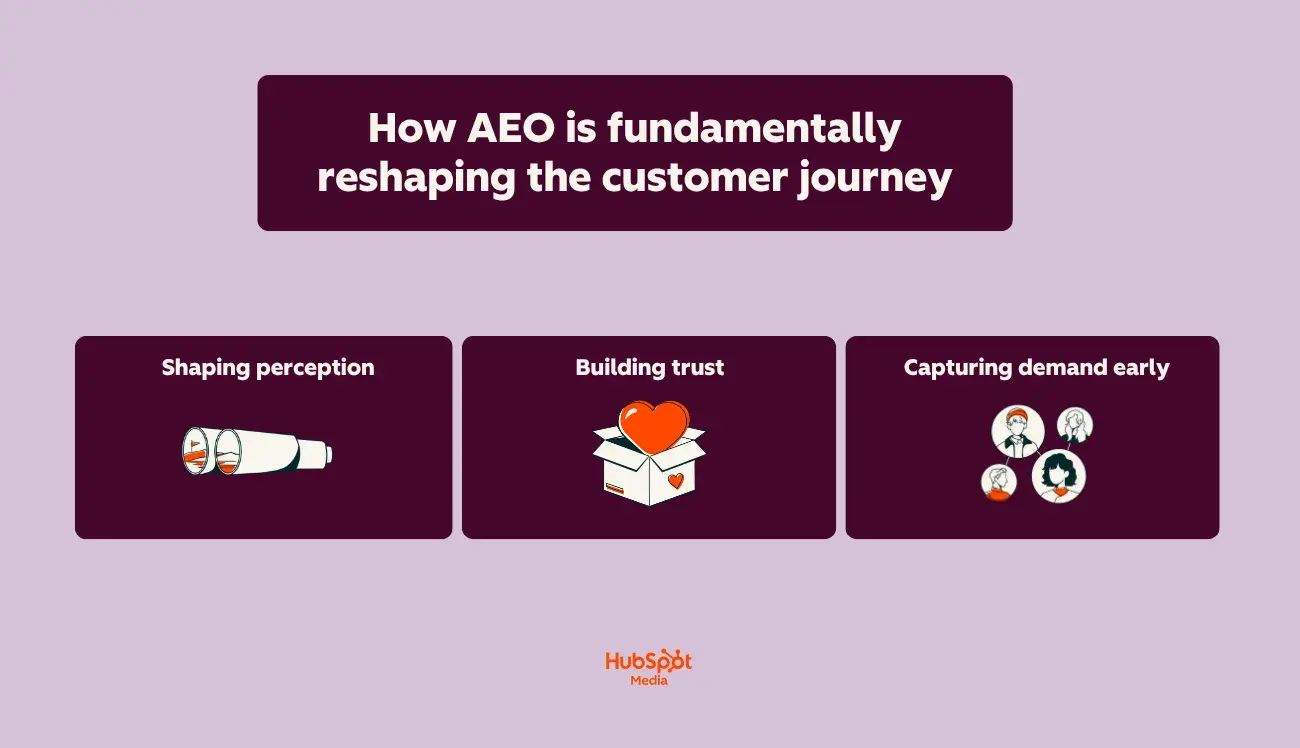
- Shaping perception
- Building trust
- Capturing demand at the earliest possible moment
Answer engine optimization increases brand visibility in AI-powered search results, and that visibility compounds over time as AI systems learn to associate your brand with authoritative, well-structured answers. For marketing leaders, this isn’t a “nice-to-have” anymore. It’s a direct line to pipeline influence.
The benefits of answer engine optimization are becoming measurable in ways they weren’t even a year ago. AEO improves conversion quality and time to value because the traffic you do earn from AI citations tends to be higher-intent (i.e., users who’ve already seen your brand positioned as the answer).
Early adopters are reporting stronger engagement metrics, shorter sales cycles, and improved content ROI, all because their content is formatted for how people actually search today.
That said, the benefits of AEO don’t materialize without addressing real answer engine optimization challenges head-on. The most common blockers for growth and enterprise teams include:
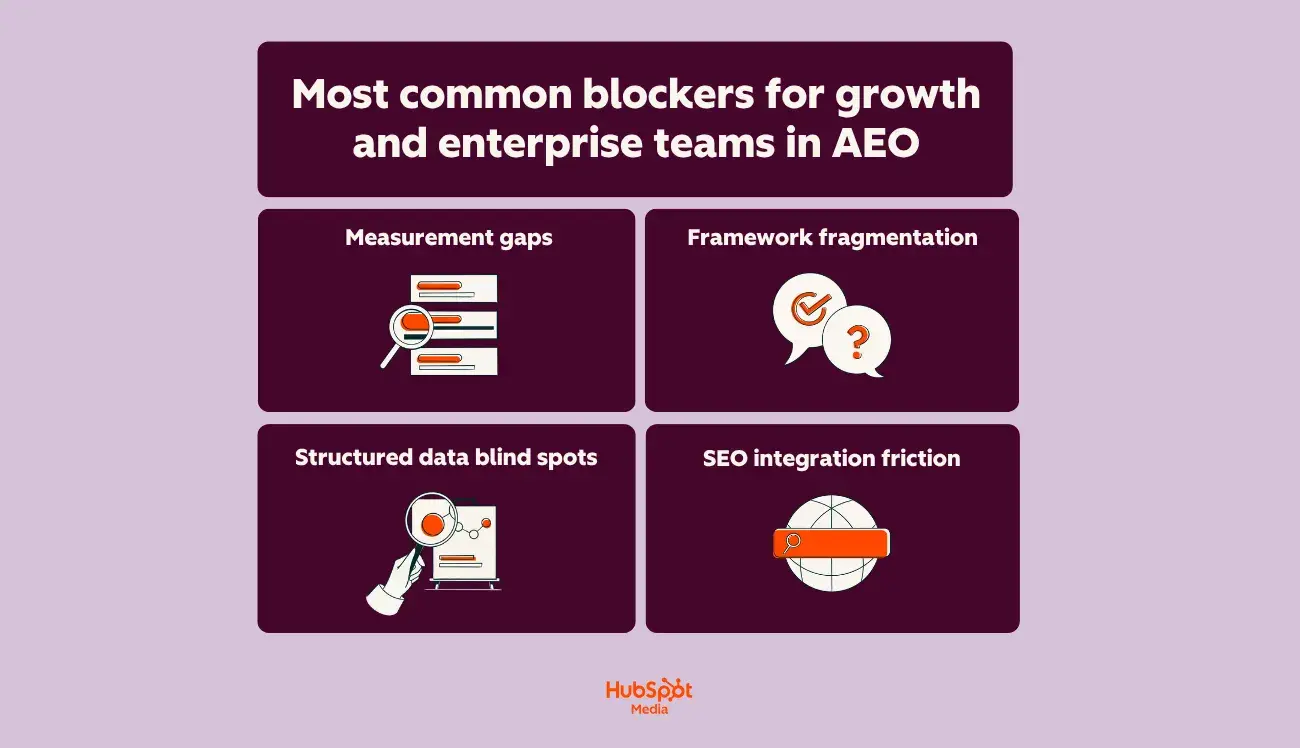
- Measurement gaps. Traditional rank-tracking tools weren’t built for AI answers, making it difficult to quantify AEO ROI or tie citation appearances back to revenue.
- Framework fragmentation. Many teams lack a repeatable, actionable process for optimizing content specifically for LLM retrieval, so efforts stay ad hoc.
- SEO integration friction. AEO differs from traditional SEO by focusing on direct answers and entity clarity, but that doesn’t mean you abandon your existing SEO stack. The challenge is layering AEO on top of what’s already working without duplicating effort or creating governance headaches.
- Structured data blind spots. Structured data and entities support AEO by enabling AI systems to extract and cite information, yet many marketing teams still under-invest in schema markup, entity definitions, and content architecture that LLMs can parse.
But there is good news, reader: the benefits of answer engine optimization tools designed specifically for this shift are making each of those challenges more manageable.
AEO strengthens E-E-A-T and long-term authority because it forces you to do what search engines (traditional and AI-powered) have always rewarded: produce clear, well-sourced, genuinely useful content.
The difference now? The payoff is more direct, and the feedback loop is faster. Marketing leaders who invest in answer engine optimization today aren’t just chasing a trend. They’re building the visibility infrastructure that will define brand authority for the next decade of search.
Pro Tip: HubSpot’s AEO Grader, for example, lets you measure your AEO visibility and performance across AI search engines, giving you a concrete baseline, identifying gaps in your content’s answer-readiness, and providing prioritized recommendations so you can take action immediately.
Benefits of answer engine optimization (AEO)
The benefits of answer engine optimization go well beyond showing up in one more channel.
For growth and enterprise marketing leaders, AEO creates compounding advantages across visibility, conversion quality, and long-term brand authority; these are advantages that become harder for competitors to replicate the earlier you start.
With all of this in mind, here are six tangible benefits of AEO that map directly to the metrics leadership teams care about:
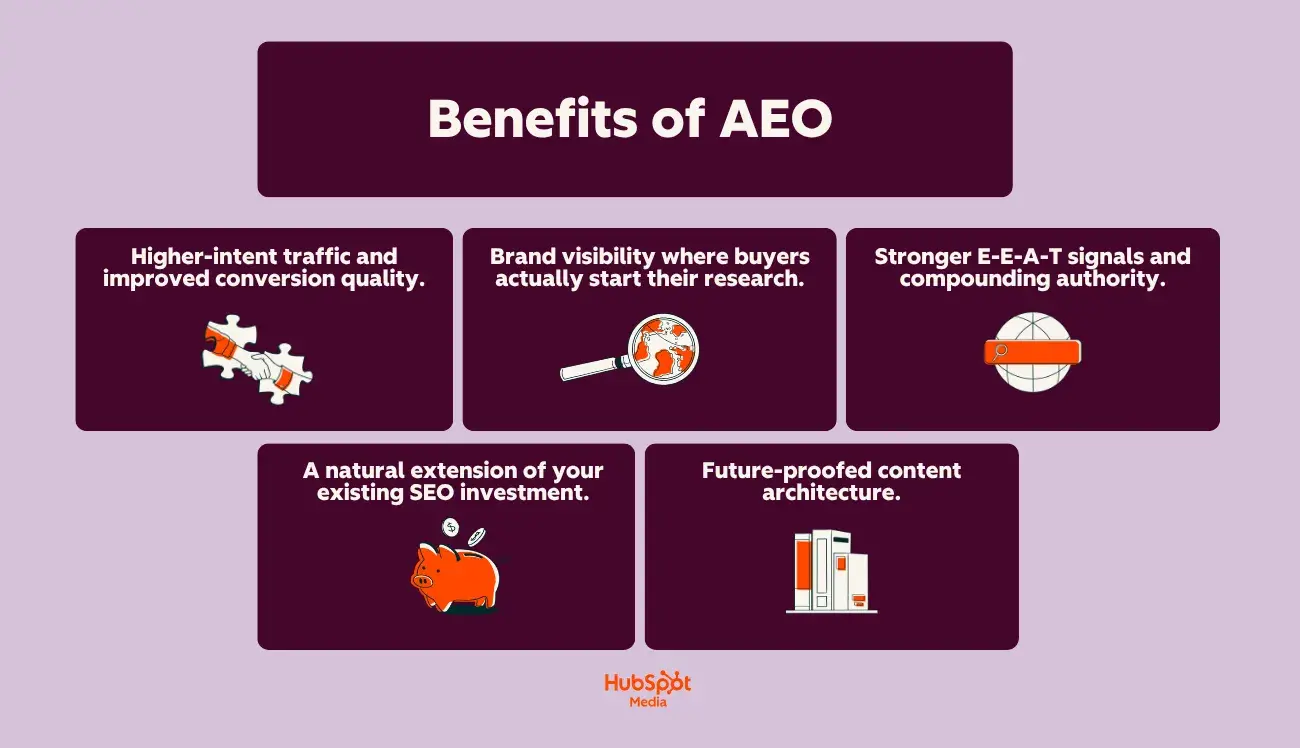
1. Higher-intent traffic and improved conversion quality.
AEO improves conversion quality and time-to-value because users who click through from an AI-generated citation have already been pre-qualified by the answer itself.
They’ve seen your brand positioned as the authority before they ever hit your site. The result is a shorter path from discovery to action, which means:
- Fewer bounce-backs
- More engaged sessions
- A pipeline that moves faster
2. Brand visibility where buyers actually start their research.
Answer engine optimization increases brand visibility in AI-powered search results, and that matters because buyer behavior has shifted.
According to HubSpot’s 2026 State of Marketing Report, nearly half of marketers (49%) agree that web traffic from search has decreased because of AI answers. However, 58% note that AI referral traffic has much higher intent than traditional search.
This means that visitors who come from LLMs such as ChatGPT are much further along in their buyer’s journey. Thus, the brands that appear inside AI-generated responses capture demand at the moment of intent formation, not after.
3. Stronger E-E-A-T signals and compounding authority.
Again, AEO strengthens E-E-A-T and long-term authority because the optimization work itself (i.e., defining entities, adding structured data, publishing clear and well-sourced answers) is exactly what both traditional and AI-powered search engines reward.
Every piece of answer-optimized content reinforces your brand’s entity profile across LLMs, increasing the likelihood of future citations. This is one of the most durable benefits of answer engine optimization: the authority you build today makes tomorrow’s visibility easier to earn.
4. Measurable performance with purpose-built tools.
One of the biggest search engine optimization challenges has been proving ROI.
Legacy rank trackers weren’t designed to measure AI citations, leaving marketing teams to rely on intuition.
However, that’s changing. HubSpot’s AEO Grader and AEO product, HubSpot AEO, measures your AEO visibility and performance across AI search engines, giving you a concrete score, gap analysis, and prioritized recommendations, so you can tie optimization efforts directly to outcomes rather than guessing.
5. A natural extension of your existing SEO investment.
AEO differs from traditional SEO by focusing on direct answers and entity clarity, but it doesn’t replace your current strategy. Instead, it amplifies it.
Let me be clear: the benefits of answer engine optimization tools become clearest when they layer onto what’s already working. Here’s why:
- Your highest-ranking pages become candidates for AI citation optimization, not a separate content initiative.
- Schema markup and structured data you add for AEO simultaneously improve traditional rich results.
- Topic clusters built for SEO provide the entity relationships that LLMs need to confidently cite your content.
This means teams can adopt AEO incrementally without rebuilding their content programs from scratch, which directly addresses the integration friction that stalls most enterprise rollouts.
6. Future-proofed content architecture.
Structured data and entities support AEO by enabling AI systems to extract and cite information, and that same architecture prepares your content for whatever comes next.
Voice search, multimodal AI, agent-driven commerce, and zero-click interfaces all rely on the same foundation:
- Clearly defined entities
- Well-structured answers
- Machine-readable relationships
Investing in AEO now means you’re not just optimizing for today’s AI search engines. You’re building the content infrastructure that scales across every emerging channel.
The benefits of AEO are no longer theoretical. They’re measurable, they compound, and they align directly with the visibility and pipeline goals that growth and enterprise marketing teams are accountable for.
The teams that treat answer engine optimization as a core capability (not a side experiment) are the ones building defensible brand authority in a search landscape that’s evolving fast.
Common AEO challenges (and how to solve them)
The benefits of answer engine optimization are well-documented at this point. (I mean, c’mon, with the current state of search, who doesn’t want to know that optimizing for AI answers involves stronger brand visibility, higher-intent traffic, compounding authority?)
But knowing the upside doesn’t eliminate the friction of actually executing. Most growth and enterprise marketing teams face the same set of AEO challenges when they try to move from experimentation to a scalable program.
Here are six of the most common blockers and, most importantly, how to solve each one:
1. You can’t measure AEO ROI with your current stack.
This is the challenge that stalls more AEO programs than any other. Traditional SEO tools track keyword rankings and organic clicks, but they weren’t built to monitor whether your brand is being cited inside AI-generated answers. Without that data, it’s nearly impossible to justify the budget or prove the impact to leadership.
How to solve it: Adopt purpose-built AEO measurement tools. HubSpot’s AEO Grader measures your AEO visibility and performance across AI search engines, giving you a baseline score, a gap analysis, and prioritized actions, so you can report on AI citation presence with the same rigor you apply to organic traffic.
The benefits of answer engine optimization tools like this compound quickly: once you have a measurable baseline, every optimization becomes trackable.
2. There’s no repeatable framework for optimizing content for LLMs.
Many teams attempt AEO in bursts (e.g., restructuring a handful of pages or adding some schema markup) without a systematic process. The work likely feels ad hoc because it is, and, on top of that, it doesn’t scale.
How to solve it: Build a repeatable AEO content workflow with defined steps.
To get started, do the following:
- Audit existing high-traffic pages for answer-readiness (clear definitions, entity clarity, structured data).
- Prioritize by search intent (start with pages that already target question-based queries).
- Optimize by adding concise, direct-answer paragraphs at the top of each section, implementing relevant schema markup, and defining entities explicitly so LLMs can parse relationships.
- Measure and iterate using AEO-specific tools to track citation appearances after each round of updates.
This turns AEO from a one-off project into an operational capability your team can run quarterly.
3. AEO feels like it conflicts with your existing SEO strategy.
AEO differs from traditional SEO by focusing on direct answers and entity clarity, which can make it seem like an entirely separate discipline. Teams worry about duplicate effort, conflicting priorities, or cannibalizing what’s already working.
How to solve it: Treat AEO as a layer on top of SEO, not a replacement. Your highest-ranking pages are your best AEO candidates because they already have topical authority.
The structured data you add for AI citation eligibility simultaneously improves traditional rich results. Topic clusters you’ve built for SEO provide the entity relationships LLMs need.
When framed this way, AEO reinforces your existing investment rather than competing with it.
4. Structured data and schema markup feel too technical to implement at scale.
Structured data and entities support AEO by enabling AI systems to extract and cite information, but many marketing teams lack the technical resources to implement schema across hundreds or thousands of pages. The gap between “knowing it matters” and “getting it done” is real.
How to solve it: Start with high-impact, low-effort schema types.
The following three are examples of schema types that don’t require heavy engineering lift:
- FAQ schema for pages that answer common questions (requires minimal dev effort and directly signals answer content to LLMs).
- Organization and author schema to reinforce E-E-A-T signals and entity identity.
- HowTo schema for process-oriented content.
5. Leadership doesn’t understand why AEO matters, so it doesn’t get resourced.
Even when practitioners see the benefits of AEO clearly, securing buy-in from VP- and C-level stakeholders requires tying AEO to business outcomes they already track:
- Pipeline
- Revenue influence
- Competitive positioning
How to solve it: Frame AEO in terms leadership already cares about. AI search engines are projected to handle a growing share of queries that previously drove organic traffic, meaning brands that aren’t cited in AI answers risk losing the visibility they’ve spent years building.
When pitching AEO to leadership, position it as risk mitigation and a competitive advantage, not just a new channel. Then, use your AEO Grader score as a benchmark and show progress over time alongside pipeline metrics.
6. You don’t know which AI search engines matter or how they select sources.
Each LLM (i.e., ChatGPT, Google AI Overviews, Perplexity, Claude) has different retrieval behaviors, which makes it unclear where to focus. This ambiguity leads to paralysis.
How to solve it: Optimize for shared fundamentals rather than platform-specific quirks. Every major AI answer engine rewards the same core signals:
- Clearly defined entities
- Well-structured content
- Authoritative sourcing
- Direct answers to specific questions
Focus on making your content the most clear, well-structured, and authoritative answer to the queries your audience asks; in the era of AEO, that consistency translates everywhere and has tons of influence.
The answer engine optimization challenges above are real, but none of them are unsolvable. The teams capturing the benefits of answer engine optimization right now aren’t the ones with the biggest budgets or the most technical resources.
They’re the ones who identified these blockers early, built practical solutions for each, and committed to AEO as an ongoing capability rather than a one-time experiment.
A checklist to get started with AEO
The biggest answer engine optimization challenges aren’t technical; they’re operational.
Most teams struggle with AEO because they don’t have a clear sequence of steps. This checklist gives you a repeatable, tool-supported workflow to start capturing the benefits of answer engine optimization within your first 30 days.
Take a look:
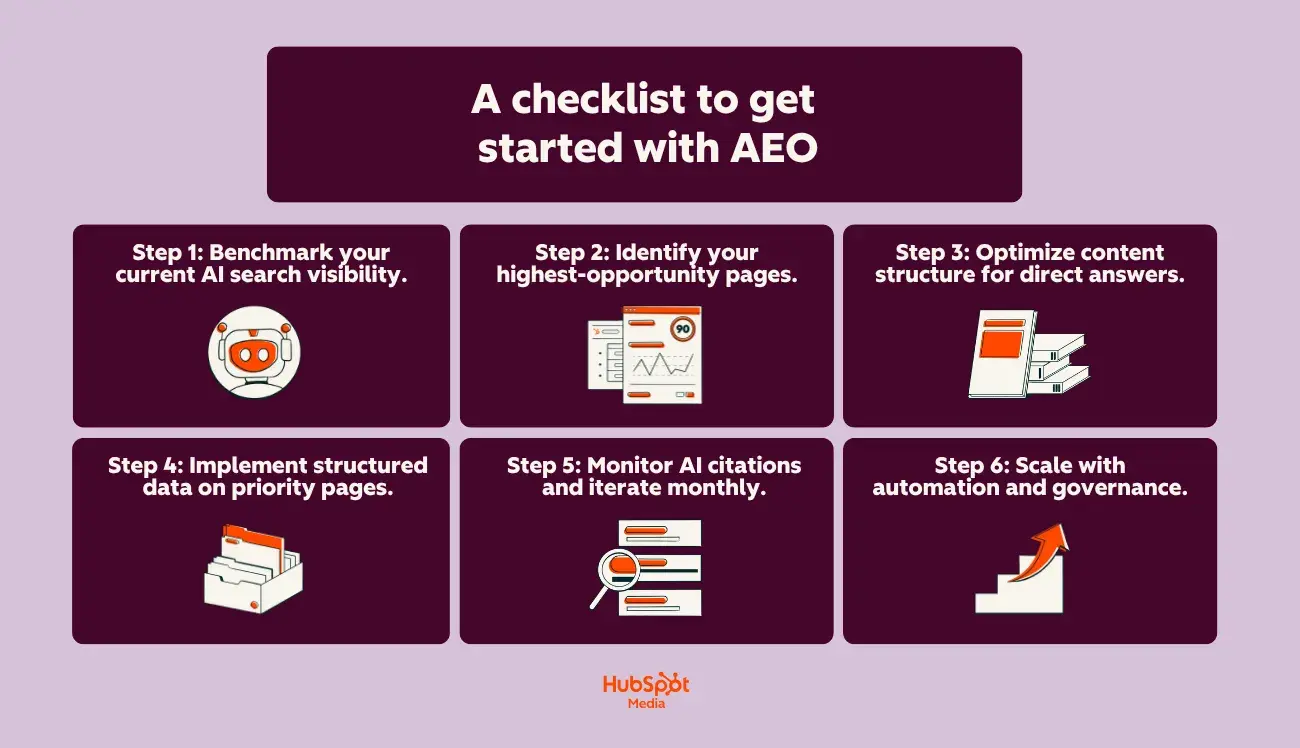
Step 1: Benchmark your current AI search visibility.
You can’t improve what you haven’t measured.
Before optimizing anything, establish a baseline of how often (and where) your brand appears in AI-generated answers. HubSpot’s AEO Grader measures your AEO visibility and performance across major AI search engines, giving you:
- A scored assessment
- A gap analysis
- Prioritized recommendations in minutes
Run your domain through it first so every optimization that follows is trackable against a concrete starting point.
Tool recommendation: HubSpot’s AEO Grader for your initial visibility score and gap report.
Step 2: Identify your highest-opportunity pages.
Not every page on your site needs AEO optimization on day one.
Start with the content that already has topical authority and organic traffic. These pages have the strongest signals for LLMs to pick up.
AEO differs from traditional SEO by focusing on direct answers and entity clarity, so prioritize pages that target question-based queries and informational intent. Then, do the following:
- Pull your top 20 organic pages by traffic and identify which ones answer specific questions your audience asks.
- Cross-reference with your AEO Grader results to see which topics are already appearing (or missing) in AI answers.
Tool recommendation: AirOps for automating content audits at scale. It can programmatically evaluate pages for answer-readiness, entity clarity, and gaps in structured data across large content libraries without manual page-by-page review.
Step 3: Optimize content structure for direct answers.
AI answer engines extract information most reliably when content is clearly structured and relationships are explicitly stated.
For each priority page, make these changes:
- Lead with a direct-answer paragraph. Open each section with a concise, definition-style response to the question the section addresses. Keep it under 50 words so it can be extracted as a standalone answer.
- State entity relationships explicitly. Use semantic triples throughout (for example, “Answer engine optimization increases brand visibility in AI-powered search results”), so LLMs don’t have to infer meaning from context.
- Cap paragraphs at five sentences. Break longer passages into bullet points to improve both reader scannability and AI parseability.
Tool recommendation: HubSpot’s Content Hub enables the creation and management of answer-friendly content formats with built-in support for structured data, making it easier to publish and maintain optimized content at scale.
Step 4: Implement structured data on priority pages.
Structured data and entities support AEO by enabling AI systems to extract and cite information, and this is where many teams leave the most value on the table. Focus on three high-impact schema types first:
- The FAQ schema on any page that answers two or more distinct questions.
- Organization and Author schema to reinforce your brand’s entity identity and E-E-A-T signals.
- HowTo schema on process-oriented content (guides, tutorials, walkthroughs).
You don’t need a full dev sprint for this. Most CMS platforms support schema plugins, and Content Hub handles structured data natively across templates.
Step 5: Monitor AI citations and iterate monthly.
The benefits of answer engine optimization tools become most valuable in the feedback loop, not just the initial optimization.
Set up ongoing monitoring so you can see which pages are earning AI citations, which queries trigger them, and where competitors are showing up instead of you.
Then, review results monthly, re-run your AEO Grader assessment quarterly, and use each cycle to prioritize the next batch of pages for optimization.
Tool recommendation: Use Perplexity as a testing surface. (Run your target queries directly in Perplexity to see whether your content is being cited, how it’s being summarized, and what competing sources appear alongside it.)
Step 6: Scale with automation and governance.
Once your initial pages are optimized and you’re seeing measurable results, the next challenge in answer engine optimization is scaling without losing quality or consistency. This is where automation tools pay for themselves.
- Establish editorial governance by documenting your AEO standards: required schema types per content format, semantic triple density, direct-answer paragraph requirements, and review cadence.
- The benefits of AEO compound fastest when optimization is systematic rather than ad hoc. Treat this checklist as a repeatable quarterly cycle, not a one-time project.
Tool recommendation: AirOps for building automated AEO workflows (i.e., programmatic content audits, bulk schema generation, and AI-assisted optimization recommendations across your entire content library).
AEO strengthens E-E-A-T and long-term authority with every optimization cycle you complete.
The teams capturing the full benefits of answer engine optimization right now aren’t doing anything beyond your reach, reader.
They’re simply following a clear process, using the right tools, and committing to iteration. Start with Step 1 today and build from there.
Frequently asked questions (FAQ) about answer engine optimization benefits
How long does AEO take to show results?
Most teams begin seeing measurable changes in AI citation visibility within 30 to 90 days of implementing structured optimizations, though the exact timeline depends on:
- Your starting point
- Content volume
- How aggressively you optimize
Additionally, quick wins like adding FAQ schema, rewriting introductory paragraphs as direct answers, and clarifying entity definitions can surface in AI responses relatively quickly because LLMs recrawl and reindex authoritative content more frequently than many marketers expect.
Overall, the longer-term benefits of answer engine optimization compound over time. As AI systems repeatedly encounter your brand associated with clear, well-structured answers, they build stronger entity associations, which means your content gets cited more frequently and across a wider range of queries.
Pro Tip: HubSpot’s AEO Grader measures your AEO visibility and performance so you can benchmark where you are today and track progress at regular intervals rather than guessing at timelines.
Does AEO risk cannibalizing my existing rankings?
No, and this is one of the most persistent misconceptions holding teams back.
AEO differs from traditional SEO by focusing on direct answers and entity clarity, but the optimizations involved actually reinforce traditional ranking signals rather than competing with them.
Here’s why:
- Structured data you add for AEO eligibility simultaneously improves rich results in traditional search.
- Direct-answer formatting (concise definitions, clearly stated relationships) aligns with what Google already rewards for featured snippets.
- Entity clarity and E-E-A-T improvements strengthen your domain authority across both AI and traditional search engines.
All in all, the benefits of the AEO layer on top of your existing SEO investment. Teams that treat them as complementary, not competing, consistently see gains in both channels.
Should I change my site architecture specifically for AEO?
In most cases, you don’t need a full architectural overhaul.
If your site already uses a logical topic cluster structure with clear internal linking, you have a strong foundation. Structured data and entities support AEO by enabling AI systems to extract and cite information, so the highest-impact architectural moves are usually additive rather than disruptive:
- Implement schema markup (FAQ, HowTo, Organization, Author) on your highest-traffic pages first.
- Ensure each page has a clearly defined primary entity and states relationships explicitly in the opening paragraphs.
- Use internal links to connect related entities across your content hub so LLMs can follow the same topical paths your readers do.
Pro Tip: HubSpot’s Content Hub enables the creation and management of answer-friendly content formats with built-in support for structured data, making these changes easier to implement at scale without re-platforming.
How does AEO impact voice assistants and smart devices?
Voice assistants like Siri, Alexa, and Google Assistant pull answers from the same AI retrieval infrastructure that powers text-based answer engines, which means the benefits of answer engine optimization extend directly to voice search.
When your content is structured as a clear, concise, direct answer with strong entity definitions, it becomes eligible for voice responses, not just text citations.
This matters because voice queries tend to be conversational and question-based, which is exactly the format AEO optimizes for.
AEO improves conversion quality and time-to-value across these surfaces because voice answers typically present a single source, meaning that if your brand is selected, you own that entire interaction with zero competition on the results page.
Do I need developer resources to start AEO?
Not to get started. Many of the highest-impact AEO optimizations are content-level changes that marketers can execute directly:
- Rewriting section introductions as direct, definition-style answers to specific questions.
- Adding explicit relationship statements (semantic triples) throughout your content so LLMs can parse meaning without ambiguity.
- Structuring content with clear headings that mirror the questions your audience actually asks.
Overall, developer support becomes more valuable when you’re ready to scale, particularly for:
- Implementing schema markup site-wide
- Automating structured data across templates
- Integrating AEO performance data into your reporting dashboards
The benefits of AEO tools that are purpose-built for this type of workflow significantly reduce that technical dependency.
Also, again, AEO strengthens E-E-A-T and long-term authority, so whether you start with a single page or a full site rollout, the best approach is to begin with what your team can execute now and layer in technical resources as the program matures.
The benefits of AEO are evolving every day
A year ago, most marketing teams treated answer engine optimization as an emerging trend worth watching. Today, the benefits of AEO are:
- Measurable
- Repeatable
- Directly tied to the visibility and pipeline metrics that growth and enterprise leaders are accountable for
That shift happened fast, and it’s accelerating.
Here’s what this post covered and why it matters for your next move:
- AEO is reshaping how buyers discover brands. Answer engine optimization increases brand visibility in AI-powered search results at the exact moment intent forms — before a prospect ever clicks through to a website.
- The benefits compound across channels. AEO improves conversion quality and time-to-value because AI-cited traffic arrives pre-qualified. It strengthens E-E-A-T and long-term authority because the optimization work (i.e., entity clarity, structured data, direct-answer formatting) reinforces signals that both AI and traditional search engines reward. (And it extends to voice assistants, smart devices, and every emerging zero-click surface that pulls from the same retrieval infrastructure.)
- The biggest answer engine optimization challenges are solvable now. Unclear ROI measurement, lack of frameworks, integration friction with existing SEO, and structured data gaps are real blockers, but each one has a practical solution. Purpose-built tools, incremental workflows, and a systematic checklist enable you to start capturing results within 30 to 90 days without rebuilding your content program from scratch.
- The benefits of answer engine optimization tools make execution scalable. From benchmarking your visibility with HubSpot’s AEO Grader to monitoring citations with Profound, automating audits with AirOps, and testing answers in Perplexity, the tooling ecosystem has matured enough to support enterprise-scale programs.
The teams winning in AI search right now aren’t waiting for the landscape to stabilize. They’re treating AEO as a core operational capability, measuring progress with real data, and iterating monthly.
What’s even more? The benefits of answer engine optimization will only grow as AI systems handle a larger share of the discovery journey, and the competitive advantage will go to the brands that build their foundations now.
Ready to see where your brand stands in AI search? Get started with HubSpot’s AEO Grader.
