


SEO attribution has always been messy. Unlike paid search, organic search lacks the same tracking granularity, has a lag between the work and the results, and often depends on signals you can’t control, such as rankings.
To make matters worse, attribution is even more of a black box today, with AI-generated answers dominating SERPs and LLMs that don’t always link back to your site or pass referrer strings.
Businesses have never really cared about that complexity. They care about the return they’re getting from their marketing dollars.
The good news?
SEOs can still tell a compelling ROI story, but it takes more nuance, more data digging, and more math than ever before. This article walks through key considerations as you build your next SEO ROI story.
The historical formula for calculating ROI
SEO ROI has traditionally been calculated using variations of the same formula:
- ROI = ((Incremental organic revenue − SEO costs) / SEO costs) x 100
It’s clean, fits on a single slide for executives, and makes sense for a long time. Before the rise of generative AI, driving incremental traffic — and therefore revenue — was the north star for most SEO campaigns.
However, sharp increases in zero-click searches and major attribution gaps from LLMs have upended traditional models.
In many cases, organic traffic may be flat or even declining, even as overall visibility increases through impressions, AI Overview rankings, or prompt visibility.
Looking only at organic metrics and incremental gains tells only part of the story. To show SEO’s true value, we need to rethink the formula.
Be the brand customers find first.
Track, grow, and measure your visibility across Google, AI search, social, local, and every channel that influences buying decisions.
Start your free trial
Here are three ways to build a more complete SEO ROI model.
1. Take credit for all organic revenue, not just incremental gains
With 60% of searches ending without a click, and that number continuing to grow, a huge part of SEO’s value today is defensive. That means maintaining and protecting traffic that would otherwise erode due to various factors.
The formula above doesn’t account for that at all. For example, would you judge a goalkeeper’s performance by how many goals they’ve scored?
The same is increasingly true of SEO. Only counting what’s new erases everything you preserved.
In a flat or declining landscape, holding the line is a major win, yet it’s completely ignored when you focus only on incremental gains.
The starting point for this ROI story shouldn’t be incremental organic revenue alone. It should be all organic revenue. That’s the entire asset SEO is responsible for maintaining and defending.
This may be a tough sell for many website owners, but it’s the truth. And if you go this route, there’s one major caveat.
Segment out brand vs. non-brand clicks
Claiming all organic revenue is disingenuous if branded growth is driving most of the performance.
Branded traffic is influenced by many factors outside SEO’s control, including PR campaigns, paid media, product, word of mouth, and more. When someone Googles your website by name, SEO rarely created that demand. It simply captured it.
SEO’s real lever is non-branded search. Before taking credit for total organic revenue, you need to segment it accordingly.
Since this can’t be done cleanly in Google Analytics, start by pulling the branded-versus-non-branded split from Google Search Console. Then apply that split to your total organic revenue using a weighted model.
Here’s some real-world data, for example:
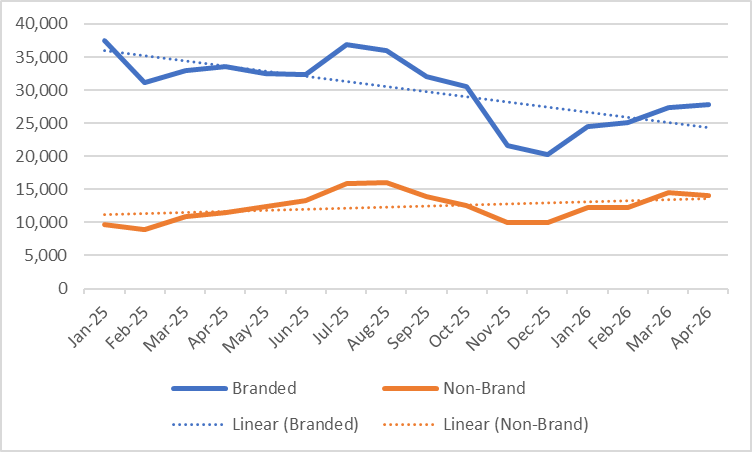
Branded traffic accounts for about 70% of total clicks and is declining, while non-brand traffic accounts for roughly 30% and is growing. That split tells a value story on its own because non-branded growth offsetting branded decline is exactly what good SEO should produce. Before taking credit for total organic revenue, though, we need to create a blended weight.
Let’s say SEO gets 10% credit for branded traffic and 100% credit for non-branded traffic. Treat these as starting points and calibrate them for each client. The calculation would be:
- (70% brand x 10% weight) + (30% non-brand x 100% weight) = 7% + 30% = 37% blended attribution weight
Apply that 37% weight to total organic revenue. If the site generates $100,000 in organic revenue per month, SEO gets credit for $37,000, not the full $100,000.
That’s likely far higher than the revenue you’d attribute to incremental gains alone. Because you’ve openly discounted credit you don’t deserve, the model is more defensible and shows stakeholders that you understand its limitations.
Dig deeper: The dark SEO funnel: Why traffic no longer proves SEO success
2. Account for assisted conversions and first-click influence
Last-click attribution buries SEO. That’s nothing new, but it’s even more relevant today.
Organic is often the first touchpoint in a user’s journey. Today, that might mean only an impression, with no measurable click at all.
Remove that influence, and SEO can look like a minor contributor to revenue it actually initiated.
SEO should take credit for the conversions it assists, even when another channel closes them. Here’s an example:

Organic dominates all three stages of touchpoint credit, but a last-click-only model rewards only the final click.
The catch is that GA4 doesn’t surface a clean assisted-conversion value the way Universal Analytics did. Precisely calculating assisted conversions requires exporting path data to BigQuery and deriving a true fractional value for each channel.
However, data-driven attribution in GA4 provides a defensible shortcut. Google already assigns each channel fractional credit based on its influence on conversions. We can use organic’s early- and mid-touch credit as a proxy for the assist value that last-click attribution ignores.
- 1,345.69 (early) + 687.34 (mid) = 2,033.03 in conversion credit
From there, multiply by the value of a conversion, using $100 as an illustration.
- 2,033.03 x $100 (conversion value) = $203,303
The same brand-versus-non-brand logic technically applies to assists. Since GA4 doesn’t cleanly split assist credit by query type, we left out late-touch credit. That’s where branded behavior tends to concentrate, and excluding it removes much of the credit that would otherwise be discounted.
Even as a directional number, the data proves the point: Organic is providing real value. Relying on last-click attribution alone leaves that ROI out of your story.
Dig deeper: Stop paying for traffic: The enterprise CMO’s guide to ROI-driven SEO
3. Measure SEO content impact across other channels
SEO-led content doesn’t stay within the organic channel. The same research, briefs, and articles your team produces can be repurposed across multiple channels:
Looking only at organic revenue ignores all the downstream value generated by SEO efforts.
I recently looked at a client where we’d just started publishing new articles and refreshing existing ones. After only one month, we were already seeing some of that content being used and generating conversions in other channels.

Sure, 29 calls and five qualified leads aren’t a huge number. But it will grow over time, and those are conversions SEO shouldn’t ignore.
Similar to assisted conversions, drilling down to an actual dollar amount requires some fancy math, but it’s possible.
Start by:
- Finding and cataloging which SEO-led pages are used across different channels.
- Calculating the percentage of conversions generated by those SEO-led pages.
- Applying that percentage to the total conversion value of each channel.
In practice, it could look something like this:
- 500 conversions (paid search) x $100 (conversion value) x 5% (percentage of conversions from SEO-led pages) = $2,500 in downstream value
Even if the numbers feel small, this is another way SEO can rightfully claim revenue and help justify the overall cost of the campaign.
Dig deeper: What 4 AI search experiments reveal about attribution and buying decisions
Own the conversation before your competitors.
See where your brand appears, where it doesn’t, and exactly how to win more visibility across search, AI, local, social, and every channel that matters.
Start your free trial
The dos and don’ts of SEO ROI
SEO can and should take credit for value beyond incremental organic revenue. Your exact methodology may differ, so work with your most data-savvy team members to get it right. The general concepts are what matter:
- Take credit for all organic performance, but don’t take credit for every branded click as if SEO created that demand.
- Look at assisted conversions and other attribution models. Don’t evaluate SEO within the organic silo alone.
- Take credit when SEO content is used by other channels. Don’t ignore the downstream impact it can have.
- Get creative when solving the ROI puzzle. Don’t let an outdated formula undersell your work.
The classic ROI formula isn’t wrong. It’s incomplete.
As search evolves, the way we measure ROI should evolve with it.
Contributing authors are invited to create content for Search Engine Land and are chosen for their expertise and contribution to the search community. Our contributors work under the oversight of the editorial staff and contributions are checked for quality and relevance to our readers. Search Engine Land is owned by Semrush. Contributor was not asked to make any direct or indirect mentions of Semrush. The opinions they express are their own.
