


I work at Ahrefs, one of the world’s best-known SEO tools, which means I get to talk with and learn from SEOs every day. And spoiler: it is wild how much SEO has changed in the past year, and how much SEOs are now expected to change with it.
A brand new awareness and growth channel appeared in the form of AI search, and in most companies, it gets shoved into the SEO remit. There’s a whole new technical infrastructure to understand, too: it’s no longer enough to know how search engines work; you also have to know how AI search engines work.
Meanwhile, the classic SEO playbook of top-of-funnel informational content (as much as it pains me to admit) seems to work a little worse with every passing day. We are all in the experimental, throw-spaghetti-at-the-wall phase, trying to work out where the next era of compounding growth comes from.
These are some of the SEO trends I have watched shift over the past year. All of these trends are backed up by real Ahrefs data (to show these are genuine industry-wide trends, and not just something I’m imagining).
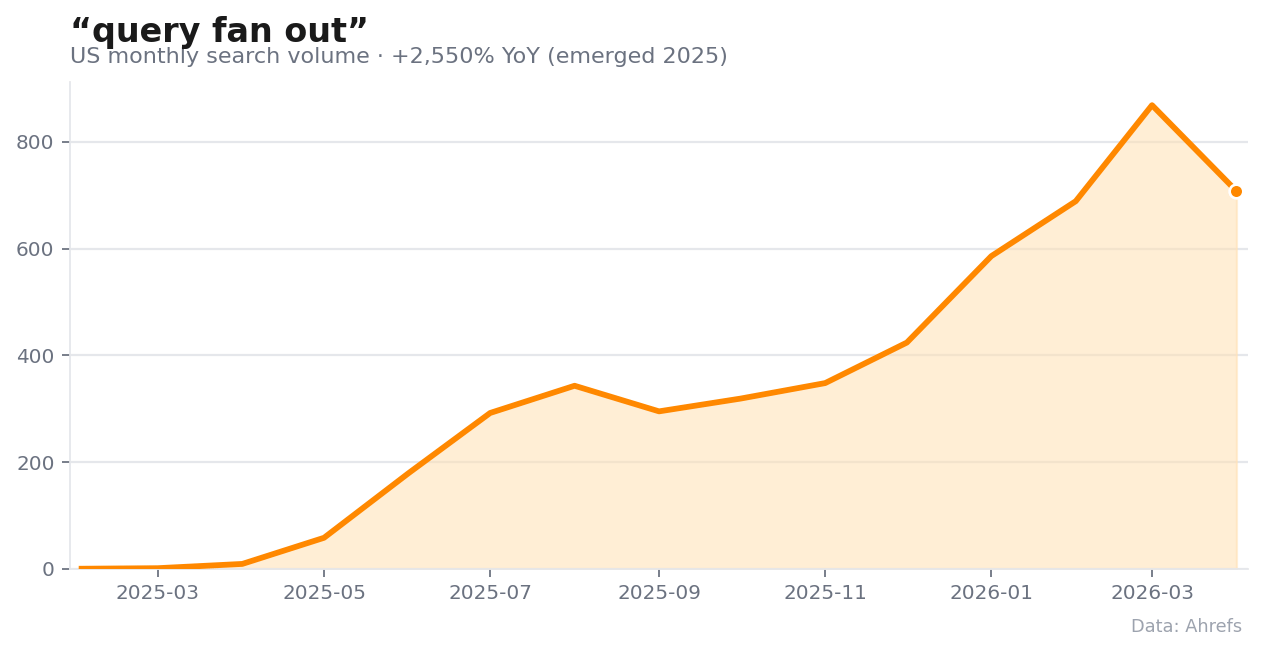
Query fan-out is essentially keyword research 2.0, adapted to the AI era. Searches for the term barely existed a year ago and are now up +2,550% year over year, and the concept matters because it changes what SEOs actually optimize for.
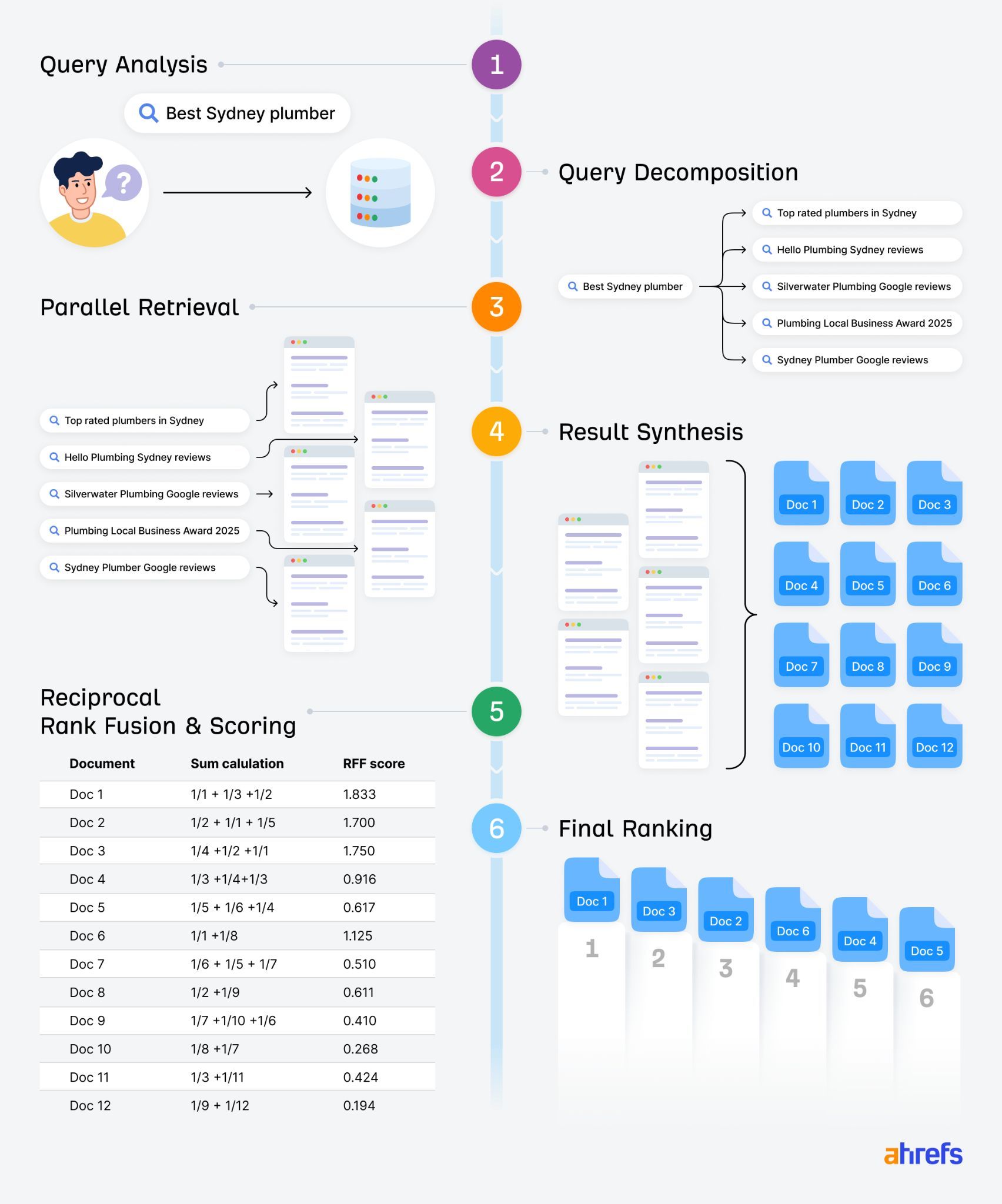
Here is how it works. When you give an AI search engine like ChatGPT a prompt, it does not run that prompt as a single query. Instead, it generates a spread of related searches, called fan-out queries, and uses those to pull relevant content from a search index.
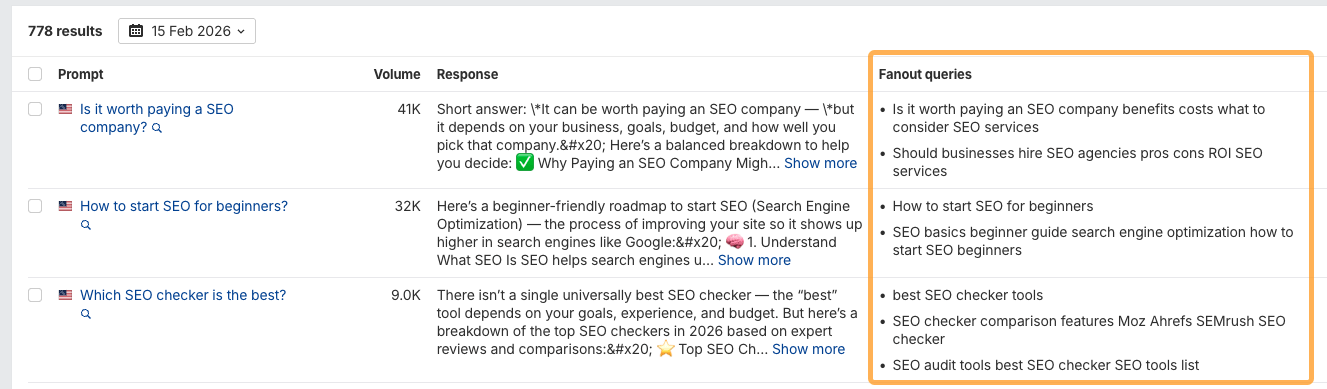
So a single question can quietly become a dozen searches behind the scenes, and the pages that get cited are the ones that answer those hidden queries. The same logic now shapes traditional ranking, too, because AI Mode sits on top of Google. If you want to show up, you need to rank for the head term and the fan-outs around it.
But there’s little use chasing exact fan-out queries: they are probabilistic, and change with every generation, so optimizing for a specific one is potentially a waste of time. Better: build a topic cluster that covers the whole topic space instead. Which is to say: the winning move is good old-fashioned keyword clustering and topical coverage, but pointed at a new search experience.
| Keyword | Value | Change |
|---|---|---|
| query fan out | 450/mo | +2,550% YoY |
| query fanout | 200/mo | new (2025) |
| google query fan out | 100/mo | new (2025) |
| query fan out seo | 150/mo | new (2025) |
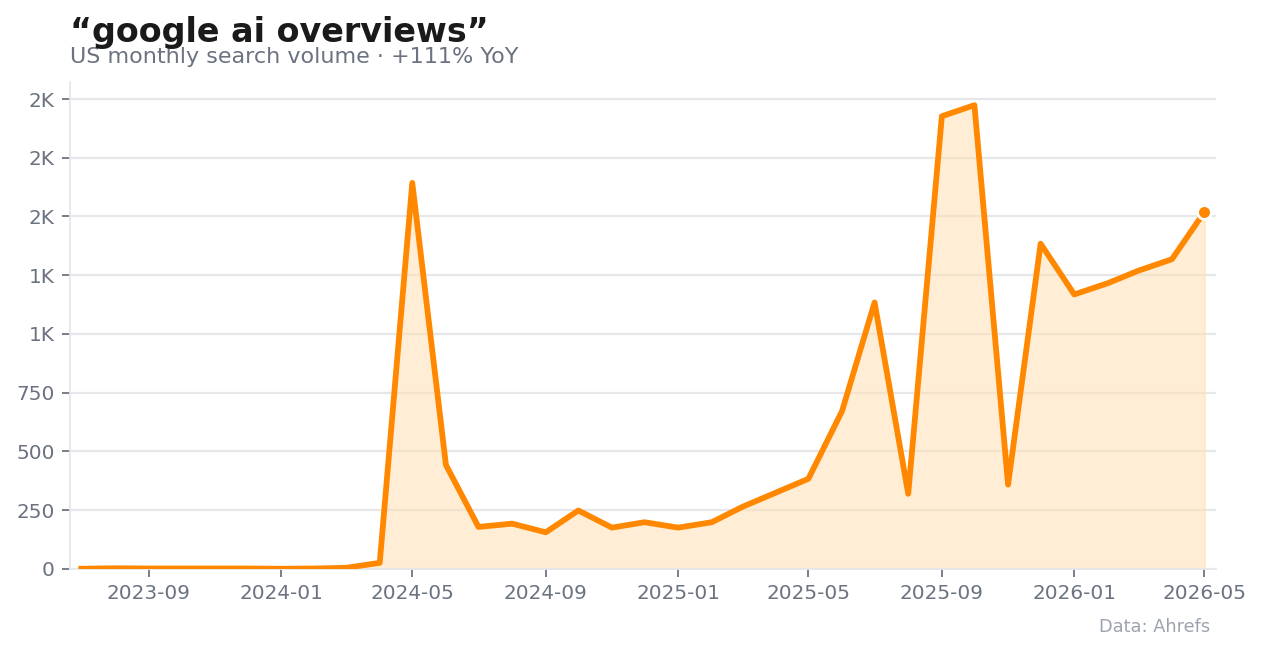
AI Overviews and AI Mode are the biggest change to how Google works in years.
The old ten blue links were already being chipped away by featured snippets, local packs, and other SERP features. Now Google is working hard to funnel people into its AI-powered experiences instead, and that changes the math for everyone who relies on search traffic.
AI Overviews already show up for a huge share of searches, and when they do, they keep people on the results page. Our latest study found that AI Overviews reduce clicks to the top-ranking page by 58%. For every 100 clicks a number-one result would historically earn, Google now keeps 58 of them. We re-ran the analysis across 300,000 keywords using December 2025 Search Console data, and the effect held all the way down the page: position 2 lost 51%, position 3 lost 46%, and so on.
Then there is AI Mode, the longer-form, conversational version that feels a lot more like ChatGPT than a traditional search. Different format, same outcome. Across both, the story is the same: there are fewer clicks available in the SERP, your blue link is harder to find, and users are far more likely to get their answer on the page itself and never visit your site.
This goes well beyond a dip in traffic. It changes the unit economics of SEO, because the clicks you used to count on are quietly being kept by Google.
| Keyword | Value | Change |
|---|---|---|
| ai mode | 881,000/mo | +17% YoY |
| ai overviews | 5,600/mo | +17% YoY |
| ai overview optimization | 900/mo | +625% YoY |
| ai overview tracking | 2,100/mo | +594% YoY |
SEOs are practical people. When there is a faster, more efficient way to do something, they find it. That is why AI content creation has become such a big part of the job.
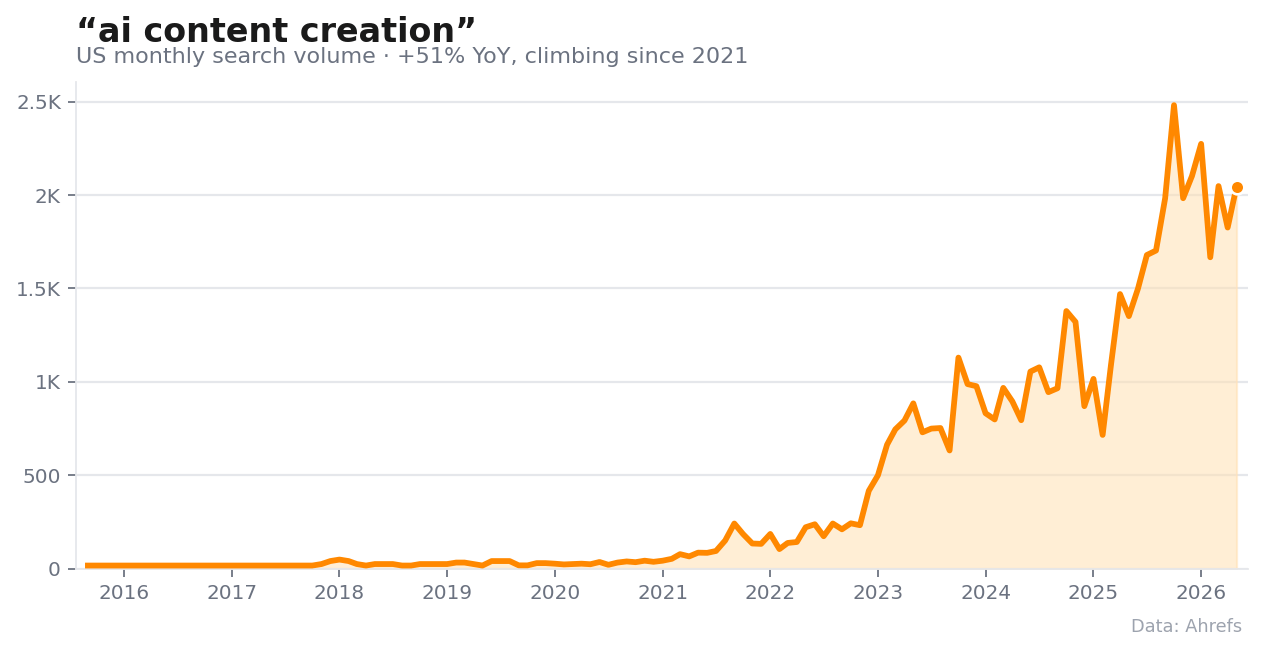
For a long time, using AI meant a trade-off. You got worse content, and we all saw the ‘mount AI’ traffic graphs: a site spams a few months of thin AI content, climbs, then gets flattened by a Google update. But I think that trade-off has largely gone away.
There is now enough infrastructure around the models (agentic harnesses, tool calling, MCPs, the plumbing that lets a model reach out to real tools and data) to produce genuinely good content with AI. I have written a lot about how to do that well, in what content engineering is, and why AI content is not inherently bad for SEO.
The data shows the attitude shift. Interest in creating with AI has climbed steadily since 2021, while interest in detecting AI content has fallen since its 2023 peak. People are normalizing the behavior. It is becoming more acceptable to use AI to produce high-quality work, which makes sense when you remember that every Google property, Docs, Sheets, Gmail, now has AI text generation built in.
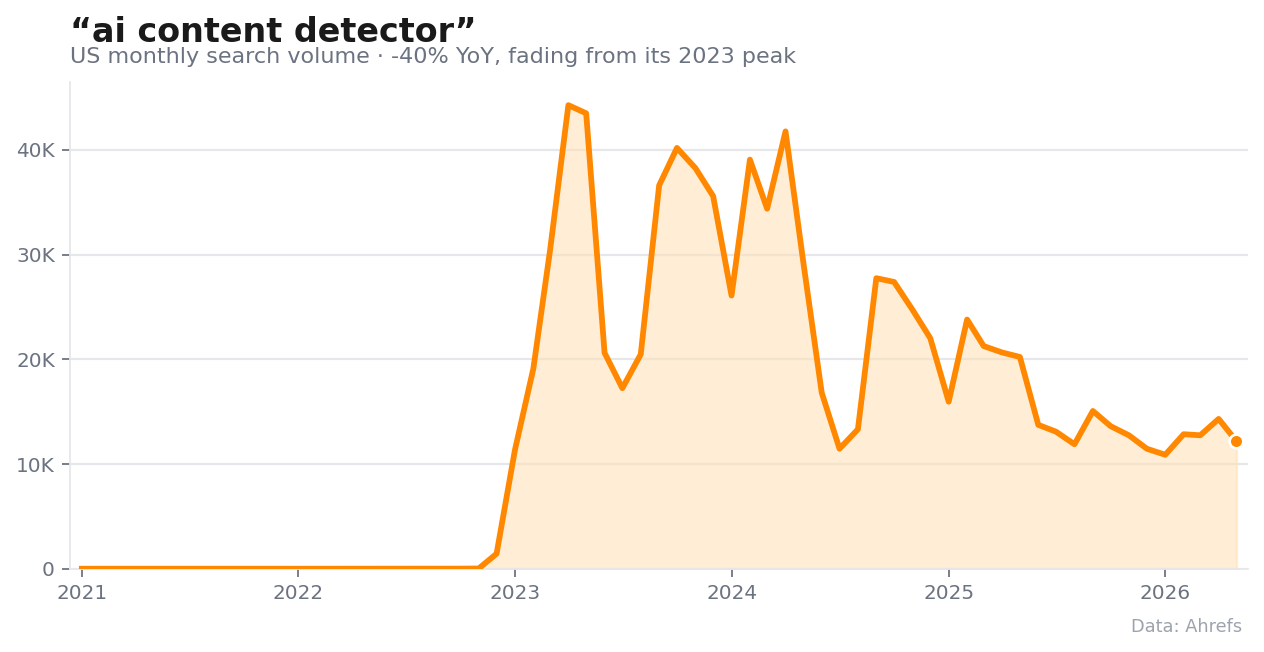
Using AI to write is no longer a dirty secret. It is just part of how information gets made and shared on the internet.
| Keyword | Value | Change |
|---|---|---|
| ai writing | 19,000/mo | +15% YoY |
| ai content detector | 14,000/mo | +11% YoY |
| ai content creation | 5,100/mo | +16% YoY |
| humanize ai content | 600/mo | +18% YoY |
As clicks from Google dry up, attention is fragmenting. People now research and buy across more places than ever: social media, YouTube, news aggregators, individual websites, and marketplaces. The single front door of Google search has turned into a dozen side doors.
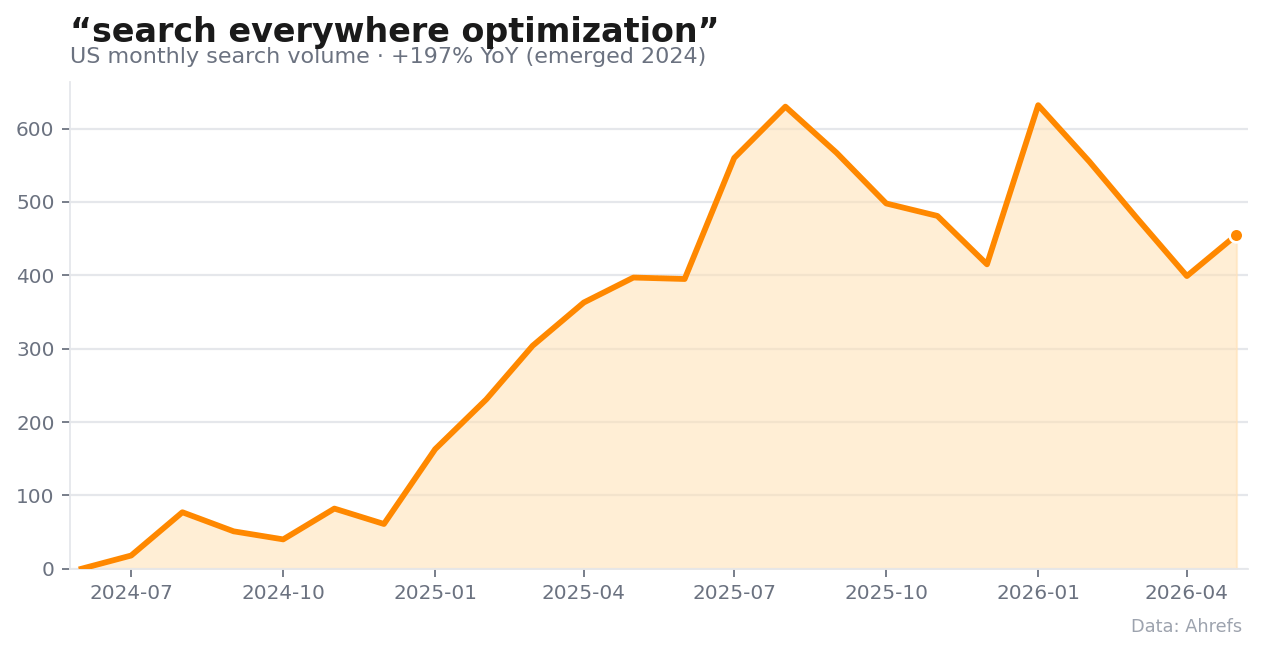
SEOs have started chasing visibility on those other surfaces, and the data shows it. Searches for ‘search everywhere optimization’ are up 197% year over year, and the platform-specific terms are all climbing too: TikTok SEO, Amazon SEO, YouTube SEO. Each is small growth on its own. Added together, they point to a real change. The SEO job is simply harder now, because there are more surfaces to win and no single one guarantees the traffic it used to.
This matters for AI search as well.
Many of these platforms feed the visibility a brand has inside AI answers. If you want to show up more often in ChatGPT, optimizing for YouTube and Reddit visibility is part of the work, not a separate project from traditional search. Where you appear off Google now shapes whether you appear on it, and inside the AI tools sitting on top of it.
| Keyword | Value | Change |
|---|---|---|
| search everywhere optimization | 500/mo | +197% YoY |
| tiktok seo | 1,600/mo | +14% YoY |
| amazon seo | 2,700/mo | +5% YoY |
| youtube seo | 3,300/mo | +4% YoY |
Technical SEO frameworks like semantic SEO and entity optimization sound are enjoying a resurgence because of AI search. In truth, they always mattered: semantics and entities have always been part of how Google works, but there wasn’t much you had to do about them beyond solid traditional SEO. But AI search has changed that.
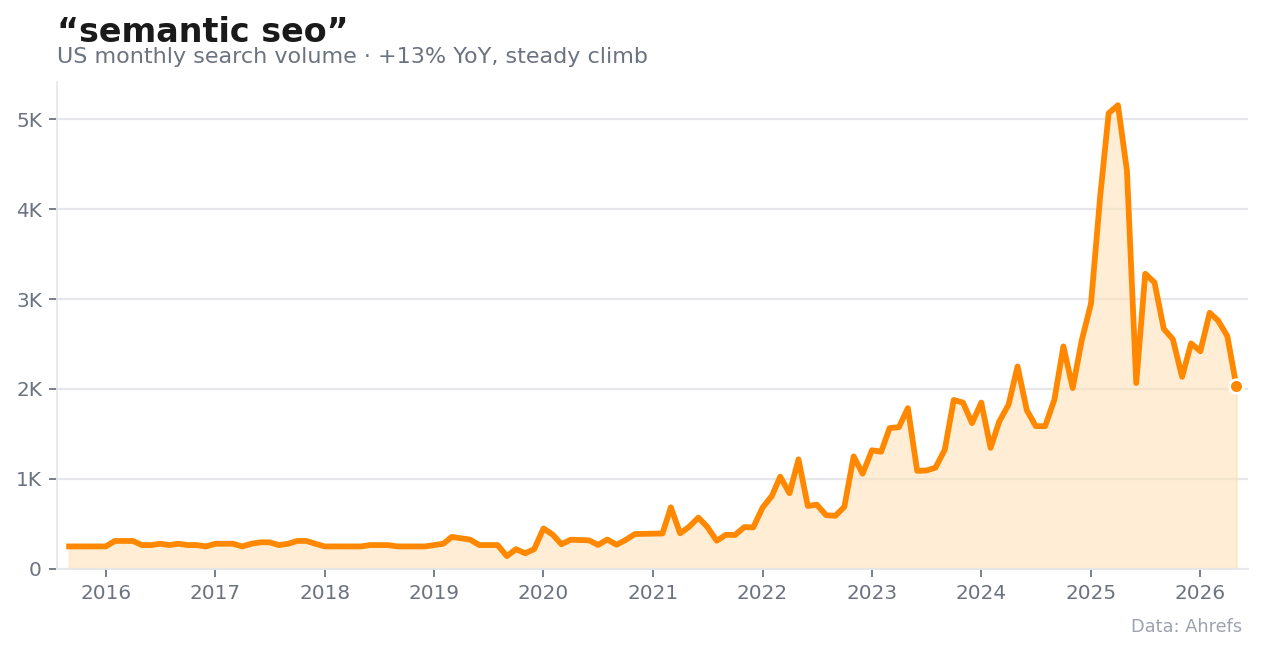
An LLM builds its understanding of your brand from how often you appear in its training data and the context you appear in. The words, entities, and phrases that show up alongside your brand shape what the model thinks you are and when it should recommend you.
For example, Ahrefs has years of old content out on the web, guest posts and mentions, that all describe us slightly differently. That is confusing for an LLM, because there is no clear consensus about what Ahrefs is or does when so many sources use different language.
A big part of modern SEO is making your entities consistent across the internet and paying attention to the semantic context your brand shows up in.
(And if that sounds kinda complicated, don’t worry: we have deep-dive guides on semantic search and the knowledge graph if you want to go deeper.)
| Keyword | Value | Change |
|---|---|---|
| semantic seo | 2,800/mo | +13% YoY |
| topical authority | 1,400/mo | +14% YoY |
| entity seo | 700/mo | +15% YoY |
| semantic keywords | 1,400/mo | +12% YoY |
With agentic AI models, it is now genuinely possible to automate real SEO work. Searches for SEO AI agents are up 285% year over year, and the reason is simple: the tools finally caught up to the hype.
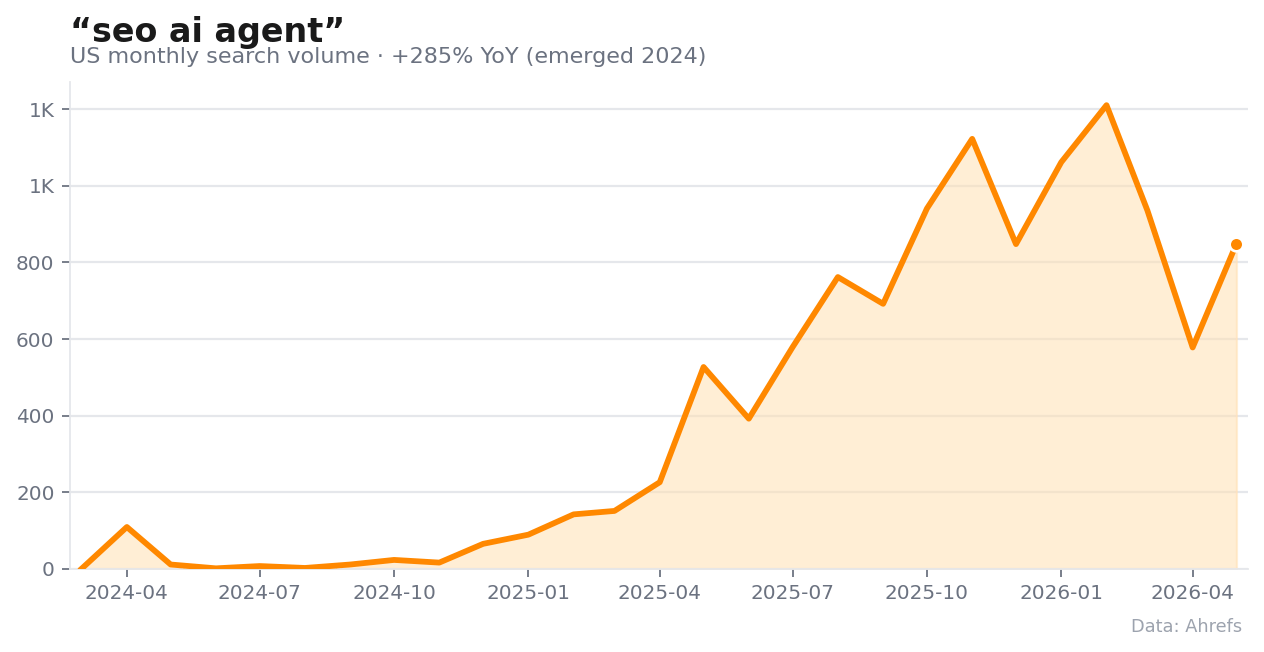
If you’re still stuck thinking of AI as a fany chatbot, here’s something to consider: if you believe AI can refactor a 50,000-line codebase, why couldn’t it write a blog post or fix a batch of internal links? The harder, more structured task is the one that is already being automated.
This goes double when you plug SEO data into the workflow. With something like the Ahrefs MCP or Agent A, you can bring world-class SEO data into your AI workflows and automate things that simply could not be automated before.
We just published a list of SEO automations built with Agent A. The short version: keyword research, content updating, internal linking, site auditing, and a long tail of rote processes are all fair game now. The work that used to eat your afternoon is increasingly something you can hand to an agent.
| Keyword | Value | Change |
|---|---|---|
| seo ai agent | 900/mo | +285% YoY |
| ai seo agent | 600/mo | +171% YoY |
| seo automation | 2,600/mo | +14% YoY |
| agentic seo | 150/mo | emerging |
Every SEO knows the humble robots.txt file. Now, there’s a new text file on the block, llms.txt, and searches for it are up 154% year over year. I am including it here because, surprise surprise, it’s usually SEOs who get asked to implement it. But I want to be blunt about what the data says.
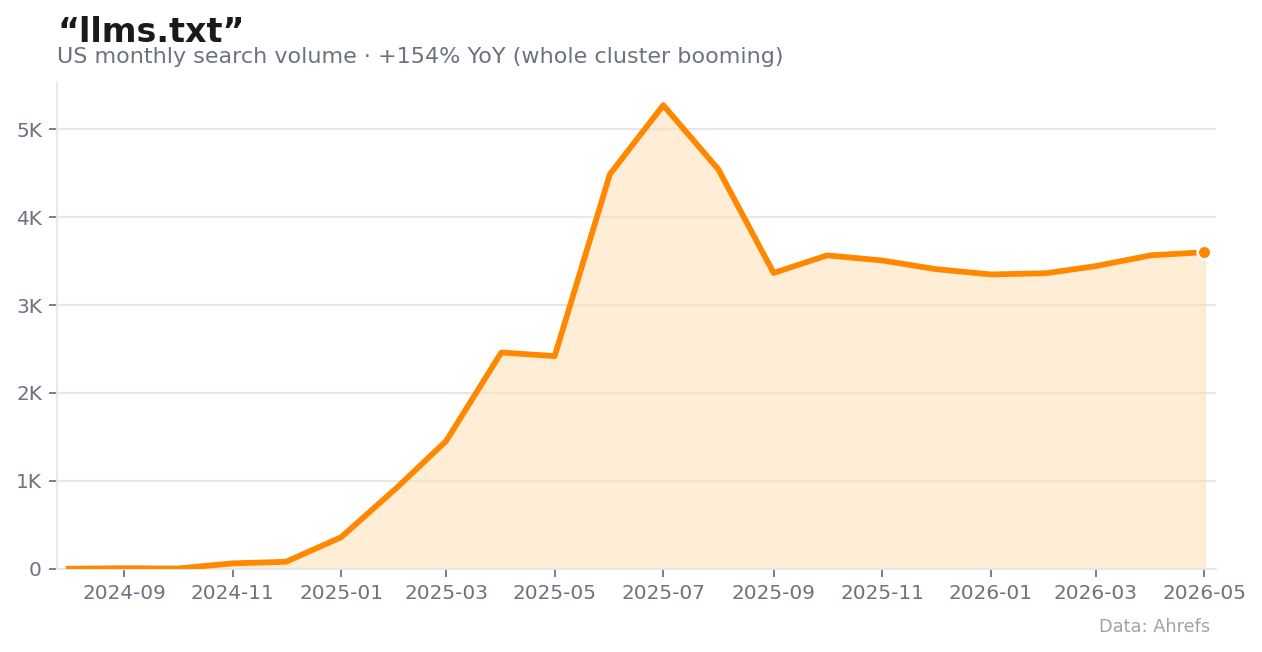
llms.txt is a proposed standard that no major AI search provider actually uses. As our research found, 28% of sites now publish an llms.txt file, and 97% of those files were never fetched at all in a given month. Of the small share that did get read, most of the requests came from bots that are not AI tools. Slackbot, the link-preview bot, fetched llms.txt files more often than PerplexityBot did. Google has said plainly that the file is not needed to appear in its generative AI features.
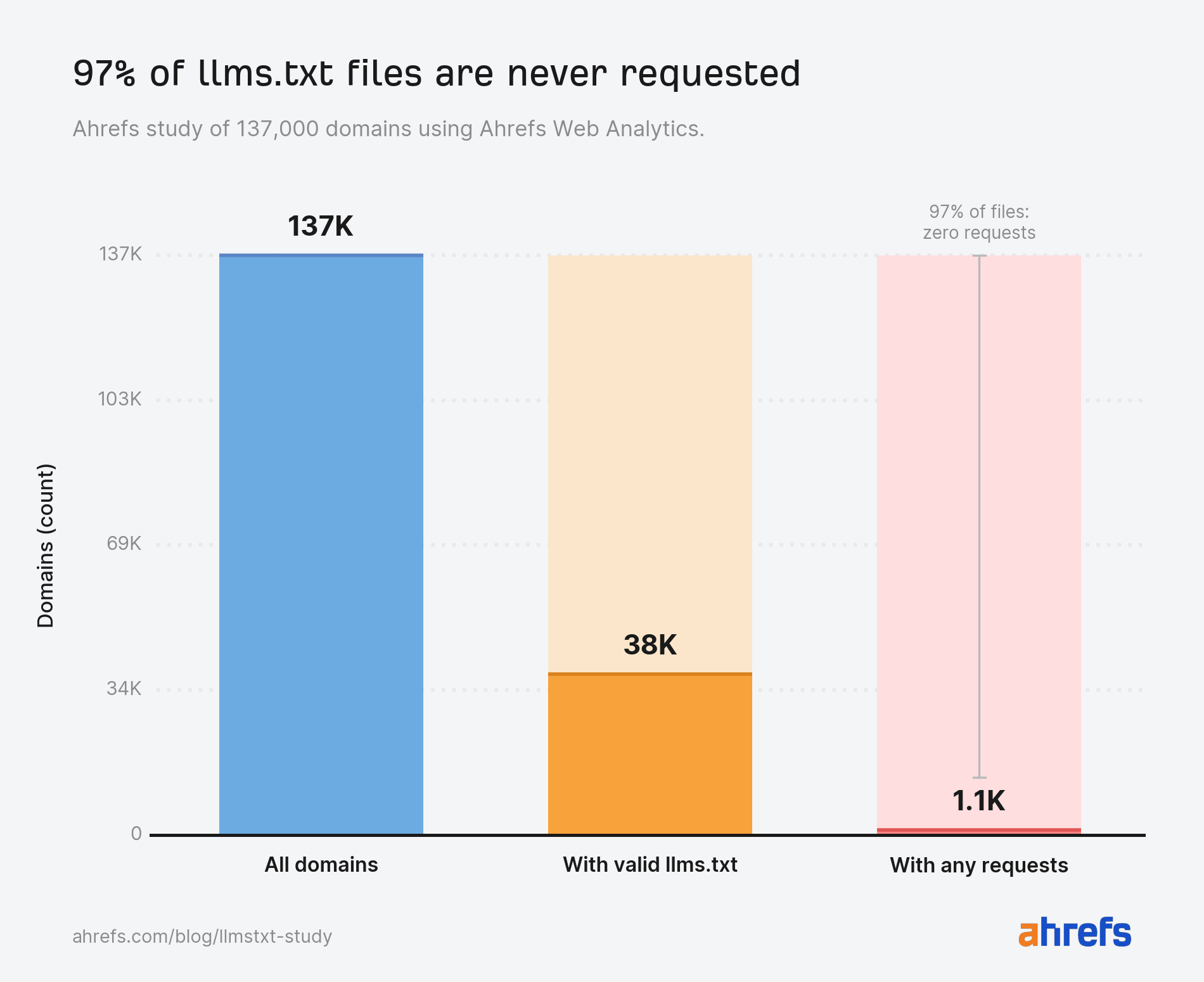
So at this point llms.txt delivers basically no benefit (and even carries a little risk, making it much easier for competitors crawl your sitemap). People like simple, concrete things they can do to influence mysterious processes like AI visibility, which is exactly why this one spread. If someone is pushing you to add one, send them this data. There are far better places to spend the hour.
| Keyword | Value | Change |
|---|---|---|
| llms.txt | 3,700/mo | +154% YoY |
| what is llms.txt | 1,100/mo | +423% YoY |
| llm.txt | 1,100/mo | +202% YoY |
| llms.txt generator | 450/mo | +223% YoY |
One of the most effective ways to influence AI search, and even traditional Google results, has been to publish ‘best’ listicles (like “The 10 best CRM tools”).
My colleague Glen Allsopp’s research on ‘best’ lists found that of all the source types cited by ChatGPT and other AI search engines, this format was cited most often, showing up in 43.8% of ChatGPT’s sources and 48.9% of AI Overviews.
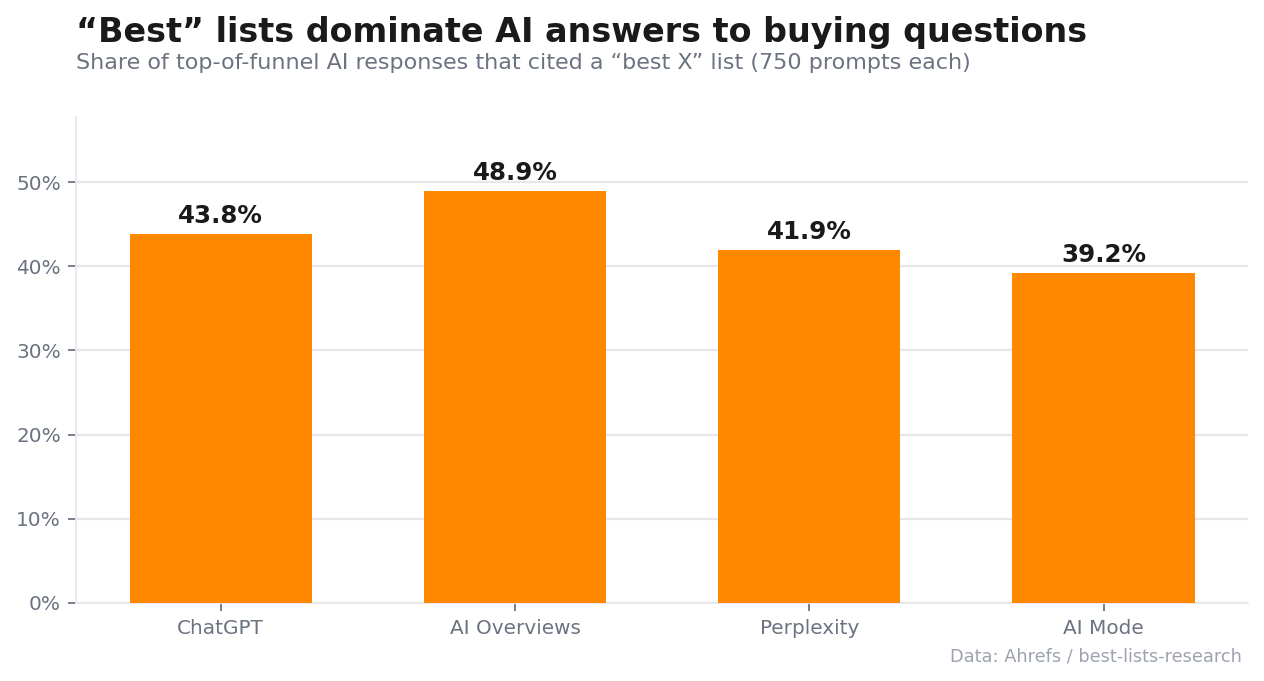
It makes sense. A lot of queries are commercial, and listicles are inherently commercial. They are genuinely useful in the buying process, as long as they are honest and not biased. But SEOs are going to SEOs: plenty of companies abused this by ranking themselves number one in ‘best’ lists published on their own domain. In Glen’s data, 67.6% of ‘best software’ SERPs featured a list where the author put themselves in the top spot.
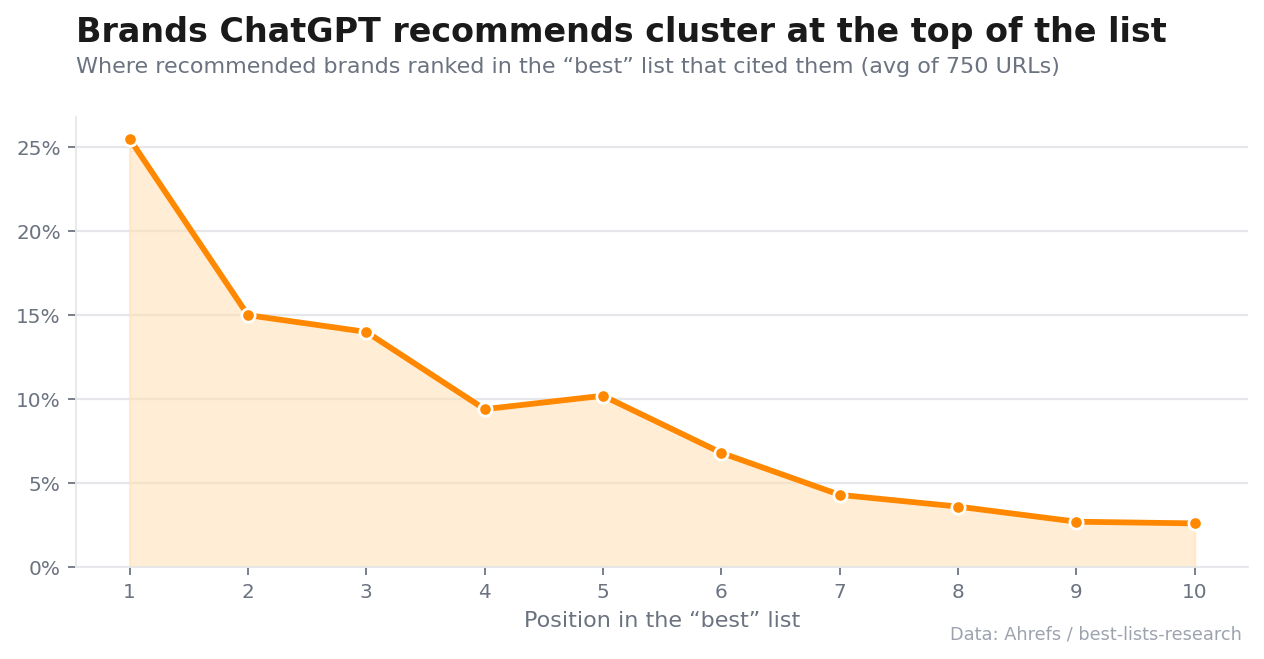
Now the tactic may be waning. As Lily Ray has reported, recent Google updates have hit self-promotional listicles hard, especially in SaaS. It increasingly looks like Google may use these lists but credit the competitors named in them while disregarding the publisher’s own self-placement on its own domain.
Worth knowing if you are leaning on this play: it may not be as effective as it was, and honestly, I hope it fades out.
| Metric | Value | Change |
|---|---|---|
| “best” lists in ChatGPT sources | 43.8% | of all page types |
| prominence in AI Overviews | 48.9% | highest of any platform |
| SERPs where author self-ranks #1 | 67.6% | 250 “best software” SERPs |
| recently updated lists | 79.1% | updated in 2025 |
The biggest macro trend I have seen in SEO is the decline of information-only websites, affiliate sites included. Google seems to have it out for sites whose whole job is to share information rather than sell a product or support a real business.
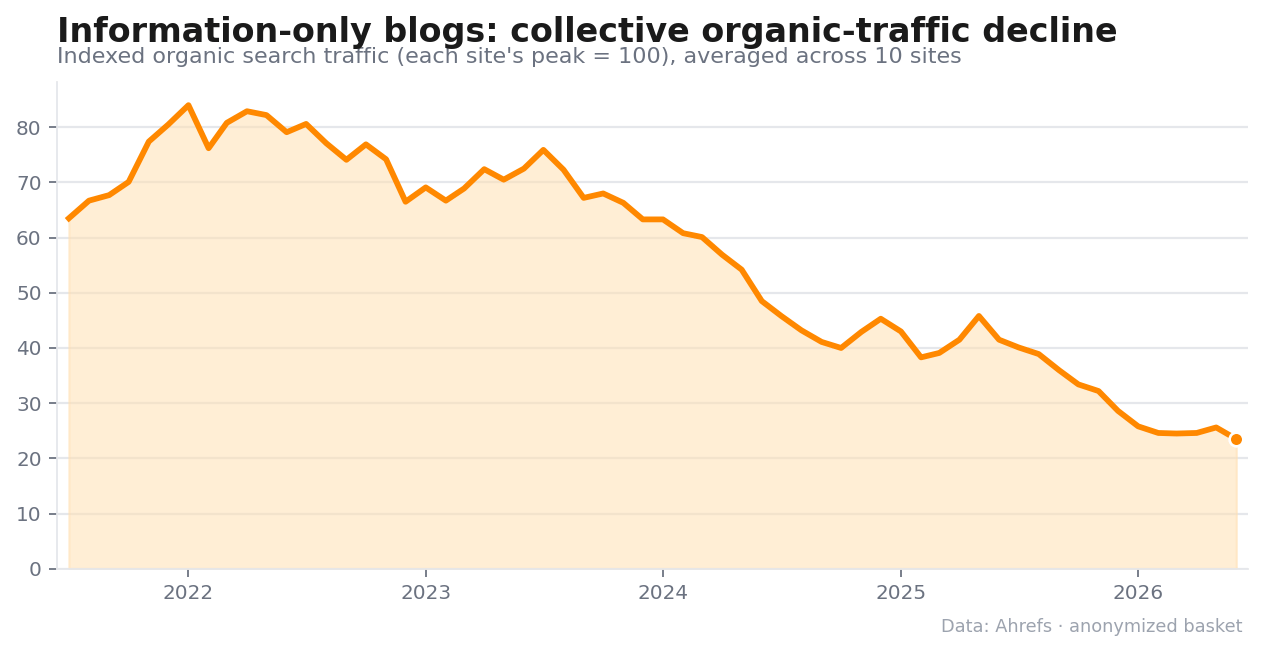
The reason is not mysterious. Once AI Overviews and AI Mode arrived, informational content became commoditized. Most informational queries can now be answered with an AI-generated response, so Google has little reason to send a click to a pure information blog.
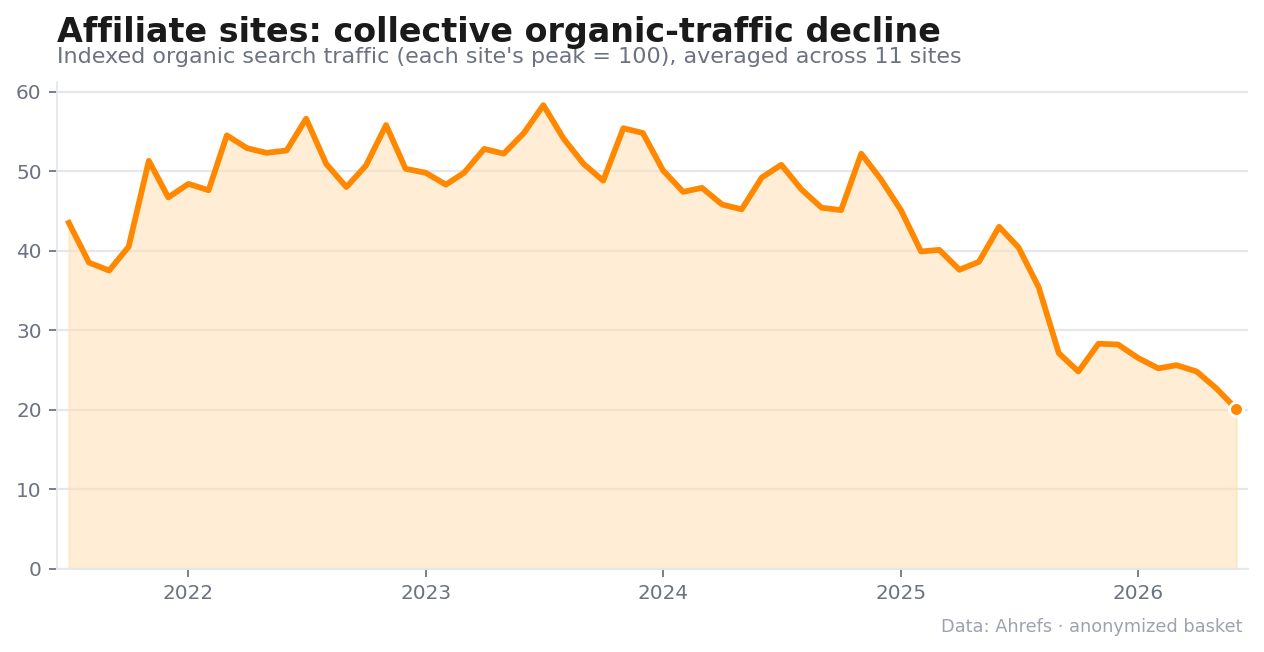
You can see it in the traffic. When I analyzed a small basket of well-known information-only blogs, I found it now sits at roughly 28% of its peak organic traffic, down about 72%. A basket of affiliate sites tells the same story, down about 66% from its peak.
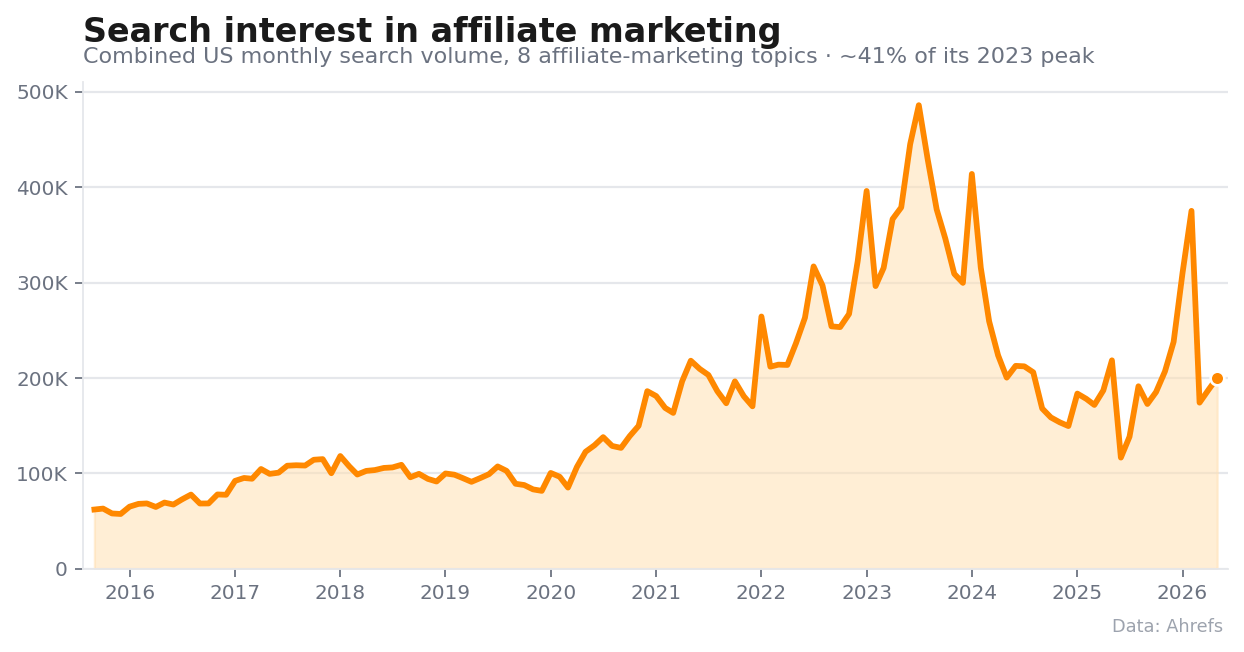
As the search traffic dried up, so did the enthusiasm: combined search demand for affiliate-marketing topics is back to around 41% of its 2023 high.
The throughline connects to everything above. Google increasingly wants to reward brands, the kind people search for by name and that do something beyond publishing information, because publishing information is the one thing AI now does very, very well.
If your site exists only to inform, you are competing directly with the answer engine, and that is a hard place to stand.
| Keyword | Value | Change |
|---|---|---|
| info-blog traffic | 10-site basket | ~28% of peak (-72%) |
| affiliate-site traffic | 11-site basket | ~34% of peak (-66%) |
| affiliate marketing (cluster) | 200,000/mo | ~41% of 2023 peak |
| what is affiliate marketing | 10,000/mo | -42% YoY |
Here is one of the clearest findings in modern SEO: the best predictor of a brand’s visibility in AI search is how often that brand is mentioned around the web.
We analyzed 75,000 brands, and branded web mentions correlated with AI visibility at 0.66 to 0.71, with YouTube mentions edging even higher at around 0.74. The more your brand is talked about, in relevant contexts and across many places, the more likely it is to show up in ChatGPT, AI Mode, and AI Overviews.
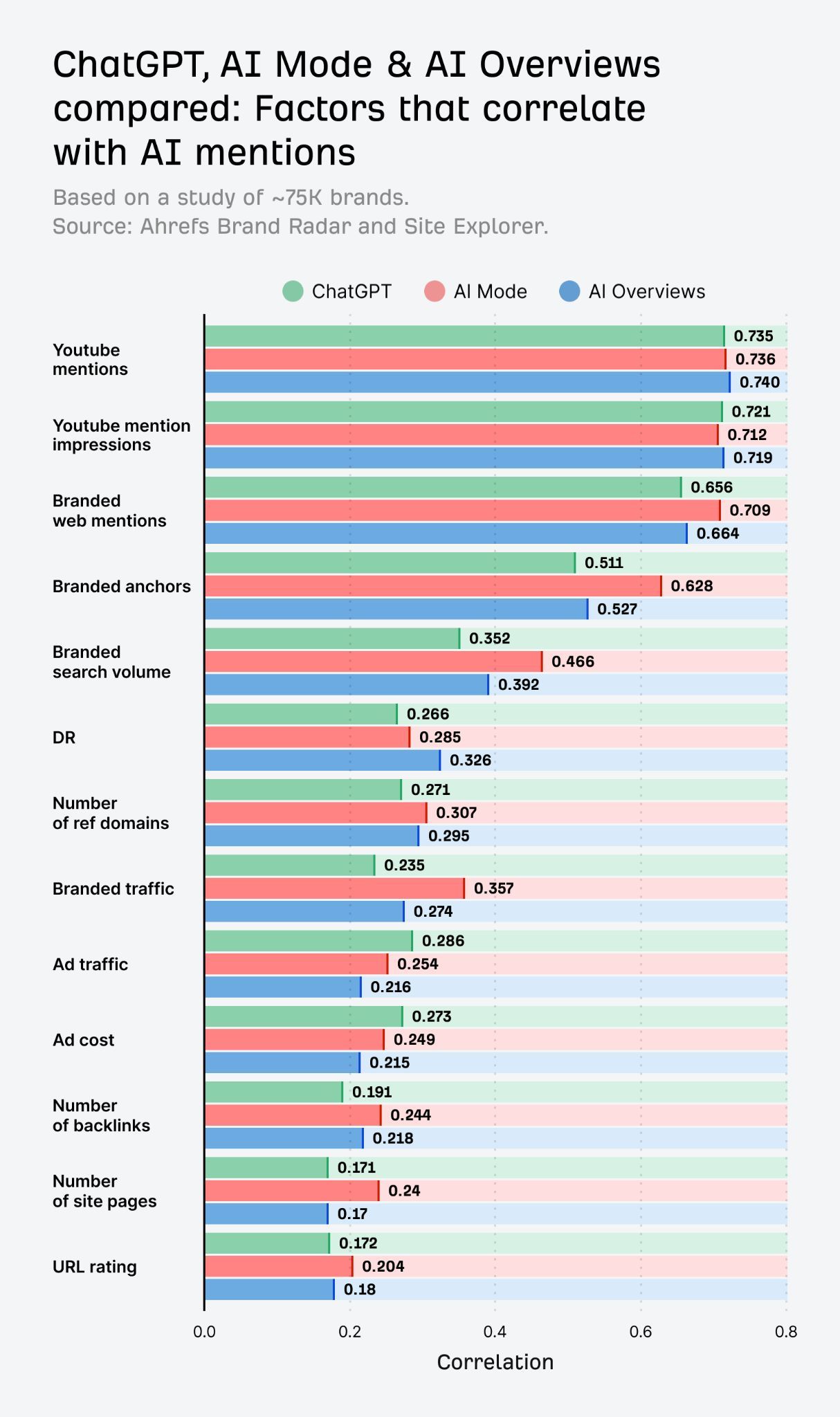
This has revived a lot of interest in plain old brand building. It also lines up with traditional search. Branded search volume is very likely a signal Google uses, because whether real people search for your brand by name is a strong tell of whether a site is legitimate or just built for SEO. A site nobody searches for is easy to discount.
And this is the natural answer to the previous trend. If Google is pulling away from sites that only inform, the sites it still rewards are brands: businesses people seek out by name and that do something beyond publishing information.
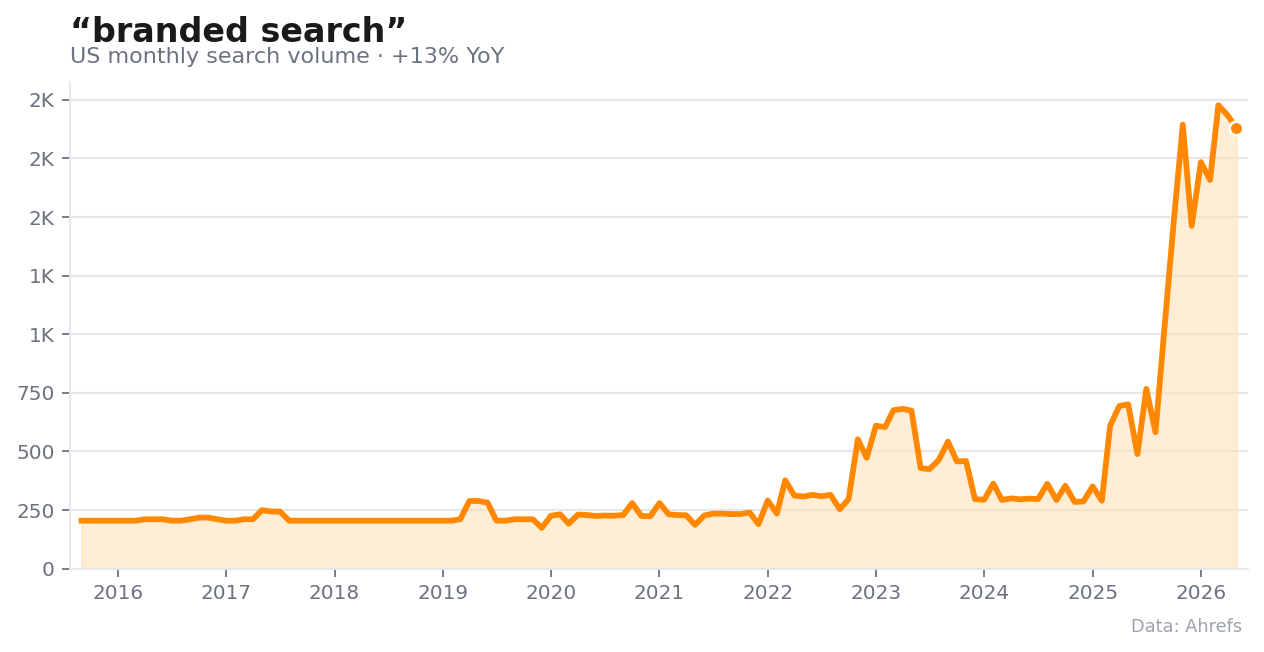
So SEOs are increasingly trying to cultivate, grow, and protect their branded search. That means more than traditional SEO. It means brand marketing, advertising, investing in other formats, and generally doing the work to make your brand more visible across the internet.
| Keyword | Value | Change |
|---|---|---|
| branded search | 1,300/mo | +13% YoY |
| brand seo | 600/mo | +12% YoY |
| branded keywords | 1,000/mo | +8% YoY |
| brand awareness seo | 200/mo | flat |
