

While traditional online shopping requires you to manually search for products, compare options, and complete a purchase, AI agents can now do all of that for you.
Google, OpenAI, and Microsoft are introducing agentic commerce capabilities in their search engines and AI assistants.
In this guide, you’ll learn what agentic commerce is, how it’s shaping the ecommerce space, and how to prepare for this shift if you’re a retailer or marketer.
What Is Agentic Commerce?
Agentic commerce is a new shopping experience where AI acts as your personal shopping assistant and helps you find the right products and complete purchases.
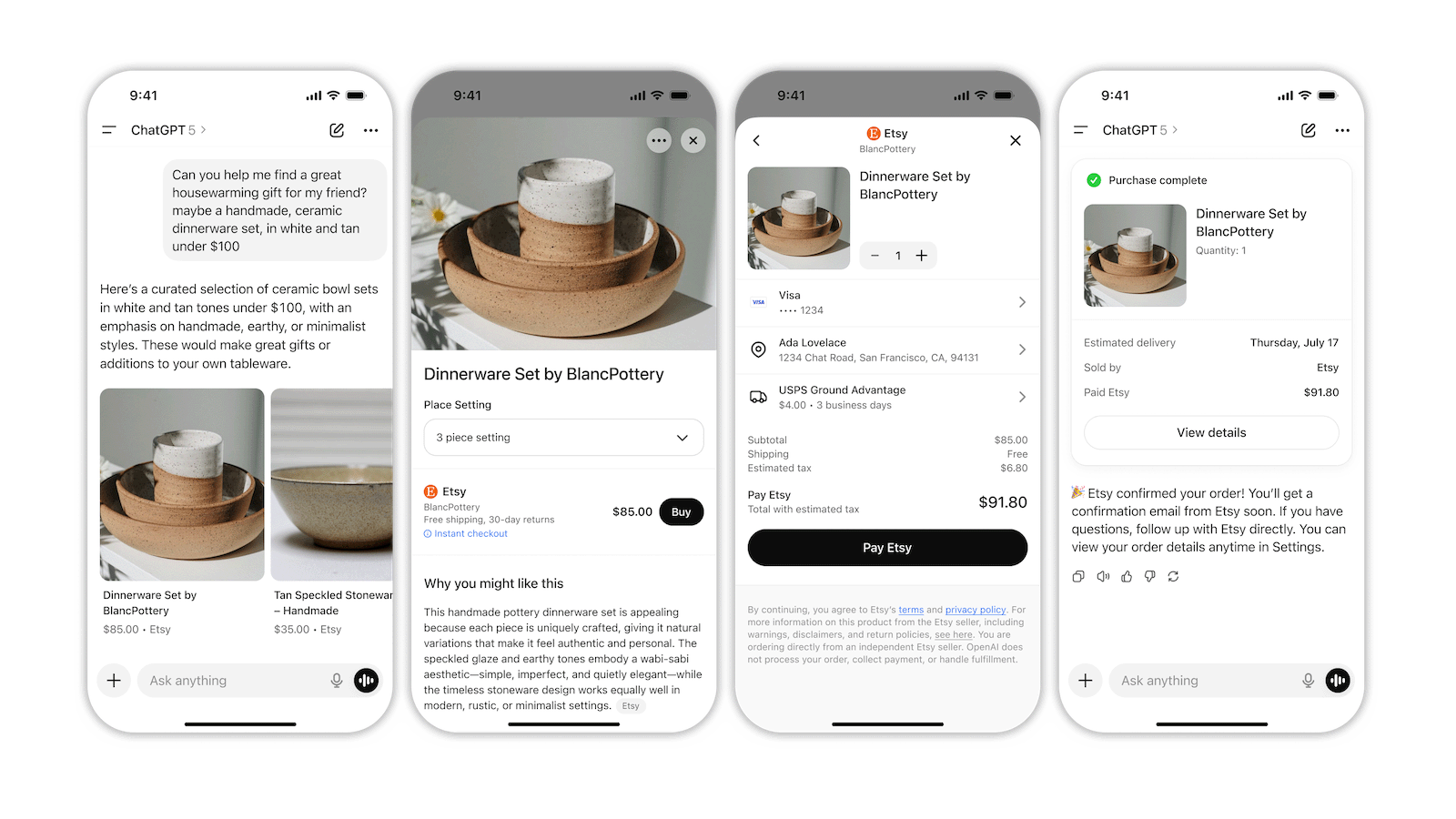
Let’s say you want to purchase a dinnerware set for your friend.
AI can search through dozens of product pages on your behalf to find the best products for your specific needs. For certain merchants, it even helps you complete the checkout process directly within the chat interface.

Image Source: OpenAI
This is the current state of agentic commerce, but the ultimate vision is for these agents to handle the entire purchase journey nearly autonomously. Different platforms are at various stages of this evolution, but they’re all moving in the same direction.
This marks the beginning of a fundamental shift in how people will shop online.
How Agentic Commerce Is Changing the Ecommerce Space
Agentic commerce is one of the biggest shifts in ecommerce since the mobile revolution. Here’s how it changes the ecommerce space:
The Discovery Problem Gets Solved for Users
In traditional commerce, you can buy almost anything online, but finding the right product requires effort.
You need to browse through multiple websites, find the product you’re looking for, read reviews, check alternatives, and then choose the option that best suits your needs and budget.
It’s a tedious process. Agentic commerce aims to solve this by having AI handle the research, comparison, and filtering work for you. You describe what you need, and the AI presents recommendations with reasoning.
Winner-Takes-Most Dynamics Intensify
AI recommends a limited number of products, typically four to six.
In traditional search, being on page one matters. In agentic commerce, being the first few recommendations matters.
This creates winner-takes-most dynamics. The products that get recommended will likely capture disproportionate market share. Those that don’t could struggle to be discovered at all.
It’s similar to voice search (“Alexa, order paper towels”), but the AI can explain why it’s recommending something.
The “Best Product” Definition Changes
What makes a product “best” in the age of AI recommendations?
It’s not just quality or price. It’s how well the AI can understand your product, verify its claims, and feel confident recommending it.
This means:
- Having machine-readable information about your products becomes more important
- Authentic reviews matter more than ever (AI agents weigh social proof)
- Clear differentiation helps AI understand when to recommend you vs. competitors
- Reputation signals from various sources build AI’s confidence in your brand
How Agentic Commerce Changes SEO
Agentic commerce doesn’t make traditional SEO irrelevant. Keyword optimization, content creation, and link building still matter, but there are a few AI-specific factors to focus on.
Your ecommerce site needs to be agent-ready so AI can understand, verify, and confidently recommend your products. That means:
- Schema markup becomes non-negotiable: AI agents don’t interpret your product page the way humans do. They favor structured, machine-readable information to understand what you’re selling, how much it costs, and whether it’s in stock.
- Product information quality matters more than ever: Having clear and accurate information about your products makes it easier for AI to evaluate and show your products for relevant searches
- Review signals carry more weight: AI agents heavily rely on social proof when making recommendations. Products with positive reviews are more likely to be recommended.
- Cross-site consistency matters more: AI agents verify information across multiple sources. If your product is listed on Amazon with specs that differ from those on your website, AI agents may lose confidence in it.
- Entity recognition is critical: When AI agents recognize your brand, product lines, and individual products as distinct and trustworthy entities, your chances of being recommended increase
To understand how your ecommerce site performs in AI search results, use Semrush’s AI Visibility Toolkit.
Open the tool, enter your domain name, and click “Check AI Visibility.”

You’ll see a high-level overview of your performance, including metrics like:
- AI Visibility Score: It tells you how visible your domain is on AI platforms compared to competitors. The score is given out of 100. The higher the score, the more visible your brand is.
- Mentions: The number of times your brand is referenced in AI-generated answers
- Cited Pages: The specific URLs AI systems are pulling from when mentioning your brand

You can also see which topics and prompts are triggering mentions of your brand. Review the list to see whether you’re showing up for the relevant queries in your niche.

How to Prepare Your Business for Agentic Commerce
Agentic commerce is new, and early movers could have an advantage. Focus on these tasks:
- Implement product schema markup: Make sure every product page on your site includes schema markup that communicates key product attributes to AI agents (such as name, price, and availability). Refer to our rich results guide for instructions on implementing product schema markup.
- Audit and enhance your product information: Review every product page to ensure it provides detailed, accurate descriptions that explain what the product is, what it does, and what makes it different. Be sure to include comprehensive specifications, such as dimensions, materials, compatibility, and technical details.
- Build a systematic review collection process: Set up automated post-purchase emails asking customers to leave reviews seven to 14 days after delivery. Make the process easier for users so they actually leave reviews.
- Ensure cross-platform consistency: Audit your product information across your website, marketplaces, price comparison sites, and review platforms. Make sure product names, prices, specifications, images, and descriptions match everywhere.
- Strengthen your brand and product entity signals: List your business in directories like Crunchbase, secure coverage in reputable publications, maintain active social media profiles, and create a Wikidata entry. To help AI agents recognize your brand as a credible and trustworthy entity.
- Create comparison content: Create “best of,” “top alternatives,” and “product vs. competitor” pages that help AI agents understand how your products compare. These pages give agents the comparative context they need when evaluating multiple options for user queries.
- Enroll in merchant programs: Join programs from ChatGPT, Google, Microsoft, and Perplexity to enable direct checkout from within their platforms. Partner merchants are more likely to receive prioritized placement in AI-generated answers.
Below, you’ll learn how major AI companies are building agentic commerce and how to enroll in their merchant programs.
How Major Platforms Are Implementing Agentic Commerce
Google, OpenAI, Microsoft, and Perplexity have all introduced agentic commerce capabilities inside their AI platforms. Here’s how they compare:
|
|
OpenAI |
Microsoft |
Perplexity |
|
|
Launched |
January 2026 |
September 2025 |
January 2026 |
November 2024 |
|
Availability |
U.S. only |
U.S. only |
U.S. only |
U.S. only |
|
Where it works |
AI Mode in Search and Gemini web app |
ChatGPT across desktop, web, and mobile app |
Copilot (copilot.com) across all devices |
Perplexity across all devices |
|
Protocol used (the standard that enables AI agents to place orders on ecommerce sites) |
Agentic Commerce Protocol (ACP) |
Not publicly disclosed |
||
|
Payment partner (users can complete checkout through these payment providers) |
Google Pay (PayPal coming soon) |
Stripe |
Paypal & Stripe |
PayPal |
|
Transaction fee (the fee charged to merchants on completed sales) |
No fee (Google has stated it won’t charge a commission) |
4% (reported for Shopify merchants) |
Not publicly confirmed whether they charge a fee |
Not publicly confirmed whether they charge a fee |
|
Merchant program (enroll to enable in-platform checkouts) |
Get started with Google’s merchant program by following this documentation. You need to join the UCP waitlist and complete the technical integration as per the docs. |
Fill out the ChatGPT merchant application to begin the process. Then you need to build out the technical integration as outlined in the docs. |
Apply through Microsoft’s merchant application form. Then build your integration following the ACP specifications—if you’ve built this out for ChatGPT, most of your work is already done. |
Perplexity’s merchant program is currently available for large retailers only. Fill out this merchant signup form if you’re eligible. |
Note for Shopify merchants: If you’re on Shopify, you don’t need to go through the enrollment process for most platforms. Shopify is building native integrations with Google, ChatGPT, and Copilot, so you’ll be able to enable agentic checkout from your Shopify admin without any technical work. You’ll be notified as each integration becomes available to you.
Note for Etsy sellers: Etsy has already integrated with ChatGPT and Copilot, so your products are automatically eligible for agentic checkout on both. Integration with Google and Perplexity hasn’t been announced yet.
Even if you don’t enroll in merchant programs, your products are still eligible to appear in AI answers as long as your site is already indexed (stored) in these platforms’ databases. If you don’t enroll, users will simply be redirected to your website to complete purchases.
For sites that have completed the integration, the entire buying journey happens within the AI interface. Which can mean less friction, fewer drop-offs, and a smoother path to conversion.
Let’s quickly review each platform and the key differences in how they’ve built agentic commerce.
1. Google
Google wasn’t the first player to launch the agentic shopping experience, but it came in with the most ambitious infrastructure play.
Rather than adopting an existing protocol, Google built its own protocol called Universal Commerce Protocol (UCP).
By defining the protocol layer itself, Google keeps tight control over how user information, inventory data, and checkout flow through its ecosystem, and avoids being dependent on standards shaped by competitors.
You can learn about UCP’s technical specifications at ucp.dev and Google’s developer documentation.
Google is already where most product searches begin. So retailers have a strong incentive to integrate with Google early.
2. OpenAI
OpenAI was one of the first to make agentic commerce real.
Their strategic move was building Agent Commerce Protocol (ACP) as an open-source protocol in partnership with Stripe. And that decision is already paying off: Microsoft adopted ACP for Copilot, which means merchants who integrate once can sell across both platforms.
OpenAI also has a very large user base—over 800 million weekly active ChatGPT users as of late 2025, making it one of the most-used consumer platforms in the world. That’s a massive number of potential buyers.
3. Microsoft
Microsoft didn’t build its own protocol or try to reinvent the wheel. It adopted ACP, which is the same standard as ChatGPT.
That’s a smart play. For merchants, it means the technical lift is minimal if you’ve already integrated with OpenAI.
Also, Copilot Checkout is expected to roll out across Bing, MSN, and Edge throughout 2026. That means you can get a huge distribution.
4. Perplexity
Perplexity introduced agentic commerce capabilities back in November 2024. It was the first AI platform to let users buy products directly from within a chat interface.
For a startup competing against giants like Google, OpenAI, and Microsoft, that’s impressive.
Since the initial launch, they’ve kept their merchant program fairly exclusive. It’s open to large merchants only.
Common Questions from Ecommerce Business Owners
Here are the common questions ecommerce business owners have about agentic commerce:
Do I Really Need to Be On All Four Platforms?
As agentic commerce grows, the businesses that aren’t visible on these platforms won’t just miss out on new revenue; they could lose existing customers who shift to AI-assisted shopping.
But you don’t need to go live on all four platforms on day one. Start with Google and ChatGPT because Google already drives the bulk of online shopping traffic and ChatGPT because it has the largest user base among standalone AI assistants.
Once you’ve integrated with these two platforms, continue with Microsoft and Perplexity.
What If AI Recommends My Competitor Instead of Me?
AI recommendations are heavily influenced by factors such as how easily they can interpret your product information (schema markup plays a big role here), the sentiment of customer reviews, and your brand’s popularity in your space.
If a competitor is showing up instead of you, they’re likely doing a better job on these fronts. The good news? You can improve all of these things.
Is My Data Secure? What About Customer Privacy?
Security and privacy requirements are built into both UCP and ACP at the protocol level, but how each platform handles merchant and customer data varies. Before enrolling, review the merchant terms for each platform you integrate with to confirm their data handling practices align with your business requirements.
Agentic commerce is in its early phase. Many ecommerce businesses haven’t enrolled in any platform’s merchant program yet. That means there’s still a window to get ahead before competition intensifies and AI assistants develop default preferences for certain brands.
Waiting might feel safer, but it could mean playing catch-up later.
