


SEO is one of the most profitable channels to invest in for long-term growth. It’s also a place where you can spend a lot of time without results. And for a growing healthcare practice, that won’t do.
The key to getting results with your healthcare SEO is knowing what strategies to use, what expectations to have, and how to effectively attribute the return on your organic investment.
In this guide, we’ll provide seven strategies you can use to dramatically enhance your medical practice’s visibility on search engines and have enough data to continue improving.
Contents
- Set up a foundation for tracking and attribution
- Shore up your technical SEO
- Solidify your Core Web Vitals
- Create a content strategy
- Optimize your Google Business Profile
- Optimize your local listings
- Create a link-building strategy
7 healthcare SEO strategies for search engine visibility
Around 77% of patients use search engines to find a healthcare provider. Use these healthcare SEO strategies to get in front of that large, interested audience.
1. Set up a foundation for tracking and attribution
Every action you take when marketing your practice’s website has to be backed by data. Whether that’s adjusting a landing page, launching a campaign, or changing your channel strategy. You need to be constantly asking yourself the important questions. Where’s my traffic coming from? What channels and landing pages are converting? What’s my customer journey look like?
The first step here is setting up Google Analytics 4. GA4 will give you a baseline understanding of how much of your traffic comes from organic search, your week-over-week session totals, and your top landing pages.
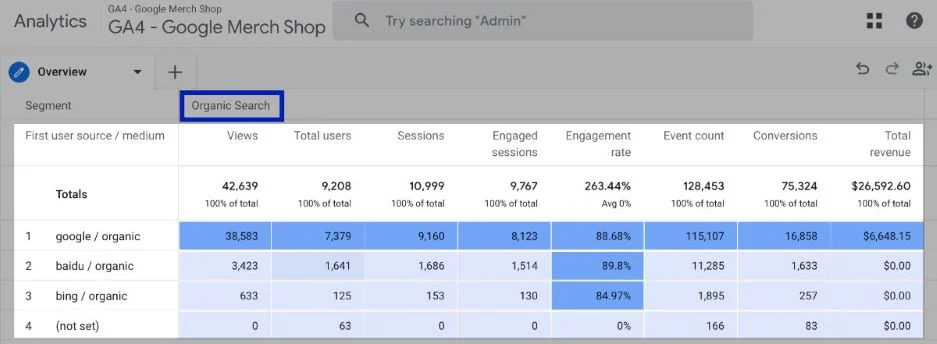
Depending on your CMS (Content Management System), this is typically as simple as installing a plugin or placing a snippet of code via Google Tag Manager.
From there, you’ll want to set up Google Search Console. You can claim your domain through your GA4 snippet, or set up a new snippet specific to Search Console.
Where GA4 focuses on post-click metrics (what happens after a user gets to your site), Search Console’s focus is pre-click. What’s your site-wide click-through rate? What’s the average position of your top services pages? How many impressions are you generating overall organically?
Once you have your pre-and-post click organic tracking squared away, the final piece of the puzzle is a site crawl. Leveraging an SEO tool like Ahrefs or Semrush to set up a weekly or biweekly crawl of your site is going to give you a better understanding of the more technical areas of your site that need to be improved.
🩺 Need to revive your SEO plan, stat? Download How to Do SEO Right—Right Now
2. Shore up your technical SEO
Generally speaking, you want to make sure all the technical SEO aspects of your website are shored up before you start creating content. Let’s start with your site crawl. Your Ahrefs site audit is typically going to score your site out of 100. This is called your Health Score.
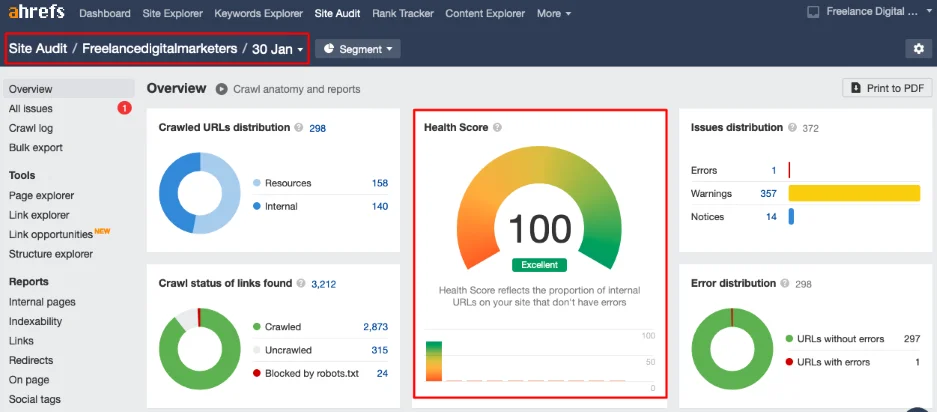
The fewer technical errors your site has, the higher your Health Score is going to be. Keep in mind–a high health score isn’t going to get you traffic on its own. It’s not even going to allow you to rank high in the search results. But a low health score can absolutely prevent strong content from ranking. So optimizing your Health Score should be the first step you take for your healthcare website.
Here are some technical deficiencies your site audit may unearth:
- Duplicate content: Pages with the same or similar content can confuse search engines and dilute rankings.
- Broken links: Dead pages or incorrect URLs damage user experience and crawl efficiency.
- Missing meta tags: Missing or poorly optimized title tags and meta descriptions reduce click-through rates by making it harder for Google to understand your pages’ content.
- Orphan pages: Pages not linked from anywhere else on the site can’t be found by crawlers or users.
- Indexability: Pages blocked by robots.txt or noindex tags that should be indexed, and pages wasting crawl budget that shouldn’t be indexed.
Once you have your list, set it in order of priority and get to work on that Health Score. The closer you get to 100%, the better your site will be set up for organic success once you start generating content.
3. Solidify your Core Web Vitals
We can’t move on from technical SEO just yet. Core Web Vitals deserve their own number in this list because they are more important than any other technical aspect of your site. Nothing tanks rankings, click-through rates, traffic, and conversion rates like slow site speed and poor usability. And when Google introduced Core Web Vitals a few years ago, they gave all website owners a straightforward report to track page speed and usability–two factors which Google has openly stated are extremely important in page rankings.
Google breaks Core Web Vitals out into three metrics:
- Largest Contentful Paint (LCP)
- What it measures: Load performance, meaning how long it takes for the largest visible content element to load (e.g., a hero image or headline).
- Good score: ≤ 5 seconds
- INP (Interaction to Next Paint)
- What it measures: Interactivity, which is the latency between a user interaction (like a click, tap, or key press) and the next visual update that occurs as a result.
- Good score: ≤ 100 milliseconds
- Cumulative Layout Shift (CLS)
- What it measures: Visual stability, or how much page content shifts unexpectedly while loading.
- Good score: ≤ 1
You can find them in the Core Web Vitals report in Search Console.
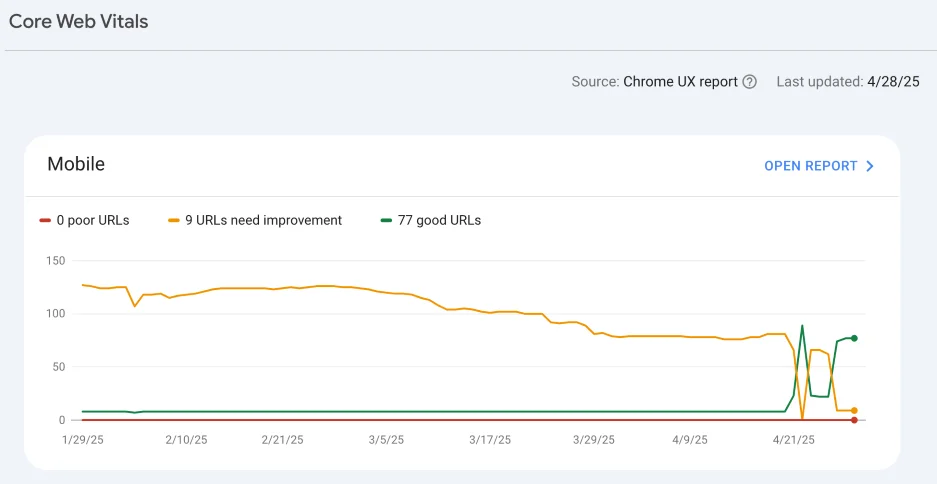
Pay attention to the pages that need improvement and are marked “poor,” and follow the links in the report to Google’s documentation on each metric. They provide useful breadcrumbs on what criteria Google uses to gauge these metrics and how to optimize them.
Again, Core Web Vitals are the most important aspect of technical SEO. Get your pages as close to 100% as you can, and you’ll be in great shape.
4. Create a content strategy
The lifeblood of SEO is really two things: content and links. And of the two, content is king.
Content, thought-leadership, and the creation of educational value on your website are how you generate traffic. For our purposes today, we’re going to break out the elements of a successful healthcare SEO content strategy into a few different categories.
Blog/Patient Education Hub
The goal of your blog is to drive top-of-funnel traffic to your service pages. It’s your first and most powerful tool for driving organic traffic. The more educational content you can create around the maladies you treat, and how you treat them, the more real estate your brand will occupy in the search results. Make sure your content is demonstrably written by subject matter experts to adhere to Google’s E-E-A-T criteria, which is especially important for healthcare providers.
Service pages
The primary responsibility of your service pages is to convert users into patients, but they can and should drive traffic in their own right.
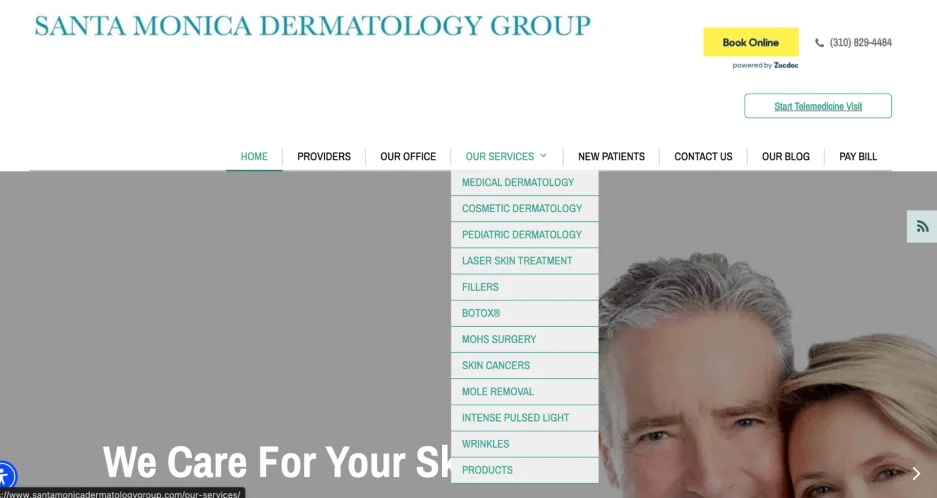
Each service page should be optimized for a primary keyword with search volume, contain ample ancillary keywords related to that treatment or malady, and offer ample opportunity for your user to convert.
Make sure you have an in-depth, optimized service page for everything you treat, every patient type, and every treatment method you provide. Basically, if it has search volume and it’s in your wheelhouse, you should have a service page for it.
Success stories, testimonials, and FAQs
People typically need some semblance of social proof before they make the decision to commit to a healthcare provider. Your GBP (Google Business Profile) reviews will do wonders here, but you want to make sure that these stories are reflected on your website in depth so customers understand the kind of service and results they can expect from your practice.
These guides to getting and replying to reviews will help:
5. Optimize your Google Business Profile
For local healthcare offices, Google Business Profile is going to be one of your most important acquisition channels. Why? Most patients interact with your GBP before ever visiting your website. Not only does it play a major role in shaping users’ first impressions, it’s also critical for local SEO.
When someone searches for terms like “pediatrician near me” or “urgent care Santa Monica,” the first thing they’re going to see is your GBP listing. A complete and optimized profile will allow your practice to show up in this coveted space and capture valuable traffic.
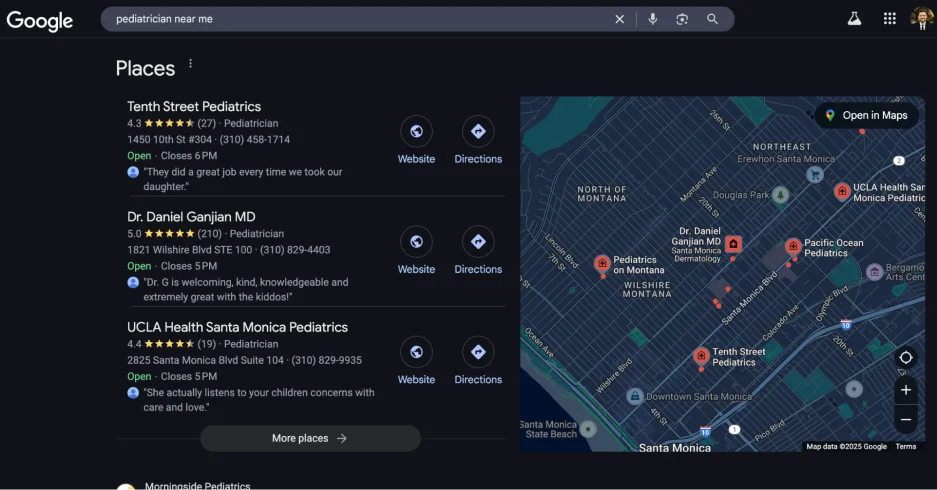
If you want to optimize your practice’s GBP listing, there are a few steps you need to take.
- Claim and verify your profile: Use your official business name and avoid keyword stuffing. Select the most accurate primary category (e.g., “Family Practice Physician” or “Dermatologist”).
- Ensure NAP consistency: Your name, address, and phone number should be identical across your website, GBP, and other directories to build trust with Google.
- Complete every detail: Include hours of operation (including holidays), services offered, accepted insurance plans, and appointment links.
- Upload quality photos: Include exterior and interior shots of your office, provider headshots, and friendly staff images. These help prospective patients feel more comfortable and familiar.
- Encourage reviews and respond: Ask satisfied patients to leave a review and always respond to reviews in a professional, HIPAA-compliant manner. This signals engagement and boosts your local SEO.
- Post weekly updates: Share blog posts, health tips, seasonal reminders (e.g., flu shots), or announcements. These keep your listing fresh and improve engagement. You can even post directly to your GBP.
- Use the Q&A section proactively: Add common patient questions and answer them yourself. This helps control the message and provides helpful info up front.
An optimized Google Business Profile is more than just a directory listing—it’s a living extension of your practice’s reputation and accessibility. If you want to get to the top of the list, you need to go after reviews aggressively to signal to users in the search results that you deserve their business.
🛑 Check the health of your local listings with our Free Business Listings Grader >>
6. Optimize your local listings
While your Google Business Profile represents the most important local listing, it’s far from the only one. And the truth is, healthcare offices can generate a lot of traction by making sure they’re up and running on all local listing sites. These include:
- Bing Places: Microsoft’s answer to Google Business. It’s often overlooked, but it reaches users through Bing, Yahoo, and voice search (e.g., Alexa and Cortana).
- Apple Maps: Crucial for iPhone users, especially those searching via Siri or iOS Maps.
- Yelp: Heavily used for healthcare-related searches. Google often pulls Yelp data into its knowledge panels.
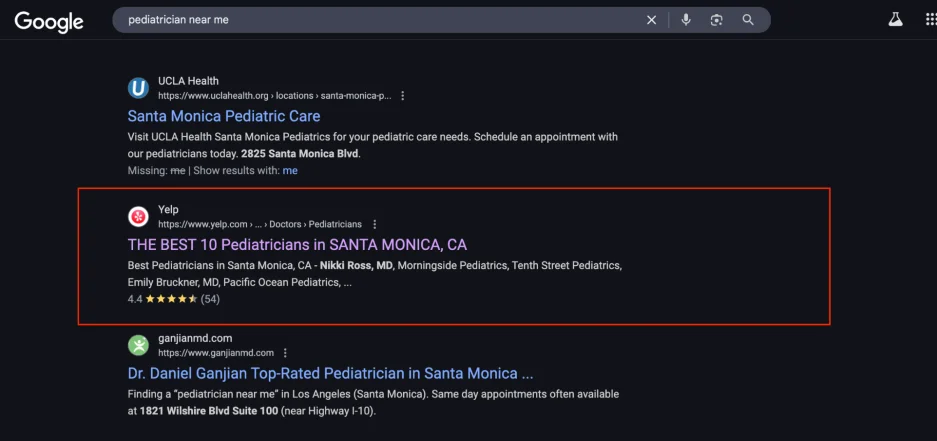
Yelp typically ranks high organically and is an organic traffic machine.
- Healthgrades: A leading platform for researching doctors, especially for specialties like OB/GYN, dermatology, or orthopedics.
- Zocdoc: Not just for booking, but also acts as a discovery engine for insured patients.
- Vitals: Another medical-specific directory focused on provider profiles and patient reviews.
- WebMD Doctor Directory: Used by patients who already trust WebMD and want to find care near them.
- Insurance provider directories: Ensure your practice info is accurate and up to date on every insurance network you accept (e.g., Aetna, Blue Cross, UnitedHealthcare), as many patients start their search here.
Each of these platforms represents its own opportunity for enhanced visibility and organic traffic. Make sure you fully complete each profile, that your practice name, phone number, and address are exactly the same across all platforms, and that you engage with reviews where possible. Here are some listing tools that’ll help make it manageable.
7. Create a link-building strategy
We mentioned earlier that the two core components of SEO are content and links. We talked about content. Now let’s talk about link building.
The more authoritative (read: from credible websites) links you can accrue, the higher your domain authority will be, and the higher your page will rank in the search results. You can build authority by doing a few critical things.
The first thing you can do to generate links is to submit to authoritative directories. Remember all those directories we mentioned earlier? They all come with the benefit of an authoritative inbound link that will help your site rank.
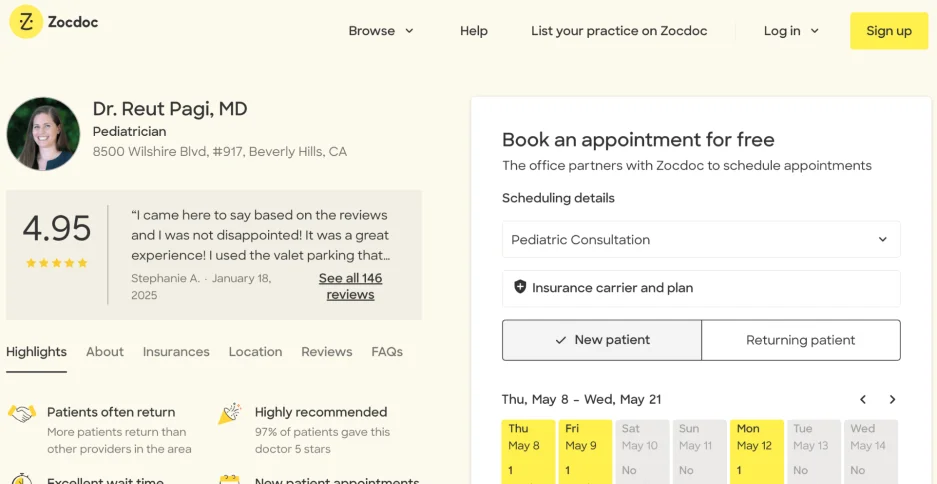
Zocdoc is a great platform for enhanced visibility and an inbound link.
The second (and perhaps most classic) way to generate inbound links is guest posting. If you’re a subject matter expert in a given field, or if one of your employees is, reach out to local news sites, parenting blogs, fitness or wellness blogs, or community websites about contributing a guest post. Offer insights on seasonal health topics, wellness trends, FAQs, or another topic in which you’re well-versed. Do this ten times, and you’ll have created ten quality inbound links to your site through your author bio.
Finally, think about what kinds of linkable content you can create on your own site. What is trending on Google related to your niche? What topics have high search volume and would be valuable resources for other blogs or experts to link to? This could come in the form of an informative blog post, a downloadable patient guide, a data study, or a local health resource list. Create an asset that other businesses will link to, link to your service pages from that asset, and you’ll be in business.
Acquire more patients through smart healthcare SEO
In today’s digital-first world, implementing the above healthcare SEO strategies is essential for growing your medical practice and staying competitive. Remember: paid media gets the glory. But SEO creates an environment to scale.
By optimizing your Google Business Profile, producing content that is genuinely valuable, improving site performance, and building strong backlinks, you can significantly enhance your online visibility and acquire more patients. An investment in SEO is an investment in your digital foundation. The results will take some time, but they’ll almost certainly come.
