

DNA storage has always attracted a lot of interest due of its potential density and longevity – and researchers have long been exploring ways to encode digital information into DNA strands that can be stored and later read back using sequencing technology.
One of the leaders in this field, French startup Biomemory, recently announced it has acquired the assets of Catalog Technologies, another firm working on DNA-based data storage, giving the former access to Catalog’s printing, reading, and computing technologies, along with a large portfolio of patents.
Both companies rely on mapping digital data to biosafe DNA blocks instead of synthesizing DNA base by base. This can improve read speeds and reduce error rates, while also opening the door to search and computing functions directly within DNA data structures.
Making DNA storage systems for data centers
The combined platform also brings together different production techniques. Biomemory uses multi-layer 3D printing methods, while Catalog developed high-throughput printing systems aimed at producing large volumes of DNA data blocks.
“Biomemory is the first company in the DNA Data Storage industry to have implemented a complete end-to-end industrialized process,” said Olivier Lauvray, VP of Industrialization at Biomemory. “It spans the digital file or object ingestion to DNA writing and storage with a data retention of 50 to 150 years, and has the capability to access and read stored digital content all along the retention lifetime.”
The goal is to make DNA storage systems practical for data centers, where storage hardware needs to fit into standard rack-mounted equipment. I spoke to Lauvray to find out more about Biomemory’s plans.
- Back in 2021, Catalog talked about building a pocket-sized DNA computer before the end of the decade. Is that still the plan, or has that idea been put aside?
Catalog was the pioneer, well ahead of the pack, in bringing searching and computing functions to the DNA realm. Biomemory has acquired all the foundational IP and patents they established, and key experts from the former Catalog joined our team.
Biomemory’s objective is to leverage this IP portfolio and technological advances in the context of our upgraded roadmap. We intend to offer these value-added capabilities to our customers.
It is too early for us to speak about the speed of deployment or the size of a resulting device, but we are pursuing this path, adding our industrialization and go-to-market approach to it.
- Microsoft’s Richard Black told one of our peers that it stopped its involvement in DNA storage, saying it is “just not meeting the orders of magnitude gain [we] thought [we] were gonna get,” before adding, “Proponents touted the extreme density, but it’s not clear that that’s in any way relevant.” Is Microsoft wrong?
They decided to invest and focus on the Silica project as an intermediate technology. After a few years, the DNA Data storage technologies have matured quite a lot. It is now reaching the industrialization stage, with players such as Biomemory.
But it will still take some time to match the hyperscalers’ scalability requirements. Speaking for Biomemory, we estimate that robust enterprise-grade rackable data storage appliances will be deployed at scale in Data Centers around 2030.
In the meantime, sizable commercial solutions will be supported with clusters of equipment operated by Biomemory or accredited partners, in a hybrid-cloud configuration.
- Can you give us an update on DNA storage technology at Biomemory? How far are we from a commercial device, and how does your approach differ from rivals such as Microsoft and Twist Memory?
Biomemory intends to launch its first end-to-end (write/store/read) commercial DNA Data Storage solutions before the end of 2026. Beyond the continuous improvement of the writing and reading performance, our focus is on securing trust from customers with a rigorous end-to-end qualification process, demonstrating reliability, integrity, robustness and life-time sustainability.
This leads to the industrialization of the DNA Data storage technology, a condition for mass deployment of real commercial solutions.
To our knowledge, Microsoft’s mid-term solution for cold-storage is relying on Silica. This is a rather capex-intensive technology, and its deployment beyond the Microsoft internal use remains to be seen.
To our understanding, Twist’s technology (now led by its spin-off Atlas) is relying on base-by-base synthesis, using semiconductor chips as consumable component. Biomemory believes this has advantages but is not the best approach for scalability and cost reduction, and is prone to biosafety-related challenges.
Biomemory (like Catalog Technologies before) is using a fast block-by-block enzymatic DNA assembly technology, which is biosafe-by-design. The cost of consumables (opex) is planned to drop massively over time, and the cost of the equipment too, aligning to the printing industry business models.
We also believe our unique DNA Card approach to reliably store the written DNA for 50, 100 or 150 years with multiple readings and an access through a standard object storage IT interface, is the right approach which brings us closer to the IT-centric customers Biomemory aims to serve.
- Perhaps the most important question: Can you give us a rough timeline, expected capacity, performance estimates, and approximate pricing?
Some significant technology industrialization challenges remain to enable the scalability of DNA Data Storage. For example, the timeline for industrializing next generation high-speed continuous DNA reading technologies.
This brings incertitude in the prediction of the launch date for the next-next generation of products. But Biomemory is marching toward the goal of deploying in 2030-2031 a rackable Write/Store/Search/Read appliance suitable for operations in 3rd party Data Centers.
This requires interoperability, full automation and high resilience, in a compact 19” 42U form factor. In the meantime, to satisfy market demand, we will grow our park of storage servers operated by Biomemory, in a hybrid-cloud configuration.
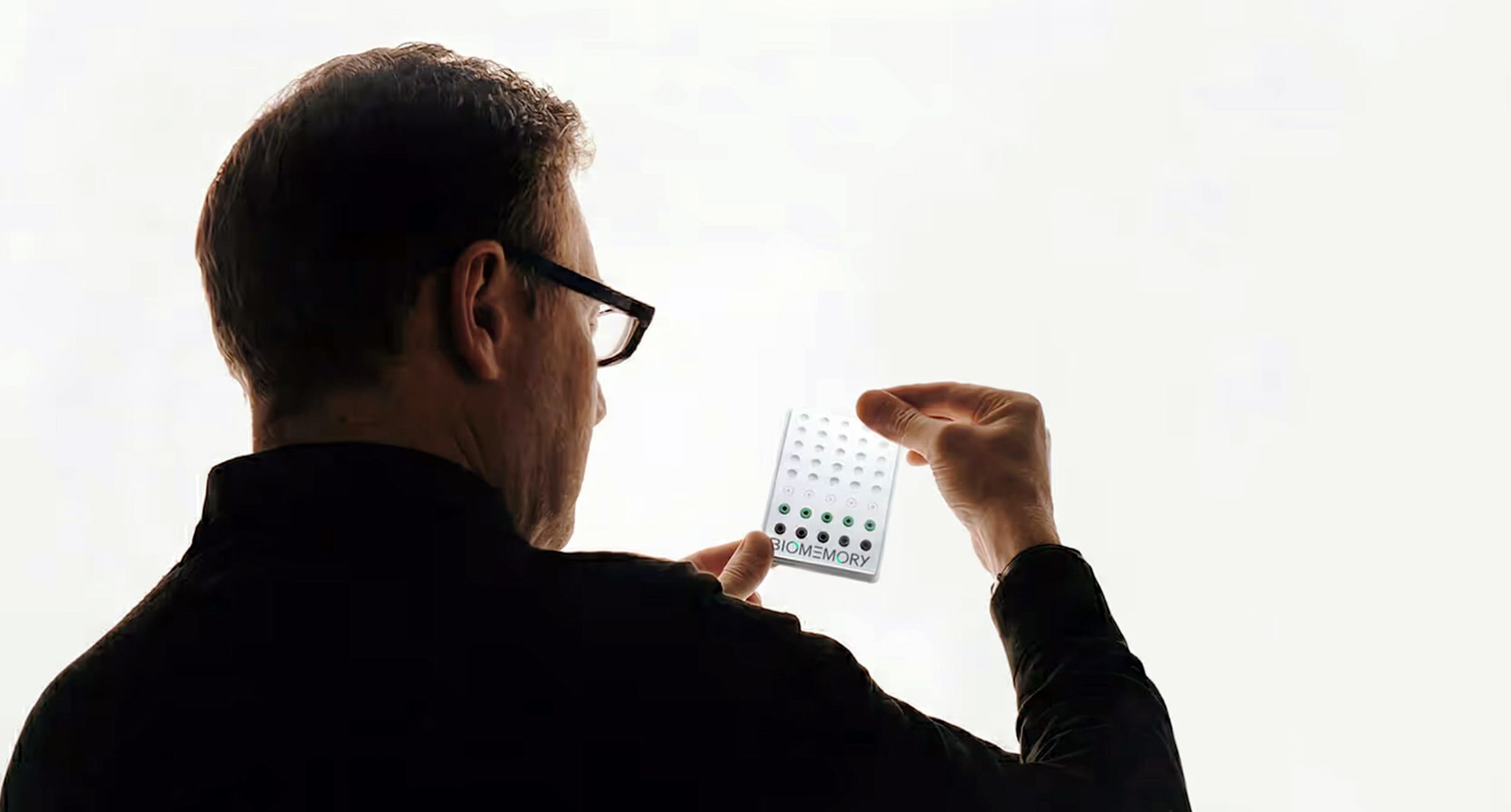
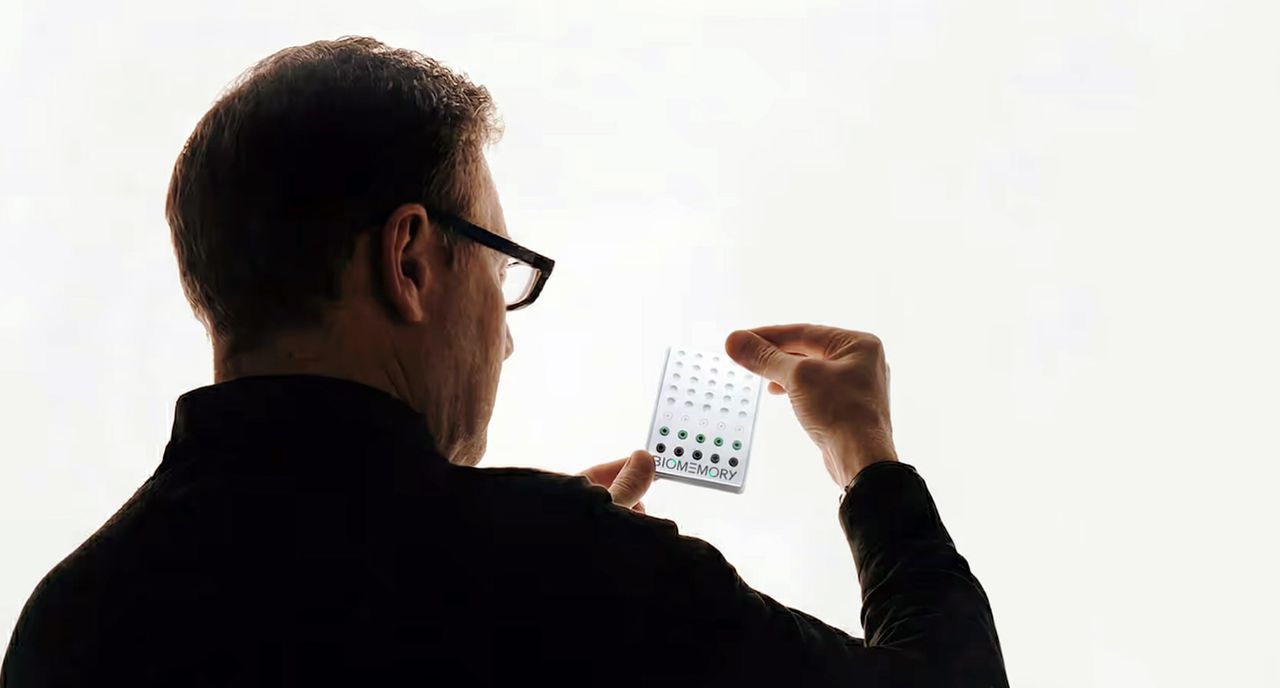
We are storing the DNA in multi-well containers called DNA Cards. Each can contain a huge amount of DNA-written digital data, and we can continuously add more DNA Cards in an appliance.
Therefore, the capacity can be extended without requiring more CapEx or footprint. This is different from the usual storage media. In parallel, among the 5 million Data Centers in the world, the private industry, hyperscalers or government agencies do not have the same needs for cold-storage capacity, covering the whole range from PetaByte to Exabyte.
Biomemory’s strategy is to serve the market segments that are aligned with the performance of its storage servers. This is naturally starting with private data centers with PB capabilities, and progressively addressing the demand toward Exabyte.
The writing and reading speeds are progressing rapidly but it is still difficult to predict when the single-rack Exabyte appliance will be commercially available.
In terms of cost ($/TB) for Biomemory’s technology, this is mainly driven by the industrialization of the production of the consumables (DNA block and enzymes) used by the systems.
Our plan is to rapidly scale up our low-cost patented production technology, and our projections are showing we can reach few $/TB when mass-deploying our products in 3rd party data centers.
There is still a long road ahead, but we are progressing fast. DNA as a data storage media will unlikely reach high IOPS until we integrate the computing capability. This is an exciting long-term perspective and paradigm shift, and is one of our motivations for the acquisition of the assets from Catalog Technologies.
Follow TechRadar on Google News and add us as a preferred source to get our expert news, reviews, and opinion in your feeds. Make sure to click the Follow button!
And of course you can also follow TechRadar on TikTok for news, reviews, unboxings in video form, and get regular updates from us on WhatsApp too.
