


Close Menu
    Facebook X (Twitter) Instagram
    Wifi PortalWifi Portal
    • Blogging
    • SEO & Digital Marketing
    • WiFi / Internet & Networking
    • Cybersecurity
    • Tech Tools & Mobile / Apps
    • Privacy & Online Earning
    Facebook X (Twitter) Instagram
    Wifi PortalWifi Portal
    Home»Cybersecurity»Chinese state hackers target telcos with new malware toolkit
    Cybersecurity

    Chinese state hackers target telcos with new malware toolkit

    adminBy adminMarch 6, 2026No Comments3 Mins Read
    Facebook Twitter LinkedIn Telegram Pinterest Tumblr Reddit WhatsApp Email
    Chinese state hackers target telcos with new malware toolkit
    Share
    Facebook Twitter LinkedIn Pinterest Email

    Chinese state hackers target telcos with new malware toolkit

    A China-linked advanced persistent threat actor tracked as UAT-9244 has been targeting telecommunication service providers in South America since 2024, compromising Windows, Linux, and network-edge devices.

    According to Cisco Talos researchers, the adversary is closely associated with the FamousSparrow and Tropic Trooper hacker groups, but is tracked as a separate activity cluster.

    This assessment has high confidence and is based on similar tooling, tactics, techniques, and procedures (TTPs), and victimology observed in attacks attributed to the threat actors.

    The researchers note that while UAT-9244 shares the same target profile as Salt Typhoon, they could not establish a solid connection between the two activity clusters.

    New malware targeting telco networks

    The researchers found that the campaign used three previously undocumented malware families: TernDoor, a Windows backdoor; PeerTime, a Linux backdoor that uses BitTorrent; and BruteEntry, a brute-force scanner that builds proxy infrastructure (ORBs).

    TernDoor is deployed through DLL side-loading, using the legitimate executable wsprint.exe to load malicious code from BugSplatRc64.dll, which decrypts and executes the final payload in memory (injected into msiexec.exe).

    The malware contains an embedded Windows driver, WSPrint.sys, which is used to terminate, suspend, and resume processes.

    Persistence is achieved via scheduled tasks and Windows Registry modifications, which are also used to hide the scheduled task.

    Additionally, TernDoor can execute commands via remote shell, run arbitrary processes, read/write files, collect system information, and self-uninstall.

    PeerTime is an ELF Linux backdoor that targets multiple architectures (ARM, AARCH, PPC, MIPS), suggesting it was designed to compromise a broad range of embedded systems and network devices used in telecom environments.
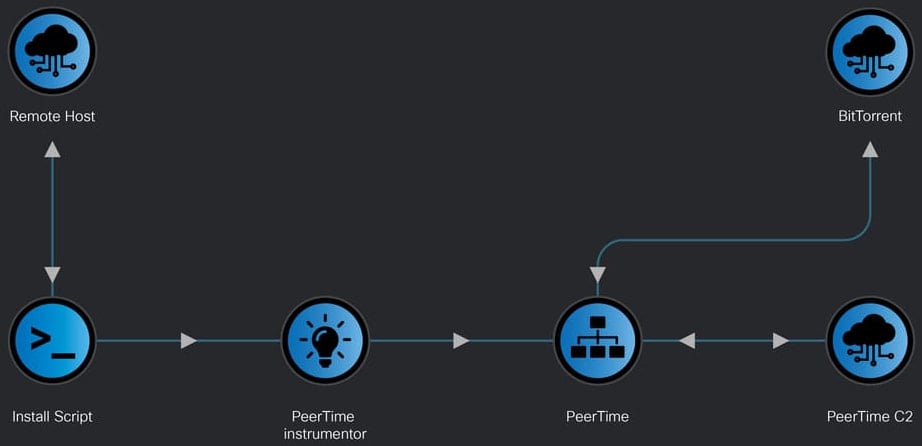
    PeerTime installation flow
    PeerTime installation flow
    Source: Cisco Talos

    Cisco Talos documented two versions for PeerTime. One variant is written in C/C++ and the other is based on Rust. The researchers also noticed Simplified Chinese debug strings in the instrumentor binary, an indicator of its origin.

    Its payload is decrypted and loaded in memory, and its process is renamed to appear legitimate.

    PeerTime, an ELF-based peer-to-peer (P2P) backdoor, uses the BitTorrent protocol for command-and-control (C2) communications, downloads and executes payloads from peers, and uses BusyBox to write the files on the host.

    Finally, there’s BruteEntry, which consists of a Go-based instrumentor binary and a brute-forcing component. Its role is to turn compromised devices into scanning nodes, known as Operational Relay Boxes (ORBs).
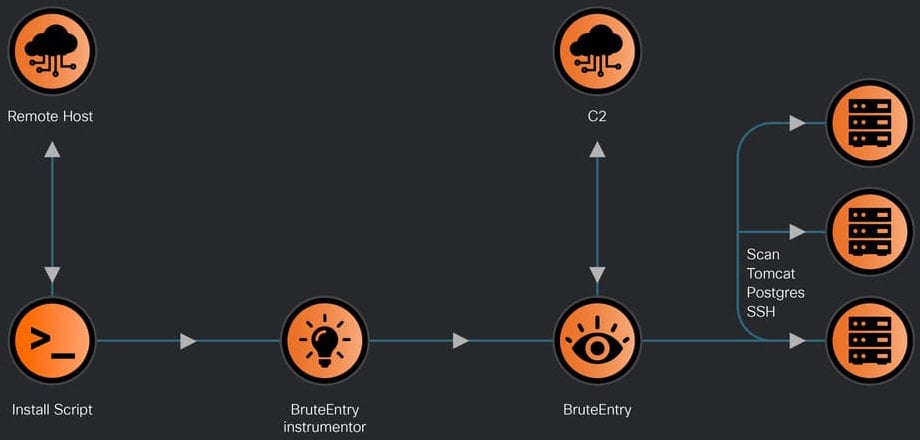
    BruteEntry infection chain
    BruteEntry infection chain
    Source: Cisco Talos

    The attacker uses the machines running BruteEntry to scan for new targets and brute-force access to SSH, Postgres, and Tomcat. Login attempt results are sent back to the C2 with task status and notes.

    In a technical report today, Cisco Talos researchers provide details on the capabilities of the three pieces of malware, how they are deployed, and achieve persistence.

    Cisco Talos researchers have listed indicators of compromise (IoCs) associated with the observed UAT-9244 activity, which defenders can use to detect and block these attacks early.


    tines

    Malware is getting smarter. The Red Report 2026 reveals how new threats use math to detect sandboxes and hide in plain sight.

    Download our analysis of 1.1 million malicious samples to uncover the top 10 techniques and see if your security stack is blinded.

    Chinese hackers Malware State Target telcos Toolkit
    Share. Facebook Twitter Pinterest LinkedIn Tumblr Telegram Email
    Previous ArticleHow to Be the Trusted & Featured Brand
    Next Article Avowed PS5 review: Obsidian’s fantasy action-RPG is better than ever on PlayStation 5
    admin
    • Website

    Related Posts

    Codenotary Trust delivers autonomous AI security for Linux and Kubernetes

    March 6, 2026

    Plankey’s nomination as CISA director now in jeopardy

    March 6, 2026

    Russian Ransomware Operator Pleads Guilty in US

    March 5, 2026
    Add A Comment
    Leave A Reply Cancel Reply

    Search Blog
    About
    About

    At WifiPortal.tech, we share simple, easy-to-follow guides on cybersecurity, online privacy, and digital opportunities. Our goal is to help everyday users browse safely, protect personal data, and explore smart ways to earn online. Whether you’re new to the digital world or looking to strengthen your online knowledge, our content is here to keep you informed and secure.

    Trending Blogs

    Codenotary Trust delivers autonomous AI security for Linux and Kubernetes

    March 6, 2026

    6 of the coolest display innovations I saw from TCL at MWC, and some of them could be in your next phone

    March 6, 2026

    Plankey’s nomination as CISA director now in jeopardy

    March 6, 2026

    83% of ChatGPT carousels use Google Shopping data

    March 6, 2026
    Categories
    • Blogging (33)
    • Cybersecurity (626)
    • Privacy & Online Earning (92)
    • SEO & Digital Marketing (397)
    • Tech Tools & Mobile / Apps (763)
    • WiFi / Internet & Networking (112)

    Subscribe to Updates

    Stay updated with the latest tips on cybersecurity, online privacy, and digital opportunities straight to your inbox.

    WifiPortal.tech is a blogging platform focused on cybersecurity, online privacy, and digital opportunities. We share easy-to-follow guides, tips, and resources to help you stay safe online and explore new ways of working in the digital world.

    Our Picks

    Codenotary Trust delivers autonomous AI security for Linux and Kubernetes

    March 6, 2026

    6 of the coolest display innovations I saw from TCL at MWC, and some of them could be in your next phone

    March 6, 2026

    Plankey’s nomination as CISA director now in jeopardy

    March 6, 2026
    Most Popular
    • Codenotary Trust delivers autonomous AI security for Linux and Kubernetes
    • 6 of the coolest display innovations I saw from TCL at MWC, and some of them could be in your next phone
    • Plankey’s nomination as CISA director now in jeopardy
    • 83% of ChatGPT carousels use Google Shopping data
    • Avowed PS5 review: Obsidian’s fantasy action-RPG is better than ever on PlayStation 5
    • Chinese state hackers target telcos with new malware toolkit
    • How to Be the Trusted & Featured Brand
    • This 49-inch gaming monitor will get the job done without hurting your wallet too much
    © 2026 WifiPortal.tech. Designed by WifiPortal.tech.
    • Home
    • About Us
    • Contact Us
    • Privacy Policy
    • Terms and Conditions
    • Disclaimer

    Type above and press Enter to search. Press Esc to cancel.