


Whether you’re a professional or a DIYer, you likely have a preferred power tool brand and a stash of battery packs. Then, the deeper you go, you’ve probably upgraded to some of the latest and greatest, like the Milwaukee Fuel line. Another option you may be considering is a hydraulic impact driver, which is quickly becoming a fan-favorite tool.
Any tool enthusiast will know what a “hydraulic impact driver” is, but if you don’t, that’s perfectly OK. Here’s what you need to know about the quiet and powerful impact tool the pros reach for.
What to know about hydraulic (oil impulse) impact drivers

If you’ve ever used an impact driver or wrench you’ve experienced the loud noise and hand-shaking power or torque of these tools. An impact doesn’t just spin like a drill; instead, there’s a hammer, an anvil, and a spring on the inside. As the hammer turns, if it meets resistance on the anvil, the spring loads and then “impacts” as it continues to rotate.
This is why these tools are excellent for driving tough fasteners, stubborn nuts and bolts, and much more. Basically, an impact has a powerful and loud metal-on-metal striking system inside tough enough to handle any job.
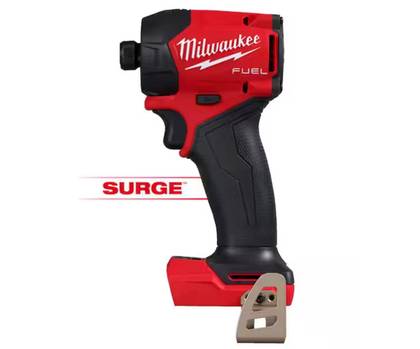
Then, there are hydraulic (oil-impulse) impact drivers like the Milwaukee M18 Surge or the DeWALT Quiet Hydraulic, which use a completely different hydraulic fluid drive system inside that’s substantially quieter.

Why You Should Own an Impact Wrench
Everyone can appreciate more power and torque.
Instead of a metal-on-metal hammer mechanism, a hydraulic pump creates high-pressure pulses in an oil-filled chamber, which drive the anvil inside your impact driver. So, why is this important? The main result is dramatically reduced noise and vibration during use.
Hydraulic impact drivers are often around 40% quieter than typical impacts, and they deliver a longer-duration impact that’s smooth, stable, and more controlled. Basically, they’re quieter and easier to use.
Hydraulic vs impact driver

So, which one is better? That depends on your preference, not to mention the job at hand. A regular impact driver is excellent for driving fasteners, but so is a hydraulic model.
Hydraulic impact drivers are usually 40–50% quieter, have a 2-4x reduction in vibration, and often deliver a smaller overall form factor that’s easier to use, especially one-handed.
If you already own a standard impact driver, you’re likely familiar with the insane levels of torque. If you’re considering switching to a hydraulic model, you’ll notice that, at least on paper, the specs are a little lower. A hydraulic impact typically won’t have the same high RPM and lb. torque rating of a regular impact.
For example, the Milwaukee M18 FUEL regular impact driver offers 2,000 in-lb of torque and 3,000 RPM. The M18 Surge (hydraulic) impact is only good for 1,000 in-lb of torque.
But that doesn’t mean a hydraulic impact driver isn’t worth trying. In fact, I’d argue the opposite. While a standard impact has more peak torque, hydraulic drivers are faster at driving screws and fasteners thanks to a more consistent torque output. At the same time, it’s quiet, doesn’t vibrate your hands and arms like crazy, yet still gets the job done.
With a hydraulic driver, you’ll enjoy a smoother, faster, more controlled driving experience. The consistent torque output makes it easier to drive screws without stripping. It’s ideal for areas where noise is a concern, like indoor jobs, finished spaces, or professionals who don’t want to deal with the hand and arm fatigue of a regular impact. On a spec sheet they aren’t as powerful, but the raw numbers don’t tell the whole story.
However, if you’re constantly dealing with large lag bolts, like rebuilding a patio deck, a standard impact full of torque is likely a better option. Essentially, it depends on the job.
Should I buy a hydraulic impact driver?
So, should you buy a hydraulic impact driver? In my opinion, yes, you should 100% buy one. Professionals will likely own both, but any DIY enthusiast will appreciate a hydraulic model over a traditional impact driver for all the reasons mentioned above.
If you’re a homeowner constantly doing DIY tasks around the house, you don’t want a big, loud, wildly powerful tool. Especially if you’re a beginner. A hydraulic impact driver is quiet, stable, and easy to use. You’ll value the performance and peace and quiet. They’re a popular tool for electricians, too, thanks to the compact form factor.
That said, if you’re a busy professional or someone framing decks and houses 8 hours a day, a traditional impact is still a solid option. When you need the power and torque, you need it. However, there’s something to be said about the smooth, stable, refined experience you’ll get from a hydraulic impact driver.
Plus, brands like Milwaukee continue to improve the tech, and its latest M12 and M18 Surge drivers are truly excellent. Here are a few hydraulic impact drivers you’ll love.
-

- Tool Type
-
Impact Driver
- Cordless?
-
Yes
- Warranty
-
3 years
- Color
-
Yellow
Complete framing, cabinetry, DIY jobs, and other applications in tight areas with DeWALT’s quietest impact. The 20V MAX XR Brushless Cordless 1/4 in. Quiet Hydraulic Impact Driver.
-
- Tool Type
-
Impact Driver
- Cordless?
-
Yes
- Warranty
-
5 years
- Color
-
Red
The new M18 FUEL SURGE utilizes a redesigned FLUID-DRIVE Hydraulic Powertrain to deliver 50% quieter operation with smoother driving and 3X less vibration compared to standard impact drivers.


