

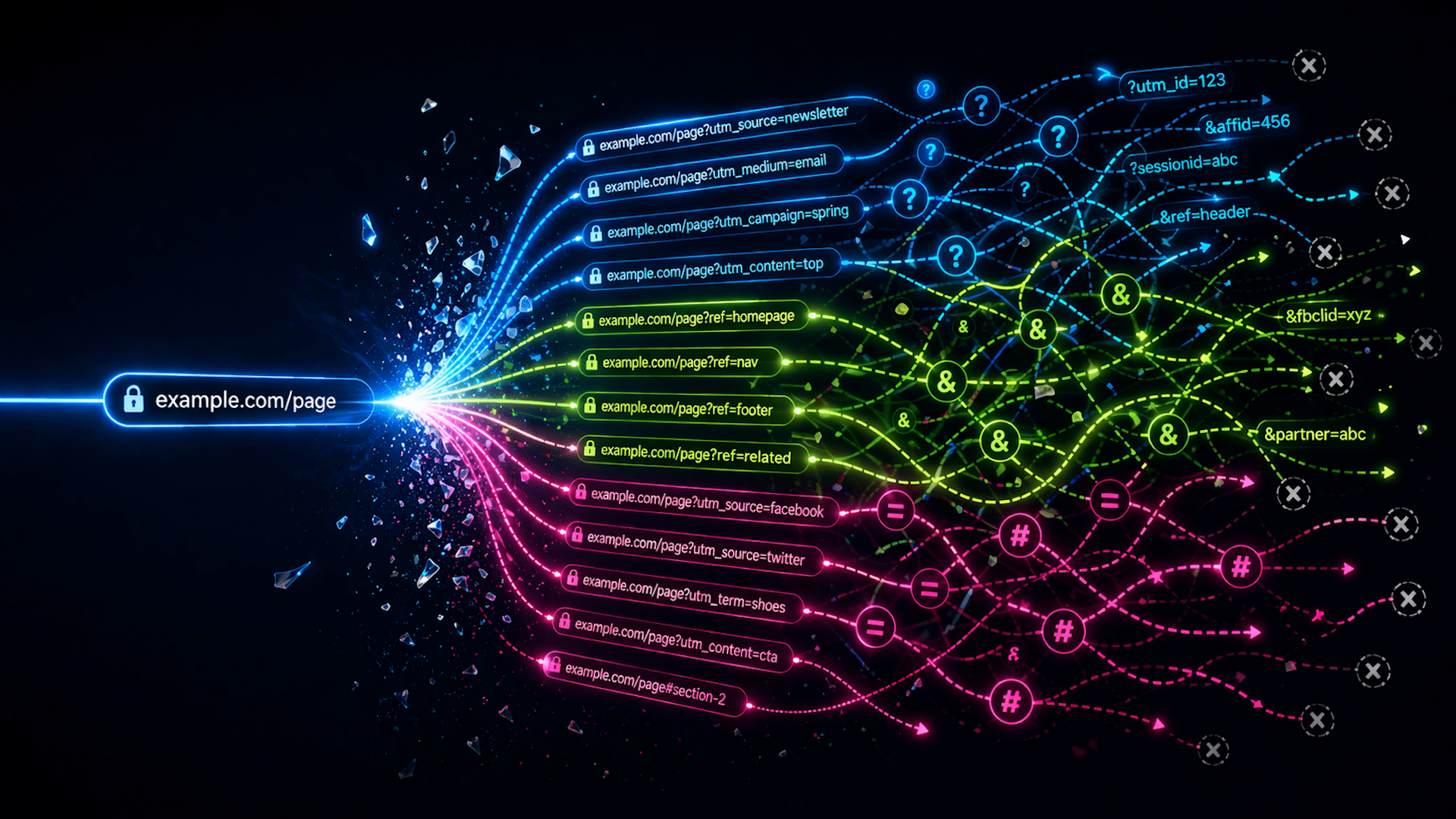
Internal linking is one of the most controllable levers in technical SEO. But when tracking parameters are embedded in internal URLs, they introduce inefficiencies across crawling and indexing, analytics, site speed, and even AI retrieval.

At scale, this isn’t just a “best practice” issue. It becomes a systemic problem affecting crawl budget, data integrity, and performance.
Here’s how to build a case study for your stakeholders to show the side effects of nuking tracking parameters in internal links — and propose a win-win fix for all digital teams.
How tracking parameters waste crawl budget
Crawl budget is often misunderstood. What matters isn’t the volume of crawl requests, but how efficiently Google discovers and prioritizes valuable pages.

As Jes Scholz pointed out back in 2022, crawl efficacy indicates how quickly Googlebot reaches new or updated content. Inefficient signals, such as low-value or parameterized URLs, can dilute crawl demand and delay the discovery of important pages.
Tracking parameters like utm_, vlid, fbclid, or custom query strings work well for campaign tracking. But when applied to internal links, they force search engines to process additional URL variations, increasing crawl overhead.
Crawlers treat every parameterized URL as a unique address. This means:
- Multiple versions of the same page are discovered.
- Crawl paths become longer and more complex.
- Resources are wasted processing duplicate content variants.
Search engines must still crawl first, then decide what to index.

Tracking parameters can quickly escalate a single URL into many variations by combining different values, creating a large number of duplicate URLs. This leads to:
- Redundant crawling of identical content.
- Longer crawl paths (more “hops” before reaching key pages).
- Reduced discovery efficiency for important URLs.

On large websites, this becomes a critical issue. Googlebot has a limited number of crawl requests per website. Any time spent crawling parameterized URLs reduces the opportunity to crawl the most important pages, even the so-called “money pages.”

Granted, crawl budget is typically a source of concern for larger websites, but that doesn’t mean it shouldn’t be ignored on sites with 10,000+ pages. Optimizing for it often reveals more room for efficiency gain in how search engines discover your content.
Your customers search everywhere. Make sure your brand shows up.
The SEO toolkit you know, plus the AI visibility data you need.
Start Free Trial
Get started with

Canonicalization isn’t a long-term fix
A common misconception is that canonical tags “fix” parameter issues and “optimize” crawl efficacy. They don’t.
Canonicalization works at the indexing stage, not at the discovery stage. If your internal links point to parameterized URLs:
- Search engines will still crawl them.
- Crawl budget is still consumed.
- Crawl depth is unnecessarily extended.

This is why parameter-heavy sites often show patterns like:

Crawl budget is not the only culprit here.
When tracking breaks attribution
Ironically, tracking parameters in internal links can corrupt the data they are meant to measure.
When a user lands on your site via organic search and then clicks an internal link with a tracking parameter, the session may break down and be reattributed.
Anecdotally, Google Analytics 4 resets a session based on campaign parameters, whereas Adobe Analytics does not.
This creates several downstream issues. Attribution becomes fragmented, especially under last-click models, where credit may shift away from organic entry points to internal interactions.

As performance is split across URL variants, page-level SEO reporting becomes unreliable and creates a disconnect between organic SERP behavior and what actually happens when a prospect lands on your pages.
Get the newsletter search marketers rely on.
How tracking parameters dilute link equity
One of the most overlooked risks is backlink fragmentation. If internal links include tracking parameters, users may share those exact URLs. As a result, external backlinks may point to parameterized versions of your pages rather than the canonical ones.
This means authority is split across URL variants, some signals may be lost or diluted, and search engines may treat these links as lower value. Over time and in large proportions, this is set to weaken your backlink profile.

Nonetheless, it piggybacks on the above tracking problems. Those external backlinks carry internal UTM parameters into external environments. This permanently fractures session attribution and wastes crawling resources.
Why URL bloat slows pages and weakens AI access
Using UTM parameters in your internal links is more than just a crawl overhead. It also strains your caching system.
Each URL with parameters is essentially a different page with its own cache entry. That means the same content may be fetched and processed multiple times, increasing load on both servers and CDNs.

This becomes even more critical with AI crawlers and LLM retrieval systems. It’s understood that many of these agents fetch content at scale and have limited rendering capabilities, making them more sensitive to parameterized URLs.
As the web is increasingly consumed by aggressive AI bots, having internal links with tracking parameters leaves traditional web crawlers and RAG-based systems wasting bandwidth on duplicate cache entries for pages that serve the same purpose.
At the same time, many of these systems rely heavily on cached versions and avoid rendering JavaScript due to architectural and cost constraints at scale.

This makes URL hygiene a foundational requirement, not just a technical preference.
On the cache front, Barry Pollard recently suggested a smart workaround that Google has been testing for a while.

Granted that removing those parameters results in identical content, helping the browser reuse a single cached response can dramatically improve Time to First Byte (TTFB), a metric that directly affects your Core Web Vitals.
Some CDNs already strip UTM parameters from their cache key, improving edge caching. However, browsers still see each parameterized URL as a separate asset and will request them one by one.
The No-Vary-Search response header closes this gap by aligning browser caching behavior with CDN logic. Implementing it allows browsers to treat URLs with specific query parameters as the same resource. Once set, the browser excludes the specified parameters during cache lookups, avoiding unnecessary network requests.
In practice, the header signals which parameters to ignore when determining cache identity. The only caveat is that it’s supported in Google Chrome +141, with support coming in version 144 on Android. If most of your organic traffic comes from Chromium-based browsers and you run paid campaigns, this is worth adding now.
The structural fix: Move tracking out of URLs and into the DOM
While canonicalization to the clean URL version isn’t a long-term solution, it remains the standard requirement. If you’re stuck in such a position, it’s likely a symptom of deeper architectural challenges at the intersection of SEO, IT, and tracking.
Either way, the preferred solution is to move measurement from the URL layer into the DOM layer.
This can be achieved successfully using a good old HTML workaround: data attributes.

This configuration allows tracking tools (e.g., tag managers) to capture click events and user interactions without altering the URL. Plus, it ensures internal links point to the canonical version without introducing duplicate cache entries.
Dig deeper: How the DOM affects crawling, rendering, and indexing
Why data-* attributes are a win-win for all digital marketing teams
| Benefit | Stakeholder |
| Enables clean internal link URLs and unbreakable tracking | SEO, analytics, product managers |
| Robust against CSS changes for page restyling | Web developers, product managers |
| Do not interfere with providing structural or semantic meaning to screen readers and search engines | Product managers, SEO |
| Easy to embed directly onto an HTML element | Web developers, analytics |
| Acts as a hidden storage layer for tracking data, allowing tools to capture interactions via JavaScript without exposing parameters in URLs | PR, affiliates, analytics |
See the complete picture of your search visibility.
Track, optimize, and win in Google and AI search from one platform.
Start Free Trial
Get started with
Rethinking internal tracking for scalable growth
Tracking parameters in internal links is a legacy workaround, often rooted in siloed teams and flawed site architecture.
However, they create downstream issues across the entire organization: wasted crawl budget, fragmented analytics, diluted backlink equity, and degraded web performance. They also interfere with how both search engines and AI systems access and interpret your content.
The solution isn’t to optimize these parameters, but to remove them entirely from internal linking and adopt a cleaner, more robust tracking approach.
Using a good old HTML trick sounds just about the right fix to win over traditional search engines, AI agents, and especially your stakeholders.
Note: The URL paths disclosed in the screenshots have been disguised for client confidentiality.
Contributing authors are invited to create content for Search Engine Land and are chosen for their expertise and contribution to the search community. Our contributors work under the oversight of the editorial staff and contributions are checked for quality and relevance to our readers. Search Engine Land is owned by Semrush. Contributor was not asked to make any direct or indirect mentions of Semrush. The opinions they express are their own.
