

Search behavior has changed dramatically, and teams need to learn answer engine optimization (AEO) best practices to keep up. While traditional search engines still dominate, people increasingly turn to AI tools like ChatGPT to answer their questions. Heck, with 79% of those who already use AI for search believing it offers a better experience, even Google has introduced AI overviews to stay competitive.

As a marketer, that shift caused a bit of a professional identity crisis. Before 2024, I spent the better part of a decade focused on topping search engine result pages, and, frankly, I was great at it. This shift demands a new approach for digital marketers like me. But luckily, AEO wins build on a foundation I already know.
This guide breaks down the most important AEO best practices marketing teams can’t ignore, offering a practical path to adapting content strategies for an AI-first search landscape. Looking to build an AEO strategy? HubSpot AEO can help teams measure their progress and make data-driven changes.
Table of Contents
What is answer engine optimization (AEO)?
Answer engine optimization (AEO) is the process of making a brand’s content easy for answer engines — like Google AI Overviews and ChatGPT — to find, understand, and cite. AEO involves structuring web content so AI-powered systems can easily extract and present it as authoritative answers. Unlike traditional SEO, AEO focuses on direct answers, structured data, and authority signals that help a brand appear in zero-click results.
While other terms like “generative engine optimization” or “AI search optimization” are also in the air, at HubSpot, we use AEO (answer engine optimization) because the focus is on the answer.
To get a high-level overview of current brand performance, use HubSpot AEO Grader for a free assessment. Then, AEO features in Marketing Hub Pro or Enterprise to map user questions, structure content for quick answers, add the right schema markup for AEO, and track brand visibility.
Teams that do not have a Marketing Hub subscription can use HubSpot AEO to measure their performance.
How is AEO different from SEO?
When people use a search engine, they get back what the tool thinks are the best resources to answer their question. That’s why the goal of traditional SEO is to increase rankings, clicks, and, in turn, website traffic.
Let’s say I search the very scientific question of “what are the best action movies of all time?” A traditional search engine like Google would give me a bunch of different resources (websites, videos, even forum responses), which it believes could offer the information I’m looking for.
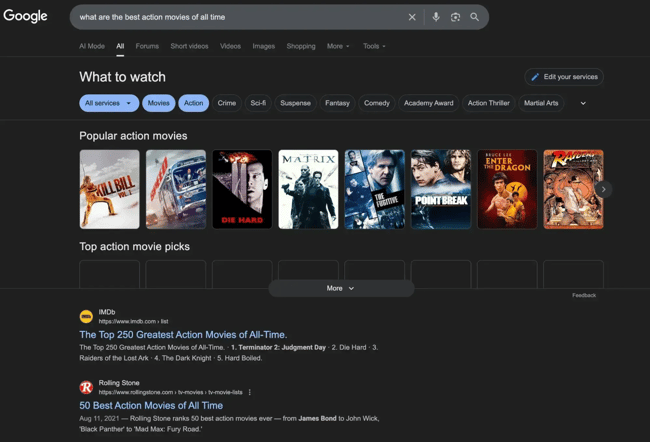
As marketers, that means targeting keywords, building backlinks, securing a place on page one, if not position one, and tracking impressions, click-through rates, and organic sessions. (All that good stuff I used to tackle.)
Featured Resource: 9 SEO challenges brands face in 2026 [HubSpot Blog data]
In contrast, answer engines don’t just give users possible resources. They attempt to provide the exact answer they want. Because of that, the goal of AEO is citations and inclusion in those answers.
For example, if I ask ChatGPT for the best action movies of all time, it’ll give me a list compiled from many sources rather than simply linking to some pages for me to check out.
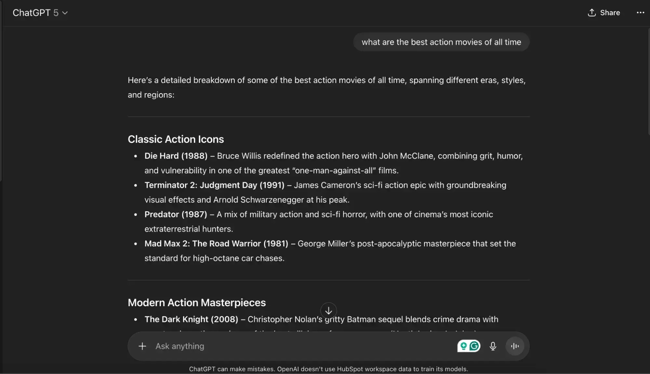
But search engines are not excluded from this either. AEO helps brands appear in featured snippets, knowledge panels, and even voice searches. It’s what helped populate that “popular action movies” carousel at the top of the SERP example.
Marketers need to structure their content for extraction, use schema markup to clarify meaning, and build authority so language models trust and reference their expertise. And marketers will track success with the number of zero-click answers, AI summaries, and voice responses, even when users never visit their website. Check out HubSpot’s AEO guide to start implementing these strategies today.
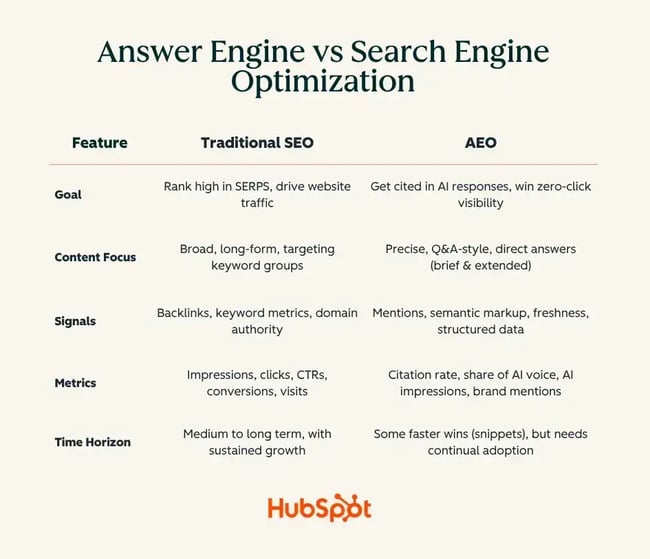
The strategic difference is visibility without traffic. A well-optimized answer might get cited thousands of times in ChatGPT conversations or Google AI Overviews without generating a single session in a marketer’s analytics. This challenges traditional attribution models but extends a brand’s reach into entirely new contexts, where buying decisions increasingly begin.
In short: SEO gets traffic. AEO owns the answer.
To operationalize this shift, tools like HubSpot AEO help marketers identify how their brand appears in AI-generated answers. From there, teams can uncover gaps in visibility and optimize content specifically for citation in answer engines.
Featured Resource: The essential SEO tutorial for thriving in the age of AI-driven search
Why Answer Engine Optimization Matters Now More Than Ever
The internet is shifting from a click-based economy to an answer-based one, and brands can easily get overlooked if they ignore AEO. Google reports that nearly 60% of searches now end without a click. ChatGPT alone more than doubled its weekly average users to 900 million from February 2025, so clearly, this trend is not slowing down. On top of that, voice assistants typically answer queries in seconds, often citing a single source.
Brand visibility now depends on being cited and summarized by these systems, not just ranking well in search. But note, that doesn’t mean marketers can neglect SEO.
AEO actually complements SEO and inbound marketing. AEO draws on many SEO foundations — strong content, domain credibility, internal linking — but reorients priorities so that content can be easily excerpted by answer engines.
While traditional SEO remains essential for driving traffic, AEO determines whether a brand appears in the most important answers. So, think of it as a new layer to the existing content strategy, not a separate thing competing for resources.
With AEO features built into HubSpot Marketing Hub, teams can track AI visibility natively in the HubSpot platform. Teams can then connect AEO insights to campaigns and optimize performance.
Best Practices for Answer Engine Optimization
- Focus on questions and user intent.
- Structure content for direct answers and extractions.
- Use schema to call out information to answer engines.
- Get into featured snippets and “People Also Ask.”
- Prioritize credibility.
- Build a strong, positive online presence across multiple channels.
- Optimize for voice search.
- Lean into localization for voice.
1. Focus on questions and user intent.
AEO is extremely question-and-answer focused. So, marketers should start by building a clear inventory of the questions their audience asks at every stage of their journey. Start by looking into insights from sales, and search data like “People Also Ask.”
Then, marketers should map those questions to funnel stages, so the content aligns with real user intent. Every piece of content should directly answer what people actually want to know, rather than what brands assume they care about.
Once collected, marketers should audit existing content to identify gaps or opportunities to update content to answer these questions. Also, research them in both search engines and AI tools to see how competitors are currently performing for them.
From there, segment questions by funnel stage and buyer persona. Here are some general guidelines to follow:
- Awareness-stage questions need educational, jargon-free answers.
- Consideration-stage questions require comparisons, frameworks, and proof points.
- Decision-stage questions demand specifics about implementation, pricing, and support.
Pro tip: Track this inventory in a shared spreadsheet or CRM. Note questions have been covered, which are in progress, and which represent content gaps competitors might be filling first. Using AEO features in Marketing Hub Pro and Enterprise, marketers can pair their question inventory to larger campaigns.
2. Structure content for direct answers and extractions.
Answer engines prioritize content that delivers clear, immediate responses in easily digestible formats. Lead each section with a concise, direct answer. Then, expand with supporting details, using bullet points, lists, and tables to improve readability. Well-structured content helps algorithms and humans quickly extract the most valuable information.
When a user searches Google, its AI doesn’t read an entire article linearly. Instead, it identifies answer-like structures (short paragraphs after questions, numbered steps, comparison tables) and decides if that content directly addresses the user’s query.
Large language models (LLMs) like ChatGPT do something similar. However, during training and retrieval, answer engines prioritize content that presents information in modular blocks that they can confidently cite. To optimize for this behavior, lead every key section with a 40- to 60-word direct answer that fully addresses the question. This is similar to how marketers would typically go after “featured snippets” in Google (more on that later).
Pro tip: HubSpot AEO can surface which content formats and answer structures are most likely to be cited, helping teams standardize high-performing patterns across their content.
Here’s an example: Consider the query, “What is inbound marketing?” Marketers should define the term in two or three sentences in the first paragraph — no fluff, preamble, or quips. After, the writer should share additional details and examples for readers wanting depth.
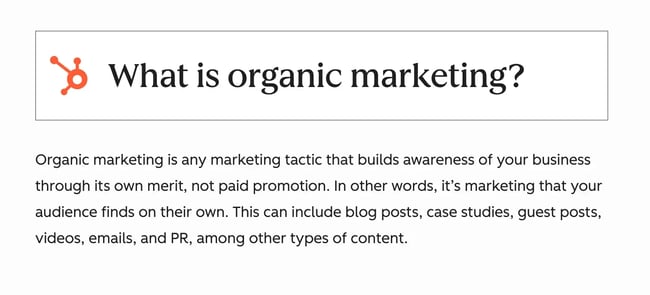
If teams have the resources, they should adopt reusable content block patterns that answer engines recognize. Think definition blocks for terminology, step-by-step blocks for processes, pros-and-cons blocks for evaluations. These patterns act as semantic signals that help AI identify what type of information an article is providing.
Here’s an example of a definition box from one of my HubSpot articles on organic marketing:
Source
Pro tip: HubSpot Content Hub can help marketers templatize these patterns and maintain editorial governance at scale as teams produce more AEO-optimized content.
3. Use schema to call out information to answer engines.
Schema markup is structured data marketers add to their HTML to explicitly tell search and answer engines what the content represents. Schema markup is the difference between Google guessing that a page is a how-to guide and Google knowing with certainty that it is.
By tagging elements like FAQs, how-to steps, and articles, marketers make their content easier to interpret. Consistent schema implementation also reinforces brand identity and authority across a site. Focus on these core schema types for AEO impact:
- Use FAQPage schema on pages with question-and-answer pairs. This helps Google surface the content in rich results and gives answer engines clear associations to extract.
- Apply HowTo schema to instructional content, marking each step, its position in the sequence, and any images or warnings.
- Tag editorial content with Article schema, including headline, publish date, author, and organization. This establishes freshness and authority signals.
- Add Speakable schema to key sections for voice assistants to prioritize when reading answers aloud.
- Finally, implement Organization schema sitewide to clarify brand identity, logo, and social profiles for consistent entity recognition.
CMS SEO tools in platforms like HubSpot let users template schema across content types, so teams don’t hand-code for every post. HubSpot users can set up templates for the most common content types — blog posts, guides, FAQs, and product pages — and the schema will be applied automatically with clean, crawlable HTML.
4. Get into featured snippets and “People Also Ask.”
Featured snippets and “People Also Ask” boxes are Google’s most visible answer formats. These callouts also serve as training data for how AI Overviews select and present information.
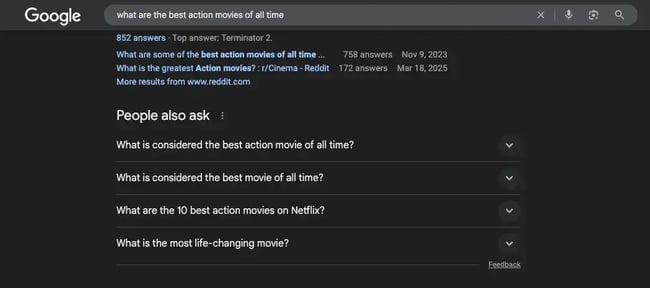
When content appears in a featured snippet, it has essentially been pre-selected by Google as the authoritative answer. So, appearing in a snippet increases that brand’s chances of being cited in AI summaries. To win featured snippets, keep these guidelines in mind when creating content:
- Format answers to match the snippet type in Google. If the existing snippet is a numbered list, structure the new answer as a numbered list. If it’s a paragraph, lead with a concise paragraph answer. If it’s a table, present the information in a comparison table with clear rows and columns.
- Mirror the question wording in the H2 or H3 header. If the PAA question is “How do you calculate ROI?”, the header should match that phrasing exactly.
- Place the answer high on the page. Ideally, this is within the first two scrolls. Google prioritizes content that’s easily accessible and clearly structured.
- Use the inverted pyramid approach. Answer first, then provide context, examples, and related information for users who want to go deeper.
Tools like HubSpot AEO help marketers track which pages are earning featured snippets and AI citations, so they can double down on formats and topics that consistently win visibility.
Pro tip: To systematically capture more features, harvest “People Also Ask” questions for target topics every quarter. Open an incognito browser, search the core keywords, and document every PAA question that appears. Marketers should note which ones they already answer well, which they answer poorly, and which they don’t address at all.
Prioritize updating existing high-authority pages to target new PAA questions rather than creating new content. Google favors established pages for featured snippets, so enhancing what already ranks often delivers faster results.
5. Prioritize credibility.
Recent research shows that content including citations, quotes, and statistics is 30% to 40% more visible in AI search results. Supporting claims with evidence, citing authoritative references, and regularly updating information strengthen both accuracy and visibility. Clear formatting further reinforces trustworthiness for both users and algorithms.
Marketers can strengthen content by:
- Formatting content for easy skimming. Think bullet points, tables, schema, and short paragraphs.
- Supporting all claims with facts. Include data-driven insights and expert citations to increase trustworthiness and demonstrate expertise. (Even better if it’s original data or research.)
- Using trusted resources. Leverage authoritative publications that AI models favor while maintaining originality in the analysis.
- Updating existing content regularly with new data and insights. This maintains relevance and helps already-ranking pages stay on top.
Pro tip: HubSpot AEO also helps monitor how credibility signals impact a brand’s presence across AI-generated answers.
6. Build a strong, positive online presence across multiple channels.
Answer engines favor brands that are consistently mentioned across reputable platforms. Answer engines are more likely to treat content as credible if the brand appears in reputable industry publications, high-quality forums, and academic or government sources. A coordinated distribution strategy ensures a brand’s expertise shows up wherever both audiences and AI systems are paying attention.
Off-site authority isn’t just about backlinks for SEO. Marketers need to establish proof that a brand is a legitimate subject-matter expert. Knowing this, it’s best to develop a multichannel distribution strategy. This could mean:
- Publishing thought leadership on LinkedIn. As a professional platform, this will help brands reach others in their industry and establish executive visibility.
- Creating educational video content for YouTube. Video transcripts are crawled by AI systems and are often more detailed than blog posts.
- Participating authentically in relevant Reddit communities and Quora discussions. These platforms are increasingly cited by AI as sources of real user sentiment and practical advice.
- Pitching byline articles to industry publications with strong editorial standards. These third-party endorsements signal authority far more than content published exclusively on an owned domain or smaller publications.
- Creating original research and data visualizations. When marketers publish a survey, benchmark report, or data-driven insight, they should create link-worthy assets that get cited across the web.
- Establishing a distribution cadence and repurposing workflow. A single piece of research can become a LinkedIn post, a YouTube video, a contributed article, a Reddit discussion, and a Quora answer — each tailored to the platform and audience.
- Assigning a content distribution owner. This person will be responsible for adapting core assets and tracking where they’re shared. Include PR angles and thought leadership opportunities in the planning. Speaking engagements, podcast interviews, and media mentions all contribute to the authority signals that answer engines evaluate.
Pro tip: Multi-channel diversification is built into the Loop Marketing playbook in the Amplify stage. Learn more about it here. Content Remix can help marketers with this repurposing in one click.
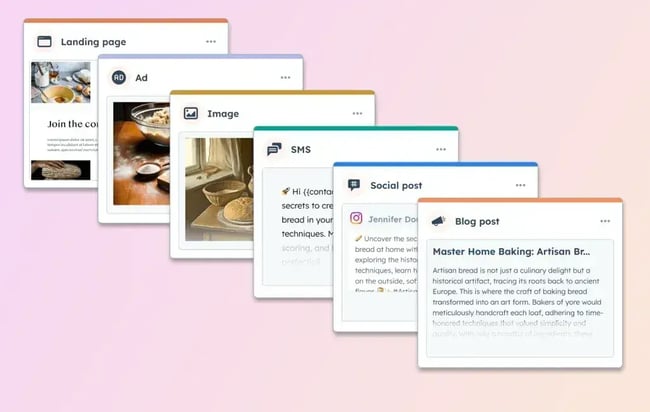
Plus, Marketing Hub automation can help orchestrate this distribution at scale. Marketers can schedule cross-platform posts, track engagement, and measure which channels drive the most referral traffic back to a company’s owned content.
7. Optimize for voice search.
When someone asks their smart speaker a question, the assistant typically cites one source. Brands want that to be theirs. Voice assistants like Alexa, Siri, and Google Assistant prioritize short, conversational answers that can be easily spoken aloud.
Writing in natural language, avoiding ambiguity, and structuring responses for quick delivery improve a brand’s chances of being selected. Speakable schema and testing queries across devices also help content perform well in voice-driven experiences. Other best practices include:
- Write answers in spoken-friendly language. Avoid jargon, long dependent clauses, and ambiguous pronouns. A voice assistant reading, “It enables seamless integration,” out loud leaves the listener confused about what “it” refers to. Instead, repeat the subject: “HubSpot’s API enables seamless integration.”
- Use Speakable schema markup. This tells assistants, “This paragraph is concise, self-contained, and ready to be read aloud.”
- Test voice queries on Alexa, Siri, and Google Assistant to audit visibility.
- Create a naming convention for voice-optimized content blocks in the CMS. Label FAQs, definitions, and key takeaways with Speakable markup. This helps marketing teams know which sections have been voice-optimized.
Featured Resource: Voice search optimization: How to get your business heard about
8. Lean into localization for voice.
Voice and AI search often surface nearby businesses, even for seemingly general queries, making local optimization essential. Keeping business information accurate and complete across platforms improves visibility in these high-intent moments. Pairing strong local profiles with reviews and location-specific content helps ensure a business appears when users are searching for solutions nearby.
For example, when someone asks “best coffee shop for remote work,” Google AI Overviews and voice assistants frequently respond with specific nearby options. Businesses are invisible in these high-intent moments if their local data is incomplete or inconsistent.
Here’s how businesses can cover their bases.
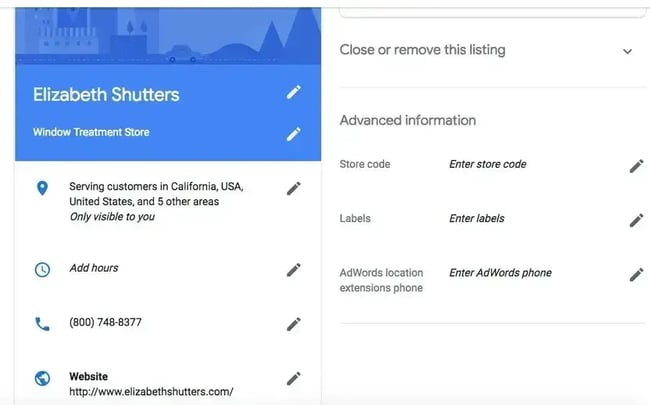
Optimize your Google Business Profile.
Businesses need to verify their contact info matches their website exactly. Google uses these to make suggestions for voice queries.
Add complete business hours, including holidays and special events. Upload high-quality photos of the location, products, and team. Select all relevant categories. Write a keyword-rich business description that includes the services and questions customers actually search for.
Build a strategy for getting reviews.
Ask satisfied customers to share their experience and respond promptly to every Google review — positive or negative. Review volume and recency are strong ranking signals for local AI results. Answer engines sometimes cite review themes when recommending businesses.
Create local landing pages for each service area.
Local landing pages help businesses show up in relevant local searches. Even for a single-location business, dedicated pages for “marketing consulting in Austin” or “HVAC repair in Brooklyn” give AI systems clear geographic and service signals to extract. Use consistent name, address, and phone number (NAP) formatting across all pages.
Ensure local business data is accurate and consistent across sources.
Contact and business information should be the same across all platforms. Look for consistency across the brand’s Google Business Profile, Apple Maps, Bing Places, the website, and even Mapquest (yes, they’re still around!).
Voice queries like, “What time does [business name] close?” or “Is [business name] open today?” pull from structured sources. Inconsistent data confuses customers and AI systems, diluting local authority. With this in mind, set a quarterly audit schedule to check and update this information as the business evolves.
Source
How does Loop Marketing fit into AEO?
Loop Marketing and AI engine optimization are natural partners in a modern content strategy. Why? Each model recognizes that buyer journeys today are not linear or monolithic.
Traditional funnel marketing assumes buyers take a linear path from awareness to purchase, interacting in the same places, and asking the same questions. Loop Marketing, in contrast, focuses on continuous engagement across multiple channels. That matches how buyers actually behave — gathering information from multiple sources rather than making a one-time conversion in a single place.
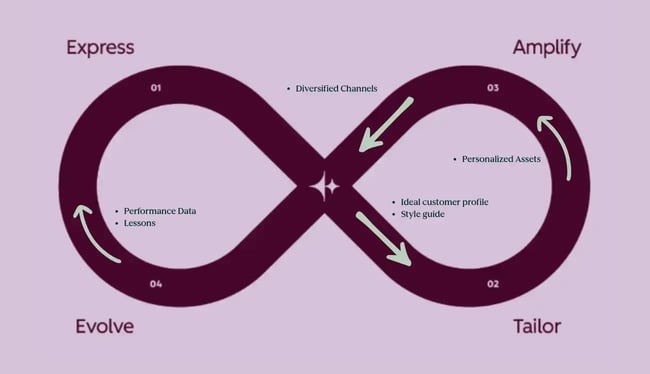
In Loop Marketing, teams create content that serves customers before, during, and after the sale. The goal is to answer new questions as they arise and nurture advocacy that feeds back into awareness. A business meets customers on social media, forums, podcasts, through AI assistants, and a host of other platforms.
AEO is a crucial part of Loop Marketing and meeting modern buyers where they are. HubSpot AEO supports the Loop by showing where and how a brand appears across AI-driven touchpoints. Marketers can then refine content to stay visible throughout the entire customer journey.
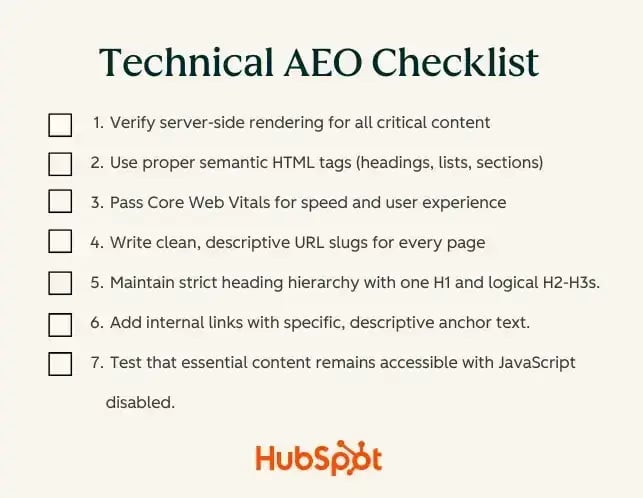
Technical AEO Checklist
- Verify server-side rendering for all critical content.
- Use proper semantic HTML tags (headings, lists, sections).
- Pass “Core Web Vitals” for speed and user experience.
- Write clean, descriptive URLs for every page.
- Maintain strict heading hierarchy with one H1 and logical H2-H3 structure.
- Add internal links with specific, descriptive anchor text.
- Test that essential content remains accessible with JavaScript disabled.
Verify server-side rendering for all critical content.
If answers, headings, or critical text load only via JavaScript (JS), many crawlers won’t see them. Marketers must ensure their HTML contains actual content when the page first loads, not just empty divs waiting for JS to populate.
Use proper semantic HTML tags (headings, lists, sections).
Mark headings with proper H1, H2, and H3 tags in logical hierarchy. Use
Pass “Core Web Vitals” for speed and user experience.
Answer engines favor content that appears quickly and doesn’t frustrate users. Compress images, minimize render-blocking resources, and use a CDN to help information load faster. Aim for Core Web Vitals that pass Google’s thresholds. Top-performing sites use the following benchmarks:
- LCP under 2.5 seconds.
- FID under 100ms.
- CLS under 0.1.
Write clean, descriptive URLs for every page.
A customer should be able to guess the information on a page just from the URL. A URL like /blog/what-is-inbound-marketing clearly signals what the content is about. A URL like /blog/post-47293 tells AI systems nothing, making the content harder to categorize and cite.
Maintain strict heading hierarchy with one H1 and logical H2-H3 structure.
Every page should have exactly one H1 and several H2s that divide the body content into major sections. From there, H3s and H4s provide additional structure. Don’t skip levels (H2 to H4) or use headers for styling instead of structure. Heading hierarchy is one of the strongest signals AI systems use to parse content’s organization.
Add internal links with specific, descriptive anchor text.
When referencing related content, use anchor text that describes what the linked page is about. Avoid generic phrases like “click here” or “learn more.” Internal links help AI systems map content relationships and understand topic clusters.
Pro tip: HubSpot’s Content Hub and CMS provide built-in tools to manage internal linking at scale and ensure every page connects logically to the broader content ecosystem.
Test that essential content remains accessible with JavaScript disabled.
If critical content disappears without JS, crawlers and assistive technologies can’t access it either. Build a baseline experience that works without JavaScript, then enhance progressively. Test pages with JavaScript disabled. Are the answers still readable, the headings navigable, and essential information visible?
Pro tip: On the technical side, HubSpot AEO helps identify structural and optimization gaps that may prevent content from being properly understood. Clarity improves citations.
Common AEO Challenges
Believe it or not, the biggest barrier to AEO success isn’t technical; it’s organizational. Getting internal buy-in from executives and stakeholders who are used to measuring success by clicks and conversions requires a fundamental reframing of what visibility means in an AI-first world.
Challenge: Executives resist investing in “visibility without clicks.”
Solution: Frame AEO as brand awareness and category leadership, not traffic generation. To get buy-in, marketers should explain shifts in internet behavior. Execs need to see how website traffic is no longer the single indicator of a brand’s actual prevalence. Competitors who own AI visibility today will own mindshare tomorrow.
When content gets cited in thousands of ChatGPT answers or Google AI Overviews, brands are shaping how buyers think about available solutions. Quantify the opportunity by tracking how often branded versus non-branded answers appear for high-value queries. Then, demonstrate the cost of letting competitors fill that gap unchallenged.
Challenge: Attribution and ROI measurement are unclear.
Solution: AI citations don’t generate sessions in Google Analytics, so traditional tracking breaks down. Build a hybrid measurement framework that combines traditional search and newer AEO metrics. HubSpot Marketing Hub offers tools for SEO and AEO, helping teams track performance across both.
Marketers can also survey new customers about how they first heard of their business. Increasingly, answers will reference answer engines and chatbots, like ChatGPT. Teams can correlate AEO milestones with pipeline velocity and deal size to demonstrate business impact, even when the path isn’t linear.
Challenge: It’s difficult to know which AI engines actually cited your content.
Solution: Tools like HubSpot AEO track where and how a brand appears across AI-generated answers. Marketers can see which queries trigger visibility, which platforms cite their content, and where opportunities exist to improve coverage.
For teams without a dedicated tool, a lightweight manual process can still provide direction. Periodically test queries across major AI platforms and log whether the brand appears and how prominently it’s cited. While less scalable, this approach can still reveal patterns in which content types and topics earn the most AI visibility.
Challenge: Content teams don’t have the capacity to retrofit existing content.
Solution: Prioritize ruthlessly. AEO can feel overwhelming if marketers are trying to optimize thousands of existing pages at once. Start with the top 20 highest-traffic pages and the 20 pages that rank on page one but don’t yet win snippets. These are the highest-leverage opportunities.
Add schema and answer-first formatting to these pages first. Then, expand to pillar pages and core conversion content. HubSpot AEO can help prioritize these efforts by highlighting which pages have the highest potential to gain AI visibility with optimization.
Challenge: Teams are unfamiliar with schema and structured data.
Solution: Schema implementation is often the bottleneck because it requires collaboration between content creators who understand the information and developers who can implement JSON-LD correctly. Bridge this gap by creating schema templates that a content team can populate without writing code.
Tools like Google’s Schema Markup Generator or HubSpot’s built-in schema modules let non-technical users add structured data through form fields.
Pair this with a validation workflow where someone tests each page with Google’s Rich Results Test before publishing. Over time, as content teams see the impact of schema on featured snippet wins and AI citations, they’ll build fluency and confidence.
Challenge: AI answers change rapidly, and there’s no clear “winning” format.
Solution: The way Google AI Overviews format answers today may differ from how they format them next quarter, and ChatGPT’s citation behavior evolves with each model update. Unpredictability makes teams hesitant to invest, but the volatility of search engines didn’t stop SEO from being a non-negotiable.
Marketers should anchor their strategy in principles that remain stable regardless of algorithm changes. These fundamentals improve user experience and site performance even if AI algorithms shift:
- Answer questions directly.
- Structure content clearly.
- Build authority across the web.
- Use semantic markup to clarify meaning.
Instead of optimizing for a specific engine’s quirks, marketing teams can make their content universally understandable and valuable, which pays dividends across all discovery channels.
Challenge: Legal and compliance teams worry about AI misrepresenting your content.
Solution: Legal and compliance are real concerns, especially in regulated industries. AI systems sometimes paraphrase incorrectly or cite out of context. Mitigate this risk by being extremely precise in an answer’s first paragraph.
If the first 60 words fully and accurately answer the question, there’s less room for AI to misinterpret. Avoid nuance and caveats in direct answers. It’s best to save those for supporting paragraphs.
For highly sensitive topics, businesses need to consider whether they want to be cited at all. In these cases, they can use robots.txt rules to block certain AI crawlers (though this limits visibility). Balance risk and opportunity with the legal team, and establish a monitoring process to flag instances where content is misrepresented in AI outputs.
Frequently Asked Questions About AEO Best Practices
How long does it take to see results from AEO?
Businesses can typically see early wins within four to eight weeks, but meaningful momentum builds over six to 12 months. The timeline depends on a business’s starting point and how aggressively it implements changes.
- Month 1: Teams map key audience questions, audit existing content, and implement schema on high-priority pages.
- Weeks 6 to 8: Early visibility gains appear, including featured snippets, PAA placements, and occasional mentions in AI-generated answers.
- Months 3 to 6: Momentum builds as more answer-optimized content is published, leading to increased snippet wins, AI citations, and rising brand awareness.
- Months 6 to 12: Measurable business impact emerges, including pipeline growth influenced by answer engine visibility.
Do we need schema on every page?
Companies don’t need schema on every page, but they should prioritize schema on pages where structured data delivers the most impact. Start with pages that fit the FAQPage schema, followed by Article, Speakable, and Organization. Depending on a business’s offerings, product and service pages can also include relevant schema types like Product, Service, or LocalBusiness.
Schema types help AI systems understand what a company sells, where it operates, and how to present it in local results and voice answers. HubSpot’s CMS Hub makes adding schema automatic with templates.
How can we track AI citations without a new platform?
Businesses don’t need expensive software to start tracking AEO performance. A simple spreadsheet and consistent manual process can go a long way. Teams can log key queries, test them across platforms, and track whether their brand appears. Over time, this reveals patterns in what content gets picked up and where visibility is improving.
To complement this, marketers can use tools they likely already have. Google Search Console helps track featured snippets and “People Also Ask” visibility as proxy metrics. Google Analytics 4 can monitor increases in branded search traffic and conversions. Together, these signals show whether AI visibility is translating into real business impact.
Teams can use HubSpot AEO to get a baseline assessment of their AI visibility across key queries. The tool shows where a brand is already appearing in AI-generated answers and if those appearances are negative, positive, or neutral.
Will AEO replace SEO?
Answer and search engine optimization are complementary, not competitive. Both are essential for maximum visibility in an AI-augmented search landscape. Trying to choose one over the other leaves opportunities on the table.
Off and on-page SEO remain foundational because they determine whether answer engines discover a brand’s content in the first place. If a site has poor technical health or weak domain authority, answer engines won’t index the content deeply or trust it enough to cite it.
Strong SEO fundamentals are prerequisites for AEO success. Invest in both.
What’s the best way to keep AEO content fresh?
AEO content requires ongoing maintenance because answer engines prioritize recency and accuracy. Outdated answers hurt a brand’s credibility and reduce the likelihood of being cited.
- Start by assigning ownership. Every piece of AEO-optimized content should have someone with subject-matter expertise responsible for keeping it accurate and up to date.
- Set a review schedule based on content type and topic volatility. High-velocity topics (like industry news, tool comparisons, or regulatory guidance) need monthly or quarterly reviews. Evergreen content might only need annual updates.
- Monitor People Also Ask and AI-generated answers for new questions. If Google starts showing PAA questions a brand hasn’t addressed, marketers should update the existing pillar page or FAQ to include them rather than creating a new article.
- Track product and market changes that invalidate existing answers. Stale answers erode trust fast.
- Use HubSpot AEO and manual audits to identify citation drops. Refresh pages with updated data, examples, and direct answers to reclaim any visibility.
AEO best practices are your answer to brand visibility.
AEO isn’t a replacement for SEO. It’s actually an evolution. The same fundamentals that have always driven strong performance need to be applied with answer engines in mind. Marketers who focus on directly answering questions, structuring content for extraction, and building authority across channels will be best positioned to show up where decisions increasingly begin.
Because at the end of the day, that’s still what great marketing has always been about.
As teams adapt, tools like HubSpot AEO and the AEO features in Marketing Hub Pro and Enterprise give marketers the visibility and tools they need to measure success in this new landscape and continuously improve how their brand shows up in the answers that matter.
So, how’s my identity crisis going today? Thankfully, the more I learn about AEO, the quieter that panic becomes.
