

Key Takeaways
- Backlinks are links from other websites to yours, and they still matter because they help search engines evaluate how authoritative and trustworthy your site is.
- Not all backlinks are equal. A few relevant, high-quality links from authoritative sites are usually more valuable than many weak or spammy ones.
- Backlinks support AI visibility because generative engines and language models favor content from authoritative, trustworthy sources, and backlinks are one of the clearest signals of that authority.
- Tracking backlinks means monitoring quality and growth. Pay attention to referring domains, anchor text distribution, and link stability over time.
- The best way to build backlinks is to earn them through useful content and targeted outreach. You will need to keep refining your approach based on what works.
AI is reshaping search, but one traditional SEO practice has held its ground: backlinks.
A backlink in SEO is a link from another website that points to yours. These mentions across different websites help search engines understand how you fit into the overall picture of your industry, and sites that reference you repeatedly signal authority and trust to Google. That authority also carries weight in AI-driven search experiences, where AI platforms favor content from sources they consider trustworthy.
Backlinks still matter, and the case for them has only grown stronger as AI reshapes how search works.
So, What Exactly Are Backlinks?
A backlink forms when another site links to your page, signaling to search engines that your content is worth referencing. You may also hear them called inbound links or incoming links.
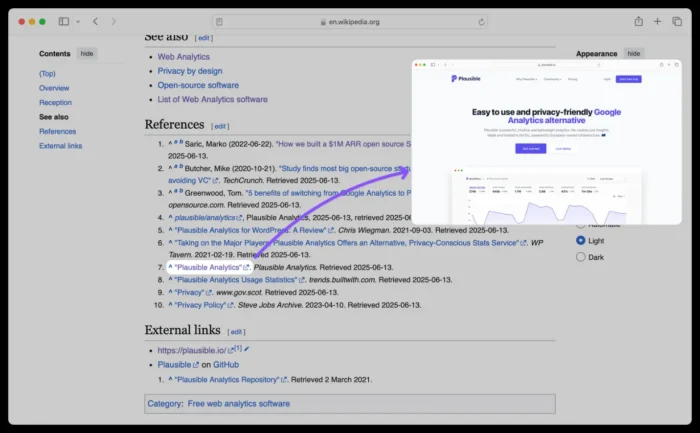
The screenshot below shows what a backlink looks like in practice, with one site linking directly to another as a reference.
Source: https://plausible.io/blog/backlinks-seo-guide
Nikki Brandemarte, Senior SEO Strategist and Local SEO Team Lead at NP Digital, explains it well: “Getting backlinks from reputable sources can demonstrate to Google that you have expertise on the topics you cover. I like to think of quality backlinks as a ‘vote of confidence’ that you know what you’re talking about.”
Backlinks help search engines understand which pages other websites find useful and authoritative enough to mention. That same authority can also support visibility in AI search experiences, even if backlinks are not the main ranking factor there.
I’ll go into what makes a “good” and “bad” backlink later in this article. For now, the key thing to know is that backlinks are one of the clearest ways authority gets passed around the web.
Backlink Examples/Types
Dofollow backlinks are the standard links most site owners want. They allow search engine bots to crawl and index your site, passing authority signals that typically have the biggest SEO impact. These are the links worth prioritizing in your outreach and content efforts.
Dofollow HTML example: anchor text
Nofollow backlinks work differently. They carry a special HTML attribute that tells search engines not to pass authority, but they still drive referral traffic and keep your link profile looking natural. You’ll commonly find them on social media, forums, and sponsored content. Since 2019, Google has treated nofollow links as hints rather than strict directives, meaning some may still carry indirect value.
Nofollow HTML example: anchor text
A healthy backlink profile includes both. Pursuing only dofollow links can signal to search engines that your links are artificially built rather than earned, which can work against you.
Why Are Backlinks Important For SEO?
Even as search has changed, backlinks still help search engines understand when other websites see your content as worth referencing. Authority and trust still influence rankings, especially for competitive topics.
Backlinks serve as a seal of approval from one site to another. They strengthen your site’s credibility and make it easier for search engines to surface your content in results. They’re also critical for driving targeted, quality traffic to your site. When someone clicks through from a relevant site, they arrive already interested in what you offer.
Backlinks also play a bigger role in the broader visibility ecosystem around search. Strong mentions and links earned through strategies like digital PR can support your presence across traditional and AI search.
Backlinks require ongoing attention, though. They aren’t “set it and forget it” things. A strong backlink profile is built over time and needs regular review. It’s an investment in your site’s long-term success and one of the clearest ways to build durable SEO authority.
Source: https://neilpatel.com/blog/free-backlink-tool/
Why Quality Backlinks Matter
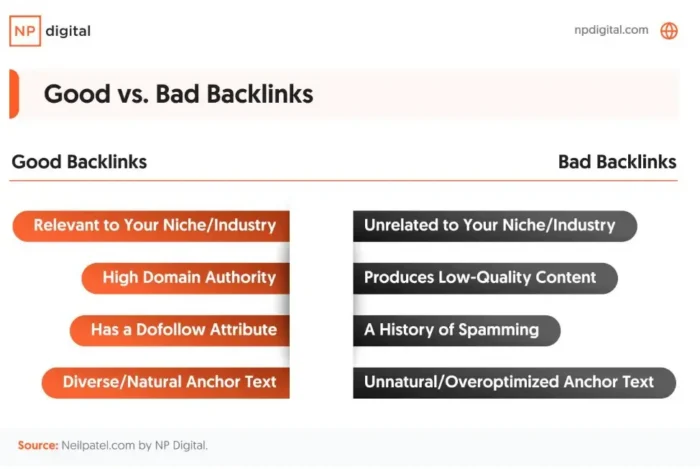
Quality beats quantity when it comes to backlinks.
A single backlink from a high-authority, relevant site can do more for your SEO than dozens of low-quality links. High-quality backlinks strengthen your site’s authority and can push your rankings higher in search results.
Going after links without caring about their quality is a recipe for trouble. It’s like inviting a bunch of strangers to your party without checking if they vibe with your crowd. This approach can tarnish your site’s reputation and lower its ranking.
High-quality backlinks share a few common traits:
- Relevancy: A link from a site in a related or complementary field helps Google see your link as more valuable.
- Domain or page authority: When authoritative sites link to yours, Google assumes your site is more trustworthy as well.
- Dofollow links: These pass authority signals to your site and are worth prioritizing in your outreach efforts. That said, a healthy backlink profile includes nofollow links too, since an all-dofollow profile can signal to search engines that you built your links artificially.
- Anchor text: Relevant anchor text can provide an even bigger potential boost to rankings.
What counts as a quality backlink can also vary by industry and competition level. In more competitive spaces, you may need stronger, more relevant links to stand out. That’s especially true for ecommerce link building, where product and category pages aren’t naturally linkable and quality links are harder to earn.
Low-quality backlinks typically come from sites unrelated to your niche, sites with questionable content, or known spam sources. Paying for links or accepting them indiscriminately puts your SEO at risk, regardless of how tempting a shortcut it may seem.
Are Backlinks Important For AI?
Backlinks are still important in AI-driven search, though not as a direct ranking factor. Google has confirmed that the same core SEO guidance applies to AI features like AI Overviews and AI Mode, and backlinks are part of that foundation.
Backlinks support visibility across generative engine optimization (GEO), large language model optimization (LLMO), and answer engine optimization (AEO), the three major AI optimization frameworks shaping modern search. In GEO, which focuses on getting your content cited in generative summaries, backlinks signal the depth and authority generative engines favor. In LLMO, which shapes how language models understand and reference your brand, backlinks reinforce the consistent authority signals models rely on. Even AEO, which targets direct answer boxes and featured snippets, stronger backlink profiles help pages earn those placements more easily.
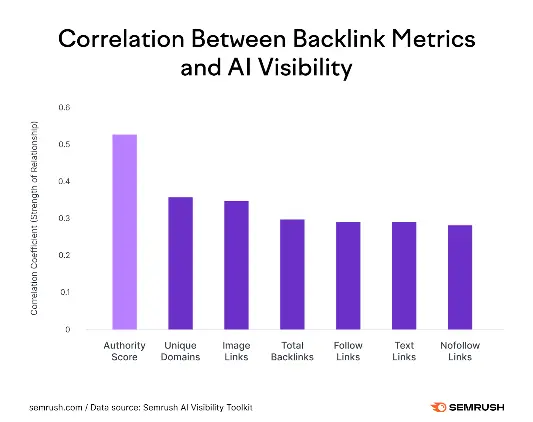
AI platforms tend to surface content from sites they consider authoritative. Semrush analyzed 1,000 unique domains and found a strong positive relationship between authority score, which reflects backlink quality, and how often a domain appears in AI-generated answers. The Pearson correlation of 0.65 and Spearman correlation of 0.57 from the study indicate a strong relationship, meaning sites with stronger backlink profiles show up in AI search results more consistently.
Publishing crawlable, useful content remains the priority, but backlinks across reputable sites reinforce that you are a trusted source worth surfacing.
Microsoft’s guidance on AI search visibility reinforces the same point, noting that traditional SEO fundamentals, including crawlability, backlinks, and content authority, remain central to whether content gets surfaced in AI-generated answers.
The chart below shows how different backlink metrics correlate with AI visibility across 1,000 unique domains. Authority Score, which reflects overall link quality, shows the strongest relationship by a significant margin.
Source: https://www.semrush.com/blog/backlinks-ai-search-study/
For AI search, backlinks are one signal among many, but they remain a meaningful one.
How to Track Your Backlinks
Tracking your backlinks is just as important as building them. Backlink analysis tools show you which sites link to yours and help you catch problems before they affect your rankings.
A backlink analysis tool like my free backlink checker lets you:
- Examine the quality of your backlinks.
- Spot any links that could be dragging your rankings down, such as links from spammy or irrelevant sites.
- Identify opportunities for higher-quality or more links.
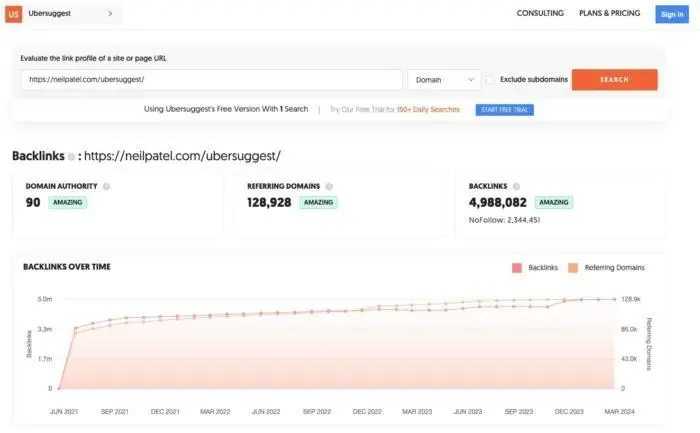
You also want to understand which sites are linking to you, whether those sites are relevant to your niche, what anchor text they’re using, and whether your referring domains are growing over time. My backlink checker surfaces all of this in one place, giving you a clearer picture of whether your backlink profile is getting stronger or just getting bigger.
The tool also makes competitive analysis straightforward. Enter a competitor’s URL and you can see everyone linking to them but not to you, turning that gap into a list of actionable link-building opportunities. Advanced filtering lets you narrow results by region, anchor text, domain score, page score, and URL, and you can choose to view only dofollow or nofollow links. Once you’ve refined your results, you can export them to CSV for further analysis.
As you get more backlinks, monitoring them manually takes too much time and effort. The right backlink analysis tools make maintaining them much easier and help you make smarter link-building decisions and catch problems early.
Backlink Building Best Practices
You’re ready to start building backlinks, but you can’t just fire off pitches to every publisher with a major name. Here’s what Kimberly Deese, Director of Digital PR at NP Digital, has to say about it:
“Two factors that impact building high-quality backlinks are the target page you are trying to build links to and the number of opportunities that currently exist that are relevant to that target page. Personalize content to personas and specific use cases to create more opportunities to reach out and build that personalization into your pitch and call to action.”
The biggest best practice is relevance. Start creating content that’s valuable and relevant to your niche. Focus on content people want to cite, like original research or genuinely helpful guides.
You should also look for broken-link opportunities. When a site in your space points to an outdated resource, you can suggest your content as a replacement.
Media requests are another strong play. Journalists and editors regularly need expert quotes, and a strong response earns you authoritative links and mentions.
It also helps to study what’s already working. Competitive backlink analysis can show you which sites, formats, and outreach angles are earning links in your niche.
These are some core moves, but backlink building rewards consistency. Check out our full guide on how to build backlinks for a deeper look at execution.
FAQs
What are backlinks?
Backlinks, also known as inbound links or incoming links, are links from one website to a page on another website. Search engines treat them as endorsements, using them to evaluate your content’s credibility and relevance, which can improve your visibility and rankings. They also play a role in AI search visibility. AI platforms tend to surface content from authoritative sources, and backlinks are one of the clearest signals of that authority.
How do I build backlinks?
Building backlinks ethically means creating content that earns links organically and reaching out to reputable sites in your industry. The strongest approaches include original research that journalists want to cite, digital PR campaigns that earn coverage on authoritative publications, and broken-link outreach that positions your content as a replacement for outdated resources. Quality and relevance matter more than volume.
How do I check my backlinks?
Ubersuggest’s free Backlink Checker is a strong starting point. It shows you which sites link to yours, flags links that look spammy or weak, and tracks referring domains, anchor text, and new or lost links over time. Those metrics together tell you whether your backlink profile is genuinely strong or just large.
Conclusion
Backlinks are one of the most important parts of a solid SEO strategy. They build credibility and authority, and search engines notice. That same authority carries into AI-driven search, where platforms consistently favor content from sources they trust.
The work is ongoing. You need to track what you have, pursue broken link opportunities, cut what’s hurting you, and keep earning better links over time. When you approach backlinks correctly, the payoff compounds. Stronger links mean stronger rankings, and stronger rankings mean more of the right people finding your content.
Unlock Thousands of Keywords with Ubersuggest
Ready to Outrank Your Competitors?
- Find long-tail keywords with High ROI
- Find 1000s of keywords instantly
- Turn searches into visits and conversions
Free keyword research tool
