


Close Menu
    Facebook X (Twitter) Instagram
    Wifi PortalWifi Portal
    • Blogging
    • SEO & Digital Marketing
    • WiFi / Internet & Networking
    • Cybersecurity
    • Tech Tools & Mobile / Apps
    • Privacy & Online Earning
    Facebook X (Twitter) Instagram
    Wifi PortalWifi Portal
    Home»Cybersecurity»Hackers exploit Marimo flaw to deploy NKAbuse malware from Hugging Face
    Cybersecurity

    Hackers exploit Marimo flaw to deploy NKAbuse malware from Hugging Face

    adminBy adminApril 16, 2026No Comments3 Mins Read
    Facebook Twitter LinkedIn Telegram Pinterest Tumblr Reddit WhatsApp Email
    New CrystalRAT malware adds RAT, stealer and prankware features
    Share
    Facebook Twitter LinkedIn Pinterest Email

    Hackers exploit Marimo flaw to deploy NKAbuse malware from Hugging Face

    Hackers are exploiting a critical vulnerability in Marimo reactive Python notebook to deploy a new variant of NKAbuse malware hosted on Hugging Face Spaces.

    Attacks leveraging the remote code execution flaw (CVE-2026-39987) started last week for credential theft, less than 10 hours after technical details were disclosed publicly, according to data from cloud-security company Sysdig.

    Sysdig researchers continued to monitor activity related to the security issue identified additional attacks, including a campaign that started on April 12 that abuses the Hugging Face Spaces platform for showcasing AI applications.

    Wiz

    Hugging Face serves as an AI development and machine learning-focused platform, acting as a hub for AI assets such as models, datasets, code, and tools, shared among the community.

    Hugging Face Spaces lets users deploy and share interactive web apps directly from a Git repository, typically for demos, tools, or experiments around AI.

    In the attacks that Sysdig observed, the attacker created a Space named vsccode-modetx (an intentional typosquat for VS Code) that hosts a dropper script (install-linux.sh) and a malware binary with the name kagent, also an attempt to mimic a legitimate Kubernetes AI agent tool.

    After exploiting the Marimo RCE, the threat actor ran a curl command to download the script from Hugging Face and execute it. Because Hugging Face Spaces is a legitimate HTTPS endpoint with a clean reputation, it is less likely to trigger alerts.

    The dropper script downloads the kagent binary, installs it locally, and sets up persistence via systemd, cron, or macOS LaunchAgent.

    According to the researchers, the payload is a previously undocumented variant of the DDoS-focused malware NKAbuse. Kaspersky researchers reported the malware in late 2023 and highlighted its novel abuse of the NKN (New Kind of Network) decentralized peer-to-peer network technology for data exchange.

    Sysdig says that the new variant functions as a remote access trojan that can execute shell commands on the infected system and send the output back to the operator.

    “The binary references NKN Client Protocol, WebRTC/ICE/STUN for NAT traversal, proxy management, and structured command handling – matching the NKAbuse family initially documented by Kaspersky in December 2023,” mentions Sysdig in the report.
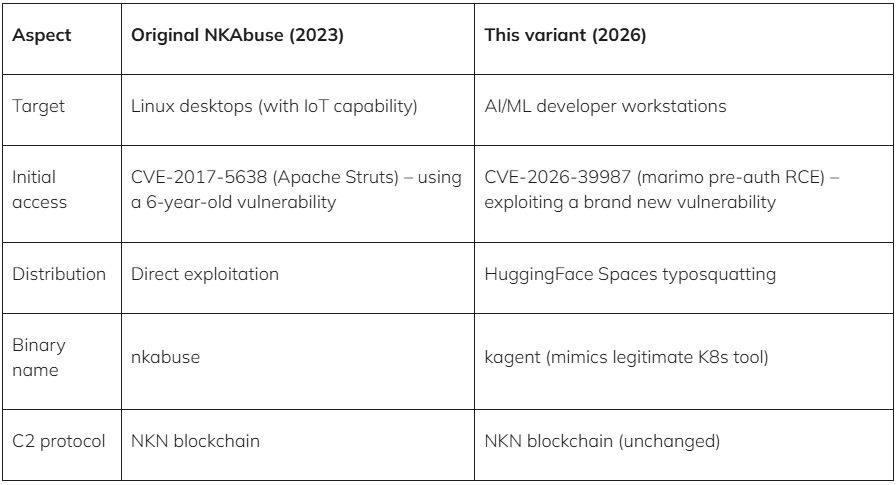
    Comparison table
    Source: Sysdig

    Sysdig also spotted other notable attacks exploiting CVE-2026-39987, including a Germany-based operator who attempted 15 reverse-shell techniques across multiple ports.

    They then pivoted to lateral movement by extracting database credentials from environment variables and connecting to PostgreSQL, where they rapidly enumerated schemas, tables, and configuration data.

    Another actor from Hong Kong used stolen .env credentials to target a Redis server, systematically scanning all 16 databases and dumping stored data, including session tokens and application cache entries.
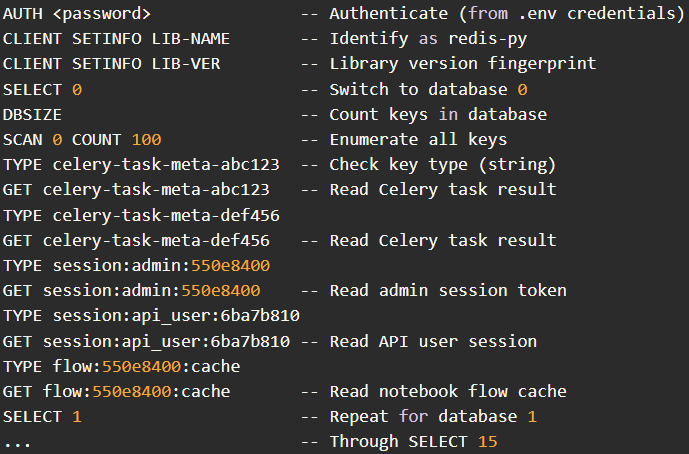
    Redis
    Source: Sysdig

    The overall takeaway is that exploitation of CVE-2026-39987 in the wild has increased in volume and tactics, and it’s crucial that users upgrade to version 0.23.0 or later immediately.

    If upgrading is not possible, it is recommended to block external access to the ‘/terminal/ws’ endpoint via a firewall, or block it entirely.


    tines

    Automated pentesting proves the path exists. BAS proves whether your controls stop it. Most teams run one without the other.

    This whitepaper maps six validation surfaces, shows where coverage ends, and provides practitioners with three diagnostic questions for any tool evaluation.

    Deploy exploit Face Flaw hackers Hugging Malware Marimo NKAbuse
    Share. Facebook Twitter Pinterest LinkedIn Tumblr Telegram Email
    Previous ArticleHow to Use Google Ads Brand Guidelines for Cleaner Automated Assets
    Next Article ChatGPT Often Retrieves But Rarely Cites Reddit Pages, Data Shows
    admin
    • Website

    Related Posts

    Two-Factor Authentication Breaks Free from the Desktop

    April 16, 2026

    Newly Discovered PowMix Botnet Hits Czech Workers Using Randomized C2 Traffic

    April 16, 2026

    CIOs fret over rising security concerns amid AI adoption

    April 16, 2026
    Add A Comment
    Leave A Reply Cancel Reply

    Search Blog
    About
    About

    At WifiPortal.tech, we share simple, easy-to-follow guides on cybersecurity, online privacy, and digital opportunities. Our goal is to help everyday users browse safely, protect personal data, and explore smart ways to earn online. Whether you’re new to the digital world or looking to strengthen your online knowledge, our content is here to keep you informed and secure.

    Trending Blogs

    Chrome just flipped the switch on its new enhanced AI Mode, and it’s a huge upgrade

    April 16, 2026

    Two-Factor Authentication Breaks Free from the Desktop

    April 16, 2026

    Microsoft makes it easier to import Google PMax campaigns

    April 16, 2026

    EFF pushes back on Google data scandal response: ‘Google screwed up’

    April 16, 2026
    Categories
    • Blogging (63)
    • Cybersecurity (1,350)
    • Privacy & Online Earning (169)
    • SEO & Digital Marketing (829)
    • Tech Tools & Mobile / Apps (1,615)
    • WiFi / Internet & Networking (226)

    Subscribe to Updates

    Stay updated with the latest tips on cybersecurity, online privacy, and digital opportunities straight to your inbox.

    WifiPortal.tech is a blogging platform focused on cybersecurity, online privacy, and digital opportunities. We share easy-to-follow guides, tips, and resources to help you stay safe online and explore new ways of working in the digital world.

    Our Picks

    Chrome just flipped the switch on its new enhanced AI Mode, and it’s a huge upgrade

    April 16, 2026

    Two-Factor Authentication Breaks Free from the Desktop

    April 16, 2026

    Microsoft makes it easier to import Google PMax campaigns

    April 16, 2026
    Most Popular
    • Chrome just flipped the switch on its new enhanced AI Mode, and it’s a huge upgrade
    • Two-Factor Authentication Breaks Free from the Desktop
    • Microsoft makes it easier to import Google PMax campaigns
    • EFF pushes back on Google data scandal response: ‘Google screwed up’
    • Newly Discovered PowMix Botnet Hits Czech Workers Using Randomized C2 Traffic
    • How Push Notifications Can Betray Your Privacy (and What to Do About It)
    • Try Using the 3-3-3 Rule to Stick to an Exercise Routine
    • CIOs fret over rising security concerns amid AI adoption
    © 2026 WifiPortal.tech. Designed by WifiPortal.tech.
    • Home
    • About Us
    • Contact Us
    • Privacy Policy
    • Terms and Conditions
    • Disclaimer

    Type above and press Enter to search. Press Esc to cancel.