

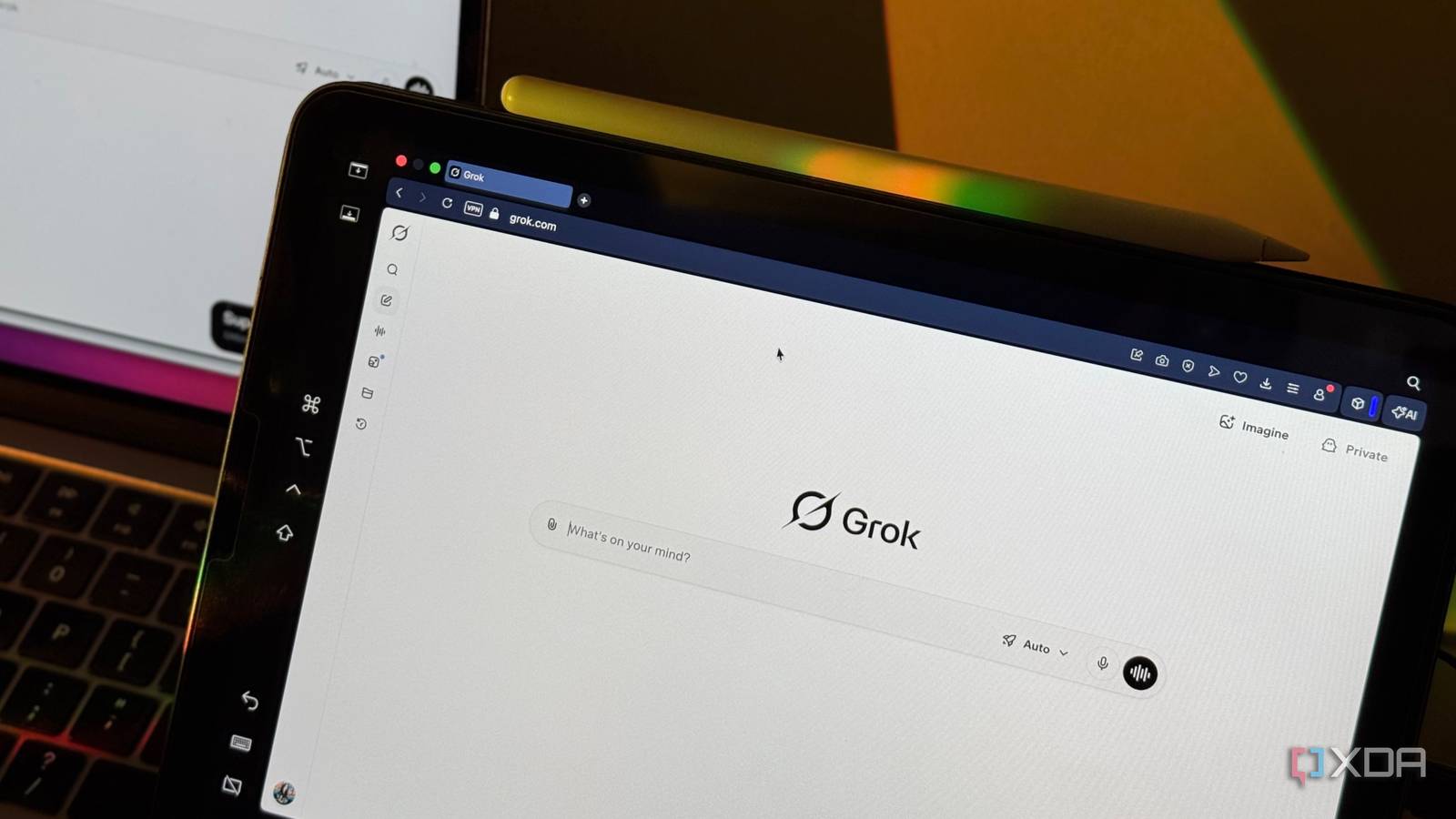
l’ve watched Grok from the sidelines for a fair bit now. For someone who tests Al tools for a living and is always rotating from one tool to another depending on what handles each task, it took an embarrassingly long time to actually try Grok properly.
It wasn’t that I’d heard bad things about the tool. Instead, it was simply the fact that I kept seeing it on X and my mind had mentally associated it as the Twitter Al chatbot. I took it for a spin in its early days, thought that there’s nothing here that ChatGPT or Claude isn’t already doing better, and moved on without looking back. That was a mistake…sort of.
Grok’s real-time X integration is impressive
Fine, you win this one, Grok
The way the majority uses Al nowadays is more or less the same: as a Google Search replacement. While it pains me to admit that as part of publications that are on the whims of Google traffic, it’s the truth. If people are going to use Al to search for things anyway, the question becomes which tool actually does it best.
Every Al chatbot out there offers some sort of web search feature. ChatGPT, for example, can browse the web and automatically switches to it when you ask for something that clearly needs up-to-date information. Claude, Gemini, and even Perplexity Al (which is primarily a search-first tool) all offer similar web search capabilities. Grok, on the other hand, takes this a step further by also pulling directly from X’s entire post database in real time. This is in addition to searching the web.
I’ve been testing Al tools since ChatGPT rolled out publicly, and even though it’s been a good while since Al tools got the ability to browse the web in real time, the majority of them still struggle when it comes to surfacing what’s actually being talked about right now. This is because they don’t work too well with social media platforms, which let’s face it, is where most real-time conversations actually happen.
Within the X interface, you can ask Grok to weigh in when you’re responding to a post, and it will pull context from the post and the broader discussion around it. You’ll see most people use this to fact-check.

When using Grok through the website or API, it’s capable of performing keyword searches, semantic search, user search, and thread fetches on X.
For instance, I’ve been constantly refreshing my X feed to get updates on the multiple things happening in the world right now. If you’ve been online lately, you know exactly what I’m talking about. Something you also likely know is how completely random accounts post blatantly wrong information, despite official accounts saying otherwise. Whenever I see a post from such an account, l’ve been simply asking Grok whether it’s true or not, and it always gives me a straight answer.
When the information checks out, it confirms it and points me to the sources backing it up. When it doesn’t, it tells me exactly why and pulls up the posts or articles that contradict it. It’s essentially become my real-time fact-checker, and it’s saved me from falling for misinformation more times than I’d like to admit.
It’s a great way to save yourself from endlessly scrolling and trying to piece together information from dozens and dozens of posts. Grok can analyze hundreds of relevant posts that are scattered across the platform and give you a consolidated summary of what’s actually going on. It’s an excellent way to find overall user sentiment too and see what the general consensus is on a topic.
For instance, say I’m working on an article about Perplexity Computer (which is an incredible Al feature I tested out recently). Given that it’s a relatively new launch and the only information available about it on the web are news posts and press releases, I’d get quite a vague answer if I were to ask any other Al tool what people think about it. The response those tools would give me depends on the handful of
articles and reviews that have been published so far (which, for a brand new feature, isn’t much to go on).

I use ChatGPT, Claude, Perplexity, and Gemini daily — here’s the only one worth paying for
One stands above the rest.
X, on the other hand, is filled with people gushing about new Al launches 24/7. It’s filled with actual users sharing first impressions, complaints, workarounds, and hot takes within minutes of something going live. Grok can instantly tap directly into all of that and give me a real picture of how actual users are reacting.
While I’m in no way saying that it’s a replacement for doing your own research or reading through posts yourself, it’s an incredibly useful starting point. Almost everyone uses some Al tool or the other to quickly search something up nowadays, and Grok just happens to be the best at it when you want to search across both the web and social media at the same time.
However, it’s worth pointing out that the real-time X integration is a bit of a double-edged sword. During breaking news, X is typically flooded with partial facts, user speculation, and unverified claims. Many of these posts are shared for virality before accuracy. There’s always a chance that Grok might pull from the loudest viral posts if there aren’t enough credible sources to balance them out. So while it’s great at telling you what people are saying, that doesn’t always mean what people are saying is true.
Grok is surprisingly fast for quick, everyday queries
Fast, casual, and surprisingly good at it

l’ve written a fair bit about how I prefer using Al tools in rotation. Rather than relying on a single Al tool for everything, I switch between them depending on what I need at that moment. For instance, I don’t need to say that Anthropic’s Opus models are currently regarded as the best for coding — that’s pretty well established at this point.
Similarly, NotebookLM is my go-to for studying, and Gemini is great when I want to take advantage of its Google Workspace integration. In my testing, Grok doesn’t compete in any of those lanes. It handles coding well, but Opus and GPT models are still ahead.
Grok fits into my rotation for quick, lightweight tasks. It responds noticeably faster than most Al tools I’ve used, and I find it great for asking random questions, having casual back-and-forths, or just quickly confirming something. It’s also genuinely funnier and more conversational than the competition.
I don’t love everything about Grok
Can’t ignore what bothers me about it

Now, I’ve always believed in giving credit where credit is due. However, I cannot (and will not) ignore what bothers me about Grok. Values matter to me when I’m choosing the tools I rely on, whether they’re Al-powered or not, and Grok’s track record in that department is something I can’t, in good faith, fully endorse.
Similar to how OpenAl lost my trust when it signed the deal with the Pentagon while Anthropic refused to, Grok and xAl have made choices that I fundamentally disagree with.
For instance, the whole NSFW scandal that unfolded was deeply disappointing. For those unaware, xAl launched an image and video generation tool called Grok Imagine that included a Spicy mode, which allowed users to generate content with nudity and sexualized imagery. The safeguards that were supposedly in place to prevent misuse were bypassed almost immediately.
Soon enough, users discovered they could manipulate images of real people and began using it to generate undressed images without their consent. The backlash was massive, and rightfully so. It was a direct result of what happens when you intentionally keep guardrails looser than every other major Al tool on the market.
I’ve also noticed a level of bias in Grok’s responses on certain topics that I’m not going to get into here. However, it was consistent enough to leave a bad taste and make me second-guess its outputs in ways I don’t quite have to with other tools.
A tool I respect more than I trust
All that said, I’m not saying Grok is unusable or that you shouldn’t try it. I clearly think you should, and I focused this article on regretting the fact that I didn’t try it properly sooner. However, there’s a difference between a tool I respect and think is doing well and a tool I fully trust. Right now, Grok falls into the former category.
