

Over the last year, I spent more time building a second brain than actually using one. I was constantly switching tools in search of a workflow that didn’t feel like a second job. But after testing dozens of apps, I finally landed on a tool that didn’t just add to the noise.
AFFiNE did what others couldn’t: it bridged the gap between a structured database and a freedom whiteboard and gave me the privacy of a local-first app without the steep learning curve of a developer toolkit. Here is why I finally stopped hunting and how this hybrid powerhouse changed everything.

7 reasons I have started looking for Notion alternatives
Jake of all trades, master of none?
The issue with PKM architecture
Why Obsidian and Notion didn’t stick

I really hit a wall about six months into my search for the perfect system. I wasn’t actually getting any work done anymore; I was just auditioning software.
It’s the moment where the tool you are using becomes more work than the project you are actually trying to finish. I would sit down with a simple plan, but instead of typing, I would spend two hours fiddling with Notion properties or trying to get an Obsidian plugin to look exactly right.
It was exhausting. I was spending all my energy building the plan instead of actually thinking.
Then I tried the new wave of apps like Capacities and Anytype. Everyone said their ‘object-based’ systems were the future, but for me, they were just a massive headscratcher. Every time I had a quick idea, I had to think twice about picking a relevant object for it.
It was like I was filing taxes every time I wanted to take a note. I wanted a PKM system that nails the basics without any complexities and that’s when I came across AFFiNE.
Advantages of AFFiNE
There are many

What finally changed everything for me with AFFiNE was that it stopped asking me to be a database manager. It felt like the first app that actually understood how a messy brain works.
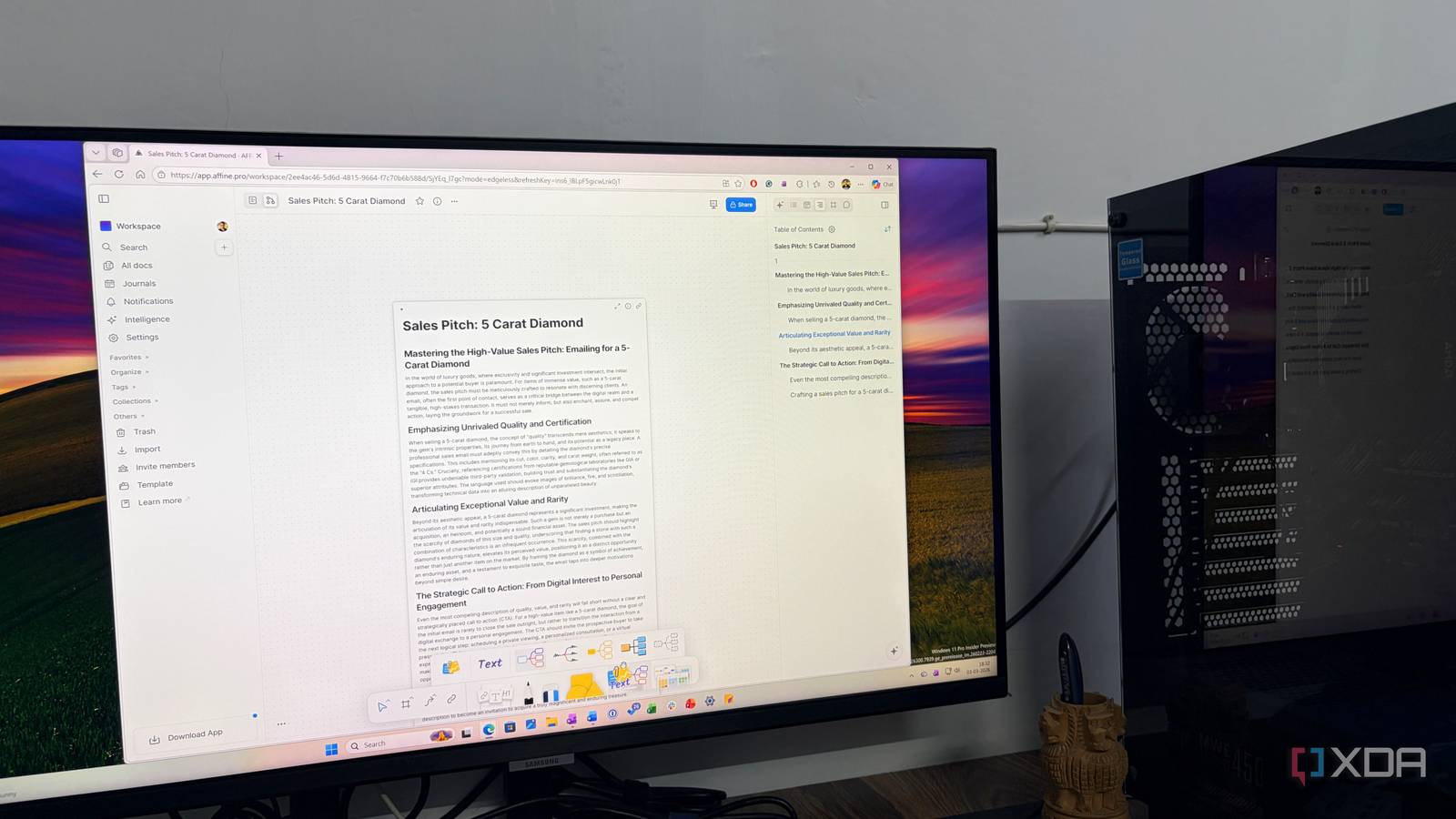
For me, AFFiNE does something the other apps just can’t seem to nail: it lets you switch between a clean document and a giant whiteboard with one click.
In Notion, I always felt trapped in a narrow column. In Obsidian, I felt trapped in a text file. But with AFFiNE, I can start typing a normal list of ideas, and then whenever I need more creative space, I just toggle to the Edgeless mode.
Suddenly, that list turns into a block on a massive canvas. I can drag it around, draw arrows to other ideas, and see how my thoughts connect.
It’s like having a notebook that can instantly turn into a wall of sticky notes without me having to copy and paste everything.
The best part is that it’s local-first. After a year of worrying about whether my Notion pages would load offline (before the offline feature rolled out) or if a cloud service might go down, having my data live on my own computer was a major relief. It’s fast, private, open-source, and I don’t need a subscription just to see my own notes.
My new workflow with AFFiNE
It’s quite productive
After a year of jumping between apps, I have settled into a rhythm that actually makes sense. I don’t spend hours setting it up anymore; I just use these five pieces to keep everything moving.
First, I use a Folder for the high-level stuff, like one for Personal, another one for Finances, and a specific one for Projects. It’s a simple way to keep my life separate from my work without overthinking it.
Inside those, I use Tags to cross-reference things. If I’m working on a Video Script that also involves Research, I just tag it with both. When I’m deep in a specific project, I use Collections. They are like my active workspace filters.
Instead of digging through folders, I just create a collection for whatever I’m focusing on this week. It pulls in all the relevant notes and docs into one view so I don’t get distracted by the hundreds of other things in my vault.
My favorite part is the Journal. Every morning, I just open the daily page and start typing. I don’t have to decide where a thought belongs yet. If a journal entry starts turning into a bigger idea, I just flip it into Edgeless mode.
I can drag my daily notes onto a giant canvas, draw arrows between them, and visually map out a thought. I start in the journal, brainstorm on the whiteboard, and organize with tags and collections. It’s simple, fast, and for once, I am actually getting things done.
Beyond the hype
For me, the best knowledge management app isn’t the one with the most plugins or the flashiest database templates; it’s the one that gets out of your way. My year-long experiment proved that I needed a tool as hybrid as my own brain.
It’s private, fast, and finally made my second brain feel like a natural extension of my first one. If you are spending more time watching ‘How-To’ tutorials than you are actually writing, your tool is failing you. It’s time to give AFFiNE a try.
