

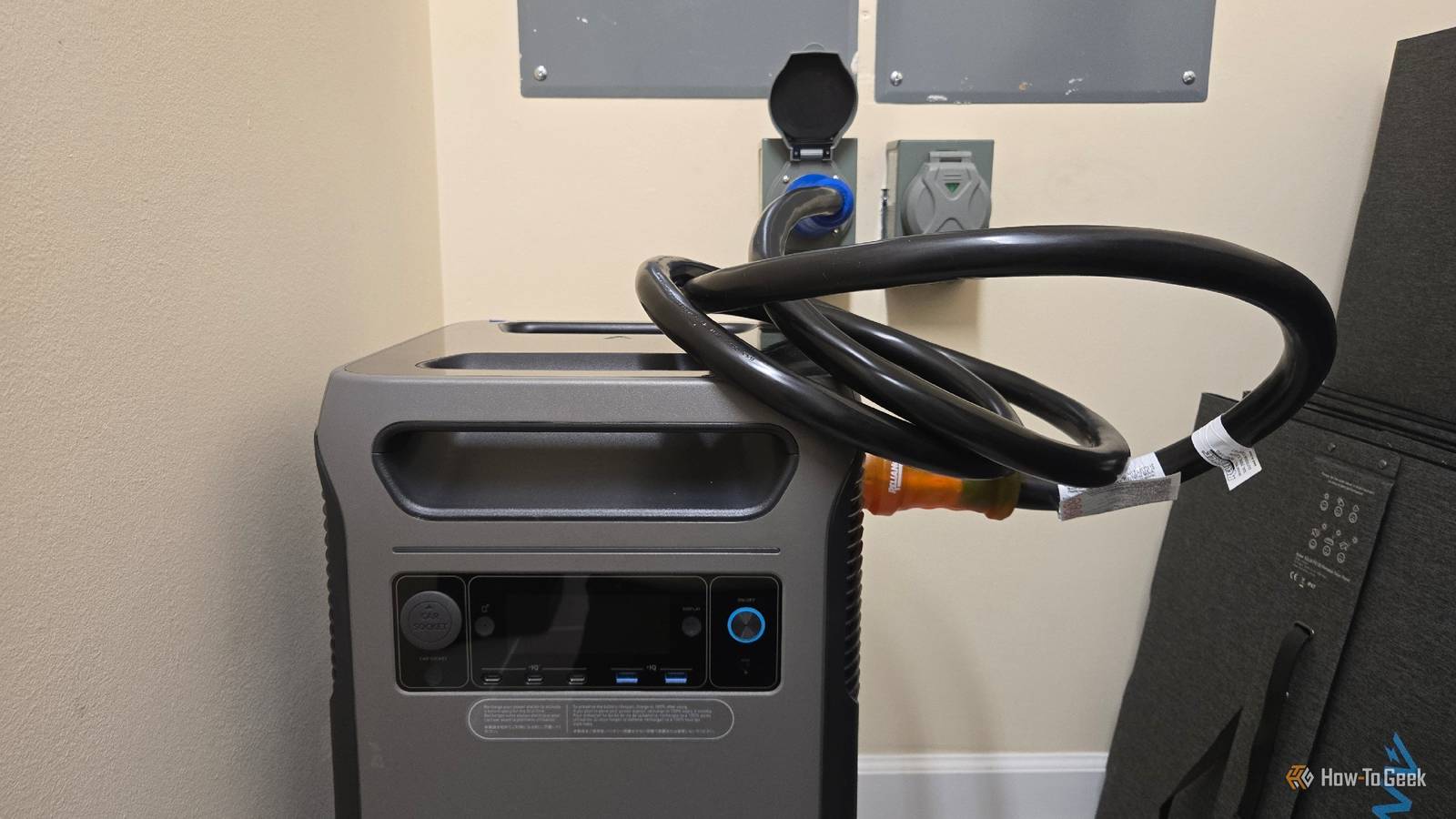
For years, I used a gas generator as backup power during outages, whether they were expected or unexpected blackouts. I recently replaced the gas generator with a battery-powered one. While both serve the same purpose, the battery-powered generator proved to be a true upgrade.
Once I plugged it in and started using it, I never looked back at the gas generator.
Charging it is much easier
Unlike a gas generator, a battery-powered one runs on stored charge. Like other devices with rechargeable batteries, such as phones or laptops, it charges by plugging into a standard outlet.

Since these generators have much larger batteries, they take longer to reach a full charge. I usually leave mine plugged in overnight when the battery is low and check the status again in the morning.
I own two battery generators, but charge only one at a time, since charging both simultaneously would blow a fuse in my house.


7/10
- Dimensions
-
27.32 x 13.43 x 16.14in
- Weight
-
113.54lbs (51.5kg)
A single source to power almost all of your essential home appliances. Power high-demand appliances—from 3-ton central AC to 1 HP water pump—with robust 4,000W and dual 120V/240V capabilities.
Even though charging takes a while, it is far easier to refill a generator with electricity than with gasoline. With my gas generator, I had to physically refill it with fuel and constantly check how much was left before refilling. Thankfully, there was a dial on the generator that showed how many hours of runtime remained.
Additionally, there are multiple ways to charge the battery generator. You can plug it in via an outlet, with a separate solar panel, or through an EV charging station.

The last option is useful in emergencies. I remember after Hurricane Sandy hit my home state, gas lines stretched for hours. If it happened again, I could charge a generator at a working EV station, either in my state or in another one if I had to.
The runtime is noticeably longer
Another reason I favor my battery over a gas model is its runtime. I’ve found the battery-powered version lasts longer on a single charge than my gas generator did on a full tank.

When I ran my gas generator, it typically lasted only a few hours. By comparison, my electric generator can run for more than a day while powering more appliances than the gas model could.
Runtime depends on how many appliances are connected, but since I use the same setup as I did with my gas generator, the electric one has lasted about three times longer on a single charge.

If I were to add a solar panel, the generator could have continuous power. That would eliminate concerns about it running out of charge during an extended blackout.
Starting it up is much simpler
While charging speed and battery life matter, functionality and day-to-day operation are another area where electric generators truly shine.
Starting a gas generator usually means flipping switches and repeatedly yanking a pull cord until it finally turns over. This is an annoying, time-consuming process, especially when power is needed quickly.

With an electric generator, it’s completely different. You press a single power button, and that’s it. The system turns on instantly and begins supplying power to whatever is plugged in, with no extra steps or hassle.
Location and accessibility are more flexible
One of the downsides of my gas generator was that it could not run inside due to the risk of carbon dioxide poisoning. This meant that the generator had to stay outside while it ran.

Furthermore, when I did take it out of my garage and start to run it, I would chain it to a nearby tree to prevent anyone from stealing it. This precaution stems from people stealing generators during the aftermath of Hurricane Sandy.
Since I switched to electric generators, I no longer have to lug them outside to use them. I keep them in my garage, and when they’re needed, I just go over, flip the power breaker switch, and turn them on.

This has become especially useful during extreme weather. When I used a gas generator, I had to go outside in heavy rain and strong winds or during significant snowfall to turn it on, check it, and refill it with gas if needed. This can be dangerous and even life-threatening.
On the flipside, with the battery-powered generator kept indoors, I do not have to brave the elements and can check on it from the safety of my home. Additionally, because it is connected to an app, I do not have to go downstairs to see how much charge remains. As long as the Wi-Fi is working, I can check all the stats from my phone.

Electric generators are also much quieter than gas generators. This means there is no motor running continuously during the day or while trying to sleep at night. The only noticeable sound from electric generators is typically the fan.
Since they can be used indoors and operate quietly, they are also well-suited for apartments, especially those not on the ground floor. Gas generators generally cannot be used in apartments because they must be operated outdoors, but electric generators can be used safely indoors.
Portability and connectivity versatility are a plus
Even though I keep my generators in one spot most days of the year, I’m happy to know that they’re easier to move than my gas generator.

Both of my electric generators have built-in wheels and a pull-out handle, making them easy to move from one place to another. My gas generator didn’t have either of these features, and moving it usually required two people.
Additionally, it has modern ports for connectivity. While it still includes standard outlets for appliances, it also has USB ports that allow you to plug compatible cables directly into the generator.

This is especially useful if I take one of the generators camping and want to travel light. I can reduce the number of power bricks I bring by plugging cables straight into the generator instead.
Again, while I rarely use these features since I primarily rely on the generators as backup power during blackouts, it’s reassuring to know I have that flexibility. If I ever need to move them or use them in a different location, those options are already there and easy to use.
In my opinion, an electric generator has been a better fit for my current situation and how I use it. I find it easier to turn on, operate, and maintain, both when it is in use and when it is not. That said, one downside is cost. Electric generators are typically more expensive upfront than traditional gas generators.
When considering long-term expenses, they can be more cost-effective, especially if you plan to use them frequently, since there is no ongoing need to purchase gasoline. I’ve enjoyed using my electric, battery-powered generator, and as of now, I don’t see myself switching back to gas anytime soon.
