

Close Menu
    Facebook X (Twitter) Instagram
    Wifi PortalWifi Portal
    • Blogging
    • SEO & Digital Marketing
    • WiFi / Internet & Networking
    • Cybersecurity
    • Tech Tools & Mobile / Apps
    • Privacy & Online Earning
    Facebook X (Twitter) Instagram
    Wifi PortalWifi Portal
    Home»Cybersecurity»Fake OpenAI repository on Hugging Face pushes infostealer malware
    Cybersecurity

    Fake OpenAI repository on Hugging Face pushes infostealer malware

    adminBy adminMay 9, 2026No Comments3 Mins Read
    Facebook Twitter LinkedIn Telegram Pinterest Tumblr Reddit WhatsApp Email
    Fake OpenAI repository on Hugging Face pushes infostealer malware
    Share
    Facebook Twitter LinkedIn Pinterest Email

    Fake OpenAI repository on Hugging Face pushes infostealer malware

    A malicious Hugging Face repository that reached the platform’s trending list impersonated OpenAI’s “Privacy Filter” project to deliver information-stealing malware to Windows users.

    The repository briefly reached #1 on Hugging Face and accumulated 244,000 downloads before the platform responded to reports and removed it.

    The Hugging Face platform lets developers and researchers share AI models, datasets, and machine learning (ML) tools. Models are pre-trained AI systems hosted on the platform comprising weight files, configuration, and code.

    Researchers at HiddenLayer, a company focused on safeguarding AI and ML models against attacks, discovered the campaign on May 7, after noticing a malicious repository named Open-OSS/privacy-filter.

    “The repository had typosquatted OpenAI’s legitimate Privacy Filter release, copied its model card nearly verbatim, and shipped a loader.py file that fetches and executes infostealer malware on Windows machines,” the researchers explain.
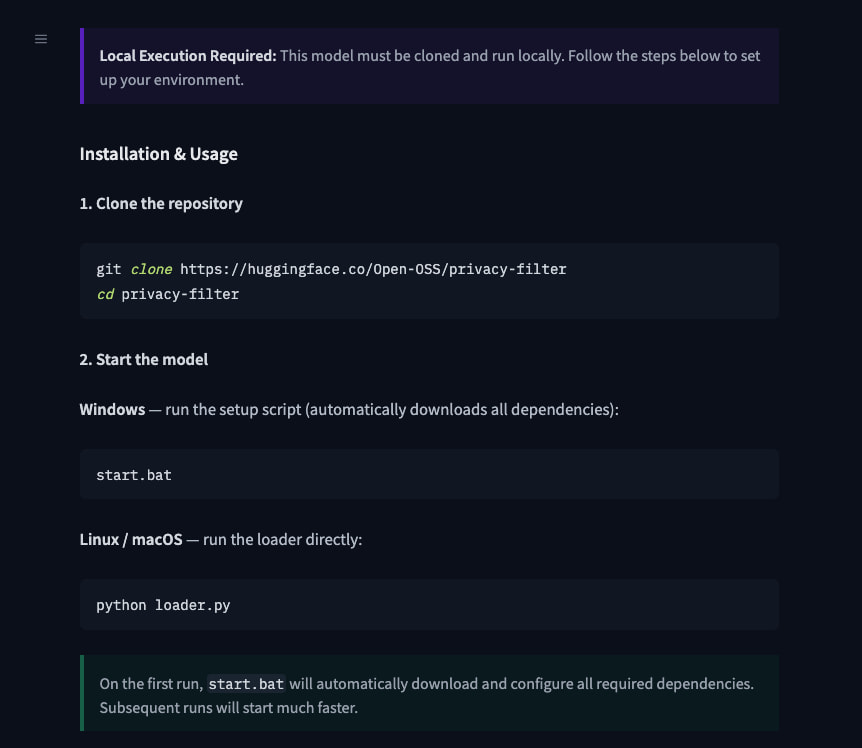
    Instructions from the malicious repository
    Instructions from the malicious repository
    Source: HiddenLayer

    The ‘loader.py’ Python script included fake AI-related code to appear harmless, but in the background, it disabled SSL verification, decoded a base64 URL pointing to an external resource, and then fetched and executed a JSON payload containing a PowerShell command.

    The command, which is executed in an invisible window, downloads a batch file (start.bat) that performs privilege escalation, downloads the final payload (sefirah), adds it to Microsoft Defender’s exclusions for it, and executes it.

    The final payload is a Rust-based infostealer that targets the following sensitive data:

    • Browser data from Chromium- and Gecko-based browsers (e.g., cookies, saved passwords, encryption keys, browsing data, session tokens)
    • Discord tokens, local databases, and master keys
    • Cryptocurrency wallets and wallet browser extensions
    • SSH, FTP, and VPN credentials and configuration files, including FileZilla
    • Sensitive local files and wallet seeds/keys
    • System information
    • Multi-monitor screenshots

    The stolen data is compressed and exfiltrated to a command-and-control (C2) server at recargapopular[.]com.

    HiddenLayer highlights the malware’s extensive anti-analysis features, which include checks for virtual machines, sandboxes, debuggers, and analysis tools, all with the purpose of evading analysis systems.

    The exact number of victims in this incident is unclear, and the researchers note that the vast majority of the 667 accounts that liked the malicious repository on Hugging Face appear to be auto-generated. Additionally, the 244,000 download count may have been artificially inflated.

    By examining those, the researchers uncovered other repositories that used the same malicious loader infrastructure. HiddenLayer researchers also noticed overlaps with an npm typosquatting campaign distributing the WinOS 4.0 implant.

    Users who downloaded files from the malicious repository are advised to reimage the machine, rotate all stored credentials, replace cryptocurrency wallets and seed phrases, and invalidate browser sessions and tokens.

    Threat actors have abused Hugging Face in the past to host malicious models, despite the platform’s security measures.


    article image

    AI chained four zero-days into one exploit that bypassed both renderer and OS sandboxes. A wave of new exploits is coming.

    At the Autonomous Validation Summit (May 12 & 14), see how autonomous, context-rich validation finds what’s exploitable, proves controls hold, and closes the remediation loop.

    Claim Your Spot

    Face Fake Hugging Infostealer Malware OpenAI pushes Repository
    Share. Facebook Twitter Pinterest LinkedIn Tumblr Telegram Email
    Previous ArticleVulnerability in Claude Extension for Chrome Exposes AI Agent to Takeover
    Next Article Transilience AI unveils Security Operating System for cloud remediation
    admin
    • Website

    Related Posts

    Encryption Consulting launches CertSecure Manager v3.3 with zero-touch certificate renewals

    May 20, 2026

    GitHub confirms breach of 3,800 repos via malicious VSCode extension

    May 20, 2026

    Grafana GitHub Breach Exposes Source Code via TanStack npm Attack

    May 20, 2026
    Add A Comment
    Leave A Reply Cancel Reply

    Search Blog
    About
    About

    At WifiPortal.tech, we share simple, easy-to-follow guides on cybersecurity, online privacy, and digital opportunities. Our goal is to help everyday users browse safely, protect personal data, and explore smart ways to earn online. Whether you’re new to the digital world or looking to strengthen your online knowledge, our content is here to keep you informed and secure.

    Trending Blogs

    Google tests new conversational ad formats in AI Mode and Search

    May 21, 2026

    How to measure AI search visibility: KPIs & reporting

    May 21, 2026

    Mueller Explains Why Google Uses Markdown On Dev Docs

    May 21, 2026

    Google Marketing Live 2026: Everything you need to know

    May 21, 2026
    Categories
    • Blogging (82)
    • Cybersecurity (1,955)
    • Privacy & Online Earning (223)
    • SEO & Digital Marketing (1,216)
    • Tech Tools & Mobile / Apps (1,796)
    • WiFi / Internet & Networking (306)

    Subscribe to Updates

    Stay updated with the latest tips on cybersecurity, online privacy, and digital opportunities straight to your inbox.

    WifiPortal.tech is a blogging platform focused on cybersecurity, online privacy, and digital opportunities. We share easy-to-follow guides, tips, and resources to help you stay safe online and explore new ways of working in the digital world.

    Our Picks

    Google tests new conversational ad formats in AI Mode and Search

    May 21, 2026

    How to measure AI search visibility: KPIs & reporting

    May 21, 2026

    Mueller Explains Why Google Uses Markdown On Dev Docs

    May 21, 2026
    Most Popular
    • Google tests new conversational ad formats in AI Mode and Search
    • How to measure AI search visibility: KPIs & reporting
    • Mueller Explains Why Google Uses Markdown On Dev Docs
    • Google Marketing Live 2026: Everything you need to know
    • Google unveils Gemini 3.5 Flash and a redesigned ‘intelligent Search box’
    • 12 Awesome Custom Google Analytics Reports Created by the Experts
    • Selector targets the network visibility gap in multi-cloud infrastructure
    • How to Persuade Your Boss to Send You to Ahrefs Evolve in San Diego
    © 2026 WifiPortal.tech. Designed by WifiPortal.tech.
    • Home
    • About Us
    • Contact Us
    • Privacy Policy
    • Terms and Conditions
    • Disclaimer

    Type above and press Enter to search. Press Esc to cancel.