


Your analytics dashboard tracks clicks, but it doesn’t convey the complete picture.
When a buyer reads an AI answer that mentions your competitor, or scrolls through a Reddit thread where your brand doesn’t appear, that’s lost visibility. And it won’t show up anywhere in your traffic data.
Share of voice (SoV) captures what traffic metrics can’t.
It measures your brand’s visibility against competitors across channels where buyers actually research and make decisions.
While SoV spans social, PR, and paid media, search is where most brands should start. It’s the channel where buyers with the strongest purchase intent show up, and it’s the easiest to measure competitively. That’s what this guide focuses on.
I’ll walk you through four steps to measure your share of voice in organic and AI search. Then, I’ll show you how to turn that data into decisions that move the needle where it matters.
What Is Share of Voice?
Share of voice measures your brand’s visibility relative to competitors across multiple marketing channels.
That includes organic and AI search, social media, review sites, communities, and more.
Traditionally, brands used SoV to track their share of ad spend in a market.
Now it’s evolved into something even more valuable. It can measure your brand’s presence across every touchpoint where buyers research and make decisions.
In simple terms: SoV tells you what percentage of the conversation you own in your category, compared to competitors.

This guide focuses on search SoV — both organic and AI — because that’s where buyer discovery is shifting fastest and where the measurement tools have matured enough to give you actionable data.
I find that search SoV also tends to be the foundation: once you understand your visibility in organic and AI results, layering in other channels becomes much simpler.
What Counts as a “Good” Share of Voice?
While there’s no universal benchmark for SoV, establishing one for your brand comes down to:
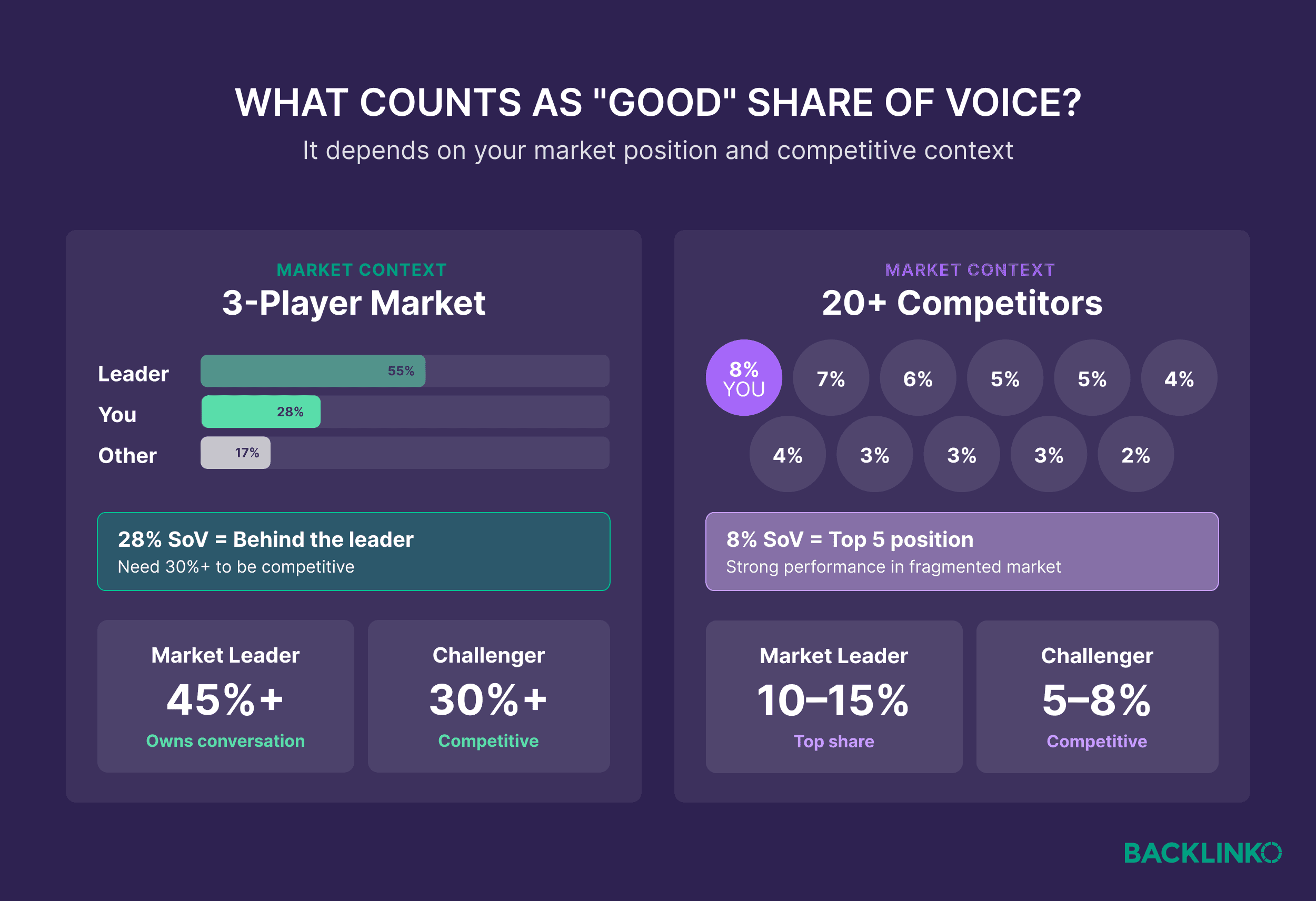
- Market position: Market leaders have a higher share of voice since they own the conversation. Challengers aim for a mid-range SoV when competing against players with decades of brand equity.
- Competitive context: In a fragmented market with 20+ active competitors, 8% SoV could put you in the top five. But in a three-player market, anything below 30% could mean you’re behind the leader.
Beyond these two factors, look at the broader market shifts within your category.
High SoV in a declining market can be a vanity metric. The real win is growing your share as the category grows.
How SoV Works in Traditional vs AI Search
Both SEO and AI SoV answer the same question: What percentage of category demand does your brand own?
But they measure different search contexts.
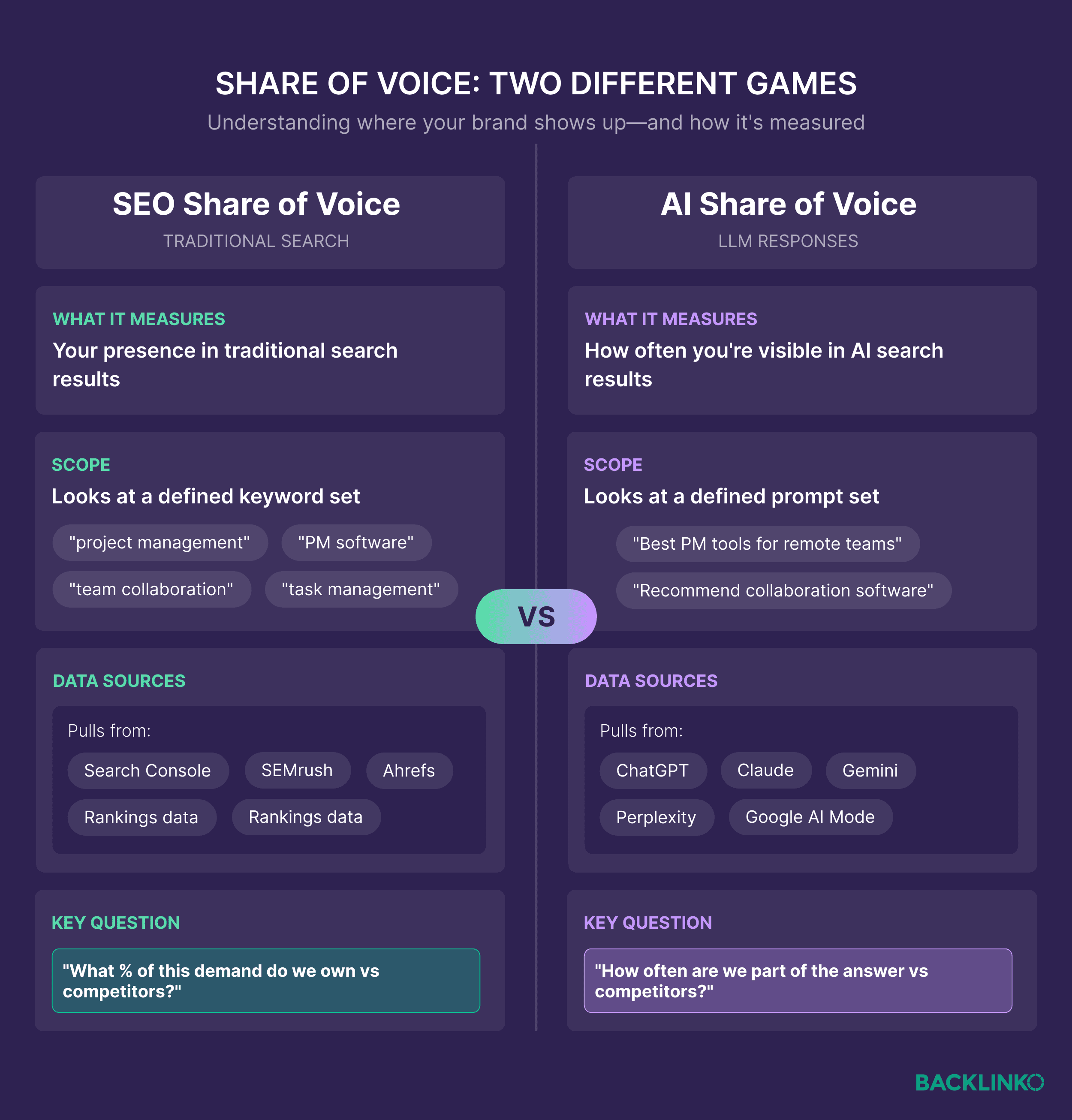
SEO SoV calculates your slice of traditional organic search traffic.
You track 100 target keywords. Those keywords generate 50,000 total monthly visits across all ranking sites. You capture 15,000 of those visits.
That’s 30% organic share of voice.
AI SoV measures brand mentions in LLM responses from ChatGPT, Perplexity, Google AI Mode, and similar tools.
For example, you test 100 category-related prompts. Your brand is mentioned in 45 responses and cited in 15. Your competitor shows up in 30 responses with 10 mentions.
An AI visibility tool can calculate your weighted AI SoV based on mentions and citations.
Why Is Share of Voice So Important, Especially Now?
Here are three reasons why share of voice should be your core KPI when visibility is scattered across platforms.
Track Visibility Beyond Traditional Traffic Data
Your organic traffic data reveals only half the story.
And with zero-click searches on the rise, that half is shrinking fast.
When users get their answers directly from AI Overviews and featured snippets, a huge chunk of your visibility is never captured in Google Analytics.
This makes traffic a lagging indicator of visibility.
Share of voice is a better metric because it measures how visible you are in the consideration set, even when users don’t click your site.

Think of it this way:
A user searches for the “best project management software for remote teams.”
They see an AI Overview listing five tools, including yours. The user reads it, takes no action, and later signs up for a product demo on your site.
Traditional traffic data would show this as “direct traffic” since the person went straight to the website. It wouldn’t capture the discovery that occurred in Google.
But SoV reveals that your brand appeared in the consideration set for this high-intent query.
Work Toward One North Star Metric
Your marketing team might be operating in silos.
The SEO team wants more website visits. PR wants more media mentions. The social team wants better engagement.
Each team tracks its own KPIs and optimizes for different outcomes.
But the long-term power of SoV is that it can become the one metric every team rallies around.
When everyone sees how their work contributes to the same visibility percentage, it changes how teams collaborate.
Here’s what this looks like in practice:
- SEO team targets specific keywords to boost traffic and visibility via content
- PR secures features in industry publications through expert quotes
- Social drives brand conversations on Reddit and LinkedIn
- Product wins better reviews on G2 and Capterra

This full picture takes time to build.
Start with the foundation by measuring your SoV in organic and AI search.
Once you have that baseline, you can layer in other channels over time.
How to Measure Share of Voice in 4 Steps
Let’s see how you can strategically calculate share of voice in four steps.
I’ll use a fictional project management software example to show how each step translates into business insights.
Step 1: Define Your Industry Landscape
Start by outlining the specific competitors and keywords you’ll track for SoV.
Without clear boundaries, you’ll either miss critical gaps or drown in too much noise.
To map your competitive terrain, pick topic clusters tied to revenue.
For a project management software, I picked these clusters:
- Category fundamentals (like “project management 101” and “project management for freelancers”)
- Use cases (like “agile project management” and “remote team collaboration”)
- Industry-specific (like “construction project management” and “marketing project management”)
One way to assess a topic’s revenue potential is to map it to funnel stages.
Categorize your clusters into three stages:
- Awareness: Where people are learning and researching, like how to manage projects
- Consideration: Where they’re exploring solutions, like the best project management software
- Decision: Where they’re comparing options and ready to buy, like Software A vs Software B
Your SoV at each stage tells you where you’re winning and losing in the buyer journey.
This allows you to allocate resources for maximum business impact.

Let’s say this project management software segments the SoV by funnel stage.
It reveals that most of the brand’s visibility is concentrated at the top with almost none at the decision stage.
That’s a problem.
They’re educating the market, but invisible when prospects are actually comparing options and reaching for their wallets.
Strategic takeaway: They need to prioritize comparison pages and case studies to shift visibility toward the decision stage.
Now, define who you’re measuring against.
In search, you’re competing for visibility against two key players:
- Direct competitors: Companies selling similar solutions like Asana, ClickUp, Notion, and Trello
- Indirect competitors: Review sites capturing the voice of the customer like G2 and industry publishers ranking for your keywords but not competing for customers like HubSpot and Zoho
Tracking them gives you the complete picture of who controls visibility in your market and where you can break through.
Step 2: Build Your Keyword & Prompt Libraries
Create a library of 200-500 queries that capture how people search in your category.
You need both keywords (what people search) and prompts (what people ask LLMs). Together, they reveal your search visibility spectrum.
Pull SEO Data First
Collect queries where you’re already visible to your audience.
Google Search Console (GSC) is a good starting point for this since it captures actual visibility through impressions.
Impressions show every time your brand appears in results, even when users don’t click.
Go to the “Queries” tab in the “Performance” report.
Click the “Impressions” column header to sort in descending order, and export this list of keywords.

And if you’re running Google Ads, export your PPC keyword list and filter for terms with conversions or high CTR.
You can also repeat this process with tools like Semrush.
Open your Semrush Position Tracking project (or create one for your domain).
Scroll down to the “Top Keywords” section and click the “View all” button.

Adjust the timeline to your preferred range before clicking “Export” to download the full keyword list.

Layer in Competitor Intelligence
Besides your own data, track where competitors show up.
This tells you where to compete directly and where to claim ground that they’ve overlooked.
You can use Semrush’s Keyword Gap tool to find these opportunities.
Add your domain along with up to four competitors, then hit “Compare.”
Filter to the “Missing” section to find keywords with proven search demand that competitors have validated.
You need to build visibility for these terms.
For example, this project management tool could target keywords like “Gantt chart” and “project management software” to boost its SoV.

Build Your AI Prompt Library
After sourcing keywords, look at how people search for your category in AI tools.
Since AI search queries tend to be more conversational, they often mirror how people talk in community spaces.
Browse Reddit, Facebook groups, and Slack communities to see how your audience phrases their needs and pain points.
For example, this post reveals that agencies want project management tools that aren’t “too corporate or complex for creative teams.”

A question like that can translate directly into an AI prompt: “What’s the most user-friendly project management tool for small creative agencies?”
For decision-stage prompts, review sites G2 and Capterra (or those relevant to your industry) offer a lot of insights.
G2, for instance, lists popular alternatives for every tool.
This is a ready-made list of “[You] vs [Competitor]” and “alternative to [Competitor]” queries your buyers are likely running in AI search.

You can dig deeper with Semrush AI Visibility Toolkit to find prompts where competitors show up in AI answers, but you don’t.
Go to “Prompt Research” and add any of your core topics, like “agile project management.”
Click “Analyze” to get started.

The tool lists real prompts that generate AI responses for your category, such as “best productivity app” and “companies that use agile software development.”
Jot down the prompts relevant to your primary cluster.
Then, repeat for each of your 3-5 clusters.

Document Your Metadata
Finally, organize everything in a master spreadsheet with columns for:
- Keyword/Prompt
- Topic Cluster
- Funnel Stage
- Source (SEO/AI)
Once you’re done measuring SoV, this metadata will become your strategic lens.
Use it to decide which clusters to prioritize, which funnel stages are weak, and where SEO and AI visibility diverge.
Here’s what this looks like for the project management software:

Step 3: Calculate Your SoV
Your SoV equals your estimated traffic divided by the total traffic for all tracked brands, multiplied by 100.
Track both SEO and AI SoV to see the full picture of your brand’s visibility.
Calculate SEO Share of Voice
Start by checking your rankings for all the keywords in your tracking list. Track your competitors’ rankings for the same keyword set.
Each ranking position gets an average share of clicks, like position 1 getting roughly 27%.
This will help in estimating the traffic share per keyword.
Multiply each keyword’s monthly search volume by the click-through rate for your ranking position to estimate your traffic for that duration.
Then, run the same calculation for each competitor.
Use this data to calculate your SoV.
Add up the estimated traffic across all keywords for each brand. Divide your total by the combined total for all tracked brands and multiply by 100.

This manual approach can be time-intensive, especially when tracking hundreds of keywords across multiple competitors.
Semrush handles this math automatically once you set up tracking correctly.
Go to Semrush Position Tracking and click “Create project.”
Enter your domain, target search engine, device type, and location.

The location setting matters for SoV tracking because search results vary by location.
If you set the location to the United States, but most of your customers are in New York, your SoV might look different than reality.
Then, click “Continue to Keywords” to manually add or import your keyword list.
Upload the CSV you made in Step 2 to preserve the data by cluster and funnel-stage categorization.
Then, press “Add keywords to campaign.”
Finally, click “Start Tracking” to begin data collection.

Once this setup is complete, Semrush starts collecting daily ranking data for every target keyword.
Check out the results in the “Share of Voice” tab under “Overview” in the Position Tracking dashboard.

You can also add up to four domains to see how you fare against others in the market.
Semrush tracks every brand’s rankings for your keyword set to aggregate the data into SoV percentages.

Calculate AI Share of Voice
Your AI SoV shows how often LLMs cite your brand when answering questions in your category.
There’s no standardized way to manually measure AI SoV yet, but this two-step process gets you close:
- Step 1: Run each prompt from your library through your AI tools of choice, such as ChatGPT, Claude, Google AI Mode, and any other AI tools your audience uses
- Step 2: For each response, document every brand that appears — yours and your tracked competitors. Record whether each brand was mentioned, cited as a source, and whether the sentiment was positive, neutral, or negative.
Once you’ve tested all prompts, count how many times each brand appeared across all responses.
Divide each brand’s total mentions by the total number of prompts tested, and multiply by 100.

Keep in mind: This calculation gives you a directional read instead of a live metric. AI responses vary by session, phrasing, location, and platform. That’s why it’s important to test regularly and track trends over time.
Measuring AI SoV manually for 20 prompts across three platforms is doable. Doing it for hundreds of prompts while tracking how recommendations shift week over week isn’t.
That’s what Semrush’s AI Visibility Toolkit is built for.
Go to the Brand Performance report in Semrush’s AI Visibility Toolkit.
Enter your domain and click “Analyze.”

Pick an AI platform between ChatGPT, Google AI Mode, or Perplexity.
Switch among these tools to identify any significant gaps in platform-specific LLM visibility.

Once the report is generated, you’ll see a pie chart visualizing the distribution of SoV for your competitors.
The tool tests hundreds of prompts related to your category across ChatGPT, Google AI Mode, and Perplexity to measure your AI SoV.
For each prompt, it analyzes AI responses for:
- Brand mentions: How often your brand appears in the answer
- Citations: Whether the AI links to your content as a source
- Context: Whether mentions are positive, neutral, or negative
It aggregates this data across all tested prompts to calculate your percentage of total visibility.

You’ll also find a section comparing each competitor against a set of business drivers specific to your industry.
These drivers are the most frequently mentioned topics for your category.
Use this data to identify clusters where you’re stronger and weaker than your competitors.

Interpreting SEO vs AI Share of Voice
SEO share of voice measures organic traffic while AI share of voice tracks LLM mentions and citations.
These might not always align.
You can have a strong organic share of voice (ranking on top for many keywords) but a weak AI SoV if LLMs don’t find your content credible.
And brands with more credible content can win a bigger slice of AI SoV even without much visibility in organic search.
Here’s a simple matrix to understand your data:
| High AI SoV | Low AI SoV | |
|---|---|---|
| High SEO SoV | You dominate both traditional and AI search.
Maintain content freshness and expand into adjacent topics to defend your position. |
You rank well, but LLMs don’t cite you.
Implement content chunking to optimize your content for AI search and create citable assets to create credibility that LLMs value. |
| Low SEO SoV | AI tools cite your content even though you don’t rank at the top on organic search.
Improve SEO fundamentals, including title tags, internal linking, site speed, and keyword optimization. |
Focus on depth over breadth.
Create a definitive, well-researched content resource for every core cluster. This is a good start for building visibility on both traditional and AI search. |
Step 4: Establish Your Baseline and Track Trends
The final step is turning your SoV numbers into an ongoing tracking system that informs decisions.
Create a baseline dashboard to capture three levels of detail:
- Overall metrics: Are you gaining or losing ground overall?
- Topic cluster performance: Which topics need more investment?
- Funnel stage breakdown: Where in the buyer journey are you least visible?
Here’s what this could look like for the project management software:

Once your baseline is locked in, set your tracking cadence strategically.
A monthly frequency allows you to spot trends without the need for reacting to noise.
With quarterly deep dives, you can:
- Analyze cluster-specific performance in detail
- Correlate SoV changes with past campaigns
- Adjust resource allocation based on what’s working
This rhythm prevents you from chasing short-term variations and missing critical shifts that impact your category.
How to Improve Share of Voice
Not every fluctuation in your SoV requires action.
Here’s how to strategically diagnose gaps in your SoV and prioritize the right tactics to fix them.
1. Close Visibility Gaps
Clusters with <10% SoV mean you’re almost invisible.
This is especially damaging in decision-stage queries.
If you have less than 10% visibility when buyers search “best project management software,” you’re not in their consideration set.
At the same time, look for opportunities where competitors dominate, but you can compete.
For example, if your project management tool serves creative agencies but you have zero visibility for “project management for creative teams,” that’s your opening.
Potential Solutions
Build topical authority for major business themes.
Create one pillar page with multiple supporting articles.
Build backlinks to your pillar content to establish visibility across every query in that cluster.
For example, if we learn that the project management software needs to gain decision-stage visibility, we could prioritize comparison content.
Build pages targeting “[Your Brand] vs [Competitor]” and category buyer’s guides.
2. Solve Efficiency Problems
Compare your SoV to actual traffic.
A cluster like “what is project management” might give you a high SoV.
But if only 1% of that traffic converts, you’re likely burning money on the wrong audience.
You’re winning visibility in areas that don’t drive business outcomes. And competitors are capturing high-intent buyers.
Potential Solutions
Reallocate resources to high-intent clusters.
Instead of producing more awareness content, shift the budget to bottom-of-funnel content.
This includes comparison pages, case studies, and ROI calculators that target buyers ready to evaluate solutions.
Update existing comparison pages with current data and competitive intelligence.
3. Address Competitive Threats
Keep tabs on competitors gaining ground in your strong clusters.
If a competitor gains over 5% SoV in your strong clusters, it’s an early sign that they’re targeting your territory.
That gap can widen unless you respond to maintain your market share.
The fix depends on where your competitors are winning.
If competitors actively feature on review sites, optimize your profiles. Run campaigns to source reviews from happy customers.
If they’re visible on community platforms, proactively engage in communities like Reddit and Slack.
Prioritize Based on Effort vs. Impact
Not all gaps matter equally.
Focus on opportunities that will actually move your revenue pipeline.
Start with high-impact, low-effort wins. Then invest in high-effort moves that compound over time.
| High Impact | Low Impact | |
|---|---|---|
| Low Effort |
|
|
| High Effort |
|
|
Making SoV Your 2026 North Star
Share of voice captures how often you show up across the fragmented platforms where buyers make decisions.
Get started by measuring your current SoV across SEO and AI search with the steps in this guide.
Pick the gap that costs you the most revenue, and strategize the best ways to close it.
