

TCL doesn’t just make phones and TVs; the company also makes the displays for these products, supplying them to various other companies. TCL China Star Optoelectronics Technology (CSOT) is a division of TCL Technology Group that specialized in display production, and at MWC 2026, the company showcased more than a few display innovations, many of which were aimed at mobile devices.
There was plenty to show off at the booth; too much for me to mention here. But here are the most interesting things I saw at the TCL CSOT booth.
Super Pixel

The headliner at the booth was the new Super Pixel technology. This technology appears to have several benefits, from increased clarity to lower power consumption and higher refresh rates.
Super Pixels are different from regular display pixels due to the way they’re configured. According to TCL CSOT, the sub-pixel density is increased by 1.8%, which may not sound like a lot, but this appears to greatly improve image sharpness. This is because unlike regular pixels, which often need to borrow colors from adjacent pixels to achieve a desired output, Super Pixels feature a true RGB arrangement for true “Pixel-level picture quality.”
Image 1 of 4


TCL CSOT says that the use of thic technology can reduce power consumption of the display by 25% because the display doesn’t have to work as hard. So, even with a high 420ppi, a Super Pixel display will use less power than a WQHD or FHD+ display of the same display size.
Finally, TCL CSOT has managed to achieve a high 165Hz refresh rate, which tends to be popular with gaming smartphones.
And what’s great is that TCL’s Super Pixel tech is already being used commercially, and can be found on Xiaomi’s latest phones.
Portable and foldable monitor

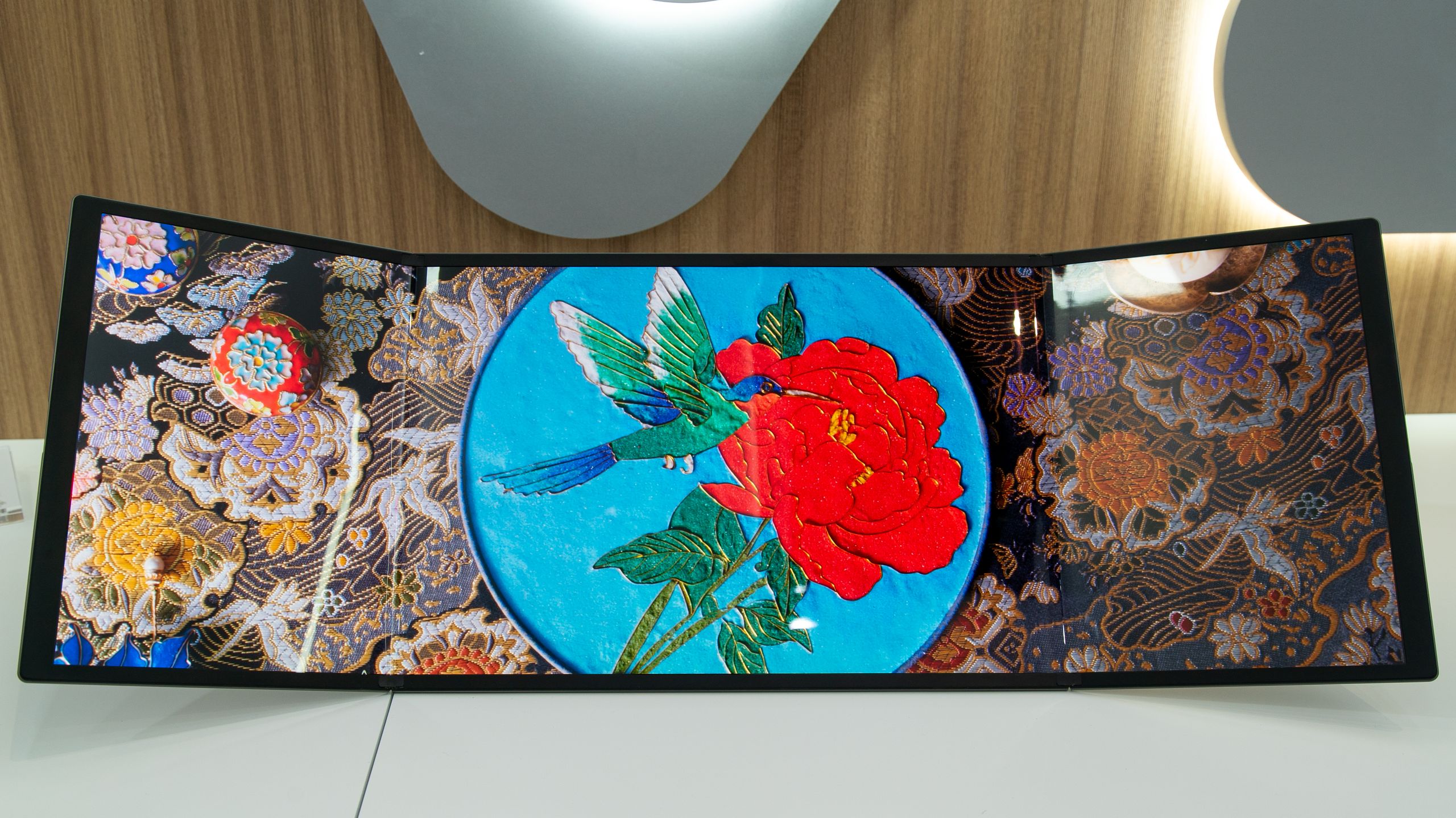
TCL CSOT’s foldable and Portable IJP OLED Monitor Display takes the idea of a trifold to the next level. When closed, it doesn’t look like much, sort of resembling a large 16-inch notebook, but unfold the two sides and you’re met with a massive 28-inch ultra-wide display.
TCL CSOT says it features the features the “world’s largest waterdrop hinge” to achieve added versatility between various modes. The display is admittedly very reflective and the bezels are enormous, and I admit I would love to see TCL implement its NXTPAPER tech into something like this to reduce glare.
Image 1 of 3


That said, it’s still a very cool and well-designed device, and the built-in stand makes it all the more useful for added productivity while on-the-go. Could you see yourself rocking a portable foldable monitor like this?
Foldable laptop
Image 1 of 4


TCL CSOT also showed off a foldable laptop, which it produced for Huawei as the world’s first tandem LTPO flexible laptop, capable of a 10-120Hz refresh rate and featuring a high contrast ratio.
This isn’t the first time we’ve seen a foldable laptop, but they’re still quite rare, and the implementation looks pretty solid. You can use it in a regular laptop mode, with the bottom portion of the display reserved as a touch keyboard, or you can lay it flat like an extra-large tablet, which would be great as a canvas or just to consume media.
And if a touch keyboard doesn’t do it for you, you can slide a physical keyboard onto the bottom half to essentially turn it into a real laptop.
Ultra-bright display

Smartphone displays seem to get brighter every year, with recent models reaching more than 6,000 nits. It almost seems like overkill, but TCL CSOT is taking it even further with the world’s brightest OLED display, reaching an impressive 15,000 nits. With this level of brightness, you shouldn’t have any problems seeing the contents of your display in direct sunlight, although I do wonder what this will do to battery consumption.
Smallest bezel

I didn’t get a figure of just how small the bezel is, but it is noticeably thinner than any other flip phone bezel I’ve seen, and I’ve tested quite a few of them.
And to top it off, the phone was also being put through its own folding test to showcase the durability of the display. It’ll definitely be interesting to see if and when Android OEMs would adopt such a narrow display on their foldables, although part of the reason the borders are pretty large is due to the fact that they act as bumpers to keep the display glass from slamming into itself.
Sun screen

Finally, the last innovation I found interesting was TCL CSOT’s natural light-certified mobile OLED display. The idea is that instead of just being a bright display to counteract direct sunlight obscuring your display, the phone uses a second-generation circular polarizer technology to reduce glare.
What’s more is that this technology helps improve visibility when viewing a smartphone display with sunglasses, and due to the nature of the polarization technology, it should reduce visual fatigue, meaning you can binge shows longer without your eyes feeling worn out.
TCL CSOT demonstrated this by having two phones on opposite ends of a rotating panel. Part of the panel had an effect on it to mimic how a display could become obscured by sunglasses, so rotating it over the phone on the left would make the screen darken to the point where the contents were difficult to see. However, when that same section of the panel was rotated across the phone on the right, the effect was negated.
It was a neat demonstration and a great way to showcase how TCL CSOT is not only thinking about improving display brightness, minimizing bezels, and enhancing pixels, but how it is trying to ensure that its displays are also comfortable for the user.
